
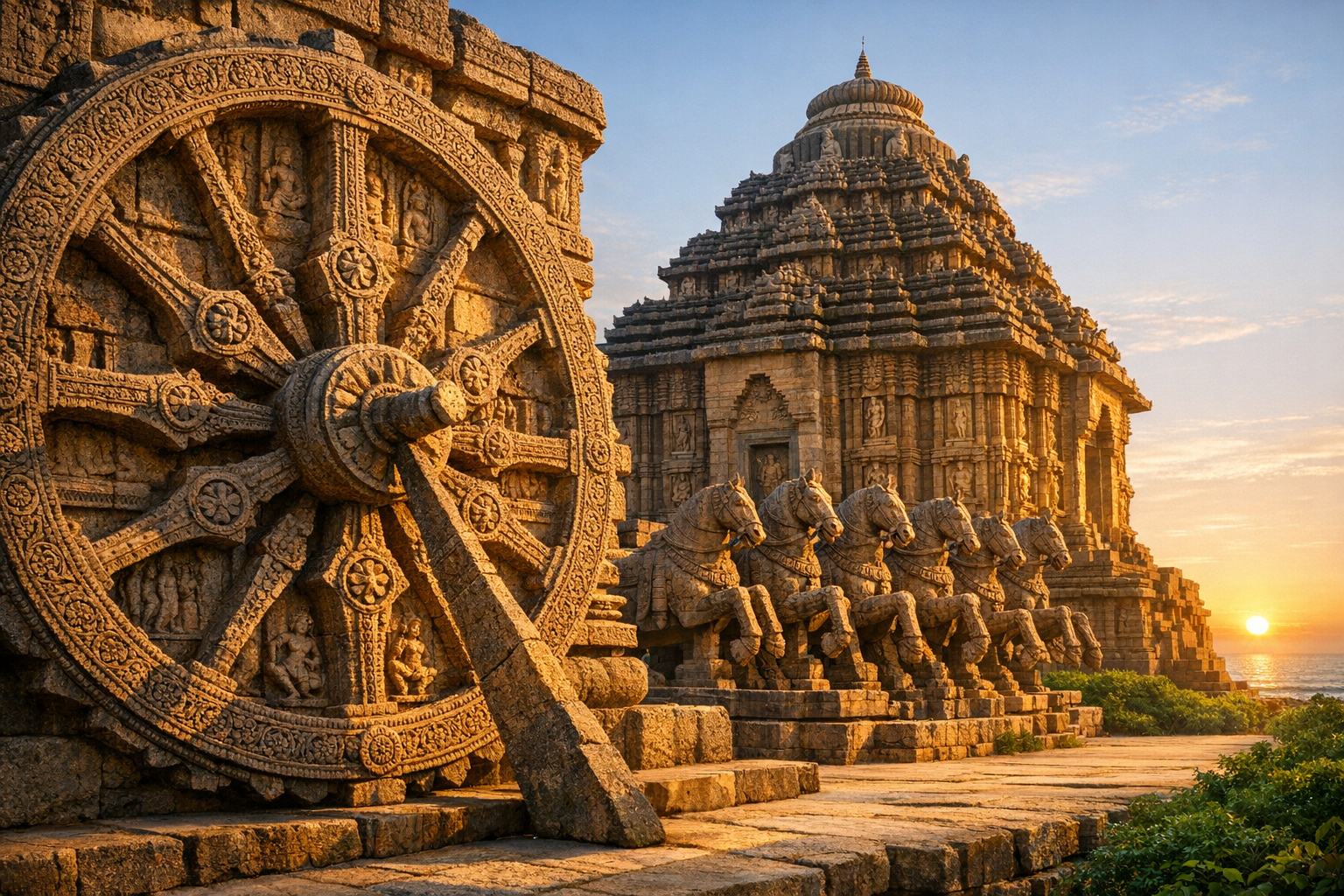
Konark Sun Temple stands on the Bay of Bengal littoral in Odisha, about 35 kilometres from Puri and roughly 60 kilometres from Bhubaneswar, as one of the most compelling intersections of art, science, and spirituality in South Asia. Built in the mid-13th century and dedicated to Surya, the Sun God, the monument embodies the zenith of Kalinga architecture and remains a UNESCO World Heritage Site for its artistic sophistication and civilizational significance.
The temple is widely attributed to Narasimhadeva I of the Eastern Ganga Dynasty, with construction placed around 1243–1256 CE and ceremonial completion often cited near 1250 CE. Royal patronage, a flourishing maritime economy, and the ritual centrality of Surya worship combined to produce a monumental vision that fused statecraft, sacred geometry, and devotional aesthetics into a single architectural statement.
Konark’s plan follows the classical Kalinga temple typology. The complex originally comprised a towering sanctum (rekha deul, now collapsed), a massive assembly hall (jagamohana, still standing), and a dance pavilion (natamandira, preserved in part). Organized on an east–west axis, the layout privileged the journey of light: dawn’s first rays were intended to illuminate the sanctum, embodying Surya’s life-giving rhythm in stone.
What distinguishes Konark within the broader corpus of temple architecture is its audacious conception as Surya’s celestial chariot. Twelve pairs of exquisitely carved stone wheels line the plinth, and seven rearing stone horses seem to draw the temple eastward toward the rising sun. This sculptural program elevates the temple from mere structure to cosmogram, articulating cyclical time, motion, and cosmic order through architectural mass and relief carving.
The celebrated wheels are not only symbolic; they function as stone sundials. Each wheel’s eight principal spokes can be used to approximate the time of day based on the position of the sun’s shadow, while smaller gradations allow for more refined readings. This union of sacred art with empirical observation underscores the temple’s role as a living laboratory of astronomy, calendrics, and timekeepingan elegant materialization of jyotisha in public space.
The engineering of Konark leverages coastal geology and metallurgical ingenuity. Builders employed khondalite for the richly carved exteriors and laterite for inner cores, binding courses with iron cramps and dowels that stabilized the colossal masonry. The jagamohana’s pyramidal roof (pidha deul) showcases corbelling techniques that distribute weight across courses, creating an interior of remarkable volume without true arches. Situated in a salt-laden environment, the fabric has endured cycles of weathering that continue to inform conservation science today.
Estimates suggest the original sanctum’s curvilinear shikhara rose to a height approaching 70 meters, dominating the littoral skyline. Even in ruin, the surviving massing communicates an architectural ambition comparable with the subcontinent’s most imposing sacred edifices. The still-standing jagamohana, with its soaring verticals and dense sculptural skin, conveys the aesthetic intent: to evoke awe while narrating a civilizational story in stone.
Konark’s iconography is encyclopedic. Surya appears in his classical form, flanked by attendants, anddistinctively in Odisha’s traditionsporting high boots and a girdled tunic. This attire, often linked by art historians to Central Asian modish elements, reflects the artistic cosmopolitanism characteristic of India’s eastern seaboard. Alongside these, the navagraha (nine planetary deities), gandharvas, apsaras, guardians, elephants, and lions animate friezes that merge myth, ritual, and courtly life.
Mithuna and maithuna motifs, often misread in isolation, serve theological and didactic purposes within Kalinga aesthetics. They signal fertility, auspiciousness (mangala), and the generative principle (shrishti) that sustains cosmos and community. Scenes of music, dance, artisanship, and martial processions preserve a visual archive of 13th-century Odisha’s social world, affirming the temple’s function as a cultural document as much as a shrine.
Konark’s ritual landscape remains vibrant. On Magha Saptami, pilgrims gather at Chandrabhaga to take a ritual bath at sunrise and venerate Surya, renewing cycles of health, well-being, and cosmic alignment. The annual Konark Festival, highlighting Odissi and allied classical traditions, transforms the natamandira’s precinct into a stage where classical arts converse with the temple’s original performative intent.
Solar symbolism at Konark resonates across dharmic traditions. In Hinduism, Surya is a visible form of the sacred, honored in mantra, vrata, and Surya Namaskar. In Buddhism, solar metaphors illumine the path of awakening, while in Jain thought, celestial bodies are acknowledged within the moral cosmos of karma and time. Sikh scripture frequently invokes the sun and celestial order to express divine reality. Konark thus becomes a shared cultural heritage site where the languages of light, time, and truth harmonize across Hindu, Buddhist, Jain, and Sikh sensibilities.
To early modern sailors, the temple’s darkened stone profile served as a navigational landmark that earned it the sobriquet “Black Pagoda,” a coastal counterpart to Puri’s “White Pagoda.” This maritime memory situates Konark within the Indian Ocean’s trade networks, reminding observers that sacred architecture and sea-borne movement often shaped one another’s histories.
The partial collapse of the main sanctum likely occurred between the 16th and 17th centuries. Scholars debate the causesstructural fatigue, cyclonic events, stone quarrying in later periods, and episodes of human interference are variously cited in chronicles and surveys. The debate itself has catalyzed advances in structural analysis and conservation methodology, shifting discussion from polemics to evidence-driven heritage stewardship.
Modern conservation began in earnest during the colonial period, when the jagamohana was stabilized and, in 1901, filled with sand to reduce internal stresses on its corbelled vaulting. Under the Archaeological Survey of India (ASI), the 20th and 21st centuries have added chemical consolidation, improved drainage, controlled vegetation, and advanced documentation. Recent scientific initiatives have explored carefully monitored de-sanding of the jagamohana, using structural health monitoring to balance risk and recovery.
Conservation at Konark is necessarily coastal and climate-aware. Salt crystallization, biofilm formation, thermal cycling, and wind-driven abrasion all inform treatment choices. Projects now integrate digital photogrammetry, 3D scanning, and GIS-based condition mapping to prioritize interventions. The paradigm is shifting from reactive repairs to preventive conservation anchored in data, sustainability, and local community engagement.
A cluster of well-known legends surrounds Konark, including the story of a powerful lodestone or magnet that once hovered the Deity’s metal crown. While evocative, such accounts lack corroborating archaeological evidence and are best valued as part of the temple’s rich oral and literary tradition. They testify to Konark’s imaginative hold on collective memoryanother layer of intangible heritage complementing the stone record.
When dawn light strikes the wheels and horses, visitors often experience a quiet astonishment: the sense that architecture can choreograph time. The chariot metaphor becomes immediatelight advances, shadows pivot, stone breathes. For many, this encounter reframes the temple not merely as a relic of the past but as a continuing pedagogy of harmony between nature’s cycles and human aspiration.
Konark also invites comparative study. Alongside Modhera in Gujarat and Martand in Kashmir, it represents a triad of major Surya shrines across India’s cultural geography. In a wider Asian frame, Angkor’s solar and equinoctial alignments underscore a pan-regional dialogue between sacred space and celestial order, in which Konark participates with distinctive Kalinga inflection.
For researchers, the site offers a rare convergence: epigraphy and iconography for historians; lithology, masonry, and corrosion science for engineers and conservators; performance archaeology for dance historians; and observational astronomy for historians of science. Its interdisciplinary value makes Konark a nexus for academic collaboration anchored in field evidence.
Visitors can approach the complex year-round, with the cooler months from November to February offering comfortable conditions. Puri and Bhubaneswarboth major nodes in Odisha’s sacred geographyprovide convenient access, and Chandrabhaga’s shoreline adds a luminous natural counterpoint to the temple’s stone poetry.
Konark Sun Temple is ultimately an ethical proposition: that civilizations are at their best when art, science, and spirituality reinforce one another, and when public architecture embodies inclusive values. For a shared dharmic future, Konark encourages unity-in-diversityhonoring multiple paths, celebrating disciplined knowledge, and safeguarding cultural memory. Its chariot still moves, carrying forward the light of knowledge, the warmth of devotion, and the responsibility of stewardship.
Inspired by this post on Hindu Pad.
