
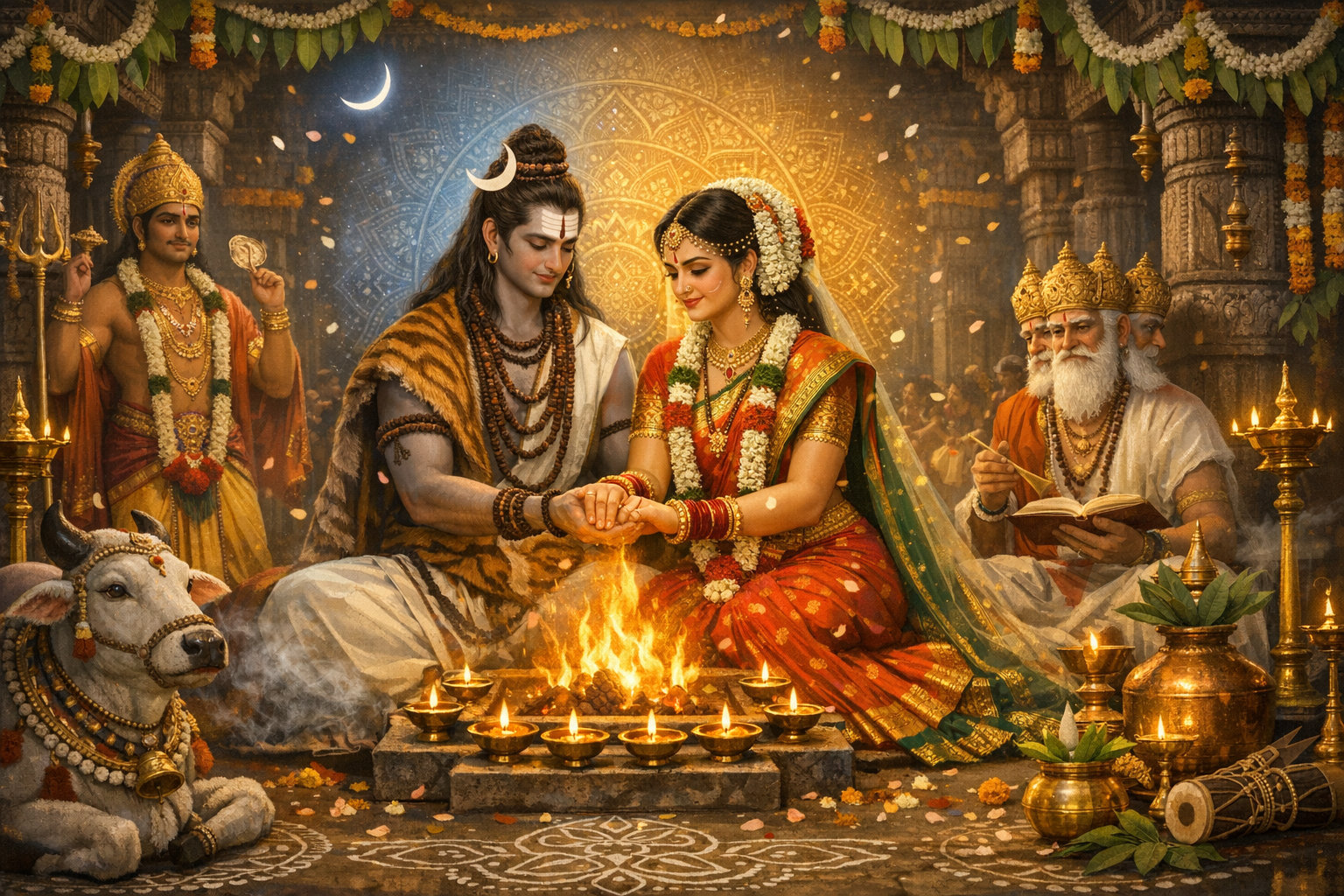
Shiva Kalyanam, also known as Shiva Parvati Kalyanam, is revered across the Hindu world as the sacred marriage of Lord Shiva and Goddess Parvati. Aligned with the profound austerities of Maha Shivaratri, this kalyanam is customarily celebrated in many temples on the day following the night-long vigil. The observance harmonizes Puranic storytelling, Agamic ritual, and living cultural practice, presenting a luminous vision of the union of Śiva (pure consciousness) and Śakti (creative energy).
Maha Shivaratri falls on Krishna Paksha Chaturdashi of the lunar month (Magha or Phalguna, depending on the regional Amanta or Purnimanta reckoning). While the vigil (jāgaraṇa) and abhiṣeka culminate on the sacred night itself, numerous South Indian temple traditions conduct the Shiva Parvati Kalyanam the next day, symbolically completing the arc from inward austerity to celebratory union. Regional calendars and temple paramparās may vary, so local panchāṅga guidance is followed for precise muhurta.
Scriptural memories of the divine wedding are preserved through Puranic and Agamic references, with narration styles differing by region and lineage. Several traditions recall that Lord Vishnu performed the Kanya Daanam (ceremonial giving of the bride) of Parvati to Lord Shiva, while Lord Brahma served as the yajña-ācārya (principal priest) presiding over the auspicious rites. This framing, well-known in many kalyanotsavams, underscores the unity of the Trimurti and the sanctity of dharmic marriage.
The theological background rests on the cycle of renunciation and return. Sati’s self-immolation at Daksha’s yajña and Shiva’s ensuing grief set the stage for Sati’s rebirth as Pārvatī, the daughter of Himavan and Mainā. Through unwavering tapas, Parvati wins Shiva’s grace. In many retellings, Kāma’s incineration and later restoration, the devas’ prayers, and Shiva’s own tests of Parvati emphasize the triumph of steadfast devotion (bhakti) guided by wisdom (jñāna).
In the marriage legend, the devās and ṛṣis gather as the cosmic household celebrates. Shiva’s gaṇas, fearsome yet devoted, arrive in an otherworldly procession, while the bride’s family experiences both awe and maternal protectiveness. Lord Vishnu’s assurance and Lord Brahma’s ritual authority calm all apprehensions, and Agni stands witness to the vows. In aggregate, the narrative portrays a universe restored to balance (ṛta) through the confluence of ascetic power and compassionate presence.
In temple kalyanotsavams, utsava mūrtis of Parameśvara and Pārvatī Devī are ceremonially brought to a kalyāṇa maṇḍapa. The procedure, rooted in Śaiva Āgamas and aligned to Vedic samskāra structures, begins with standard purifications: ācamana, saṅkalpa, Gaṇeśa pūjā, punyāha-vācana, rakṣābandhana, and kalaśa-sthāpana. The sacred space is then ritually protected, and the assembly invites blessings from lineage gurus and deities.
Vara-pūjā (honoring the groom-form of Shiva) follows, accompanied in many regions by Nandi-devatā pūjā for auspicious beginnings. The bride-form of Parvati is welcomed with śobhana maṅgala-vādyas (auspicious music), and the families exchange blessings. In such moments, devotees perceive more than ritual formality; they experience a living pedagogy of humility, reverence, and mutual respectvirtues central to dharmic household life (gṛhastha āśrama).
Kanya Daanam occupies a pivotal place in the ceremony. In numerous temple traditions, Lord Vishnu is remembered as the Kanya Daanam kartā who entrusts Parvati to Shiva, while Lord Brahma officiates as the yajña-ācārya. This highlights a theological tapestry where preservation (Vishnu), creation (Brahma), and transcendence (Shiva) converge to sanctify the dharma of companionship. Panigrahaṇa (joining of hands) signifies the acceptance of sacred responsibility, witnessed by Agni and the sādhus.
Maṅgalyadhāraṇasymbolizing protection, commitment, and auspicious continuityensues with mantras that extol prosperity, harmony, and shared purpose. Saptapadī, the seven steps, distills cardinal commitments: dharma (righteous living), artha (responsible prosperity), kāma (wholesome joy), mutual support, ecological and social duty, resilience in adversity, and pursuit of inner freedom (mokṣa). In many regions, laja-homa (offering of parched grain) venerates Agni as the witness to vows.
Regional aesthetics enrich the rite. In Andhra and Telangana, tālambrālu (showering of sanctified rice or turmeric rice) adds playful grace, teaching that joy and tenderness are integral to sacred life. In Tamil and Kannada areas, oonjal (swing) or flower showers may be performed, while in North Indian settings, akṣata (consecrated rice) blessings predominate. Everywhere, the kalyānam culminates in āśīrvāda, maṅgala-ārati, and prasāda distribution.
Maha Shivaratri itself emphasizes vigil, introspection, and abhiṣeka. Devotees perform Rudrābhiṣeka with water, milk, bilva leaves, and pañcāmṛta, chant “Om Namah Śivāya,” and observe fasting aligned to health and śāstra. The following day’s Shiva Parvati Kalyanam translates that inward stillness into outward celebration, affirming that the highest yoga (union) is not flight from the world but harmony within it.
Many households observe a simplified kalyānam at home as a sankalpa of unity and well-being. A clean altar with icons or images of Shiva and Parvati, brief Gaṇeśa pūjā, lighting of dīpa, and recitations such as Śiva Aṣṭottara and Pārvatī Aṣṭottara can be offered. Couples may renew vows by sharing intentions aligned with saptapadī virtues, concluding with maṅgala-ārati and wholesome sāttvika naivedya.
Timekeeping is critical to authenticity. Muhurta selection typically avoids rāhu kāla and yama ghaṇṭa and respects the temple’s or family’s paramparā. Because tithis and lunar transitions differ by geography, reputable panchāṅga references and local ācārya guidance ensure fidelity to both Vedic and Āgamic expectations.
Cultural diversity around the kalyānam reflects Hinduism’s famed breadth. In Kerala, Thiruvathira celebrates the auspicious conjugal grace associated with Shiva and Parvati, centering women’s vrata and dance traditions. In Kashmir, Herath (Maha Shivaratri) carries unique home-centered rites venerating Vatuka Bhairava as a form of Shiva. Nepalese celebrations at Paśupatinātha integrate fasting, vigil, and public devotion with majestic scale.
The symbolism is philosophically profound. Śiva, as nirguṇa-cit (unconditioned awareness), and Śakti, as dynamic prakṛti (manifesting energy), are not two separate absolutes but two modes of the same Reality. Their marriage proclaims that consciousness without energy is quiescent potential, while energy without consciousness lacks direction; together they establish cosmic order and personal wholeness.
These insights resonate across Dharmic traditions that value wisdom, compassion, restraint, and service. Buddhism’s complementary ideals of prajñā and upāya, Jainism’s tapas and ahiṃsā guiding disciplined living, and Sikh tradition’s seva and the dignity of gṛhasthāśrama all affirm that spiritual excellence and ethical household life can coexist fruitfully. The Shiva Parvati Kalyanam thus becomes a shared civilizational metaphor for harmony between inner realization and outer responsibility.
Ethically, the kalyānam encourages annadāna, community support, and ecological mindfulness. Offering food to guests, caring for animals, and choosing eco-friendly flowers and oil-lamps align ritual beauty with stewardship of the natural worldan extension of Śakti reverence to the living environment.
Frequently asked clarifications arise around timing and roles. Whether the kalyānam occurs on the night of Shivaratri or the following day depends on regional custom; both practices honor the same theological truth. Similarly, traditions that recall Lord Vishnu as Kanya Daanam kartā and Lord Brahma as yajña-ācārya express a pan-Indic intertextuality; other retellings emphasize Himavan and Mainā’s parental roles without invoking Vishnu’s fraternal guardianship. Diversity of narration is part of Hindu scripture’s living elasticity.
For personal observance, clarity of sankalpa matters more than scale. Families who cannot access temple programs may still benefit deeply from a modest home rite centered on japa, reading of selected verses from Śiva Purāṇa or Skanda Purāṇa, and silent contemplation of the Purusha–Prakṛti union. Sharing prasad with neighbors extends grace into society, transforming devotion into gentle social action.
From an academic lens, Shiva Parvati Kalyanam integrates Vedic samskāra syntax (e.g., panigrahaṇa, saptapadī, laja-homa) with Śaiva Āgamic temple praxis (utsava mūrti processions, kalyāṇa maṇḍapa, kalaśa-vidhi). This layered architecture explains why devotees experience the rite as both familial and cosmic, intimate and transcendent.
The devotional impact is equally tangible. Many experience the vigil’s quiet powerlistening to the conch, offering bilva with steady breath, and sensing a heart-level stillnessculminate in the joyful kalyānam. Children delight in the floral showers; elders savor scriptural recitations; couples carry home a renewed ethic of partnership anchored in dharma and compassion.
In sum, Shiva Kalyanam during the Maha Shivaratri cycle offers a comprehensive spiritual education: disciplined worship, scriptural memory, ethical vows, and communal celebration. Whether witnessed in a grand temple hall or kindled at a simple home altar, the marriage of Mahādeva and Pārvatī Devī invites everyone into a practice where austerity matures into love, and love returns to silenceŚiva and Śakti abiding as one.
Inspired by this post on Hindu Pad.
