
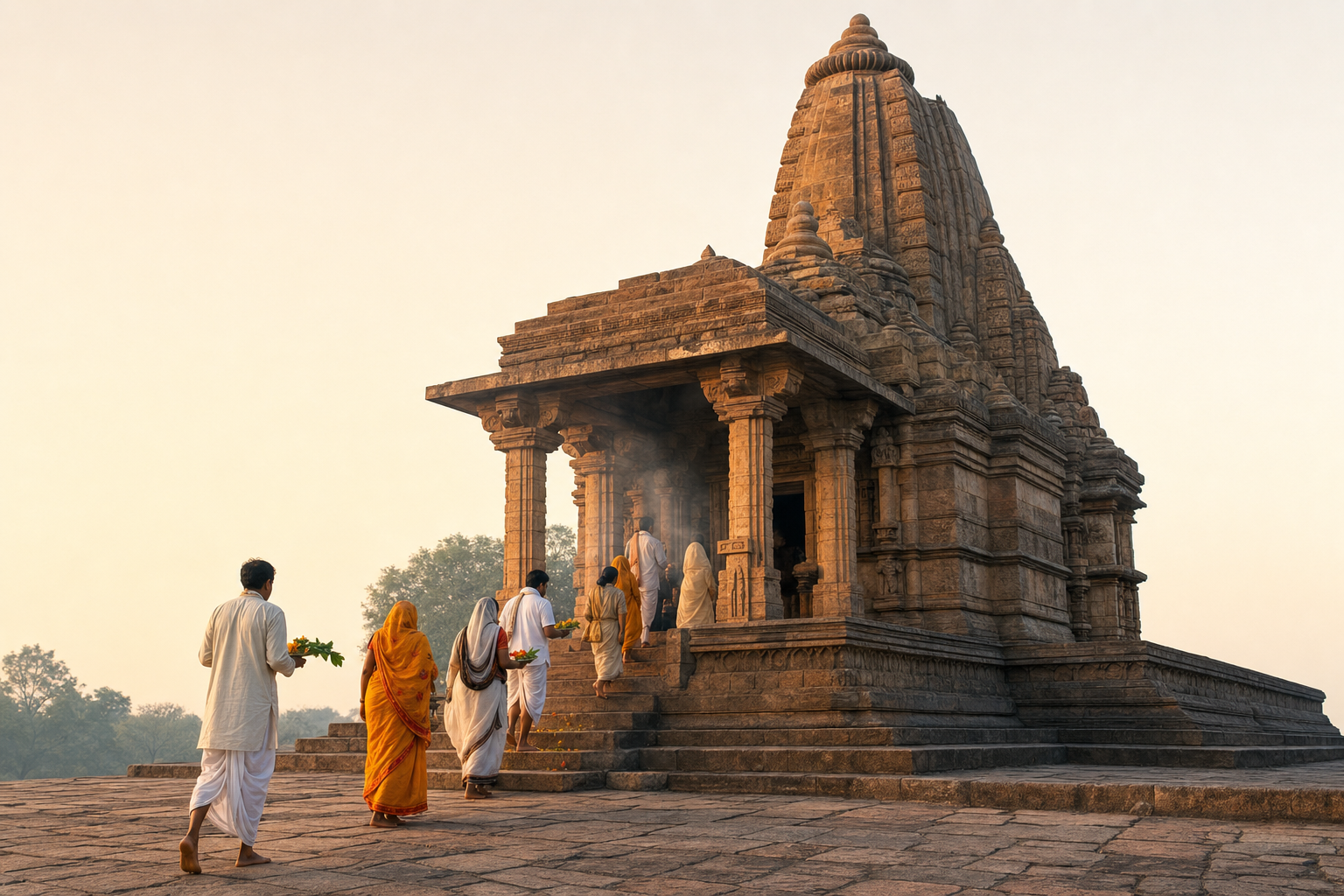
You may arrive in Khajuraho expecting to examine a celebrated landscape of historic stone temples. Matangeshwar asks something different of you. It remains an active Shaiva shrine, so the most important question is not simply what you can see, but how you should enter a place where worship has continued for roughly a millennium.
Once you understand that distinction, the temple becomes easier to read. Its restrained architecture, monumental Shivling, daily abhisheka, local belief in the lingam’s growth, and even its conservation rules belong to one living system. You are not only looking backward at the Chandela age. You are meeting a sacred relationship still being renewed.
Living means continuity, not merely survival
An ancient temple can survive physically after its original ritual life has ended. Walls may remain, inscriptions may be studied, and sculptures may still reveal the achievements of their makers. That makes the structure historically important, but age alone does not make it a living temple.
Matangeshwar is described as living because daily worship has continued for about a thousand years. Built within the cultural sphere of the Chandela dynasty in the 10th–11th century CE, it is among the few temples at Khajuraho where the ritual tradition did not lapse. The building survived, but so did the community’s practice of approaching Shiva through darshan, offering, recitation, and festival.
That continuity changes the meaning of everything you encounter. The Shivling is not treated as an archaeological specimen placed inside a preserved room. Through prana-pratishtha and continuing puja, devotees approach the deity as present and responsive. Water poured in abhisheka, bilva leaves placed in offering, the sound of Rudra hymns, and the evening arati are not demonstrations of an extinct custom. They are current acts of worship.
The temple’s living character therefore resides in more than an uninterrupted calendar. It lives in a repeated relationship: devotees come, offerings are made, sacred words are recited, the community gathers, and another generation learns how to continue the pattern. Remove that ritual ecology and you may preserve the stone while losing much of what the stone was built to serve.
Key takeaways
- Matangeshwar is both a Chandela-era monument and a functioning Shiva temple; neither identity should erase the other.
- Its importance comes from roughly a millennium of continuing worship, not simply from the age of its masonry.
- The monumental Shivling is the ritual center of the temple, while the restrained architecture directs attention toward it.
- The lingam’s reported growth is a devotional belief and part of the temple’s intangible heritage; it should not be recast as a measured scientific conclusion without evidence.
- A respectful visit means following the darshan queue, removing footwear, dressing modestly, and confirming photography rules before using a camera.
The architecture teaches you where to direct your attention
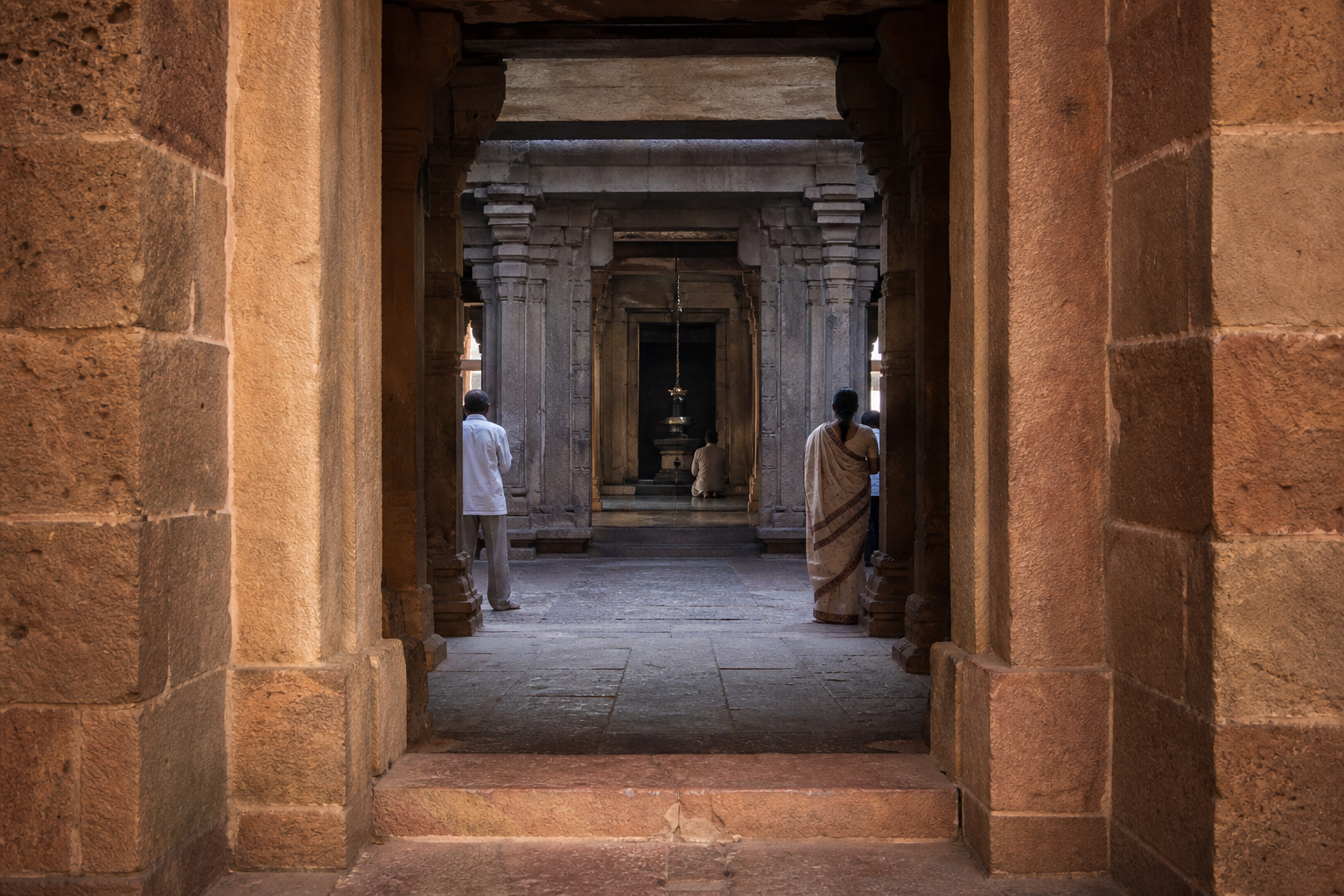
Khajuraho is famous for sculptural richness, so Matangeshwar’s relative austerity can initially look like an absence. It is better understood as concentration. Compared with the elaborate Kandariya Mahadeva Temple, Matangeshwar places less visual pressure on its exterior surfaces. Your attention is progressively drawn toward the sanctum and the immense Shivling within it.
Begin your reading from outside. The temple follows the North Indian Nagara tradition. Its latina, or rekha-prasada, shikhara rises above the square garbhagriha and culminates in an amalaka and kalasha. The amalaka is the ribbed crowning element beneath the finial; the kalasha completes the upward profile. Finely worked regional sandstone and a proportioned plinth give the structure its compositional balance.
Then notice how the plan governs movement. The garbhagriha is the ritual core. A short antarala provides transition, while the mandapa remains comparatively modest. These are not merely labels to memorize. They tell you how the building orders experience: gathering gives way to approach, and approach gives way to the concentrated presence of the sanctum.
Inside, the monolithic Shivling of unusual height stands within a circular yoni-pitha. Its scale immediately dominates the encounter. Instead of looking for a crowded sculptural program, watch how bodies, offerings, chants, and sightlines orient themselves around this single ritual center. The devotee’s movement supplies an essential part of the architecture’s meaning.
A useful way to study Matangeshwar is to give the temple three distinct moments. First, view its overall profile and identify the shikhara, amalaka, kalasha, and plinth. Second, notice the reduction in ornament as you move toward the interior. Third, stop treating the sanctum as one more item on an architectural checklist and observe how worship activates it. This sequence helps you see why visual restraint is not artistic deficiency. Here, restraint makes liturgical focus unmistakable.
How to understand the belief that the Shivling grows
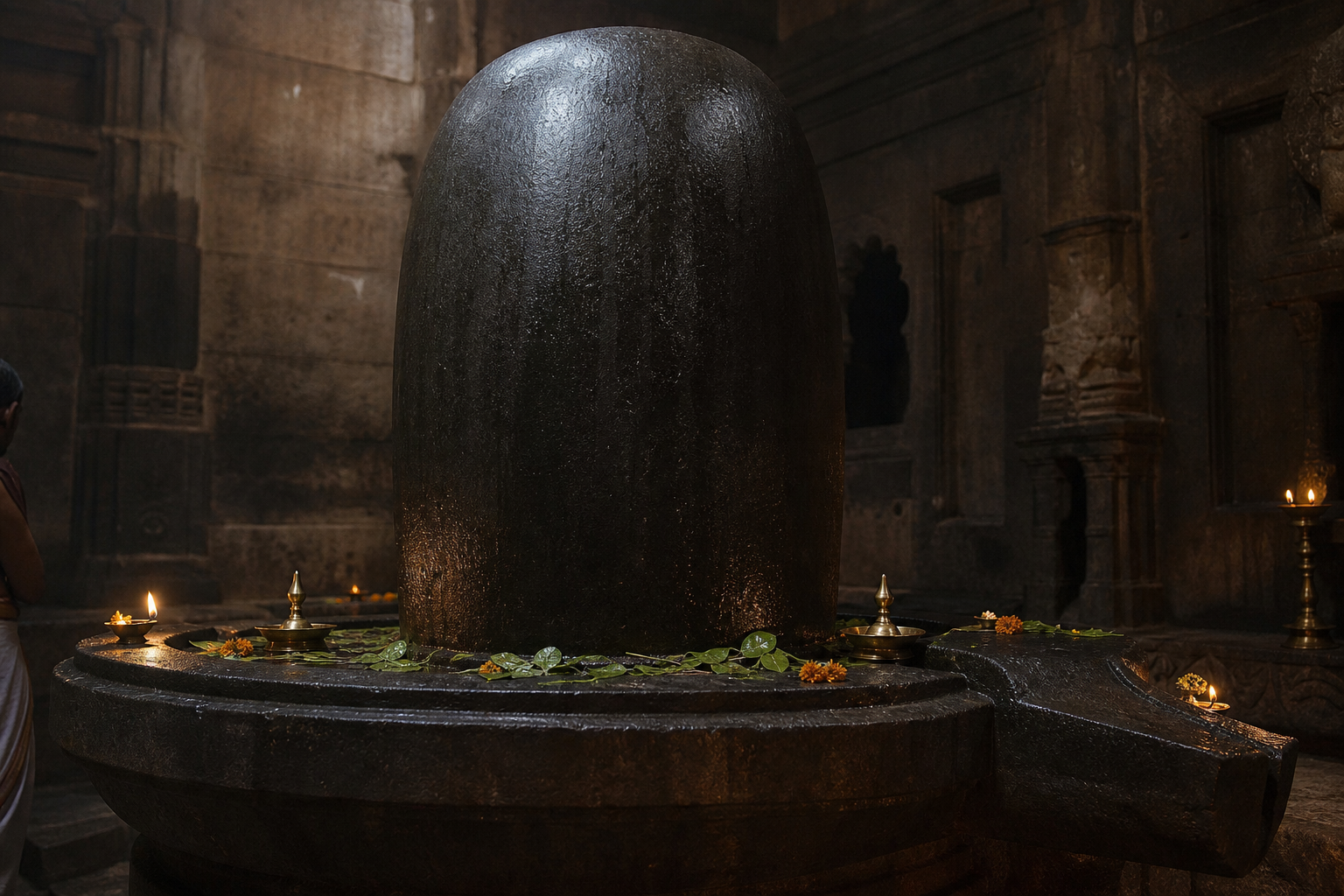
The claim you are most likely to remember is that the Matangeshwar Shivling grows. The precise and respectful formulation is narrower: devotees commonly believe that it rises imperceptibly with time. That conviction belongs to the temple’s living devotional inheritance.
Three different kinds of statement are easily confused here. The first is observable: the lingam is a monumental stone emblem of exceptional scale. The second is devotional: the community understands it as living and growing. The third is explanatory: physical mechanisms might account for a perceived change. Keeping those levels separate allows you to take faith seriously without presenting an unverified mechanism as settled fact.
Possible natural explanations sometimes proposed include minute mineral deposits left through repeated abhisheka, cycles of thermal expansion and contraction, or apparent changes created by settlement and shifting sightlines. Each is a hypothesis, not a conclusion merely because it sounds plausible. A physical-growth claim would require consistent measurements taken from stable reference points over time. Without that kind of documented series, assigning a rate or declaring a mechanism would go beyond what can responsibly be claimed.
Devotional truth does not need to disguise itself as laboratory data. For worshippers, the growth tradition expresses Shiva’s continuing presence and the vitality of a shrine that has never become religiously inert. For historians, the belief is evidence of how a community narrates continuity and relates sacred time to a physical icon. Those readings answer different questions and need not be forced into a contest.
If you discuss the tradition, choose your words carefully. Say that the Shivling is believed to grow, not that modern measurement has proved continuous enlargement. Equally, do not dismiss the belief as worthless merely because it operates devotionally. The conviction itself has historical and cultural significance: it shapes how people approach the deity, remember the temple, and transmit its sanctity.
Enter the ritual rhythm instead of treating it as a performance
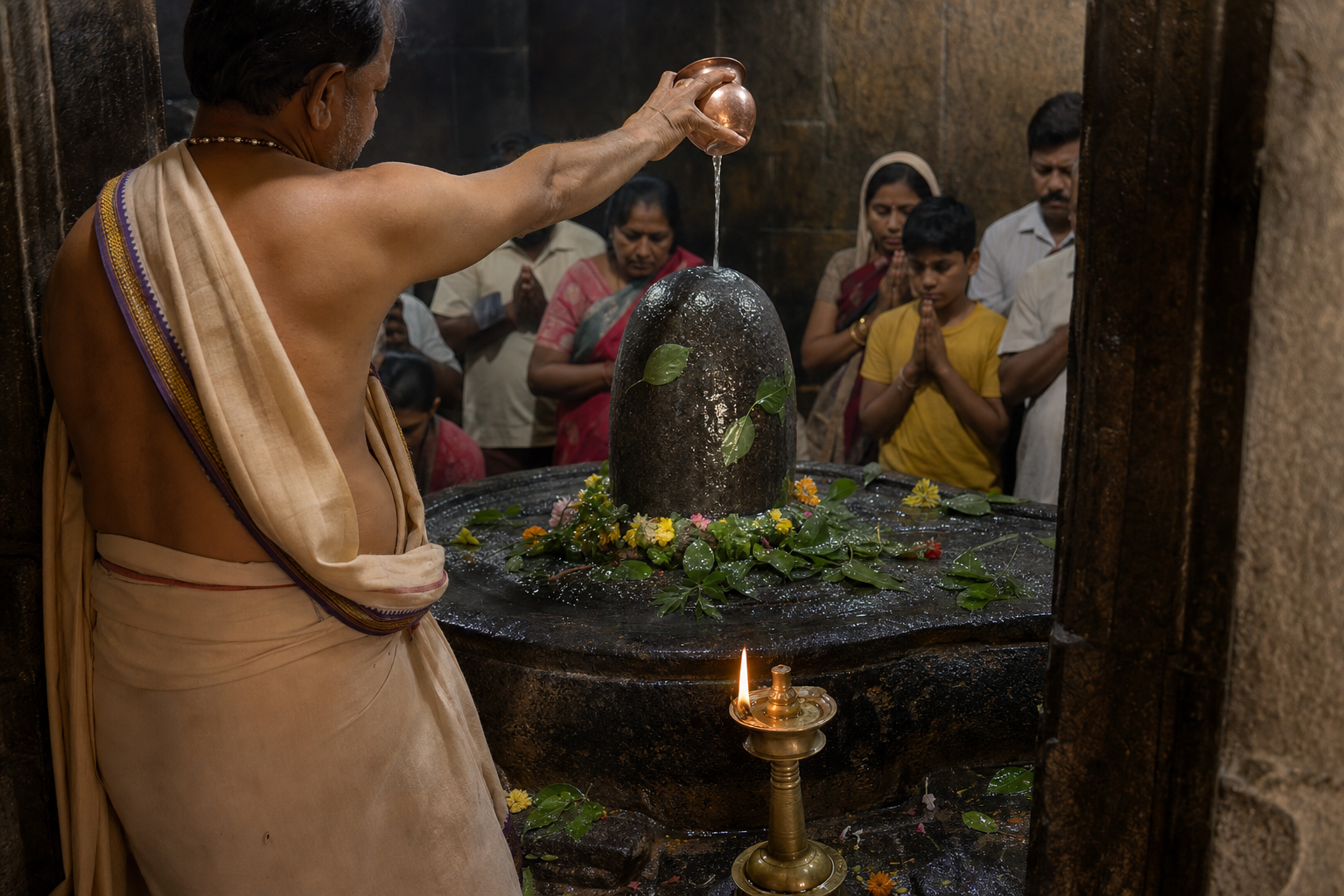
The continuity of Matangeshwar is made from recurring acts. Daily worship includes abhisheka with water, milk, and Panchamrita, together with bilva leaves, flowers, recitations from the Rudra hymns, and evening arati. These practices are not decorative additions to an old building. Their repetition is the means by which the temple remains a center of worship.
Abhisheka makes the relationship particularly visible. Liquids pass over the lingam, offerings accumulate around the ritual center, and the queue advances through darshan. What may appear repetitive to a hurried visitor is precisely the point: continuity is constructed through disciplined recurrence, not through occasional commemoration.
Maha Shivaratri reveals the same pattern on a larger scale. Matangeshwar becomes Khajuraho’s devotional center for large congregations, night-long vigil, kirtan, and darshan. Fasting, sacred bathing, lingam worship, and communal singing bring individual vrata and collective celebration together. If your purpose is a quiet architectural examination, understand that the festival serves a different priority: worship leads, and sightseeing must yield to it.
For an ordinary visit, use a simple darshan sequence:
- Wear modest clothing and remove your footwear where directed. These are not gestures for display; they mark the transition into sacred space.
- Join the established darshan queue. Watch its rhythm before moving forward, especially when devotees are carrying offerings or abhisheka is underway.
- Follow the temple’s procedure for offerings rather than improvising your own. Ritual order protects both other worshippers’ access and the historic fabric around the sanctum.
- Confirm the local photography rule before taking a picture. Permission may vary, and a camera should never interrupt puja or turn worshippers into unwilling subjects.
- If you want to experience the temple’s liturgical atmosphere, early morning and evening are especially meaningful, when chants and bells animate the mandapa. Arrive prepared to listen rather than to control the setting.
You do not have to be a ritual specialist to behave appropriately. Let the queue show you the pace, give active worship priority, and keep architectural observation from obstructing darshan. That small discipline will teach you more about a living temple than attempting to inspect every surface while ignoring the people for whom the shrine remains sacred.
Responsible stewardship must preserve stone and practice
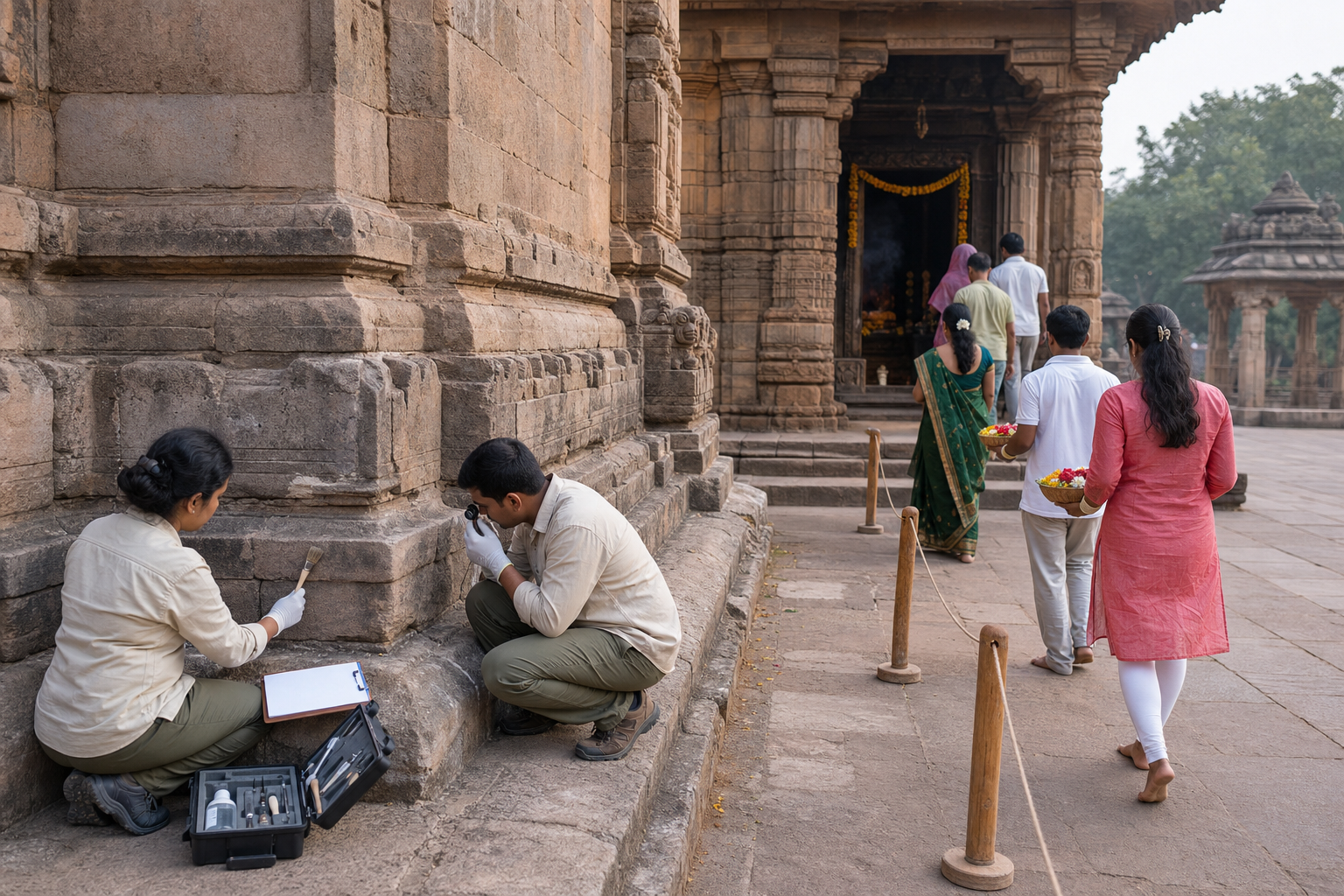
Active worship creates a conservation problem with no honest one-sided solution. Water, milk, and other liquids used in abhisheka can affect surfaces and drainage. Lamp soot and floral residue can accumulate. Large festival congregations increase pressure on circulation areas. Yet eliminating these practices would remove the very tradition that makes Matangeshwar living heritage.
The Archaeological Survey of India oversees the site within the wider, UNESCO-recognized Khajuraho Group of Monuments. Its task is therefore more demanding than preserving an inactive shell. Conservation and temple management must accommodate recurring worship while protecting historic masonry.
Practical responses can include gentle cleaning, better drainage, protective flooring around the yoni-pitha, and carefully planned crowd movement during peak periods. Each measure addresses a specific mechanism of wear. Drainage limits prolonged exposure to ritual liquids; cleaning manages residue without aggressive treatment; protective surfaces receive some of the pressure that would otherwise fall on historic fabric; and queue planning reduces congestion without stopping darshan.
This is why you should not automatically interpret a barrier, controlled route, or instruction about offerings as hostility to worship. At a living heritage site, a sensible boundary may be what allows the same practice to continue without consuming the physical setting that has carried it for centuries. Follow the rule in front of you, even when another temple handles the same ritual differently.
Matangeshwar also offers a wider Dharmic lesson, provided we do not blur distinct traditions. It is first and specifically a Shaiva temple. At the same time, its union of sacred form, continuing practice, and communal responsibility can be placed beside symbolic and aniconic forms associated with early Buddhist stupas, Jain sthapanas, and the Sikh reverence for living scripture and seva. The forms and theologies differ, but each asks communities to carry inherited sanctity through disciplined conduct rather than passive admiration.
When you visit, give your first attention to the ritual before reaching for the camera. Trace the temple’s architectural movement, enter the queue without disrupting it, and describe the growing-lingam tradition with both reverence and precision. That approach lets Matangeshwar remain what it has long been: not an old structure pretending to live, but a sacred place whose continuity still depends on how people act within it.