
You may keep a disciplined routine of puja, japa, study, and temple worship yet still feel that the Divine remains at a distance. Or you may worry that loving family and friends too deeply makes you less spiritual. Ramanujacharya directs you toward a more demanding question: what has your devotion made you capable of giving?
His answer brings love, bhakti, and grace into one path. Ordinary affection is not the goal, but it can train the attention, fidelity, and self-giving that devotion requires. Bhakti purifies those capacities by directing them toward Narayana. Prapatti then entrusts the whole person to divine grace without abandoning responsibility.
Why “Have you loved?” is a spiritual diagnosis
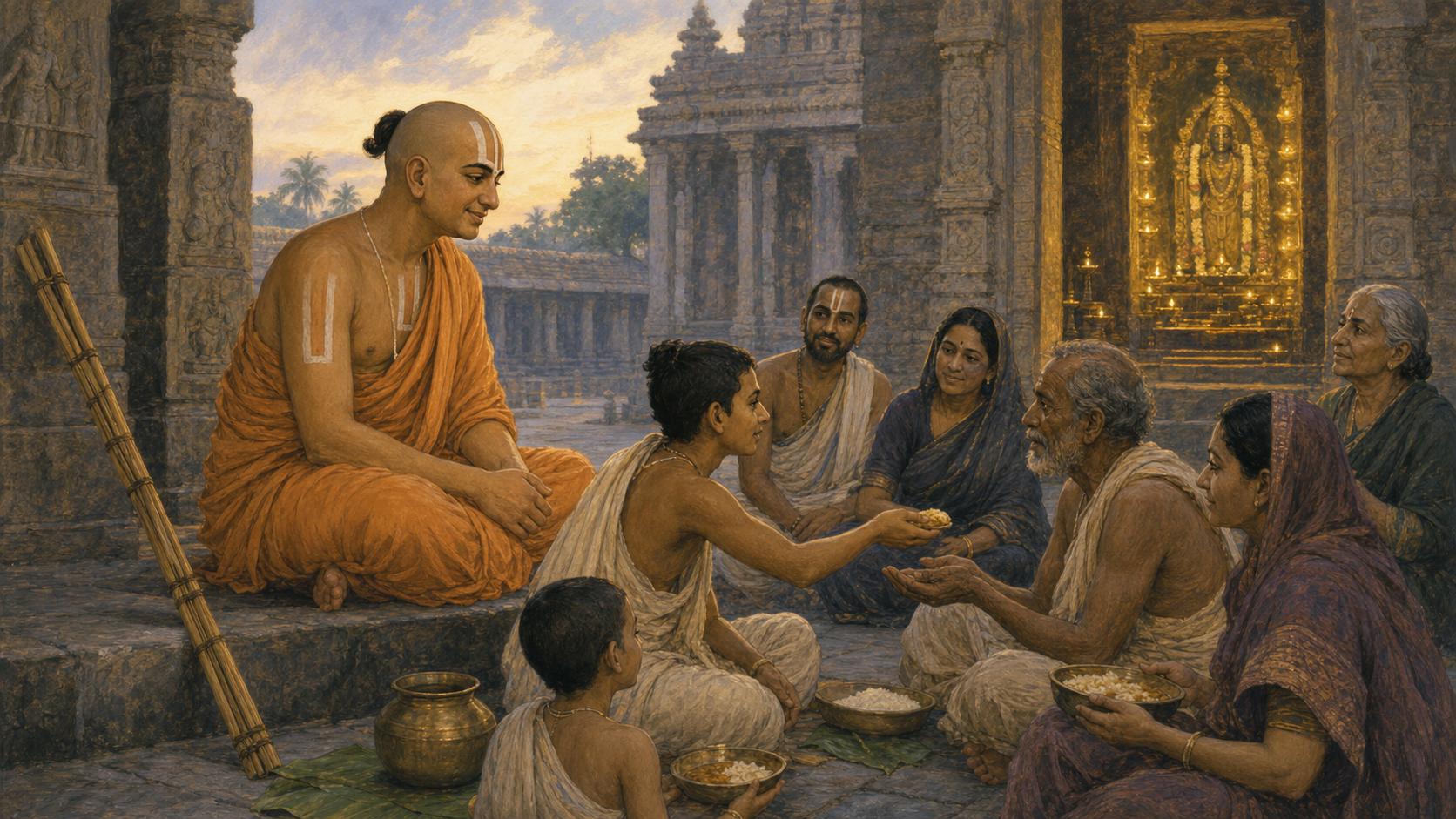
In a well-known teaching story about Ramanujacharya, a seeker asks how to attain God. Instead of beginning with metaphysics or ritual instructions, Ramanujacharya asks whether the man has ever loved anyone. The seeker points to his strict celibacy and avoidance of worldly entanglements. Ramanujacharya repeats the question.
The exchange does not imply that you need romantic experience before you can approach the Divine. A celibate can possess immense tenderness, and a person surrounded by relationships can remain deeply self-absorbed. The question tests something more fundamental: has your heart learned to attend to someone other than itself?
Discipline can restrain an impulse. It cannot, by itself, create empathy. Withdrawal can reduce distraction. It cannot guarantee that you will stay kind when another person becomes inconvenient. Ramanujacharya therefore turns the seeker away from a merely negative achievement—what he has avoided—and toward the positive capacity needed for bhakti.
- Attention means noticing another being’s need before converting the encounter into a story about yourself.
- Self-giving means accepting a real cost in time, effort, comfort, or recognition without keeping an emotional ledger.
- Fidelity means remaining truthful and dependable after the first warmth of affection has faded.
- Empathy means allowing another being’s reality to interrupt your preferences and judgments.
These capacities can serve either kama or prema. Kama seeks possession, stimulation, or personal reward. It asks what the other person can provide. Prema seeks the good of the beloved. It does not erase desire, but it frees care from the demand to control or consume its object.
You can apply this distinction immediately. When affection is refused, delayed, or unreturned, watch what appears next. Resentment, manipulation, and punishment reveal how much possession was hidden inside the feeling. Patience, truthful boundaries, and continued concern for what is right point toward self-giving love. The difficult moment, not the pleasant one, usually shows which kind of love you have been cultivating.
Vishishtadvaita makes relationship central to spiritual life

Ramanujacharya, who lived from 1017 to 1137 CE, did not offer this counsel as a substitute for philosophy. Vishishtadvaita Vedanta gives the counsel its depth. Individual selves and the universe are real, inseparable modes of Brahman. Distinction is real, but isolation is not. Relationship with the Supreme is therefore not an emotional fiction to be discarded when higher knowledge arrives.
This is why sambandha-jnana matters. It is knowledge of your actual relationship to the Divine, not merely assent to the proposition that God exists. You are not a detached observer trying to solve Narayana as an intellectual problem. You belong in a relationship of dependence, service, remembrance, and love. Anubhava makes that relationship lived and felt rather than merely stated.
Ramanujacharya’s Sri-bhashya and Sharanagati Gadyam should not be treated as representing rival spiritual temperaments, one intellectual and the other emotional. Metaphysical clarity identifies the reality to which devotion responds. Devotional intimacy prevents clarity from hardening into pride. Bhakti needs both.
The Lord’s kalyana-gunas give the devotee concrete qualities to contemplate. Karuna is compassion. Saulabhya is divine accessibility. Saushilya is the Lord’s gracious willingness to be near those who might seem lowly or insignificant. During archana, kirtana, or smarana, you are not addressing a remote abstraction. You are learning to recognize and answer these auspicious qualities.
The Alvars give this relationship an emotional language. Andal’s Tiruppavai and the songs associated with Nammalvar allow longing, loyalty, joy, and dependence to become vehicles of theological intimacy. If your worship has become mechanical, sacred poetry can retrain attention: chant slowly enough to notice the form of love being expressed, then ask what that same fidelity requires in your conduct.
Vairagya, in this light, is not hostility toward love. It is freedom from wrongly placed attachment. Celibacy can support this freedom when it is joined to compassion and reverence. When joined to contempt, fear, or emotional numbness, it may protect the ego while appearing to conquer it. The practical test of renunciation is whether it leaves you more available for service, not merely less available to other people.
A similar ethical structure appears across the Dharmic family. Buddhist metta and karuna, Jain ahimsa and anukampa, and Sikh seva and prem are not interchangeable doctrines. They do, however, refuse to separate spiritual depth from care for living beings. The shared warning is plain: rigor that makes you indifferent has gone off course.
Grace asks for surrender, not spiritual passivity

Bhakti is sometimes mistaken for strong religious emotion. Ramanujacharya’s vision is more exacting. Bhakti is a cultivated and enduring orientation toward Narayana, informed by knowledge and expressed through remembrance, worship, ethical conduct, and loving service. Feeling may accompany it, but emotional intensity is not a reliable measure of maturity.
As bhakti deepens, it ripens toward prapatti: trust-filled entrustment to the Divine. Prapatti is not a declaration that effort no longer matters. It is the relinquishment of the fantasy that your effort can make the Divine indebted to you. Practice prepares your attention and conduct; it does not purchase grace.
Grace does not make responsibility irrelevant. It makes transaction irrelevant. You still apologize when you cause harm, keep promises, perform your dharmic duties, and take the next honest action available to you. What you surrender is the claim to absolute control, the demand that God reward you on your schedule, and the belief that spiritual achievement is private property.
- Prapatti is not inertia. If a duty is yours, surrender includes doing it.
- Dependence on Narayana is not cultivated helplessness. You use the capacities and opportunities already placed in your care.
- Grace is not entitlement. Religious effort does not become an invoice presented to God.
- Ananya-bhakti is wholehearted devotion, not permission to hate people outside your community.
The Bhagavad Gita gives an observable standard in 12.13–20. The devotee dear to the Divine is free from hatred, friendly, compassionate, steady, and not governed by possessiveness or ego. These virtues are not decorations added after spiritual realization. They reveal whether devotion is actually reorganizing the person.
This also exposes counterfeit surrender. If you invoke God’s will to avoid a difficult conversation, neglect a dependent, refuse to repair harm, or wait passively for a problem you can address, you are using religious language to protect avoidance. Do the duty that is genuinely yours, seek help when the matter exceeds your ability, and entrust the result rather than abandoning the task.
A daily sadhana for training the heart in prema
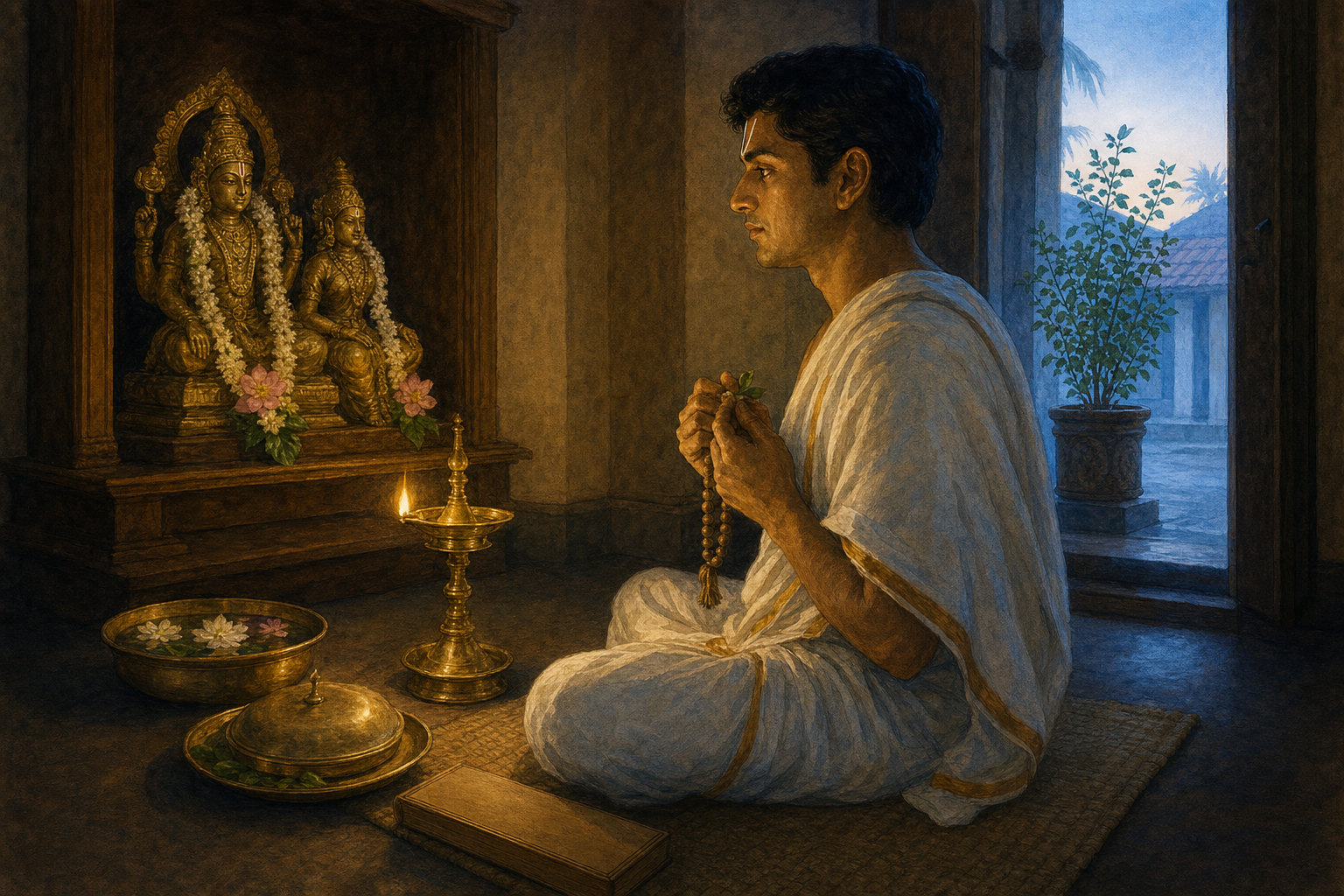
You do not need to manufacture devotional emotion. Begin with reliable conduct and let feeling mature within it. The following routine translates Ramanujacharya’s insight into practices you can carry through an ordinary day.
- Begin with relationship. Before entering the day’s demands, remember that you belong to Narayana and that the people and creatures you will meet are not spiritually disposable. Let sambandha-jnana set the terms of your attention.
- Contemplate one divine quality. During archana, kirtana, japa, or quiet remembrance, dwell on karuna, saulabhya, or saushilya. Then identify the next situation in which you can embody compassion, accessibility, or humility.
- Choose an inconvenient act of care. Reduce a specific burden without waiting to be praised: listen without reaching for your phone, complete a neglected household duty, help a colleague fairly, feed or protect an animal, or give someone your undivided attention.
- Repair speech promptly. If you exaggerate, mock, dismiss, or speak from anger, correct the statement and apologize where appropriate. Mindful speech turns devotion into something another person can actually experience.
- Separate action from control. Name the concern before you, identify the next dharmic action that is genuinely yours, perform it, and consciously entrust what remains beyond your control to Narayana.
- Review the day without performance. Ask where love became bargaining, where discipline became coldness, where fear prevented truthful care, and where grace made generosity possible. Choose one repair rather than making a vague promise to improve.
Do not confuse prema with unlimited access. Love does not require you to remain exposed to cruelty, coercion, or abuse. Truthful boundaries, distance, and appropriate help can protect dharma more faithfully than passive endurance. Prapatti is surrender to the Divine, not surrender to another person’s harmful conduct.
Expect the most revealing practice to occur outside formal worship. It appears when a family member repeats a complaint, a colleague receives credit you wanted, a stranger delays you, or service goes unnoticed. These moments expose the bargain hidden inside affection. They also give you a precise place to replace possession with care.
If worship feels dry, do not immediately increase its quantity. First examine its relational quality. Are you rushing through the Divine Name while treating the people around you as interruptions? Are you asking for help while refusing to help anyone whose need is inconvenient? A smaller practice carried into speech and service may form the heart more deeply than a longer practice sealed off from conduct.
Key takeaways: tests for mature bhakti
- Human affection is a training ground, not a substitute for devotion. It teaches capacities that bhakti purifies and directs toward Narayana.
- Prema seeks the good of the beloved; kama demands possession, reward, or control. Watch your response when affection is not repaid.
- Renunciation is spiritually useful when it loosens attachment and increases compassionate availability. Emotional numbness is not vairagya.
- Prapatti means entrusting yourself to divine grace while continuing to perform the duty that is actually yours.
- Grace cannot be purchased by ritual or austerity. Practice makes you more receptive and responsible; it does not put God in your debt.
- The clearest evidence of bhakti is not intensity during worship but reduced hatred, steadier compassion, truthful speech, and dependable service afterward.
At your next worship, choose one divine quality rather than chasing a particular feeling. Carry that quality into the next conversation, obligation, or act of service. When love becomes dependable there, bhakti has begun to move from an idea about God into a life entrusted to grace.