
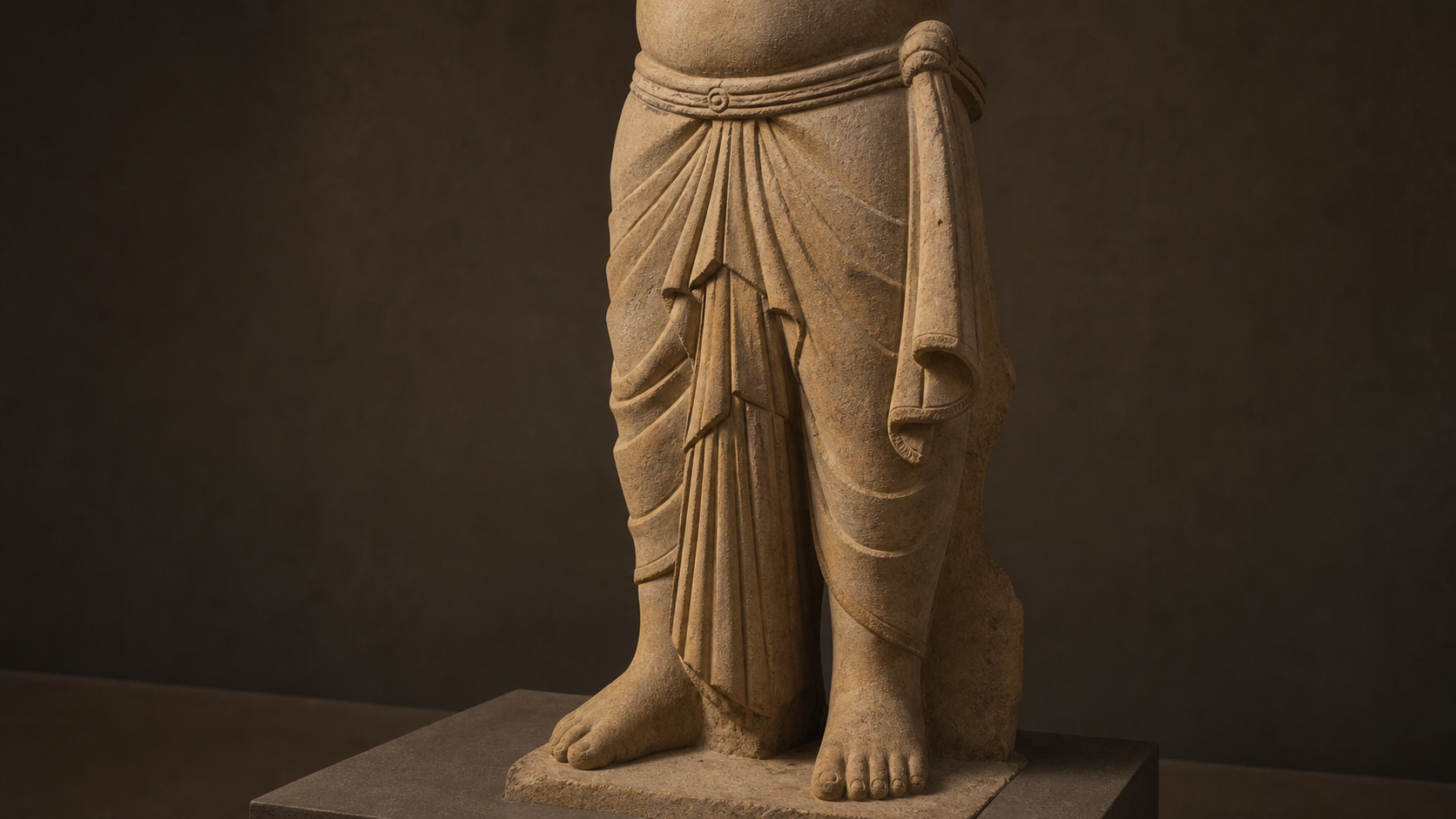
When a temple or museum label names the deity but calls the clothing simply drapery, begin at the waist. The belt, pleats, and direction of the folds can tell you whether you are looking at an antariya, how the sculptor has organized the body, and what kind of movement the image is meant to convey.
The antariya is a continuous, unstitched lower garment wrapped around the hips and thighs. It predates later dhoti forms, though the family resemblance is clear. Once you know its visual grammar, apparently decorative lines become evidence: a fan of pleats marks the front, a tuck prepares the legs for movement, and a girdle establishes the body’s center.
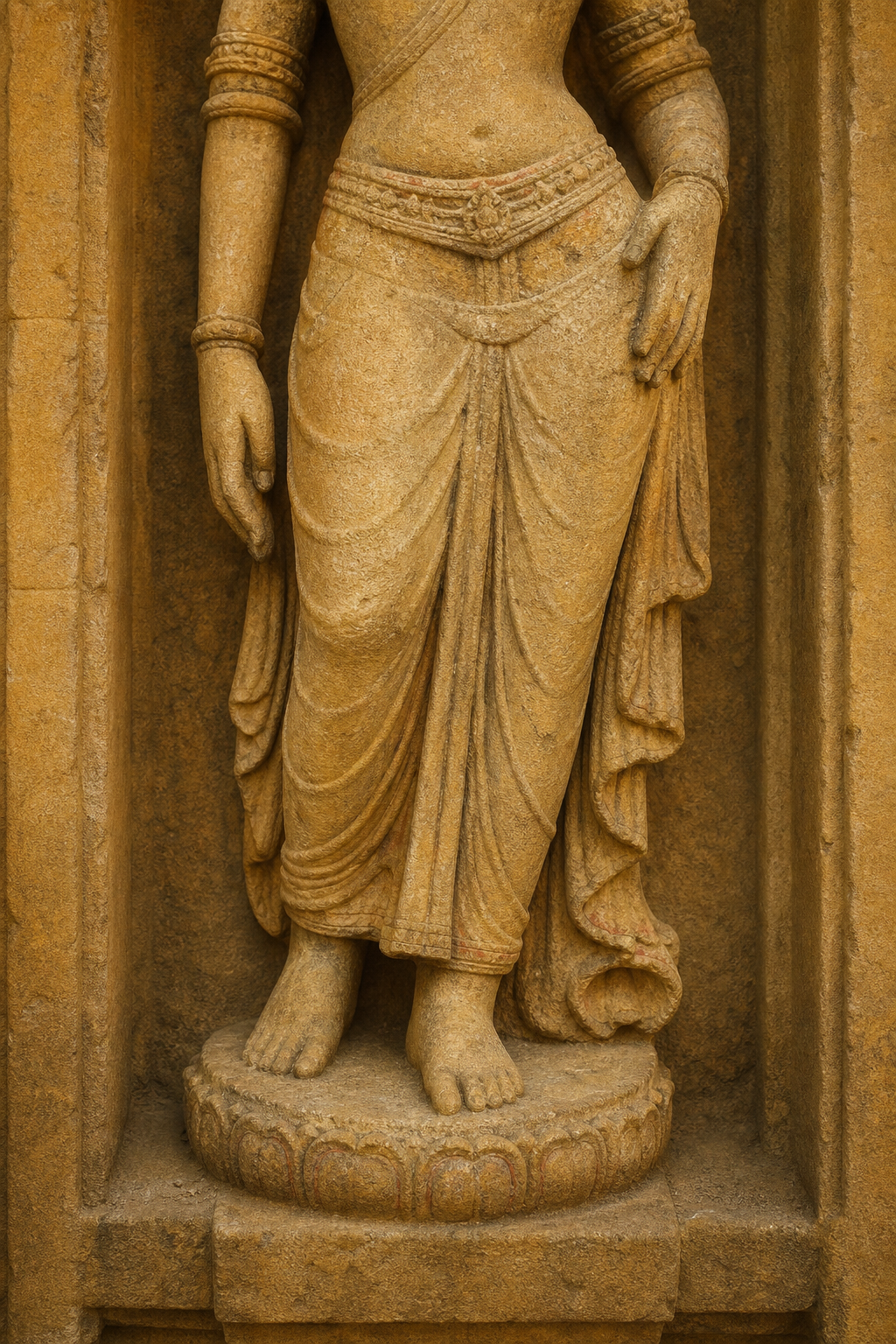
Identify the antariya from the waist downward
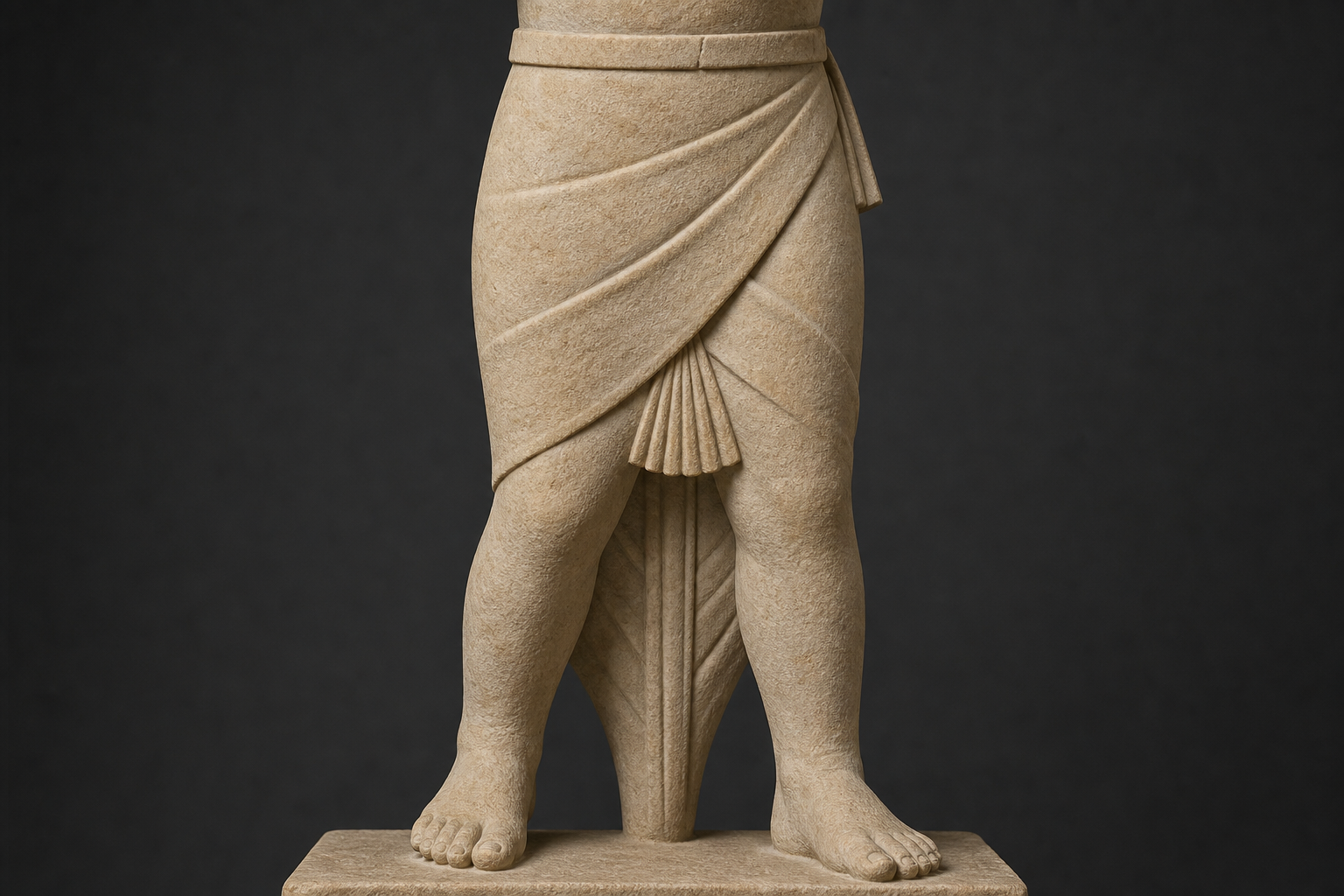
Do not begin by asking whether the garment looks like a modern dhoti, skirt, or pair of trousers. Those comparisons can help later, but they encourage you to force an ancient drape into a modern clothing category. Instead, reconstruct how one piece of cloth would have been arranged around the figure.
- Locate the fastening line. Look for a girdle, cord, beaded strand, jeweled belt, or compact knot encircling the waist. This is usually the mekhala holding the antariya in position. The fastening may be modest or more conspicuous than the cloth itself.
- Trace the cloth over the hips and thighs. The antariya should read as one draped field extending downward from the waist. Coverage alone proves little; the useful evidence is the way the folds return to a common fastening point.
- Find the principal pleat system. A frontal fan is one of the clearest signs. You may also see V-shaped rhythms over the thighs, a central gathering, or a knot placed slightly to one side. These are structural clues, not incidental decoration.
- Check for a kachcha tuck. In this arrangement, part of the cloth passes between the legs and is secured at the waist. It allows the legs to remain visually distinct and supports an active stance. A carved line between the thighs therefore need not indicate trousers.
- Read the surface and edge treatment. Incised borders can mark a hem or patterned textile. Crisp undercut edges sharpen heavy pleats. A smooth, polished surface may suggest very fine or translucent cloth, while stippling can imply a thicker weave.
Use several signs together. A single V-shaped groove might belong to anatomy, damage, jewelry, or another garment. A waist fastening combined with a frontal fan and a continuous fall across the thighs makes a much stronger identification. If the kachcha tuck is also visible, you can describe the arrangement with greater confidence.
This method also prevents a common misreading of fine ancient drapery. When cloth clings closely to the body, the sculptor may indicate it through contour, polish, a narrow border, or a few controlled lines rather than carving a bulky mass. The apparent absence of dense folds does not necessarily mean the figure is unclothed. It may be a deliberate representation of gauzy cotton, silk, or exceptionally fine muslin.
Separate the antariya from its belts, sashes, and companion garments
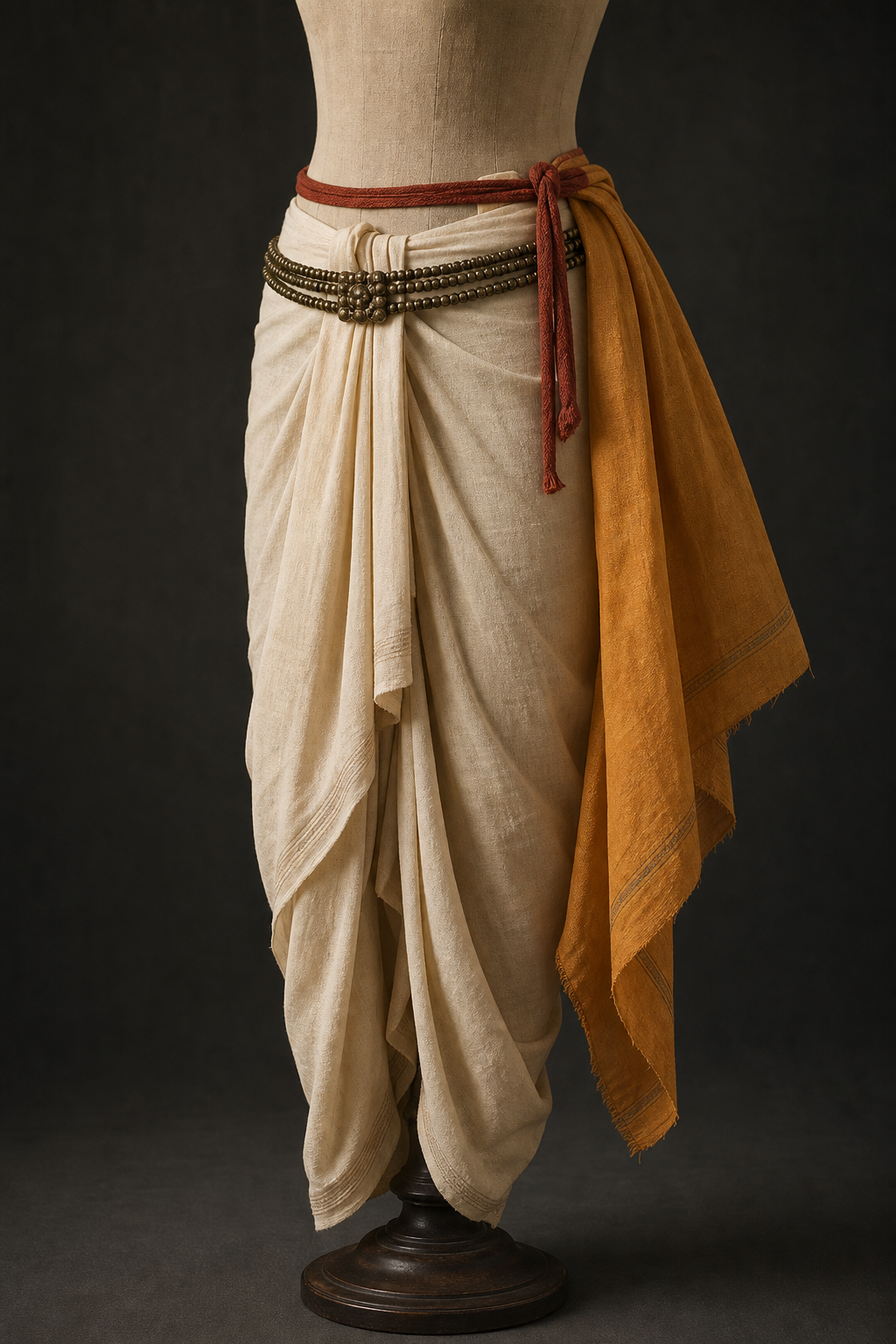
Much confusion disappears once you distinguish the lower cloth from the elements that secure, ornament, or accompany it. The terms describe different jobs within the ensemble.
| Element | Where to look | What it does |
|---|---|---|
| Antariya | From the waist across the hips, thighs, and sometimes lower legs | Forms the principal unstitched lower garment |
| Mekhala | Encircling the waist, often above the main pleats | Secures the drape and may also serve as a jeweled ornament |
| Kayabandh | Tied or looped around the waist, sometimes with hanging ends | Adds a cloth sash to the waist arrangement |
| Kati-sutra | Close to the waist as a narrow cord or string | Defines and secures the waist with less visual weight than a broad girdle |
| Uttariya | Across the upper body, shoulders, arms, or trailing beside the figure | Provides the companion upper drape |
| Stanapatta | Across the chest of a female figure | Functions as a breast-band within a fuller ensemble |
The distinction matters when an image contains several overlapping lines. A jeweled mekhala is not itself the antariya. A narrow waist-string should not be mistaken for a textile border. A strip that crosses the torso or streams beside an arm may be an uttariya or sash rather than a detached part of the lower garment.
Nataraja images make the difference especially useful. The pleated form projecting from the lower body belongs to the organization of the antariya, while fluttering sash-ends enlarge the surrounding field of motion. If you treat every projecting strip as the same garment, you lose the sculptor’s carefully layered choreography.
The mekhala deserves particular attention because it can dominate the waist. It appears as a plain cord, a strand of beads, a jeweled band, or a system of plates and pendants. First identify its circular path around the body. Then look immediately below it for the cloth gathering, knot, or pleat fan. That sequence tells you which feature fastens and which feature is fastened.
Use pleats and girdles as clues to period and region
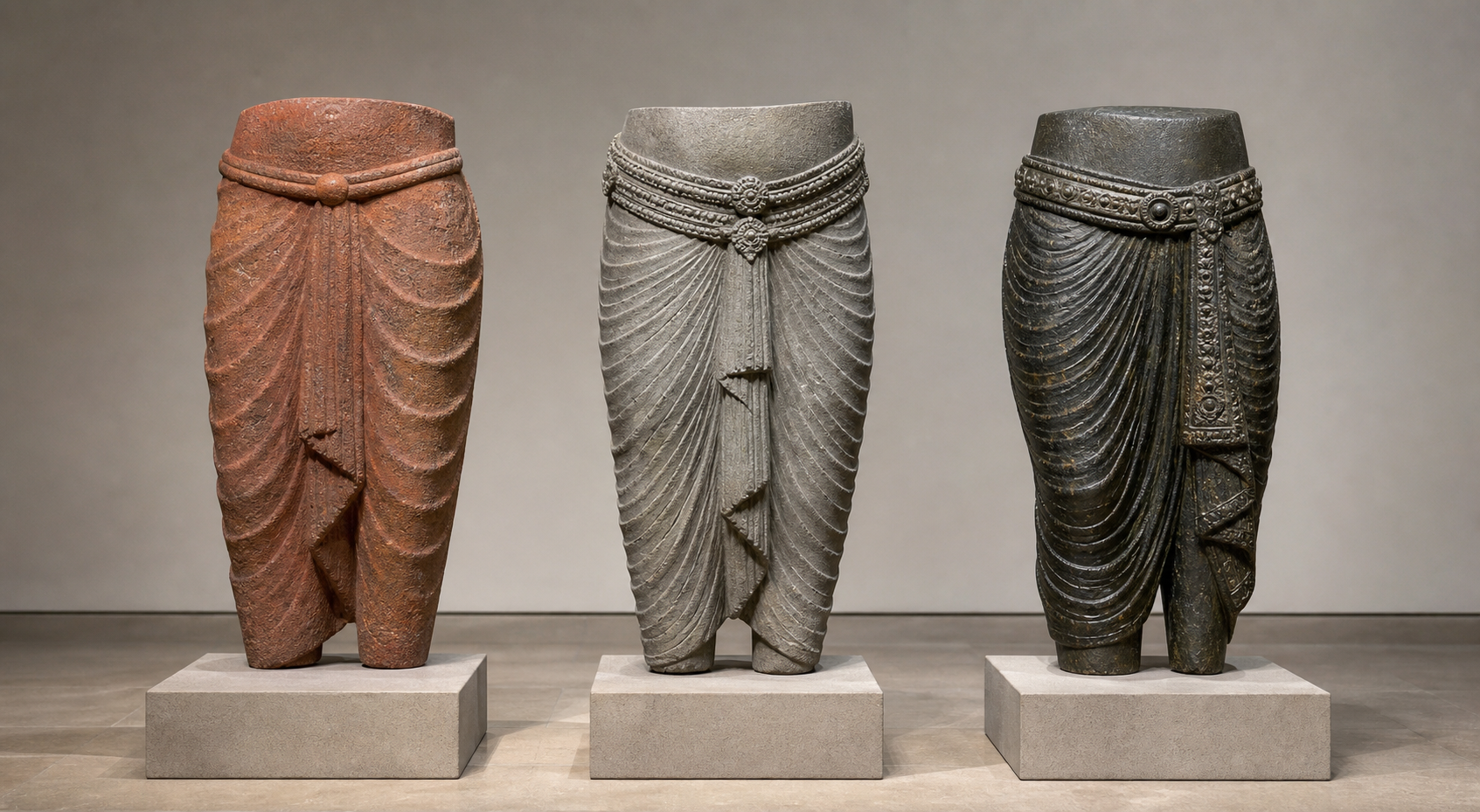
Antariya forms changed as workshops adapted shared principles to regional taste, material, patronage, and pose. Drapery can therefore help you compare sculptures, but it should not bear the entire burden of dating. Check its evidence against the figure’s proportions, posture, facial treatment, jewelry, and other ornament.
Early historic economy: short wraps and clear fastening
In Maurya-Sunga-Satavahana idioms, the antariya is often succinct and may end around the knee. Reliefs at Bharhut and Sanchi from the 2nd-1st centuries BCE show male figures in short wraps with controlled frontal pleats. Female figures can wear closely adhering cloth whose presence is registered through the waist arrangement, polished surface, and incised hem.
Your practical cue is economy. Look for a compact silhouette, a legible belt, and relatively few structural folds. Do not expect the long, highly ordered frontal cascade associated with later classicism. The luminous lower drape and emphatic girdle of the Didarganj yakshi also show how little carving may be needed to anchor an entire pose.
Mathura and Amaravati: cloth brought closer to movement
In Kushan and Mathura work of the 1st-3rd centuries CE, the garment can appear gauzier and more responsive to the body’s surface. Subtle contouring and polish allow the form of the thighs to remain visible through the implied fabric. The cloth is present, but it does not behave like a thick shell.
Amaravati workshops in the eastern Deccan often favor low-slung girdles, longer falling sections, and more intricate pleating. In crowded scenes of procession, devotion, or dance, the pleats help the eye follow bodily action. When comparing these idioms, ask whether the cloth quietly reveals the body, as in a clinging treatment, or actively extends its motion through longer and more elaborate falls.
Gupta classicism: the ordered frontal fan
From the 4th-6th centuries CE, Gupta sculptural language gives the antariya a particularly authoritative balance. The garment is generally longer, the frontal fall becomes more pronounced, and the folds settle into an orderly, tiered fan. Refined beadwork or gem-like forms may articulate the mekhala. At centers such as Sarnath, this measured drapery works with serene expressions and gently shifting postures rather than competing with them.
Look for coordination rather than one isolated feature. A long garment is not automatically Gupta. A long antariya, disciplined frontal fan, delicate girdle, and composed bodily rhythm form the more persuasive cluster. The key impression is controlled grace: the cloth acknowledges motion while keeping it within a stable design.
Early medieval multiplication: southern rhythm and eastern weight
Across the Pallava-Chola horizon of the 7th-13th centuries CE, South Indian bronzes turn the antariya into a powerful instrument of movement. In Nataraja forms, a forward-flaring fan reinforces the direction of the dance, while sash-ends and waist pendants widen its rhythm. The mekhala can combine beaded ropes, jeweled plates, and pendant clusters that catch light against the softer modeling of bronze.
Odishan sculpture and Pala-Sena work in eastern India often give the garment a different physical emphasis. Chevron-like pleats, substantial girdles, forceful hems, and dense ornament make the lower body feel weightier and more tactile. Compare the geometry: southern work may stretch a fold into an undulating movement, while eastern arrangements can consolidate folds into emphatic patterns and borders.
A reliable comparison uses three passes. First read the silhouette: short, long, clinging, or flaring. Then inspect the waist: plain, low-slung, beaded, plated, or heavily pendant. Finally examine the surface: polished, finely incised, sharply undercut, or texturally dense. When all three point in a similar direction, you have a useful stylistic hypothesis. When they disagree, keep the attribution provisional.
Read the garment as sacred language, not a costume code
Identification answers what the figure wears. Interpretation asks why the sculptor made the cloth behave in this particular way. The safest approach moves from the visible arrangement to its possible meaning. Begin with the fastening, length, texture, and motion you can actually see; only then consider discipline, status, ritual propriety, or divine energy.
In Dharmic sacred settings, unstitched cloth can evoke purity, simplicity, continuity, and self-restraint. The mekhala contains the drape at the body’s center of balance, so it can also support a metaphor of energy held within discipline. This harmonizes with the ethical cultivation associated with yama, niyama, and sattva. Treat that as a meaningful reading, not as an inflexible cipher: a belt is not always a one-to-one symbol for a particular doctrine.
Movement provides firmer visual ground. Folds gathering toward a forward leg make a step intelligible. A kachcha arrangement separates the thighs and accommodates an active pose. A frontal fan can project from the body’s axis, while a trailing sash continues an action into the surrounding space. In a dancing image, these features let still stone or bronze carry the force of performance. In Nataraja, that choreographed geometry becomes especially apt for expressing divine energy and shakti.
Gendered tendencies are useful only when kept flexible. Male deities and donors often wear the kachcha form, with a compact knot or pleats that articulate the thighs and imply mobility. Female divinities and attendants often receive longer, softer cascades, sometimes enriched with incised textile borders. Both male and female figures wear the antariya, however. Do not turn a tendency of arrangement into a rule of identification.
The same caution applies across traditions. Bodhisattvas in Buddhist reliefs, salabhanjika-type attendants, Svetambara Jain images, and yaksha-yakshi figures can use closely related lower drapes and girdle arrangements. That shared vocabulary reveals a broad cultural continuum of sacred dress. It does not erase the distinct identity, theology, or ritual setting of the image in front of you. Establish the figure’s tradition through attributes, context, and iconographic program, not from the antariya alone.
The Vishnudharmottara Purana and the wider silpa traditions represented by Manasara and Mayamata place proportion, pose, and drapery within an interconnected discipline of divine representation. They do not impose one uniform antariya on every deity or region. Their larger principle is more useful: cloth must belong to the body’s measure, stabilize its form, clarify its action, and contribute to its sacred presence.
This is why two antariya forms can look different without one being incorrect. A workshop carving stone in Odisha, casting bronze in the Chola realm, or shaping a serene Gupta figure solves a different visual problem. Canon supplies order; regional artistry gives that order a particular weight, rhythm, surface, and rasa.
Key takeaways: a one-minute museum checklist
- Begin at the waist. Identify the mekhala, cord, sash, or knot before following the lower cloth.
- Confirm continuity. Look for one unstitched drape wrapping the hips and thighs rather than assuming a stitched skirt or trousers.
- Find at least two structural cues. A frontal pleat fan, V-shaped thigh folds, a side or central knot, and a kachcha tuck are the most useful signs.
- Let the surface describe the textile. Polish can imply fine, clinging cloth; incised lines can mark borders; undercut edges sharpen pleats; stippling can suggest a heavier weave.
- Keep the garment layers separate. The antariya is the lower cloth, the mekhala secures it, the kayabandh and kati-sutra organize the waist, and the uttariya belongs to the upper drape.
- Date by clusters, not a single fold. Compare length, waist treatment, pleat geometry, surface, posture, physiognomy, and ornament before proposing a period or region.
- Interpret after you identify. Movement, discipline, purity, status, and sacred energy become more convincing when tied to features you can point out on the image.
On your next temple or museum visit, record five things before reading the label in detail: fastening, pleat shape, tuck, textile surface, and direction of movement. That small discipline turns the antariya from background clothing into a readable part of the murti’s form. You will not merely see what covers the divine body; you will see how the artisan made cloth organize grace, action, and sacred presence.