
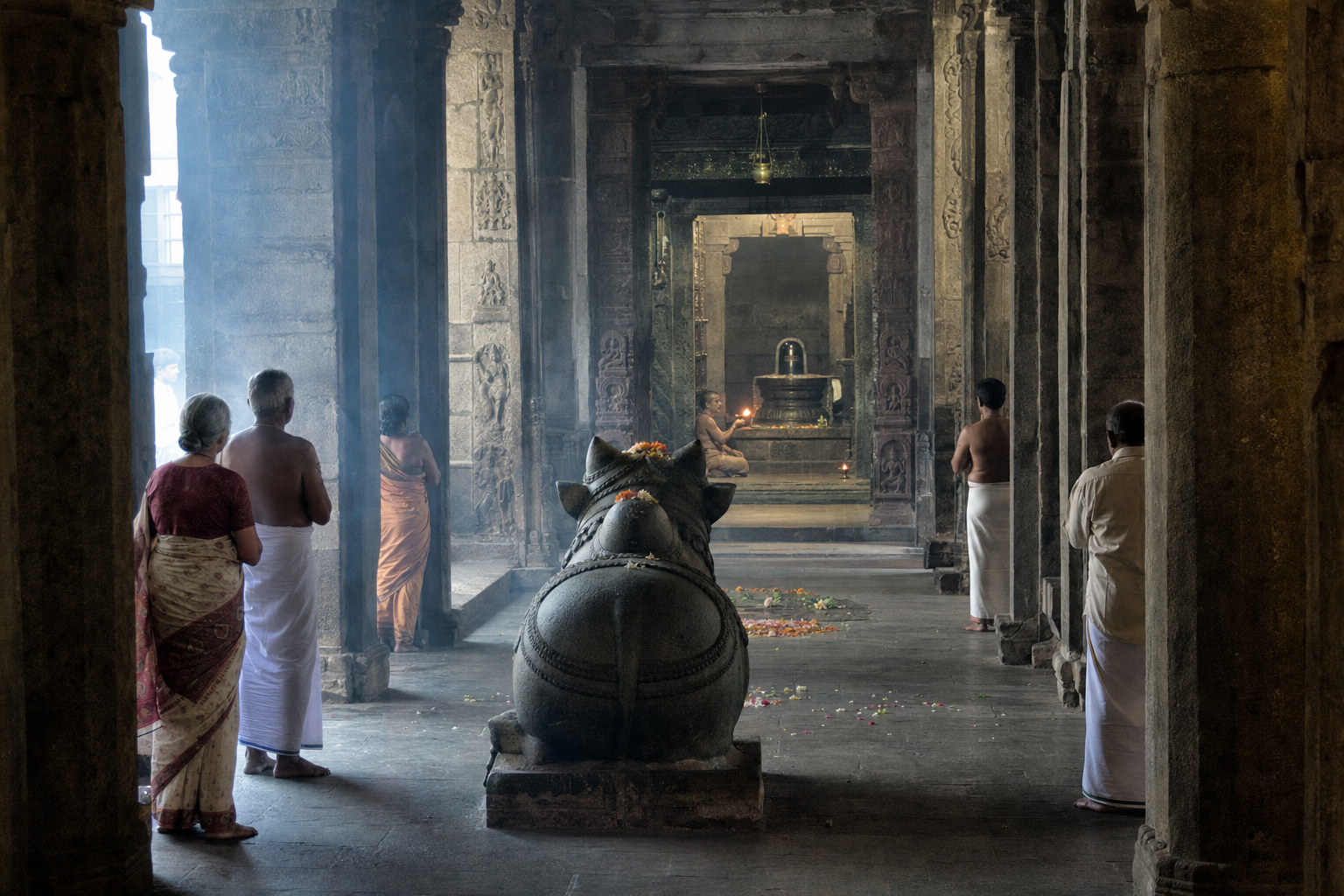
You may recognize a linga, Nandi, or Nataraja and still wonder what you are meant to notice after crossing a temple threshold. A catalogue of names will only take you so far. Shaiva symbols become intelligible when you see how image, space, ritual, sound, and movement direct your attention together.
The most useful approach is to follow the temple’s own sequence. Begin with its line of sight, read each image as a relationship rather than an isolated object, and let current worship show you how inherited forms remain alive.
Begin with the temple’s line of attention
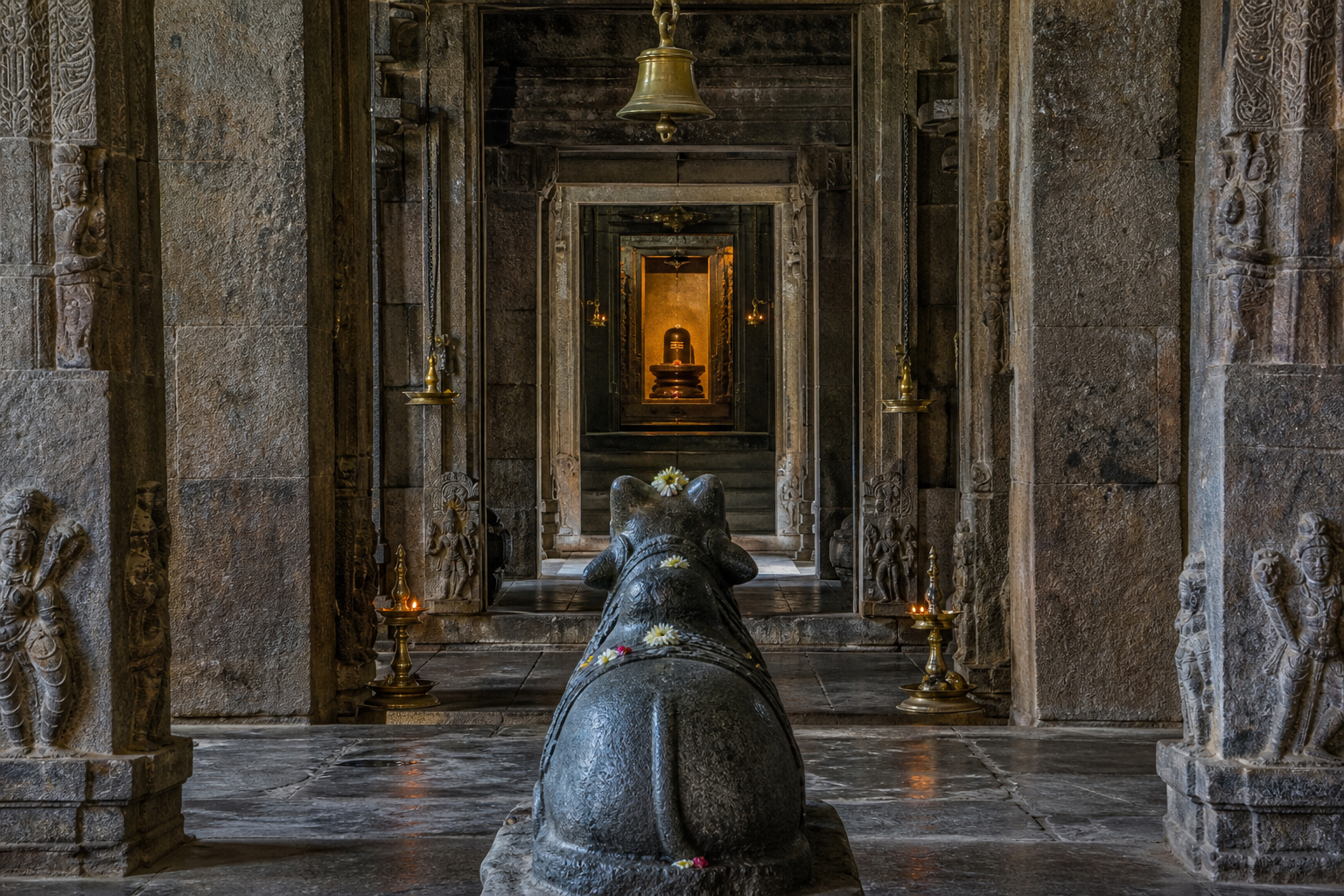
Before examining individual sculptures, find the temple’s organizing axis. In a typical Tamil Shaiva layout, the line commonly passes from the balipeetha and dhwajasthambha through Nandi and the mandapas toward the garbhagriha. Nandi faces the linga, while the prakaras create paths for circumambulation around the sacred center. The compact Eraiyur Thagam Theerthapureeswarar Temple participates in this Dravida ritual grammar.
Treat that arrangement as an orientation, not as a rigid blueprint for every temple. Shrines differ in scale, additions, local custom, and architectural history. The underlying lesson is that placement carries meaning. Nandi’s fixed attention tells you where your own gaze is being invited. The movement from an outer prakara toward the sanctum asks you to leave distraction at the margins and become more collected as you approach the deity.
Pause after entering, without blocking the path of worshippers. Locate Nandi, follow the direction of his gaze, and notice how many thresholds remain between you and the sanctum. Observe whether the space becomes darker, quieter, or more concentrated as you move inward. After darshan, use pradakshina to see subsidiary shrines and sculptural details in relation to the center rather than as unrelated attractions.
This simple change prevents a common mistake: entering with a camera-led search for impressive objects. A living temple is arranged for approach, presence, worship, and return. Its meaning unfolds through movement.
Read Nataraja from tension to refuge
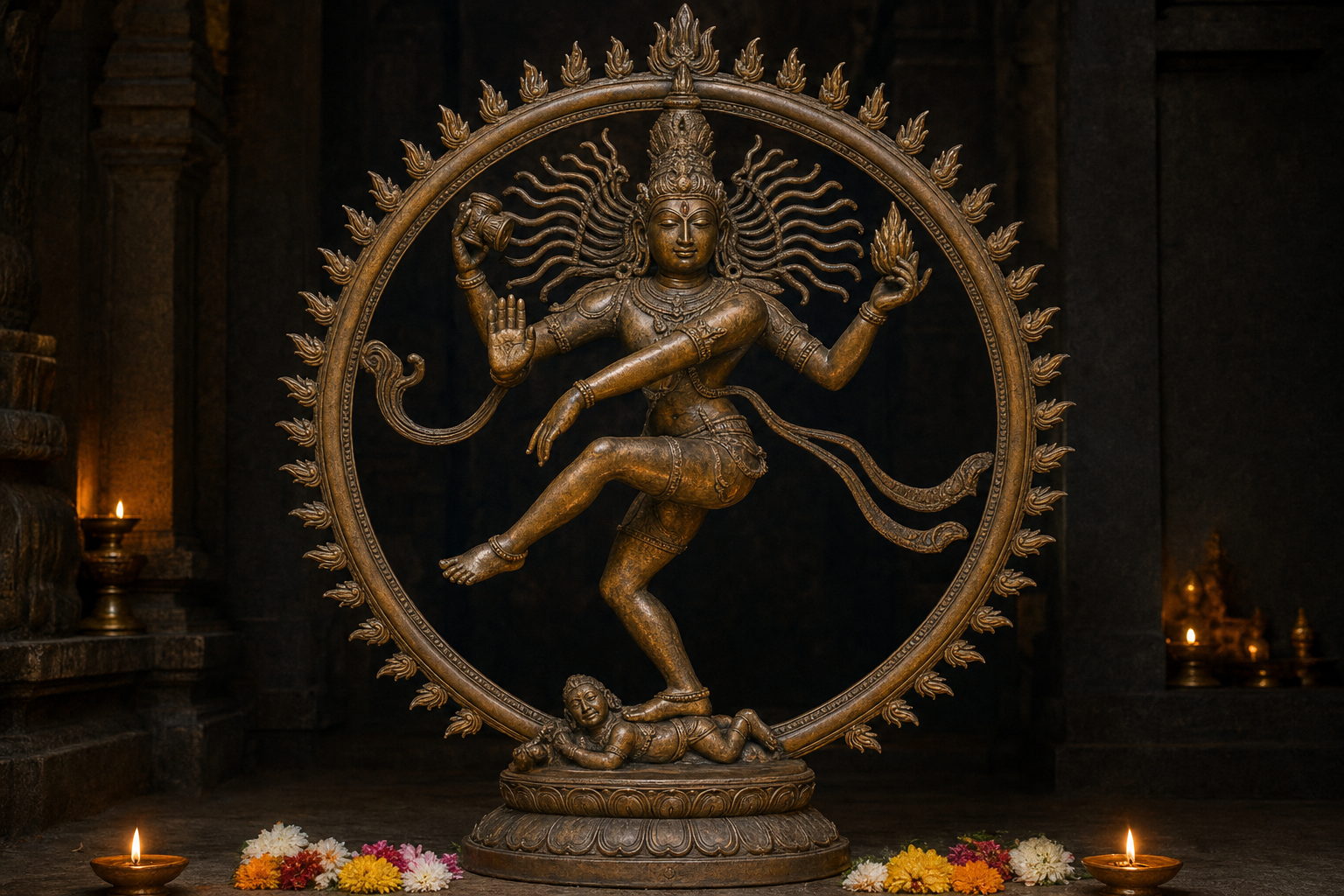
Nataraja is not merely Shiva represented while dancing. The composition holds a complete Shaiva account of a cosmos that continually appears, endures, withdraws, becomes veiled, and is opened again through grace. These are the pancakritya, the five divine operations named in the Shaiva Agamas: srishti, sthiti, samhara, tirobhava or tirodhana, and anugraha.
| Visible detail | Meaning | What to notice |
|---|---|---|
| Damaru in the upper right hand | Srishti, or emanation and creation | The universe begins with rhythm rather than static matter. |
| Agni in the upper left hand | Samhara, or dissolution and withdrawal | Transformation belongs to cosmic order; it is not an accidental interruption of it. |
| Lower right hand in abhaya | Fearlessness and reassurance | The image addresses the devotee directly amid fire and movement. |
| Lower left hand crossing the body in gaja-hasta | Direction toward refuge | The gesture guides your eye toward the raised left foot. |
| Raised left foot | Anugraha, or liberating grace | Release is offered within the dance, not outside the changing world. |
| Right foot upon Apasmara | Forgetfulness and spiritual ignorance brought under control | The obstacle is subdued through awakened awareness. |
| Prabhamandala, the aureole of fire | Time, matter, and transformation | The entire dance takes place within a field of ceaseless change. |
The damaru, flame, abhaya hand, raised foot, Apasmara, and fiery aureole form one visual argument. Do not force every one of the five operations into a separate prop. Creation and dissolution have especially clear emblems, but the pancakritya belongs to the composition as a whole. Preservation, veiling, and revelation are understood through the balanced dance and the relationships among its parts.
A frequent misreading stops at the flame and treats Nataraja as an image of destruction. Samhara is more precise: dissolution or withdrawal. The same murti that carries fire also offers abhaya and points toward grace. Change may be formidable, but it is not the final meaning of the image.
When you stand before Nataraja, begin with the lower right hand. Receive the assurance of abhaya. Follow the lower left hand across the torso to the raised foot. Then look down to Apasmara beneath the planted foot. Only after tracing that movement should you take in the entire ring of fire. This sequence lets your gaze travel from fear, through refuge and the restraint of ignorance, toward a balanced vision of transformation.
The drum adds another layer. A well-known tradition associates Shiva’s damaru with the fourteen Maheshvara Sutras, the organizing sequence of the Sanskrit phonemic system. The point is linguistic cosmology: sound, articulation, movement, and creation belong to one ordered field. When bells, chant, or temple instruments accompany darshan, the soundscape is therefore not an ornamental background to the icon. It activates a principle already held in the drum.
Let ritual complete the symbolic reading
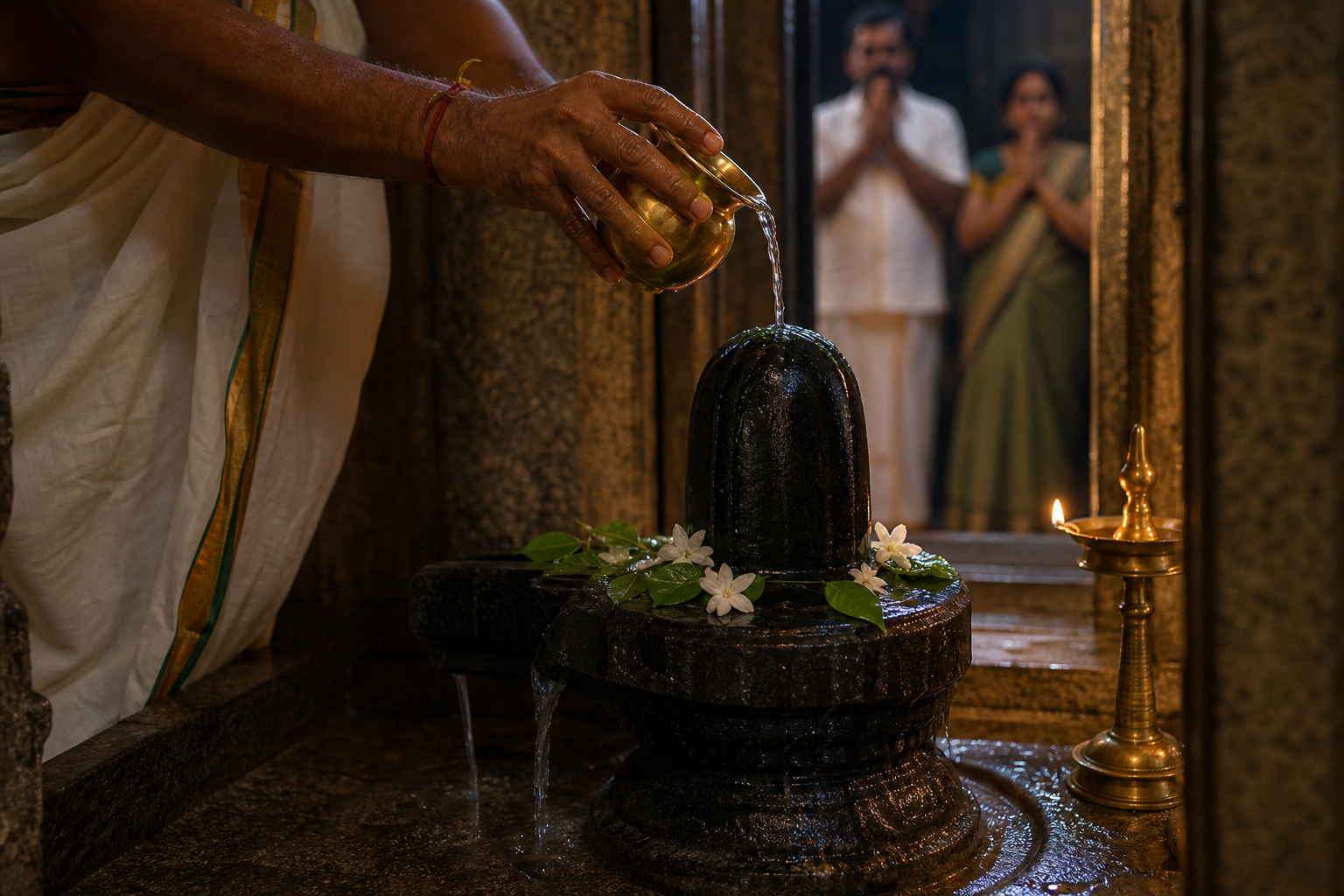
Iconography tells you what a form can mean. Ritual shows you how a community lives with that meaning. During abhishekam, alankaram, upachara, and deeparadhana, the deity is approached through water, adornment, offering, light, recitation, and disciplined attention. Bells, conch, chant, nadasvaram, and tavil can shape the encounter as decisively as stone or bronze.
Within the temple’s own ritual logic, the murti is not an art object temporarily surrounded by religious activity. Worship, image, sacred space, and community are parts of the same reality. If an upachara is underway, allow the ritual to set your pace. Watch where devotees direct their gaze, when lamps reveal the deity, and how the atmosphere changes as sound rises and subsides. You will learn more by attending to one complete act of worship than by rushing past many sculptures.
Local names often reveal the specific theology a temple keeps alive. At Eraiyur, Shiva is worshipped as Thagam Theerthapureeswarar alongside Annapurni. Thagam signifies thirst, theertha evokes sanctified water, and Annapurni brings the theme of nourishment into the same devotional field. The resulting message is concrete: thirst and hunger, both bodily and inward, are met through water, food, hospitality, and grace. The village name Iraiyur is also traditionally read through irai, god, and oor, village, binding devotional identity to locality.
Use this method whenever you visit an unfamiliar shrine. Ask what the deity’s local epithet emphasizes, which goddess or accompanying deities share the sacred precinct, and which ritual substances or acts repeat the same theme. A name involving theertha should make you notice water. Annapurni should make you notice food, prasadam, and anna-dana. The temple is teaching through repetition across name, form, and practice.
Plan your visit around the experience you actually want. Daily darshan at many Tamil Shaiva temples generally follows morning and evening worship windows, but rural schedules should be confirmed at the entrance noticeboard or locally. Pradosham and Maha Shivaratri may alter or extend the usual hours. Agricultural seasons and festival observances can also affect local timings. A fixed online schedule is less reliable than current information at a living village shrine.
For Nataraja-centered worship, Arudra Darshan during Margazhi Thiruvathirai gives the cosmic dance a distinct liturgical setting. Procession, deepa aradhana, nadasvaram, and tavil allow the theology of rhythm to be encountered collectively. If your purpose is close architectural observation, an ordinary worship day may leave you better able to follow the temple’s spatial grammar. If your purpose is to understand how the icon lives in communal devotion, the festival context matters.
See sculpture, dance, and music as one knowledge system
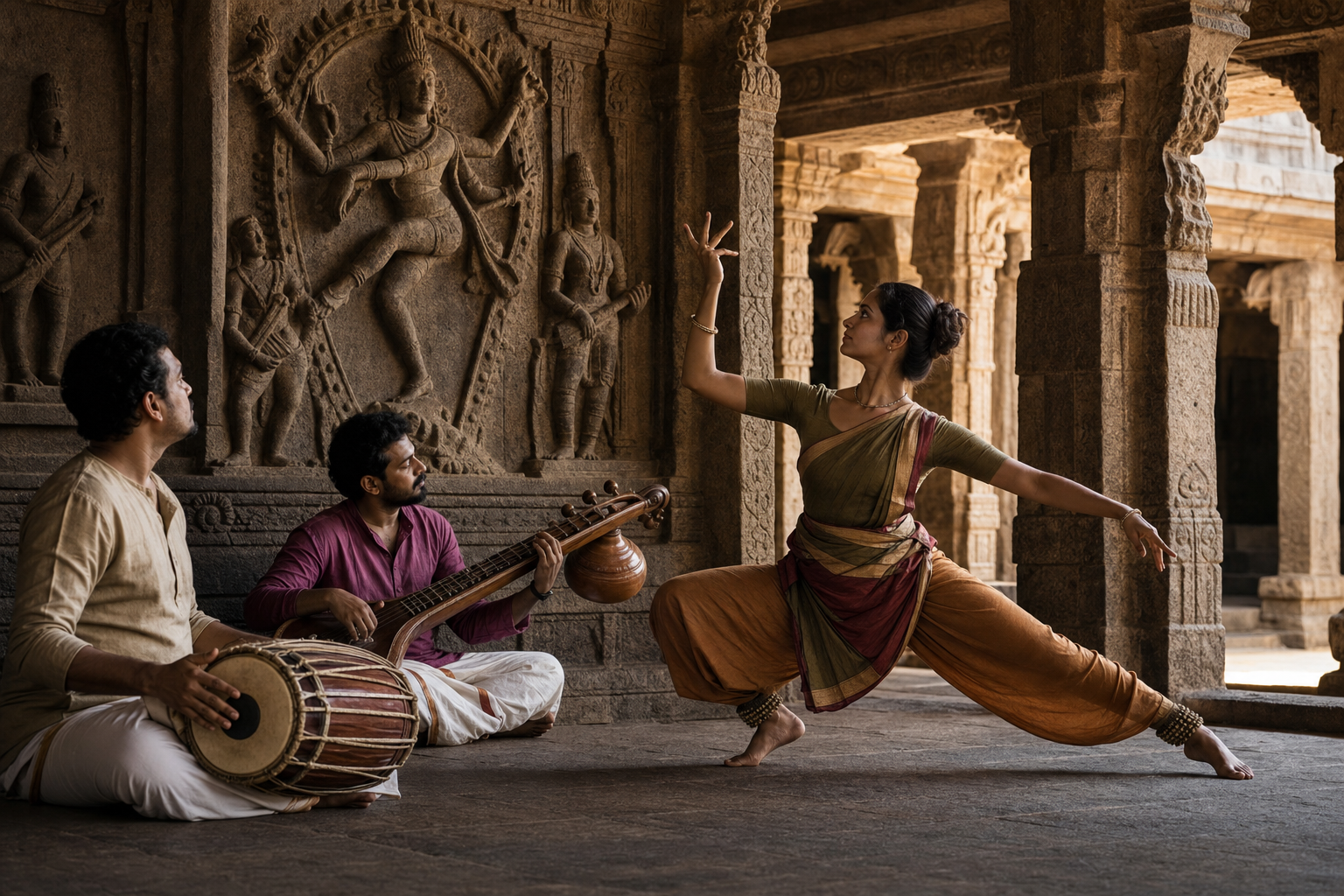
A dancing figure on a temple wall is not simply decoration added to architecture. South Indian temple culture preserved movement through bodies, texts, sculpture, bronze, rhythm, and ritual. Bharatanatyam draws upon the Natya Shastra attributed to Bharata Muni and the Abhinaya Darpana attributed to Nandikeshvara. The one hundred and eight karanas described in the Natya Shastra connect codified movement with sculptural sequences, including those at the Brihadeeshwara Temple in Thanjavur.
When you encounter a dancing sculpture, look beyond its general pose. Follow the alignment of feet, knees, torso, arms, hands, and gaze. Ask where the figure’s weight seems to rest and in which direction the movement appears ready to continue. A karana is a dynamic unit, not a frozen gesture in the modern sense. At the same time, do not label every dancing figure as one of the canonical karanas without site-specific evidence. The better first observation is that stone has been made to retain the potential for motion.
The distinction between tandava and lasya also helps, provided you do not turn it into a crude opposition. Tandava is dynamic and can become vigorous or fierce; lasya is graceful and often gentle. Traditions associate these complementary modes with Shiva and Parvati. Ananda tandava and rudra tandava show that even within the vigorous mode, bliss and formidable energy are different modulations rather than interchangeable labels. Lasya’s smaller expressive gestures demonstrate that tenderness requires discipline and precision, not less power.
Nandikeshvara and the sage Tandu connect divine dance with transmission. Nandikeshvara is associated with dance knowledge and the Abhinaya Darpana, while Tandu is remembered as an archetypal master of tandava. Their presence in narrative and technical vocabulary matters because temple heritage has never depended on objects alone. Knowledge survives through teachers, performers, musicians, ritual specialists, artisans, and devotees who continue to embody it.
The Chola Nataraja bronze gives this integrated system an especially concentrated form: balance appears fluid, movement remains legible from multiple directions, and theology is carried by the body’s disposition rather than by an explanatory inscription. Temple walls and bronzes should therefore be read alongside performance. Notice how a dancer coordinates drishti, limbs, breath, tala, raga, and bhava; then return to the sculpture and look again. The still form will no longer appear still.
You can also read dance as sacred geography. The Panchasabha Sthalas remember Shiva’s dance through five halls in Tamil Nadu: Chidambaram’s Kanaka Sabhai, the Golden Hall; Madurai’s Rajata Sabhai, the Silver Hall; Thiruvalangadu’s Ratna Sabhai, the Gem Hall; Tirunelveli’s Tamra Sabhai, the Copper Hall; and Kutralam’s Chitra Sabhai, the Painted Hall. A pilgrimage linking them should not become a box-ticking tour. Choose one comparison to carry from place to place: how the hall is named, how Nataraja is encountered, which sounds accompany worship, or how the local community narrates the dance.
Key takeaways for your next temple visit
- Find the sacred axis before collecting details. Let Nandi’s orientation and the movement toward the garbhagriha teach you how the temple organizes attention.
- Read Nataraja as a sequence. Move visually from abhaya to the raised foot, down to Apasmara, and outward to the ring of fire.
- Do not reduce agni to destruction. Nataraja holds dissolution together with creation, continuity, veiling, fearlessness, and grace.
- Use the deity’s local name, accompanying deities, offerings, and ritual materials as connected clues. At Eraiyur, thirst, sacred water, Annapurni, food, and hospitality reinforce one another.
- Let active worship set the pace. Confirm darshan timings locally, stand clear of ritual movement, and postpone close visual study when it would disrupt devotees.
- Protect what you came to understand. Dress modestly, remove footwear where required, respect restrictions on photography near the sanctum, dispose of offerings mindfully, and support fair-priced local transport and village enterprises.
On your next visit, carry one question rather than a long checklist: where is this temple directing my attention? Follow that direction through architecture, image, ritual, and sound. Record your observations only after darshan. That order allows you to study Shaiva heritage while honoring the worship that keeps it alive.
References
- DharmaRenaissance Blog — Awe-Inspiring Nataraja: The Timeless Cosmic Dance, Bharatanatyam Roots, and Dharmic Unity
- DharmaRenaissance Blog — Eraiyur Thagam Theerthapureeswarar Temple: Shaiva Heritage, Travel Guide and Architecture