

If you are trying to plan Vaishakha in 2026, do not begin by copying a row of Gregorian dates from a calendar made for another city. In the Telugu Amanta calendar, Vaishakha Masam runs from April 18 through May 16, but the observances within it are governed by tithi, local sunrise and, in some cases, moonrise or the time for breaking a fast.
Shankara Jayanti provides an early focal point for the month. In most of India, the primary date is Tuesday, April 21, 2026, corresponding to Vaishakha Shukla Panchami. You can mark that date now, then use the plan below to verify local timings and build an observance you can actually sustain.
Dates to mark now and timings to verify locally
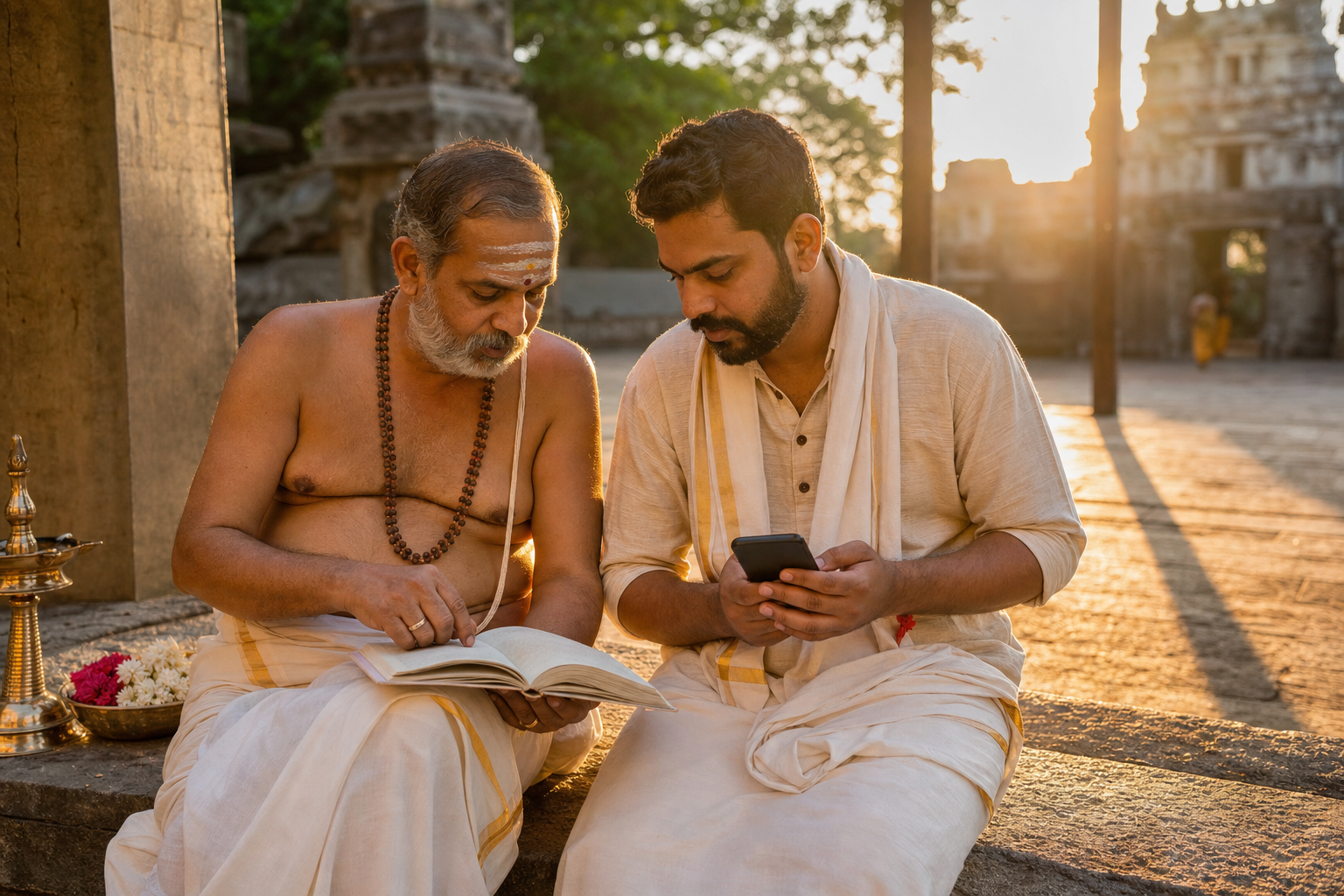
A tithi is not a midnight-to-midnight date. It is determined by each 12-degree increase in the longitudinal separation of the Sun and Moon. Because that boundary can occur at any clock time, the tithi prevailing at local sunrise commonly determines the festival day. Longitude, latitude and time zone can therefore move an observance to a different civil date.
This matters even more if you live outside Bharat. Panchami may enter earlier by the civil clock in Europe or the Americas and later in some eastern locations. Use a panchang calculated for your city rather than automatically importing Indian Standard Time.
Key takeaways
- Telugu Vaishakha Masam 2026 begins on April 18 and concludes with Amavasya on May 16.
- Shankara Jayanti is primarily observed in India on Tuesday, April 21, on Vaishakha Shukla Panchami.
- Confirm the tithi at local sunrise before stating your sankalpa or fixing a temple or household observance.
- Record parana for Ekadashi and moonrise for Sankashti Chaturthi separately; the festival date alone is not enough.
- Choose one daily sadhana, a few anchor observances and one practical form of dana. You do not need to perform every rite in the month.
The Amanta system used by the Telugu calendar begins the month after Amavasya and ends it at the following Amavasya. North Indian Purnimanta calendars divide named months differently, but major observances remain tied to their tithis. If two calendars appear to name the surrounding month differently, compare the tithi before assuming that one is wrong.
The Vaishakha observance sequence in 2026
The following is a planning map, not a substitute for your city-specific panchang. Put the tithis into your calendar first. Add local clock times only after checking all five panchang limbs where the ritual requires them: tithi, nakshatra, yoga, karana and vara.
| Position in Vaishakha | Observance | What you can plan |
|---|---|---|
| Shukla Tritiya | Akshaya Tritiya; Parashurama Jayanti in many sampradayas; beginning of Chandan Yatra; Jain Varshi Tapa Parana | Lakshmi-Narayana puja, dana, the beginning of a constructive undertaking, or support for a service project. Jain observance remembers the fast-breaking associated with Bhagavan Rishabhanatha and the disciplines of tapas and ahimsa. |
| Shukla Panchami | Shankara Jayanti | For most of India, plan Guru-puja, study and contemplation for April 21. Verify Panchami at sunrise for your location. |
| Shukla Saptami | Ganga Saptami | Perform a respectful snana, offer arghya and recite a Ganga stotra. If the Ganga is distant, honour the sacred-water principle through a local tirtha or temple tank without pretending that the places are interchangeable. |
| Shukla Navami | Sita Navami | Offer a simple household puja, read a passage from the Ramayana and reflect on Devi Sita’s steadfastness, patient strength and relationship with the living world. |
| Shukla Ekadashi | Mohini Ekadashi | Combine Vishnu worship with restraint in food, speech and consumption. Record the local parana period before beginning the vrata. |
| Shukla Chaturdashi | Narasimha Jayanti | Recite a Sri Lakshmi-Narasimha stotra, visit a Narasimha temple where practical, or follow the special sevas of sacred centres such as Ahobilam. |
| Purnima | Vaishakha Purnima; Satyanarayana Vratam; Kurma Jayanti; Buddha Purnima or Vesak | Choose the observance appropriate to your tradition. Vishnu Sahasranama, Satyanarayana worship, meditation, charity and Pitru tarpanam are among the Hindu practices associated with the day. Buddhist communities commemorate the Buddha’s birth, awakening and parinirvana in many traditions. |
| Krishna Chaturthi | Sankashti Chaturthi | Plan Ganesha worship and obtain the correct local moonrise time before arranging the concluding darshan. |
| Krishna Ekadashi | Apara Ekadashi | Observe inward restraint, Vishnu worship and charity. Confirm both the fasting period and local parana time. |
| Twice during the month | Pradosha Vrata | Set aside the evening twilight for Shiva worship, once in each paksha. This can sit naturally beside the month’s regular Vishnu upasana. |
| Amavasya, May 16 | Vaishakha Amavasya | Close the month with Pitru tarpanam where it belongs to your practice, quiet dana, feeding birds or animals, and restraint in speech and consumption. |
If fasting is part of your vrata, distinguish spiritual discipline from avoidable harm. Do not interrupt prescribed medicine or disregard a health condition to complete a full fast. Choose a medically safe form of restraint and seek appropriate clinical guidance when fasting could affect your health; your family or sampradaya can guide the ritual form, but it cannot replace medical advice.
How to observe Shankara Jayanti at home
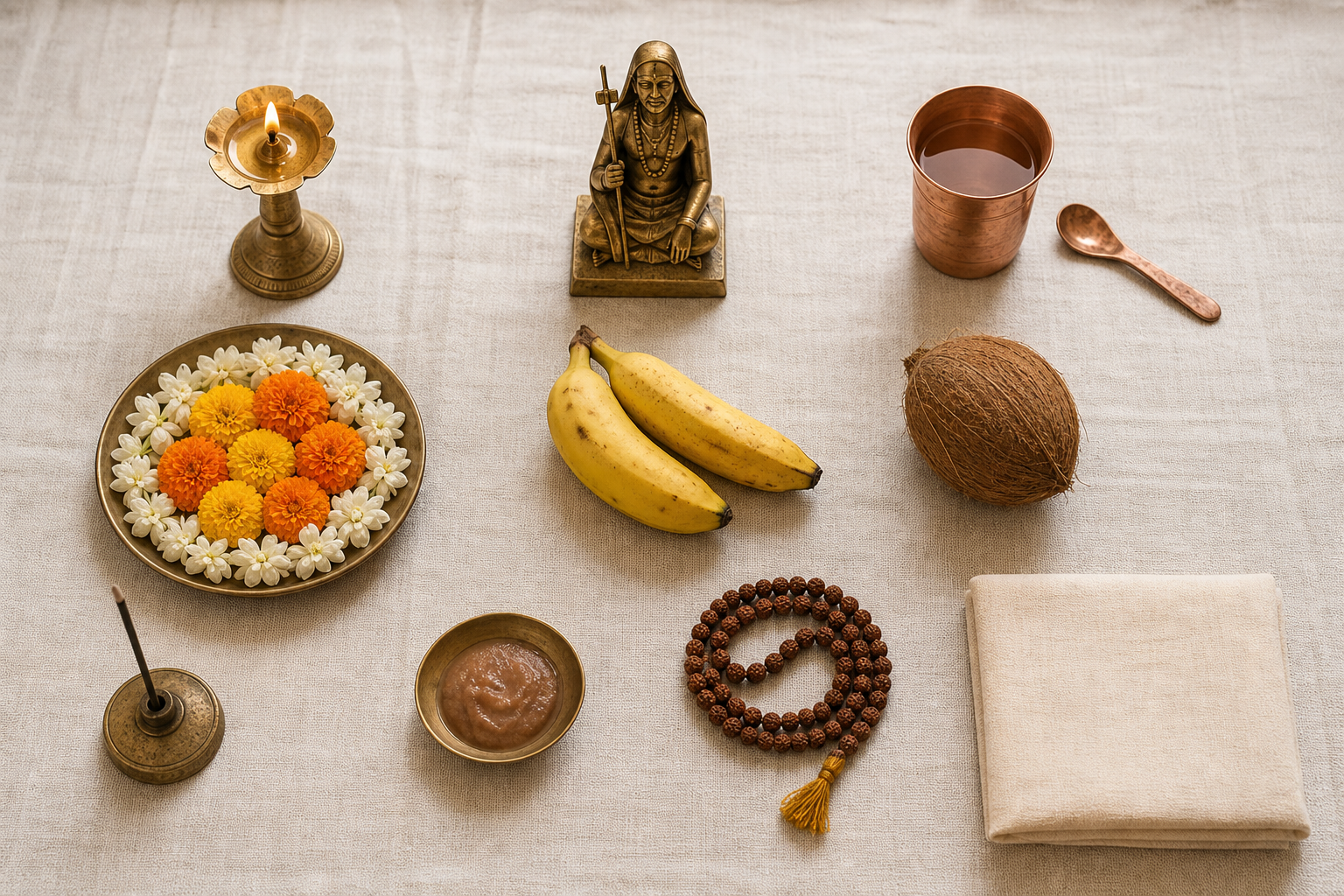
Traditional chronologies do not all assign the same historical dates to Adi Shankaracharya. Much modern scholarship places him in the late eighth to early ninth century CE, while several lineages preserve earlier dates. That disagreement need not prevent a meaningful Jayanti. The enduring reason for the observance is his clarification of Advaita Vedanta, his commentaries on the Upanishads, Bhagavad Gita and Brahma Sutras, and his renewal of disciplined scriptural inquiry.
Advaita teaches the non-dual identity of atman and Brahman, but Shankara Jayanti should not become a day for repeating that formula without examination. Its traditional method moves through shravana, careful reception of the teaching; manana, reasoning through doubts; and nididhyasana, sustained contemplation. Your puja and your study therefore belong in the same observance.
- Begin in the morning. Bathe, clean the worship space, light a lamp and place flowers before your image of the Acharya, Guru or padukas. Sunrise to late morning is customary because Panchami at sunrise establishes the day in most locations.
- Make a clear sankalpa. State your place, Vaishakha Shukla Panchami and your purpose. A plain intention to honour the Guru-parampara and cultivate clarity is better than reciting a formula you do not understand.
- Perform Guru-puja. Offer flowers and recite a Guru-stotram. Acharya-padavandana can be performed through respectful worship of the Guru’s sandals or their representation.
- Choose one recitation. Bhaja Govindam, Kanakadhara Stotram, Totakashtakam, Soundarya Lahari and Shivanandalahari are all associated with the Acharya’s living devotional legacy. Select one you can pronounce and contemplate attentively instead of hurrying through several.
- Read with a question. Take one passage from an Upanishad or the Bhagavad Gita together with Shankara’s bhashya. Write down what the passage claims, what distinction it asks you to make and what doubt remains. That turns reading into manana.
- Sit quietly. Bring to mind the distinction between what is transient, anitya, and what is enduring, nitya. Notice one attachment or fear that depends on treating a changing condition as your permanent identity.
- Conclude with service. Annadanam, sharing a useful book or providing food to someone in need carries the observance beyond your altar.
If your available time is limited, retain the connection between learning and contemplation: one sincere offering, one carefully read passage and a period of silence express the purpose of the day more faithfully than an elaborate programme performed without attention.
Let Shankara’s legacy shape the form of the day

Adi Shankaracharya is traditionally credited with organising the four amnaya mathas: Sringeri in the south, Dwaraka in the west, Puri in the east and Jyotirmath in the north. These centres helped sustain Vedic study, teaching and the Shankaracharya parampara across Bharat’s sacred geography. If you cannot attend a local programme, use the Jayanti to identify the matha or teaching lineage you intend to study with rather than collecting disconnected quotations online.
Panchayatana Puja expresses another part of this legacy. Shiva, Vishnu, Devi, Surya and Ganesha are worshipped without turning their forms into rival camps. That does not erase sampradaya or require every Hindu to adopt the same theology. It shows how firm spiritual commitment can coexist with reverence for other Hindu forms of worship.
You can carry that principle into conversation on April 21. State your own position accurately, ask what another school actually teaches and separate disagreement from contempt for the seeker. Shravana is impossible if you listen only long enough to prepare a rebuttal; manana is impossible if no claim may be examined.
Build a Vaishakha practice you can keep until May 16

Vaishakha is revered as Madhava Masam, a month especially associated with Lord Vishnu. Its recurring disciplines are snana, dana, japa, homa and vrata. The practical error is to attempt all of them at maximum intensity, miss several days and then abandon the month. Give your observance three layers instead.
- A daily foundation: Bathe at or near sunrise where your circumstances permit, light a deepa, offer tulasi or flowers, and undertake a manageable Vishnu practice. This may be mantra-japa, a portion of Vishnu Sahasranama or a passage from the Bhagavad Gita.
- Anchor days: Give fuller attention to Shankara Jayanti, Akshaya Tritiya, Mohini Ekadashi, Narasimha Jayanti, Vaishakha Purnima and Apara Ekadashi according to your tradition. Place their verified local timings in your calendar before the month begins.
- Seasonal dana: Provide clean drinking water, buttermilk, sharbat, hand-fans, umbrellas, food or shaded rest where these meet a real need. Heat relief turns the month’s theology of merit into direct care for another being.
Akshaya Tritiya deserves one caution. Its reputation as an auspicious time does not make every purchase prudent or guarantee success to an undertaking. Begin something constructive because it is worthy and sustainable, not because a festival label removes ordinary judgement. Griha-pravesha and other significant life events still call for proper muhurta assessment, including tithi, nakshatra, yoga, karana, lagna, local sunrise and practical circumstances.
Satyanarayana worship on Purnima, the two Pradosha evenings and ancestral remembrance on Amavasya also prevent the month from being reduced to a single sectarian identity. Madhava remains its Vaishnava centre, while household dharma can make room for Guru, Shiva, Devi, Ganesha and the Pitris.
Recognise the wider dharmic season without flattening it
Vaishakha makes several relationships within the dharmic family visible. Jain communities mark Akshaya Tritiya through the Varshi Tapa Parana associated with Bhagavan Rishabhanatha. Buddhist communities observe Vaishakha Purnima as Buddha Purnima or Vesak. Sikh Vaisakhi falls around the solar entry into Mesha in mid-April and remembers the establishment of the Khalsa while also carrying the significance of the agrarian season.
These observances are close in season, but they are not alternate names for one event. Vaisakhi is solar rather than a tithi within the Telugu lunar month, and it may fall before the Amanta Vaishakha span begins. Buddha Purnima and the Jain fast-breaking also retain meanings proper to their respective traditions. Shared values such as discipline, truthfulness, compassion, courage and non-injury become more credible when we preserve those distinctions.
If you are organising a multi-tradition gathering, make service the common ground: distribute water or food, then allow Hindu, Buddhist, Jain and Sikh participants to explain their own observances in their own terms. Unity is strengthened by accurate listening, not by pretending that distinct histories and teachings are identical.
Your next step before Vaishakha begins
Before April 18, enter the month boundary and April 21 in your calendar, obtain a panchang for your actual city, and record the local timings for every vrata you intend to keep. Then choose one daily practice, one text for Shankara Jayanti and one heat-relief service you can continue through May 16. A small discipline maintained for the whole month will give you more to contemplate than an overfilled calendar abandoned after its first festival.
References
- Hindu Pad — Telugu Vaishakha Masam 2026 (Madhava Masam): Dates, Key Festivals, Rituals, and Panchang Guide
- Hindu Pad — Shankara Jayanti 2026: Exact Date, Rituals, and the Advaita Legacy of Adi Shankaracharya