
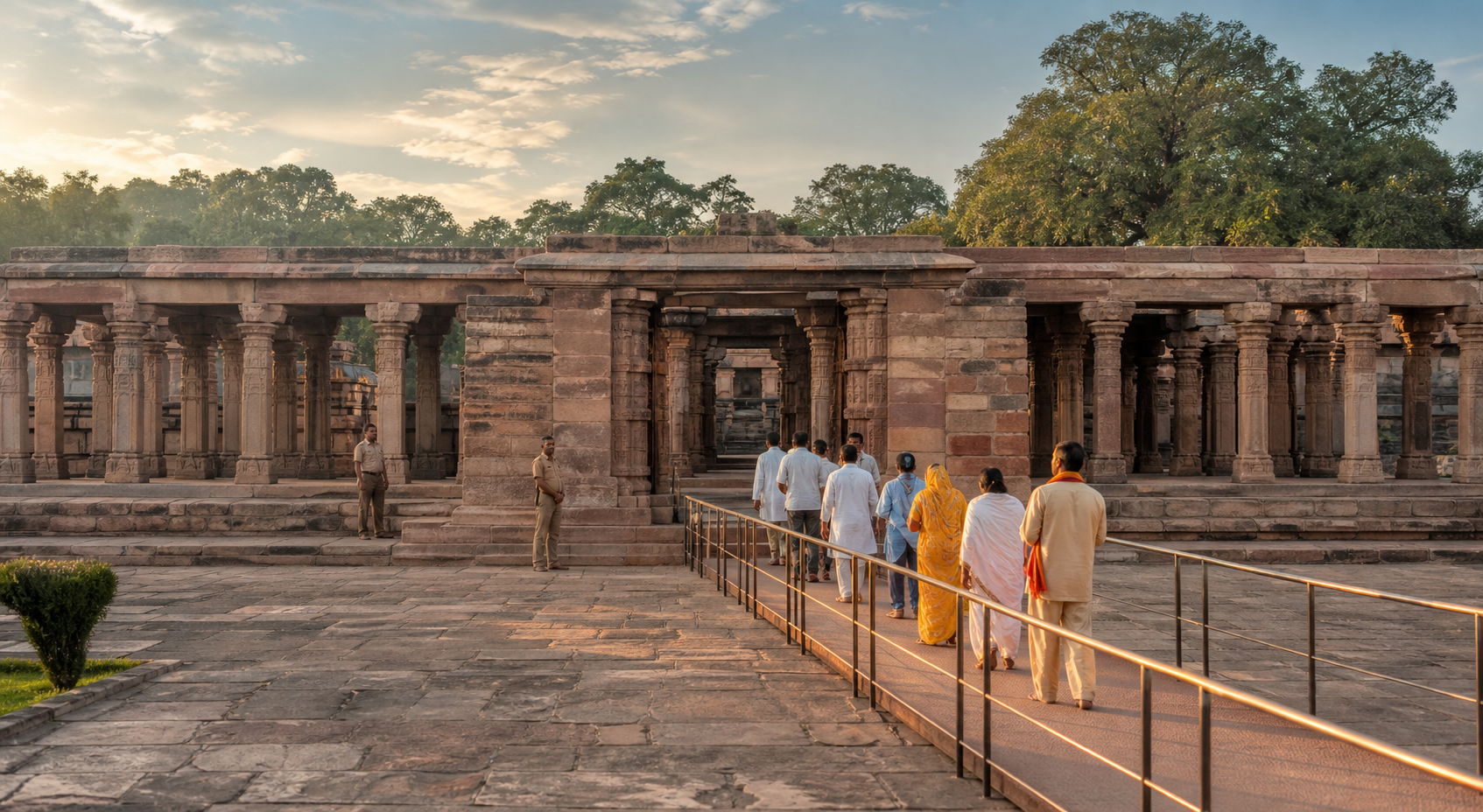
If you are asking whether the 2026 ruling means Hindus can now treat Bhojshala like an unrestricted temple, the short answer is more precise: the Madhya Pradesh High Court affirmed its primary religious character as a Saraswati temple, while worship remains subject to monument protection, crowd management and public-order controls.
That distinction matters. You can defend Bhojshala’s Hindu identity without pretending that heritage law has disappeared. In practice, the temple’s future will depend on disciplined worship, precise legal claims and conservation strong enough to preserve the physical evidence on which its history rests.
Key takeaways: what changed and what did not
- The High Court held that Bhojshala’s primary religious character is that of a Hindu temple dedicated to Mata Saraswati.
- The State was directed to facilitate puja and darshan in a regulated manner. The direction is tied to monument-protection rules, crowd planning and law-and-order requirements.
- Temple recognition is not permission to repair, paint, install, clean, drill into or otherwise alter protected fabric without the required authorization.
- The complex contains later Kamal Maula dargah or mosque components as well as material associated with the Paramara period. Recognizing those later physical layers does not negate the finding about Bhojshala’s primary religious character.
- For any practical question about entry, offerings, ceremonies or events, rely on the operative court directions and the latest written notice from the district administration or ASI, not on a headline or social-media summary.
The ruling answers identity, not every operational question
Public debate often compresses several different legal questions into one: What is the site’s religious character? Who protects the monument? When may people enter? Which rituals are permitted? Who can authorize physical work? A judgment on one question should not be stretched into an answer to all the others.
Religious character
The central change is the judicial recognition of Bhojshala as a Saraswati temple in its primary religious character. The High Court reached that conclusion through an evidentiary record that included ASI material, gazette notifications, expert affidavits and archival records. This gives devotees and cultural advocates a legal proposition they can state clearly, rather than relying only on inherited memory or political assertion.
Precision protects that gain. Say that the Court affirmed the primary religious character described above. Do not automatically convert that formulation into claims about title, management, every portion of the complex or an unlimited right to conduct any chosen ritual. To determine whether one of those separate questions was decided, read the relevant reasoning and operative directions in the judgment itself.
Protected-monument law
Bhojshala remains governed by the Ancient Monuments and Archaeological Sites and Remains Act, 1958 and the applicable 2010 Rules. Those controls matter whenever an activity could affect protected structures, archaeological material or regulated space. A devotional motive does not, by itself, remove the need for authorization.
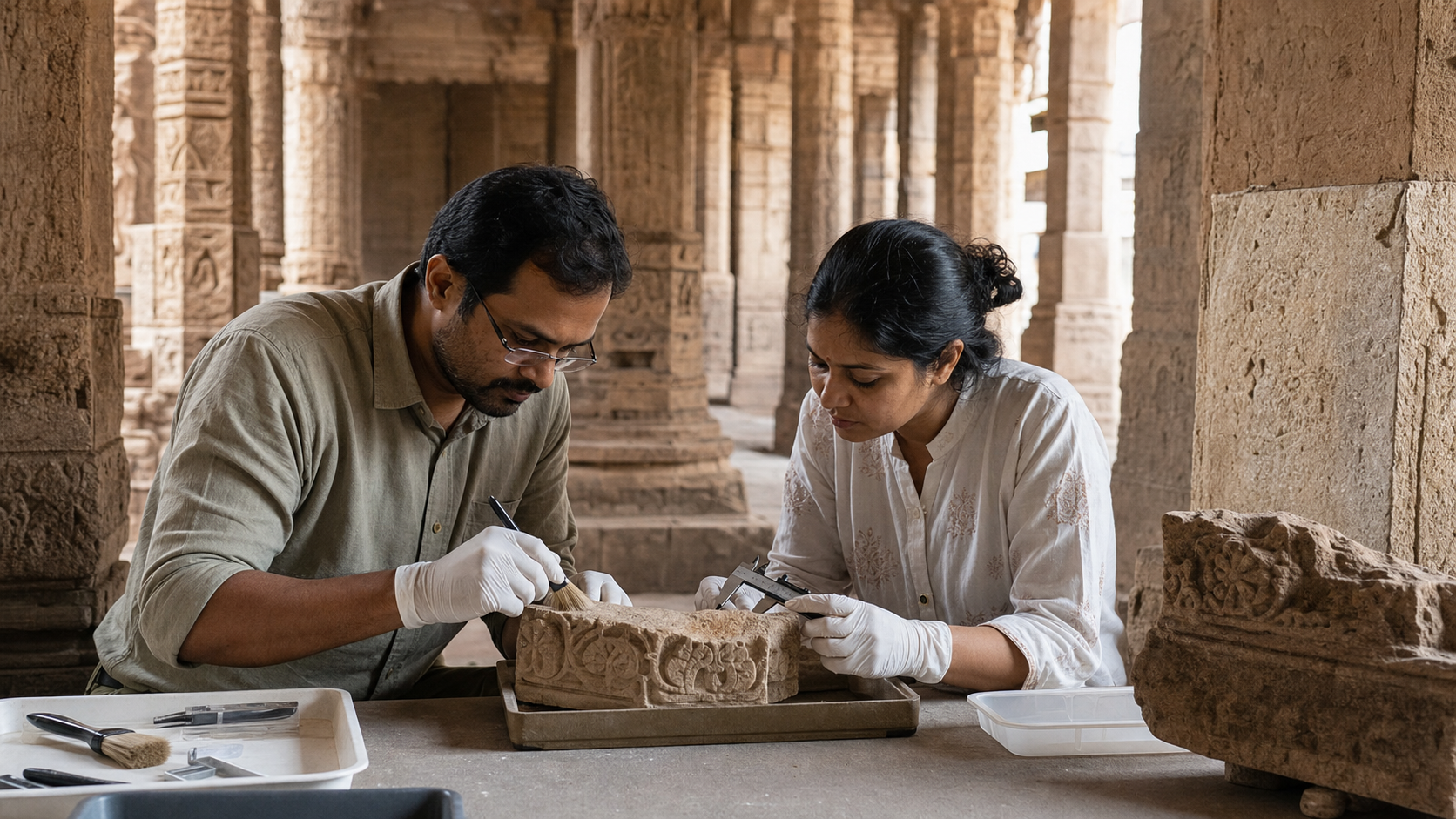
This is not a secondary concern imposed against worship. The columns, carvings, mouldings, medallions and inscriptions are part of the evidence through which Bhojshala’s history can be studied and defended. An unauthorized intervention can damage both the monument and the historical case. If you believe a repair, installation or cleaning intervention is necessary, submit a written request and wait for written approval rather than attempting the work informally.
Access and public order
The Court’s direction to facilitate worship is expressly regulated. On the first day after the verdict, hundreds of devotees worshipped under controlled entry, security and protected-zone arrangements. That experience shows that meaningful darshan and firm site management can operate together.
It does not establish a permanent schedule or an unchanging list of permitted objects. Before travelling, check the latest official instructions for the day of your visit. Confirm the entry window, route, security requirements and permitted puja materials. Flowers, akshata and notebooks were carried during the first post-verdict worship, but you should not assume that an item allowed on one occasion will automatically be permitted at every later event.
The Places of Worship (Special Provisions) Act, 1991 also forms part of the dispute’s legal framework. Its interpretive reach cannot safely be reduced to a slogan for either side. If you are preparing litigation, advising an organization or challenging an administrative restriction, obtain the judgment and current orders and have a qualified local advocate assess the exact issue. Acting on a generalized interpretation can create avoidable legal exposure.
The strongest Hindu case follows the evidence carefully
Bhojshala is associated with the 11th-century Paramara ruler Bhoja, whose reign is remembered for the patronage of Sanskrit learning. Local memory, textual references and epigraphic material connect the precinct with Vagdevi, or Saraswati, and help explain the name Bhojshala.
The physical case is more specific than the broad phrase “temple remains.” Temple-style column fragments, sculptural mouldings, lotus medallions and Sanskrit inscriptions have been identified within the complex. Epigraphic paleography and stylistic analysis place many elements in the Paramara horizon, while later insertions show reuse during subsequent political periods.
This layered fabric calls for accuracy, not hesitation. You do not have to claim that every stone belongs to one century, that every surviving feature served one function or that later additions never occurred. Those overstatements are vulnerable because the site itself preserves more than one historical phase. The firmer argument distinguishes the site’s primary religious character from its later architectural adaptations.
If you write, speak or submit a representation about Bhojshala, build each claim through four steps:
- State the proposition narrowly. Specify whether you are discussing religious character, architectural chronology, present access or conservation.
- Name the evidence that fits it. Use inscriptions and dated architectural features for historical claims, the judgment for legal claims, and current official notices for entry conditions.
- Preserve the level of certainty. Distinguish an identified feature from an interpretation, and a primary character finding from a claim about every part of the site.
- Ask for a defined action. Request a published schedule, a conservation survey, a festival-day plan or a written clarification instead of making a vague demand for “restoration.”
This discipline also prevents a common mistake in heritage advocacy: physically “improving” a place before its evidence has been completely recorded. A carved surface, masonry joint or reused fragment may contain information that disappears after aggressive cleaning, repainting or repositioning. Documentation must come before intervention, and any necessary stabilization should be authorized, expert-led and reversible wherever possible.
Responsible worship protects both sanctity and stone
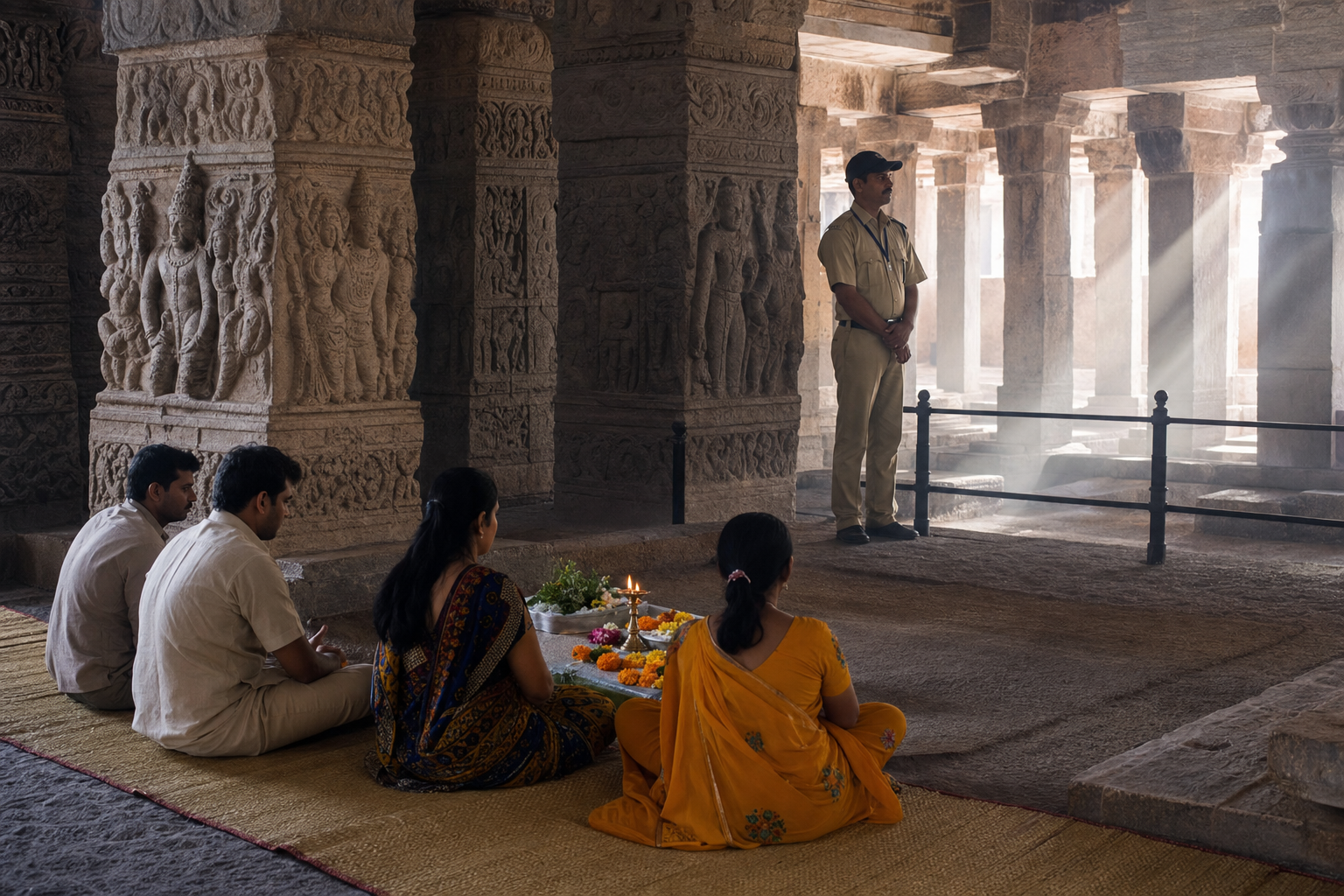
The first post-verdict worship offers a workable operational model. Families arrived with simple devotional items, Saraswati vandana was recited collectively, and aarti was performed. Volunteers separated entry and exit movement, assisted elderly visitors and kept people away from identified protected areas. Security included perimeter controls, screening, CCTV monitoring, response teams and medical support.
If you visit Bhojshala, responsible conduct is concrete:
- Read the current notice before leaving. A festival arrangement, ordinary worship day and court-directed special occasion may have different controls.
- Carry only expressly permitted items. Security staff at a protected religious site must consider both public safety and the effect of materials on historic surfaces.
- Stay on the marked route. Do not cross barriers to approach a carving, pillar or inscription, even for a closer darshan or photograph.
- Do not touch carved fabric. Repeated contact can wear vulnerable surfaces. Do not treat a protected architectural fragment as a place for an unauthorized physical offering.
- Keep the exit moving. Lingering at a narrow point increases pressure behind you and can push people toward fragile elements.
- Follow directions during a pause or closure. A temporary hold may be required for crowd density, security or conservation. Ask for clarification later through the grievance channel rather than arguing inside a compressed queue.
If you are helping organize access, plan for the people who predictably need more time. Use separate entry and exit flows, identify low-density zones near vulnerable pillars, establish assistance for elderly devotees, and place clear signs before visitors reach a restricted point. A medical station and an agreed emergency route should be part of the plan, not an improvised response after a crowd forms.
Large observances such as Vasant Panchami need a written standard operating procedure. A usable SOP should identify the responsible authority, entry capacity, queue layout, protected zones, emergency exits, medical support and the method for communicating a temporary change. A real-time coordination room can help officials respond to crowd density before it becomes dangerous.
Conservation equipment should never be installed casually. Measures such as protective walkway material, non-intrusive lighting or vibration monitoring may be useful, but their placement must be assessed by conservation professionals and approved by the responsible authority. A well-meant installation can trap moisture, conceal damage or place stress on old fabric if it is designed without examining the site.
Stewardship is now the practical test of the verdict
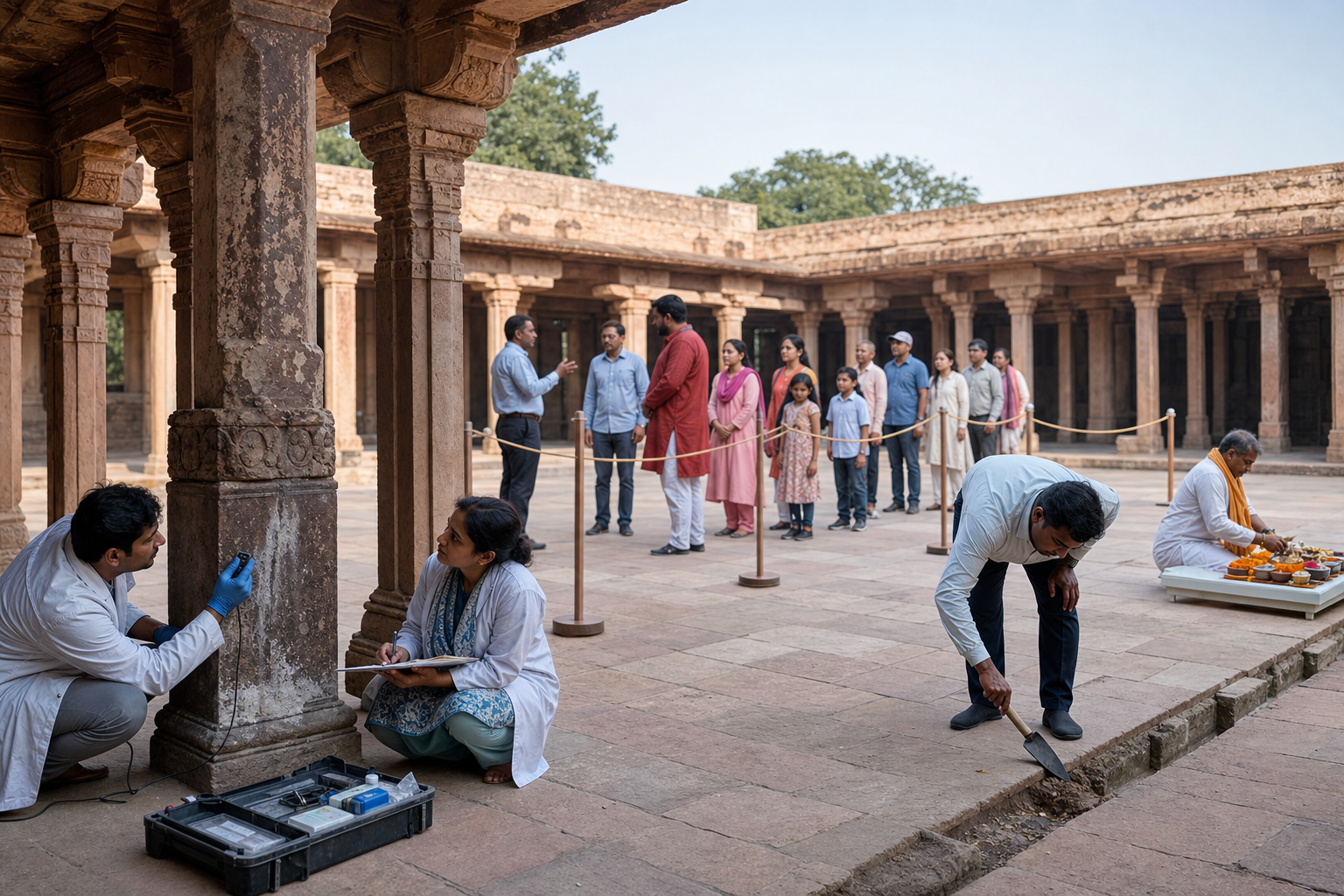
Recognition establishes a legal foundation. Stewardship determines whether Bhojshala can remain both a living Saraswati temple and a conserved monument. That work should begin with a complete digital baseline: high-resolution photogrammetry and 3D LiDAR scanning can record the geometry and condition of vulnerable elements before growing footfall produces further wear. Periodic comparison can then reveal movement or deterioration that casual inspection may miss.
Interpretation also needs to be candid. Hindi and English panels should explain the Paramara setting, Saraswati associations, inscriptions, architectural features, later additions and current conservation rules. Visitors should be able to distinguish what belongs to the original or early sacred horizon, what reflects later reuse and what has been stabilized in modern times. Local youth trained as certified heritage guides could turn that clarity into both education and livelihood.
Administrative transparency will reduce needless confrontation. Authorities should publish schedules, festival-day procedures, prohibited actions and the reasons for conservation restrictions in one accessible place. An on-site and online grievance process should allow devotees to report unclear queues, access problems, cleanliness concerns or accidental breaches of protected areas without turning every operational complaint into a dispute over the temple’s identity.
Community peace work remains essential because public order affects whether worship can proceed. Local engagement after the verdict included representatives from Hindu, Buddhist, Jain and Sikh communities and emphasized ahimsa, seva and mutual respect. For a Dharmic audience, those principles are not demands for silence about history. They are methods for pursuing truth without allowing provocation or indiscipline to injure devotees, neighbours or the temple itself.
If you intend to visit, begin with the latest written access instructions and follow the marked route. If you intend to advocate, cite the Court’s exact finding, connect each historical claim to identified evidence, and ask for measurable protections such as digital recording, a published SOP and professionally designed visitor controls. Above all, do nothing to the physical fabric without authorization. Bhojshala’s next chapter will be secured not by the loudest claim, but by worship and stewardship rigorous enough to preserve Mata Saraswati’s precinct for those who come after us.