
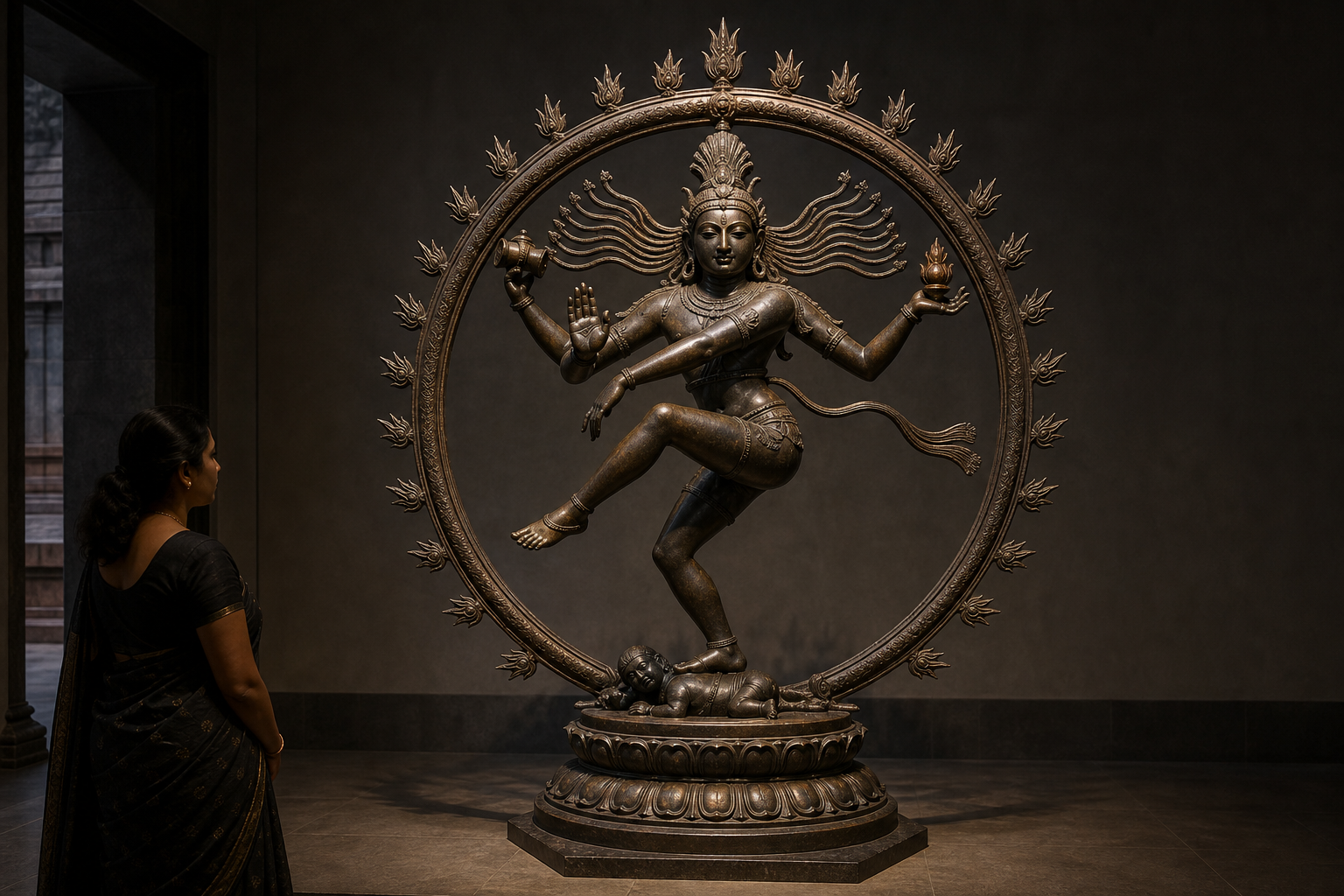
You stop before a Hindu bronze or stone image. The label supplies a deity, dynasty, and century, but the figure still feels unreadable. Why is one hand raised? Why does another hold a bowl? Does a seated posture mean meditation, sovereignty, fulfilled devotion, or something else?
You do not need to memorise an enormous catalogue of symbols. You need a disciplined order of attention. Begin with the image’s ritual setting, read the whole body before isolated attributes, and test every detail against the deity’s larger identity. That method lets you look closely without reducing a murti to decoration or treating iconography as a code in which every sign has only one answer.
First decide what kind of encounter the image creates
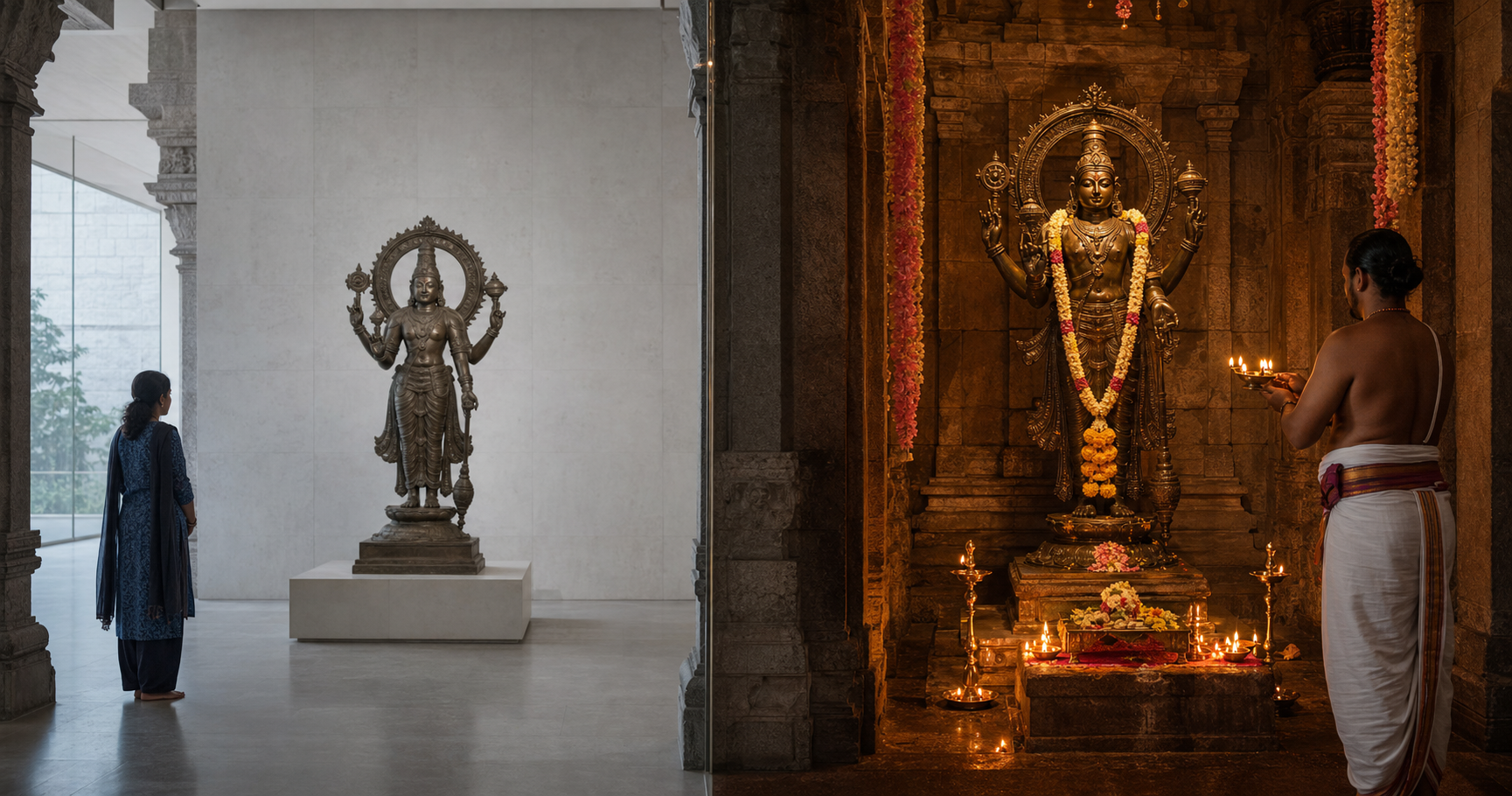
The same bronze can be discussed as sculpture, recognised through iconography, and approached through worship. Those are related encounters, but they are not interchangeable. A museum display usually privileges date, style, material, and condition. An active temple may place the image within darshan, recitation, offerings, adornment, procession, and a sacred calendar. An architectural relief has yet another task: it belongs to a larger visual programme and may be designed to be read while you move.
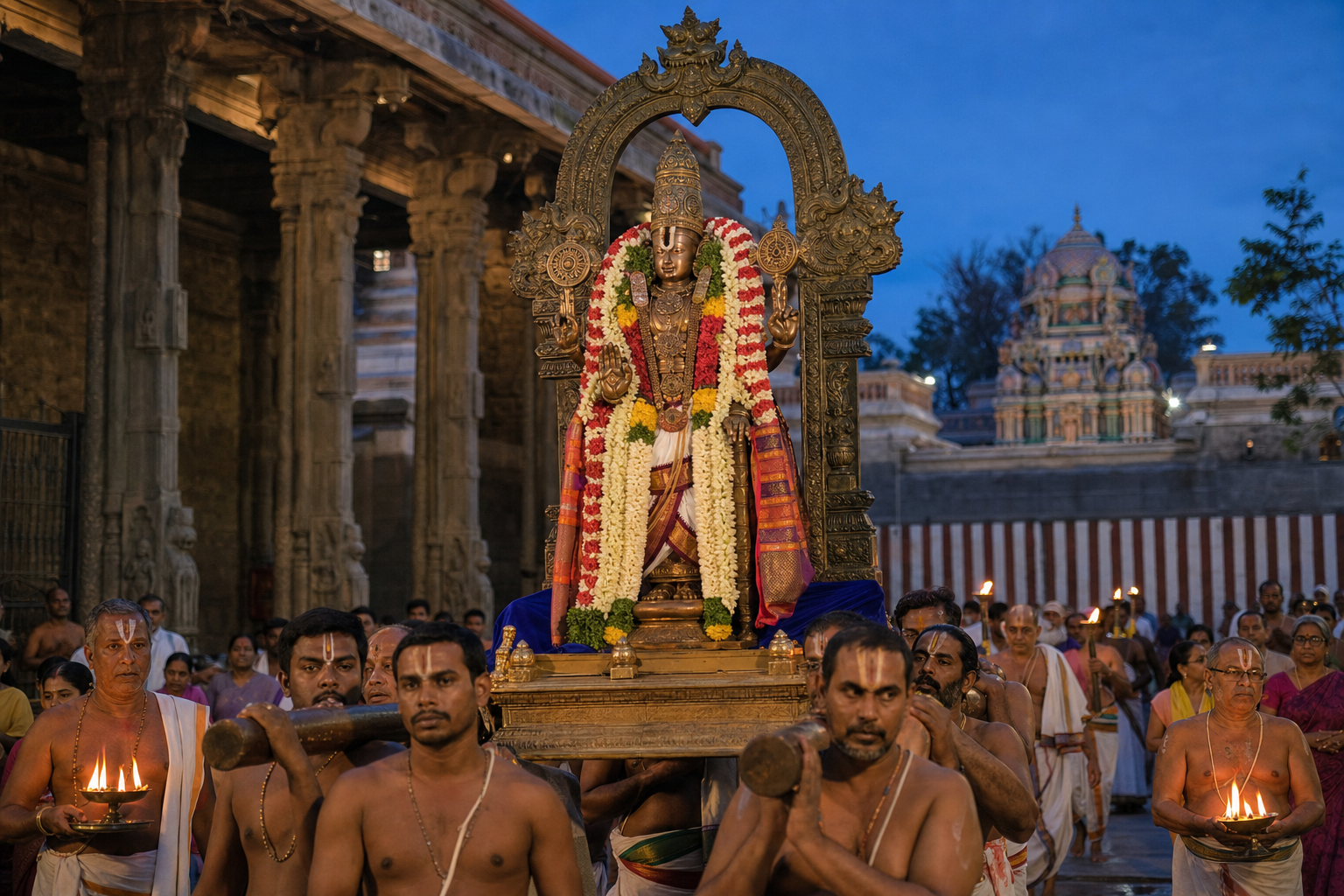
In a temple, ask four questions before trying to identify every object. Where is the image situated? Is it fixed or intended for ceremonial movement? What acts of worship occur around it? From what distance was it meant to be seen? A processional image can receive offerings, wear changing adornments, and enter the community’s festival life. Its meaning is enacted over time rather than exhausted by its bare metal form.
Architecture also directs attention. A movement from gopuram through mandapa toward the sanctum narrows the field of experience. Recitation, lamps, tulasi, camphor, and the density of the inner space prepare the devotee for darshan. If you encounter the same image in a museum, the missing architecture and ritual should become part of your questions. Do not pretend the display case reproduces a shrine, but do not ignore the image’s former or continuing liturgical purpose either.
Canonical form does not make every image identical. Agamic traditions, including Pancharatra and Vaikhanasa streams, and sculptural disciplines associated with texts such as the Manasara inform proportion, gesture, ornament, and attributes. Tala-based proportions and codified hand forms provide a visual grammar, not a mechanical stencil. Regional workshops, sectarian theology, a temple’s liturgical needs, and the intended function of an image all shape the final choice.
Your first practical rule is therefore simple: do not identify a deity or declare a meaning from one clue. Build the reading from several features that agree with one another.
Read the whole figure before decoding individual symbols
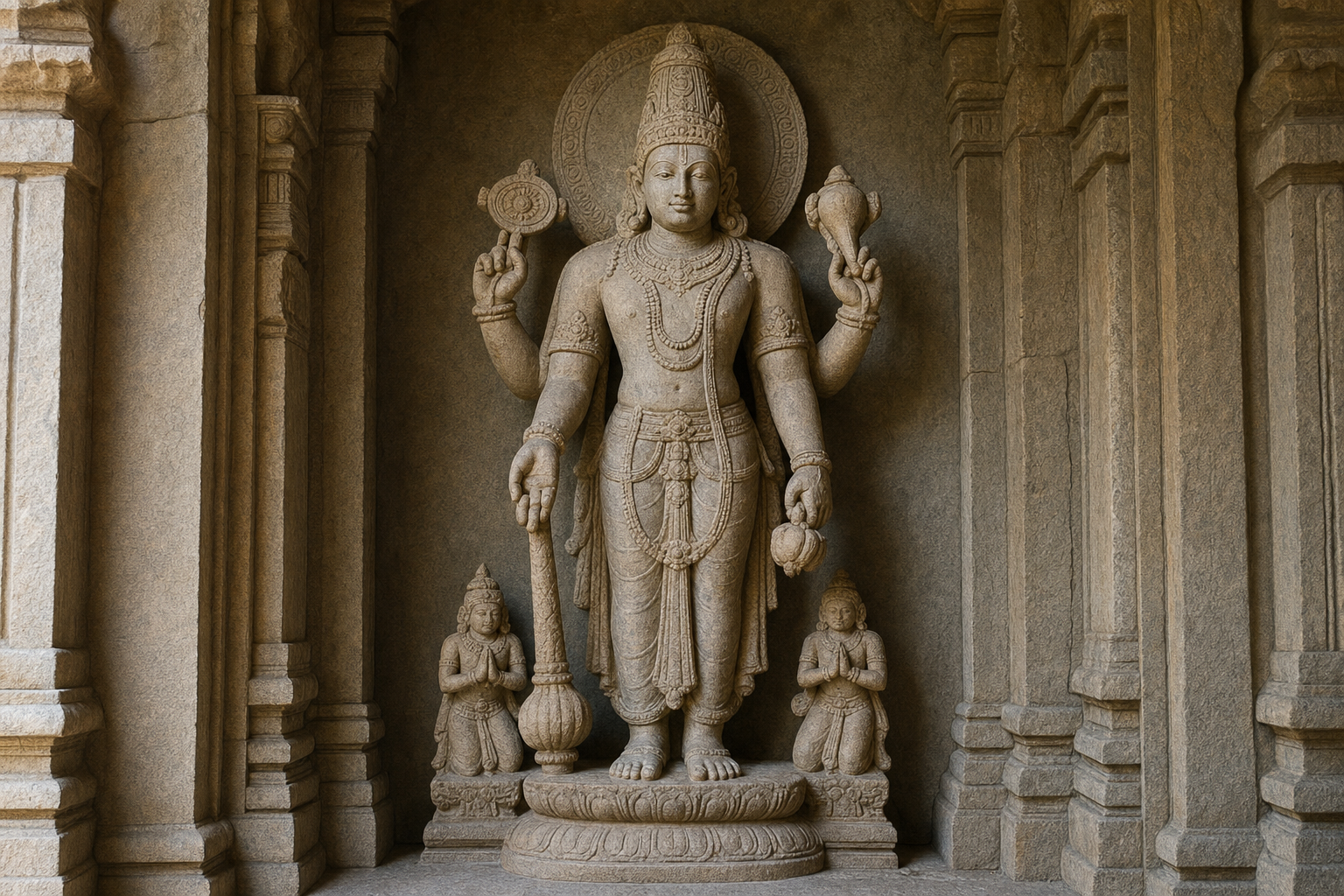
A reliable visual reading moves from large structure to small detail. Use the following order whether you are looking at a temple bronze, a stone image, or a clear photograph.
- Start with posture and bodily axis. Is the figure standing, seated, dancing, reclining, or moving? Is the body frontal and stable, gently curved, or dramatically extended? Posture establishes the image’s governing mood before an attribute refines it.
- Read the hands as actions. Notice which hands offer reassurance, grant a boon, hold an object, point, teach, or participate in movement. Abhaya and varada are not decorative hand positions; they establish a relationship between divine presence and devotee.
- Name held objects literally. Say “flower,” “bowl,” “weapon,” or “garland” before assigning a symbolic meaning. A premature interpretation makes it easy to force the image into a familiar story.
- Study hair, crown, dress, and jewellery. A distinctive coiffure or ornament may identify a figure more securely than a general posture. Ornament can also signal royal authority, asceticism, auspiciousness, or a specific local tradition.
- Examine the seat and pedestal. A throne, lotus, simple platform, or supporting figure changes the image’s status and visual emphasis. The support is part of the composition, not leftover space beneath it.
- Look for relationships. Companions, attendants, the direction of a gaze, a paired gesture, and nearby ritual objects often resolve an ambiguity that no isolated emblem can settle.
The distinction between an identifier and a modifier is especially useful. An identifier tells you who the figure is. A modifier tells you what aspect, state, or theological emphasis is being presented. Confusing the two causes many bad readings.
Andal at Thiru Anbil provides a precise example. Andal is commonly represented standing in Tamil Vaishnava art, yet the Thiru Anbil bronze presents her seated while retaining the distinctive Andal Kondai coiffure. The coiffure preserves identity. The throne and composed posture modify the customary presentation.
That seated form can be read as more than physical rest. It gives visual weight to inward poise, realised devotion, and the repose of prapatti, or loving surrender. The interpretation becomes persuasive because it agrees with Andal’s identity as the only woman among the twelve Alvars, the devotional movement of the Tiruppavai and Nachiyar Tirumozhi, and the image’s Sri Vaishnava setting. It is not persuasive merely because “seated always means contemplation.” No such universal shortcut is dependable.
Optional attributes require the same care. A flower can reinforce offering, while a parrot in some regional Andal images can evoke voice and song. Their absence does not automatically make another image incomplete. If the coiffure, posture, temple identity, gestures, and ritual use agree, one missing optional emblem should not overturn the reading.
Comparison across Dharmic traditions can deepen attention, provided you compare structures without collapsing theology. Seated images of Tara or Prajnaparamita in Buddhist art may concentrate compassion or wisdom; enthroned Ambika and Padmavati in Jain sculpture may convey guardianship and grace. A calm feminine posture can therefore resonate across traditions, but resemblance does not make the figures interchangeable. Sikh tradition requires an even clearer boundary: contemplation and remembrance of the Divine Name are central, while anthropomorphic icons are not worshipped as murtis. Notice the shared concern with inward steadiness, then preserve the distinctions each tradition makes.
Treat every attribute as part of a sentence, not a lone word
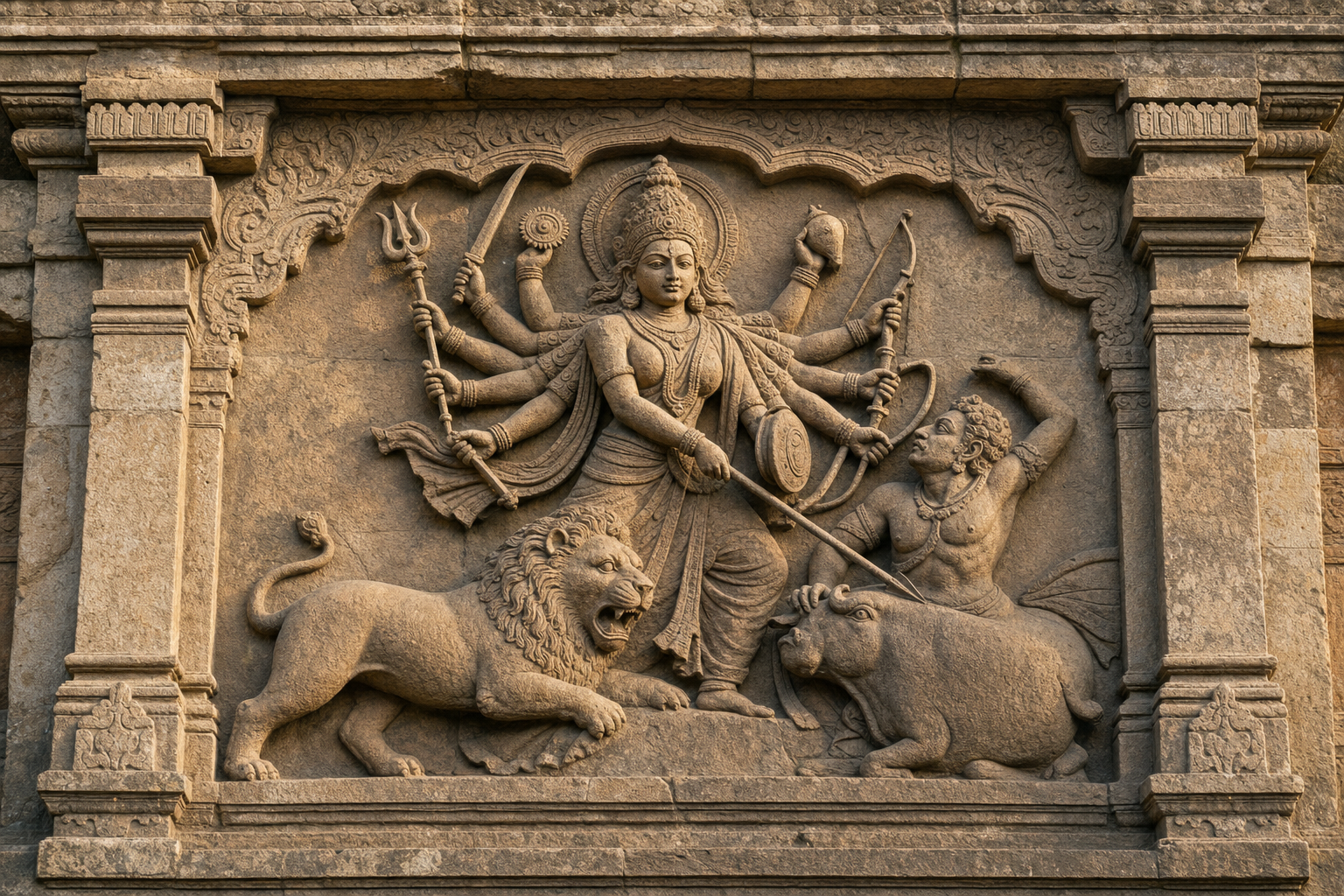
A held object does not carry meaning by itself. Its contour, contents, grip, accompanying gesture, deity, and ritual setting work together like words in a sentence. The pana patra shows why this matters.
Pana patra literally denotes a drinking vessel and should not be confused with the similarly named panchapatra, the puja vessel set used with an uddharini spoon for ritual sipping. In sculpture, a pana patra or related bowl can signify nourishment, distribution, wealth, mendicancy, transformation, or measured enjoyment. You can select among those possibilities only by reading the complete configuration.
- Annapurna with a bowl and ladle: the objects present food as something given. The pairing makes anna-dana, the dharmic gift of nourishment, more important than the vessel considered alone.
- Lakshmi with a bowl of coins or seeds: prosperity becomes tangible and distributable. If the other hand forms varada, the image joins abundance to bestowal rather than mere possession.
- Kubera with a vessel, money bag, or jewel-producing mongoose: the group of attributes identifies wealth, while the vessel can sharpen the emphasis toward rightful giving.
- Shiva as Bhikshatana with a skull-bowl: the kapala belongs to the divine mendicant. Lack, transgression, and dependence on alms displace the prosperous meaning that a bowl might carry beside Lakshmi.
- Bhairava or Chamunda with a skull-cup: the same basic vessel form enters fierce iconography, where death, impurity, and their transformation become central.
- Varuni or a courtly figure with a cup: context may point toward rasa and cultivated enjoyment under dharmic bounds. A small cup should not be labelled automatically as either a ritual vessel or a sign of excess.
Form narrows the possibilities further. Hemispherical or footed bowls suit images of grace and abundance. Lotus-petal decoration links a vessel with purity, fertility, and auspicious order. A shallow cup permits a delicate offering gesture. An elliptical skull-cup with an interrupted contour belongs to a different semantic register. Beaded rims, protective faces, makara forms, hamsas, and vegetal patterns can reinforce courtliness, protection, or life-energy.
Placement gives you another test. A bowl cradled in the left hand while the right grants protection or a boon often couples possession with distribution. A vessel beside the feet may instead function as an accessory of worship, suggesting an exchange of offering and grace. These are tendencies, not rules that override the rest of the figure.
When you meet an unfamiliar attribute, use a three-part sentence: “This is a [literal object], held or placed in [this manner], beside [these gestures or figures].” Only then add, “In this configuration, it most likely emphasises [meaning].” That small discipline keeps observation separate from inference and makes your conclusion easier to revise if another detail appears.
Let material, light, movement, and worship finish the reading
Iconography tells you what forms signify. Material and ritual tell you how those forms become present to a viewer or devotee. A thin metal bowl, a massive stone vessel, and a cup partly concealed by festival adornment do not communicate in the same way even when their basic outline is related.
South Indian bronzes made through the lost-wax method begin with detailed modelling in wax, followed by investment, casting, and finishing in metal. Panchaloha is traditionally a copper-dominant alloy with tin, lead, and smaller additions of other metals. The method can preserve subtle facial modelling, rhythmic bodily contours, jewellery, drapery, and a remarkably fine vessel rim. Under an oil lamp, highlights travel along those edges. Light does not merely reveal the sculpture; it activates the visual rhythm for which the surface was made.
Stone establishes another kind of presence. Granite or chlorite-schist gives a vessel weight, firmness, and architectural continuity. Bronze can make a cup seem suspended in the hand; stone can make the same category of object feel inseparable from the deity’s enduring mass. Notice this difference before using material simply as a clue to date or region.
Style can support dating, but it rarely proves a precise century by itself. The restrained sensuality, torso modelling, facial type, and jewellery of some South Indian bronzes may support placement in a late Chola to early Pandya continuum. The seated Andal at Thiru Anbil has been situated broadly in an eleventh- to twelfth-century range through such comparisons, yet a precise date would require epigraphic or metallurgical corroboration. If you lack that evidence, describe the stylistic affinity and preserve the uncertainty.
Ritual use adds changes that a bare catalogue photograph cannot show. Alankaram may foreground bridal, royal, seasonal, or sectarian meaning. Abhishekam, offerings, and processional handling place the image within reciprocal acts rather than passive observation. During Margazhi, for example, recitation of the Tiruppavai and Andal’s bridal adornment connect her visible form with sacred poetry, communal vow, and festival memory. The sculpture does not stop being art when worship begins. Its artistry is serving a larger liturgical life.
If you are permitted to spend time near an image, make two visual passes. First, remain at the distance from which worshippers ordinarily approach and register the complete silhouette, light, adornment, and surrounding sound. Second, examine the hands, attributes, coiffure, ornaments, and pedestal from the closest permitted position. Follow the temple’s rules for access, touching, and photography. Restricted access is part of the living institution’s authority over the image, not an inconvenience to be worked around.
When viewing in a museum, note what the display lets you see unusually well, such as casting seams, the back of a coiffure, or the exact grip around a vessel. Then write down what it cannot restore: consecrated space, changing adornment, recited text, lamp light, procession, offerings, and darshan. Holding both sets of information produces a fuller reading than either aesthetic admiration or ritual generalisation alone.
Key takeaways for your next temple or museum visit
- Establish context first: distinguish an active shrine image, processional murti, architectural sculpture, and museum display before assigning ritual meaning.
- Move from large to small: posture, bodily axis, and composition set the governing tone; hands and attributes refine it.
- Separate identifiers from modifiers: a coiffure may establish who the figure is, while a throne or unusual posture presents a particular aspect.
- Read attributes relationally: a bowl beside Annapurna, Lakshmi, Bhikshatana, or Chamunda does different work because deity, contents, gesture, and vessel form differ.
- Treat canon as grammar: proportion and gesture make an image legible, while regional and liturgical variation can remain meaningful within the sacred repertoire.
- Include ritual action: adornment, offering, recitation, lamp light, and procession are modes through which an image’s meaning is enacted.
- State uncertainty honestly: distinguish what you can see, what you infer, and what would require inscriptional, metallurgical, textual, or local liturgical evidence.
At the next image you encounter, delay naming it for thirty seconds. Record five things in order: setting, posture, hands, attributes, and ritual action. Then identify the figure and test whether every major clue supports your conclusion. You will see less as arbitrary decoration and more as a precise conversation among sculptor, tradition, temple, deity, and devotee.
References
- DharmaRenaissance Blog – Seated Andal at Thiru Anbil: Chola Bronze Mastery, Iconography, and Living Devotion
- DharmaRenaissance Blog – Pana Patra in Hindu Sculptures: A Powerful Symbol of Abundance, Compassion, and Divine Grace