Adhyantha Prabhu brings Ganesha and Hanuman into a single sacred body. Its importance lies not simply in combining two familiar deities, but in presenting discernment, devotion and sustained action as parts of one spiritual movement.
The supplied DharmaRenaissance article is the sole member source available for this synthesis. Its historical details are therefore reported claims rather than independently corroborated facts. The account itself makes an essential distinction: the Madhya Kailash shrine is modern, while its imagery draws meaning from much older deities, symbols and ritual patterns.
From a wise beginning to a faithful completion
The name is commonly interpreted through adi, or beginning, and anta, or end, with Prabhu understood as lord or master. On this reading, Adhyantha Prabhu is the Lord of the beginning and the end. The temple-based interpretation expands that formula into a vision of an entire undertaking: initiation, effort, accomplishment and closure belong to a continuous process.
Ganesha represents the intelligence required at the outset. He is associated with auspicious beginnings, discernment and the removal of obstacles. Hanuman represents the devotion and disciplined strength that carry a worthy intention through difficulty and toward completion. The pairing therefore resists two common imbalances: reflection that never becomes action, and energetic action undertaken without adequate judgment.
The source reports a local Madhya Kailash explanation in which prayer opens with Ganesha and reaches successful completion through Hanuman. It appropriately cautions that this is a meaningful temple tradition, not a mandatory sequence observed identically by every Hindu community.
A second local interpretation relates Ganesha to sound and Hanuman to breath. The account frames embodied life between the sound of a newborn child and the departure of breath at death. Hanuman’s association with Vayu, the deity of wind and vital movement, supports the breath symbolism. This is best understood as temple theology rather than a universal scriptural definition of the composite.
How the two halves create one ethical message
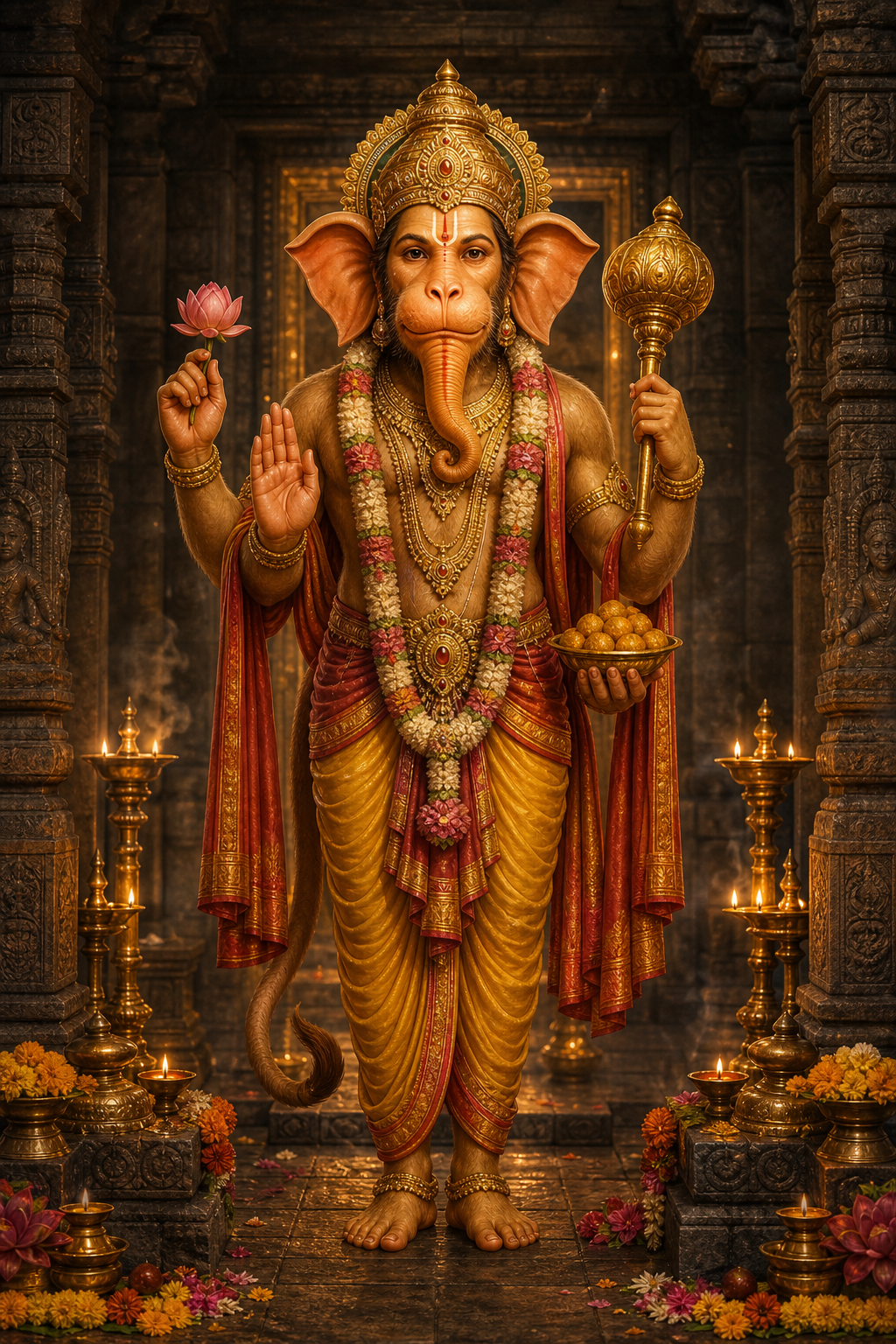
Ganesha’s elephant head supplies a visual language of intelligence, attentive listening, memory and adaptability. In the source’s interpretation, the broken tusk suggests sacrifice and the conversion of apparent loss into knowledge. The goad indicates direction and disciplined control, while the noose can signify restraint of harmful tendencies or the drawing of a person toward a worthy purpose.
These attributes give obstacle removal a more demanding meaning than the disappearance of every inconvenience. Some barriers must be overcome, some respected and others treated as evidence that a method or intention needs correction. Ganesha’s half consequently asks whether an undertaking has been understood before power is applied to it.
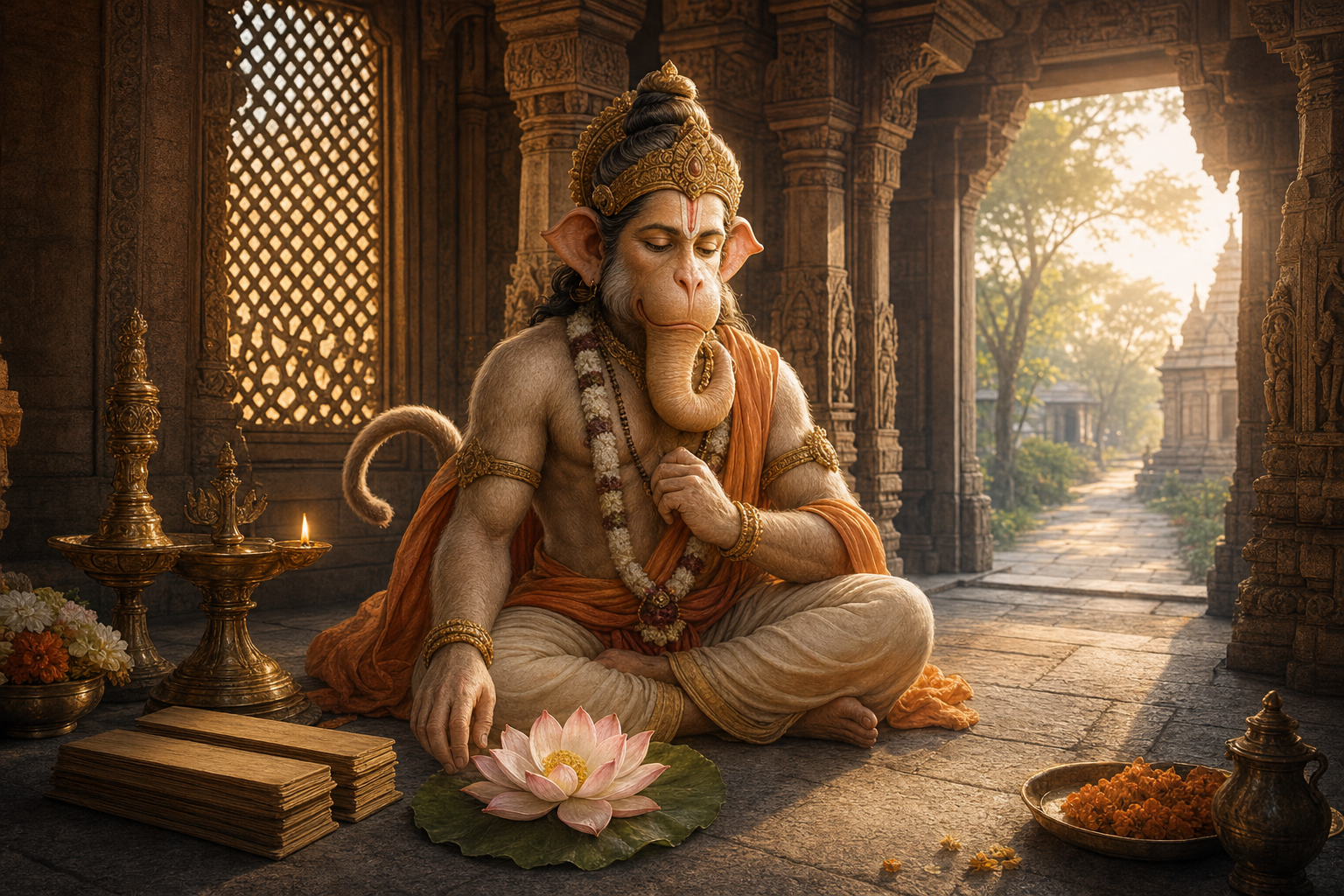
Hanuman’s half answers the question of what follows a sound decision. His identity in the Ramayana is shaped by service to Rama and Sita, and the article emphasizes that his extraordinary achievements are acts of seva, not displays of strength for its own sake. The mace represents power and readiness; the raised tail conveys energy and alertness; and anjali mudra expresses humility and devotion.
The composite thus places limits on both intelligence and strength. Discernment must accept the duty of action, while power must remain accountable to devotion, compassion and moral purpose. Ganesha and Hanuman are not merely assigned separate stages. Each corrects what the other’s symbolism could become if viewed in isolation.
The Madhya Kailash shrine and its reported chronology
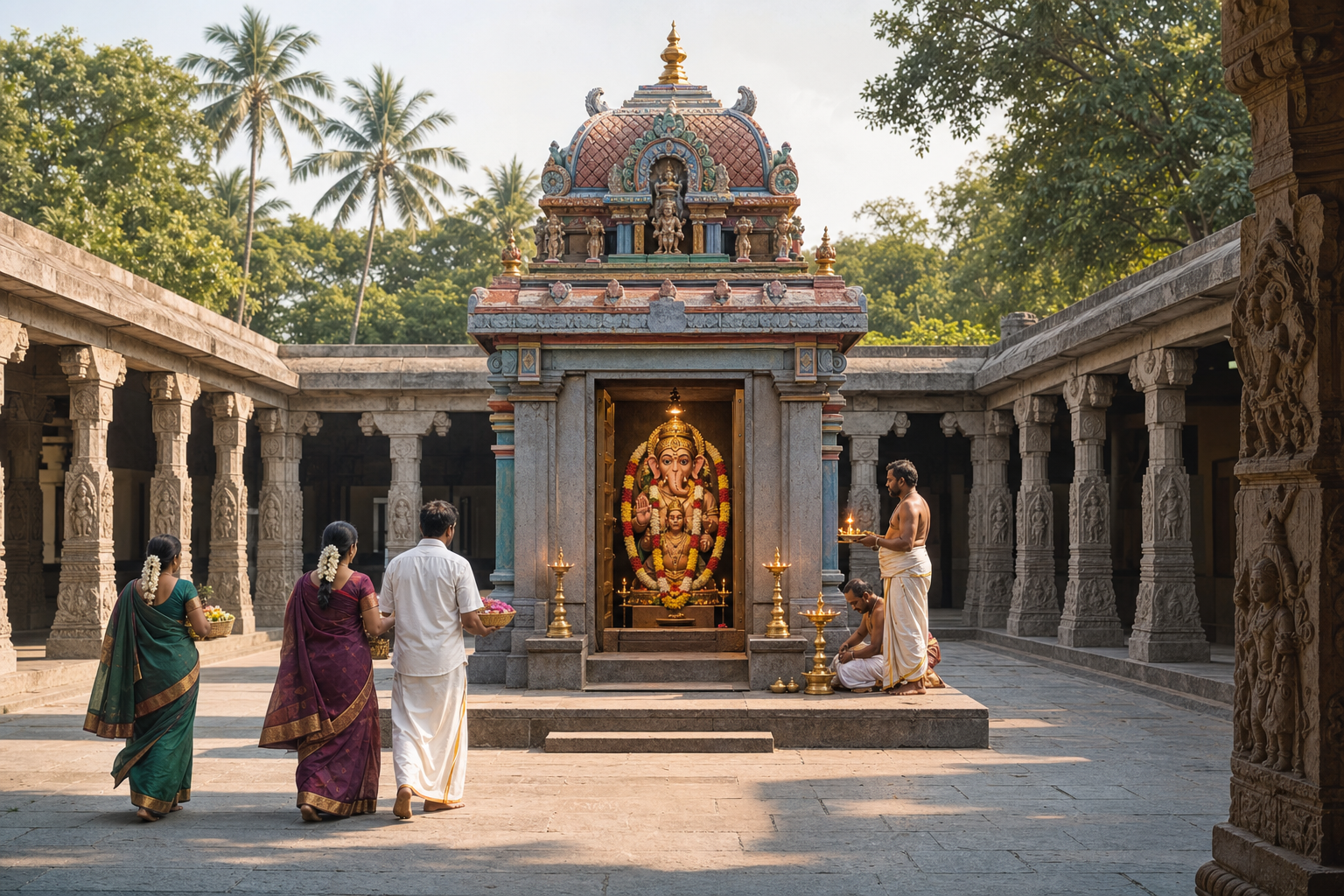
The source identifies Madhya Kailash as an urban temple in Adyar, Chennai, with Ananda Vinayaka as its presiding deity. Citing a temple-history account, it reports that the temple land was transferred in December 1977, an important consecration occurred in 1984 and the idea for Aadhyanta Prabhu arose after 1991. That account places the composite deity’s kumbhabhishekam in 1994.
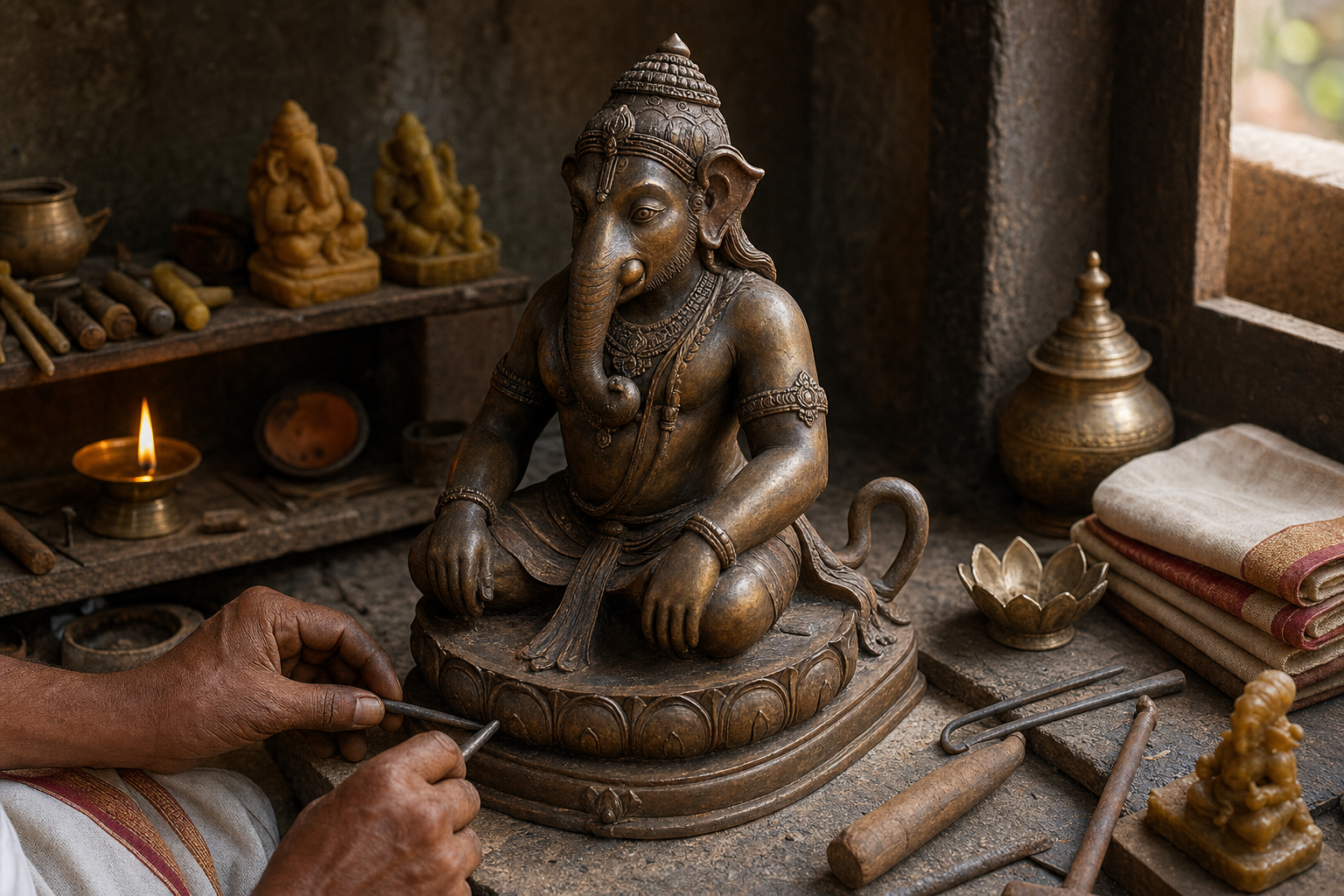
The reported origin narrative begins during worship, when devotees perceived Hanuman together with Ganesha as arati was offered before the temple’s Ganesha image. Organizers subsequently investigated whether this intuition could take material form. According to the article, they consulted scholars and collaborated with a sthapati, a specialist in sacred architecture and image design, before the murti received ritual consecration.
This sequence is significant for understanding temple tradition. The image did not emerge from private imagination alone: the account describes a movement from devotional experience through communal deliberation, learned consultation, skilled craftsmanship and consecration. Innovation entered temple life through recognizable religious and artistic processes.
The chronology is not completely settled within the material summarized by the source. Its temple-history account gives 1994 for the kumbhabhishekam, while a devotional account reportedly says that a five-metal image was created and enshrined in 1993. Manufacture, installation and formal consecration may have been separate stages, but the available material does not establish that explanation. The careful conclusion is that the Madhya Kailash form belongs to the early 1990s, with both reported dates preserved.
A modern murti using an inherited visual grammar
The historical distinction matters because online descriptions may present Adhyantha Prabhu as an ancient or directly scripturally prescribed form. According to the supplied article, accessible documentation does not support that claim. The deities and many of their symbolic associations are ancient, but the documented Madhya Kailash embodiment is modern.
Modern origin and religious authenticity are not opposites. The source places Adhyantha Prabhu within a wider Hindu visual language in which composite bodies can communicate relationships that prose might separate too sharply. The image employs inherited iconographic attributes and established processes of consultation, craftsmanship and consecration to articulate a new temple-specific synthesis.
The article draws on Joanne Punzo Waghorne’s study of modern urban temples to contextualize this creative process. As summarized there, urban temple communities do more than reproduce inherited architecture; they can develop new visual forms through which established theological principles address contemporary circumstances. It also invokes Philip Lutgendorf’s scholarship to situate Hanuman as a mediating figure with broad regional and sectarian appeal. These scholarly references support a contextual reading, although the supplied article remains the only source directly available here.
Several English spellings circulate, including Aadhyanta Prabhu, Aadyanta Prabhu, Adyantha Prabhu, Adhiyantha Prabhu and Aadhyantha Prabhu. The source treats these as transliteration variants generally referring to the same Ganesha-Hanuman composite, rather than evidence of separate deities or traditions.
Key takeaways
- Adhyantha Prabhu joins Ganesha’s discernment at the beginning of action with Hanuman’s devotion and perseverance through its completion.
- The image’s attributes form an ethical argument: intelligence should guide strength, and strength should remain accountable to service.
- Sound-and-breath symbolism and the opening-and-completion of prayer are reported Madhya Kailash interpretations, not universal rules for every Hindu tradition.
- The documented shrine belongs to the early 1990s; the supplied account reports 1993 for the image’s creation and enshrinement in one narrative and 1994 for its kumbhabhishekam in another.
- Its modern origin does not negate continuity: the murti applies inherited iconographic and ritual practices to a new composite expression.
Future study can sharpen this history by distinguishing the dates of design, manufacture, installation and consecration, while temple interpretation can continue exploring how wisdom and devoted action remain mutually dependent.