
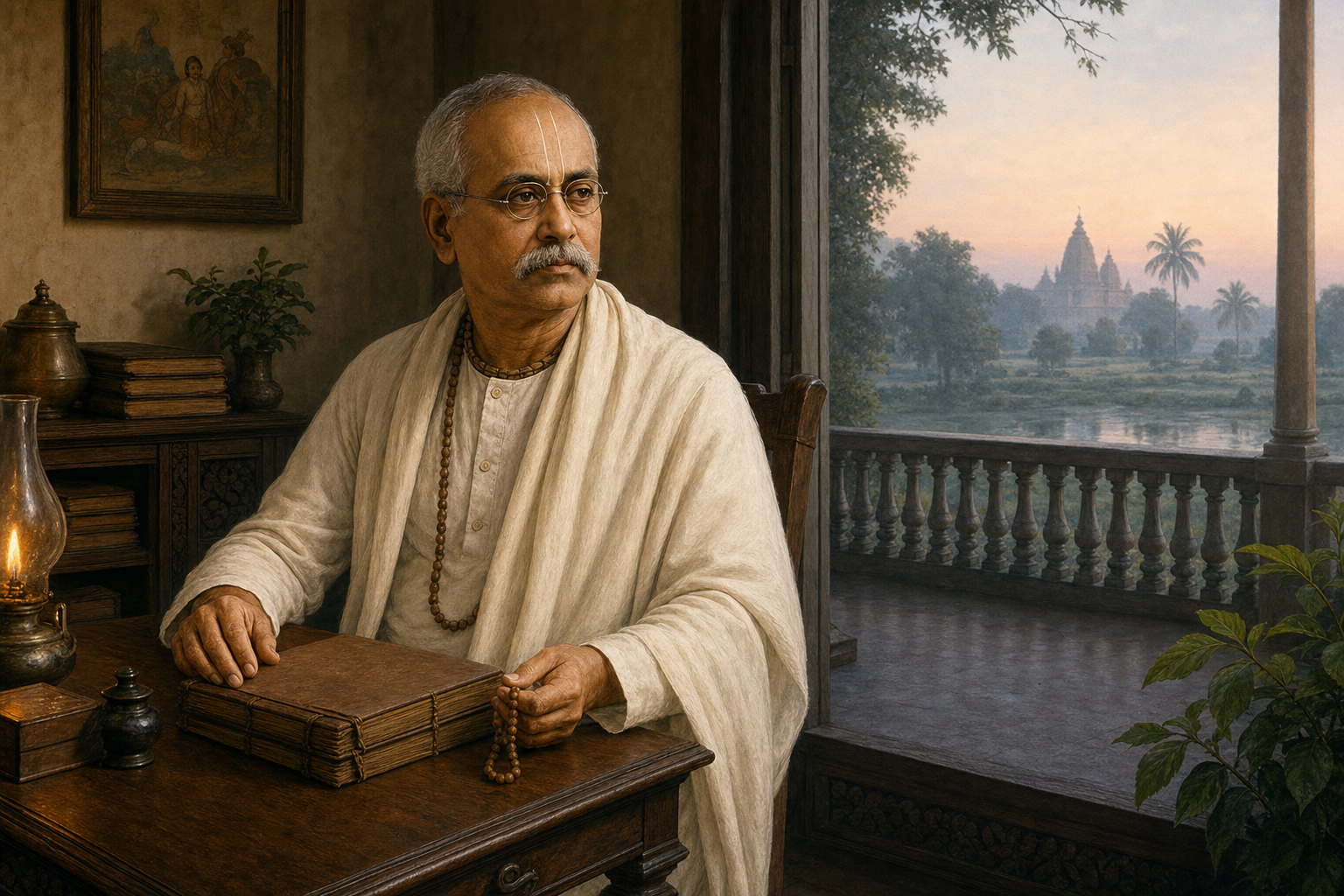
Srila Bhaktivinoda Thakura’s importance lies not in a single book, institution, or episode, but in the way he connected inner discipline with public communication. Taken together, the source articles portray a householder and official who helped make Gaudiya Vaishnavism intellectually articulate, socially organized, geographically rooted, and capable of reaching audiences far beyond nineteenth-century Bengal.
Each account supplies a different part of that picture. The biographical studies emphasize the pressures and achievements of his life; the study of his vows concentrates on spiritual formation; the remembrance lecture examines the architecture of a worldwide mission; and the archival article shows how handwritten pages preserve the human labor behind the published legacy.
Renewal at the meeting point of tradition and modernity
The four sources identify Srila Bhaktivinoda Thakura as Kedarnath or Kedaranatha Datta, born in 1838. Two biographical accounts place his visible life between 1838 and 1914 and describe him as a government official, family man, scholar, writer, organizer, and increasingly dedicated practitioner. This combination is central to understanding his historical role: his response to modernity did not require either discarding inherited religion or withdrawing from contemporary institutions. DharmaRenaissance Blog’s biographical survey and its remembrance based on a 1991 lecture both develop this interpretation.
The setting was colonial Bengal, where English education, missionary criticism, print culture, reform movements, and disputes over religious authority were changing how traditions represented themselves. The sources also describe internal problems within the Vaishnava world: fragmented institutions, inadequate education, and conduct presented as devotion without sufficient ethical or scriptural grounding. Bhaktivinoda’s answer was therefore revival rather than invention. He sought to recover authoritative teachings, explain them to contemporary readers, and distinguish disciplined bhakti from sentiment, exploitation, or spiritual claims unsupported by character.
That reforming purpose requires careful interpretation. The longer biography situates his polemics within particular intra-Vaishnava controversies and cautions against turning them into generalized hostility toward other Hindu or non-Hindu traditions. His enduring methodological contribution was the conjunction of fidelity and scrutiny: a tradition could preserve its theological center while examining how convincingly its institutions and representatives embodied it.
A public life reorganized around devotion
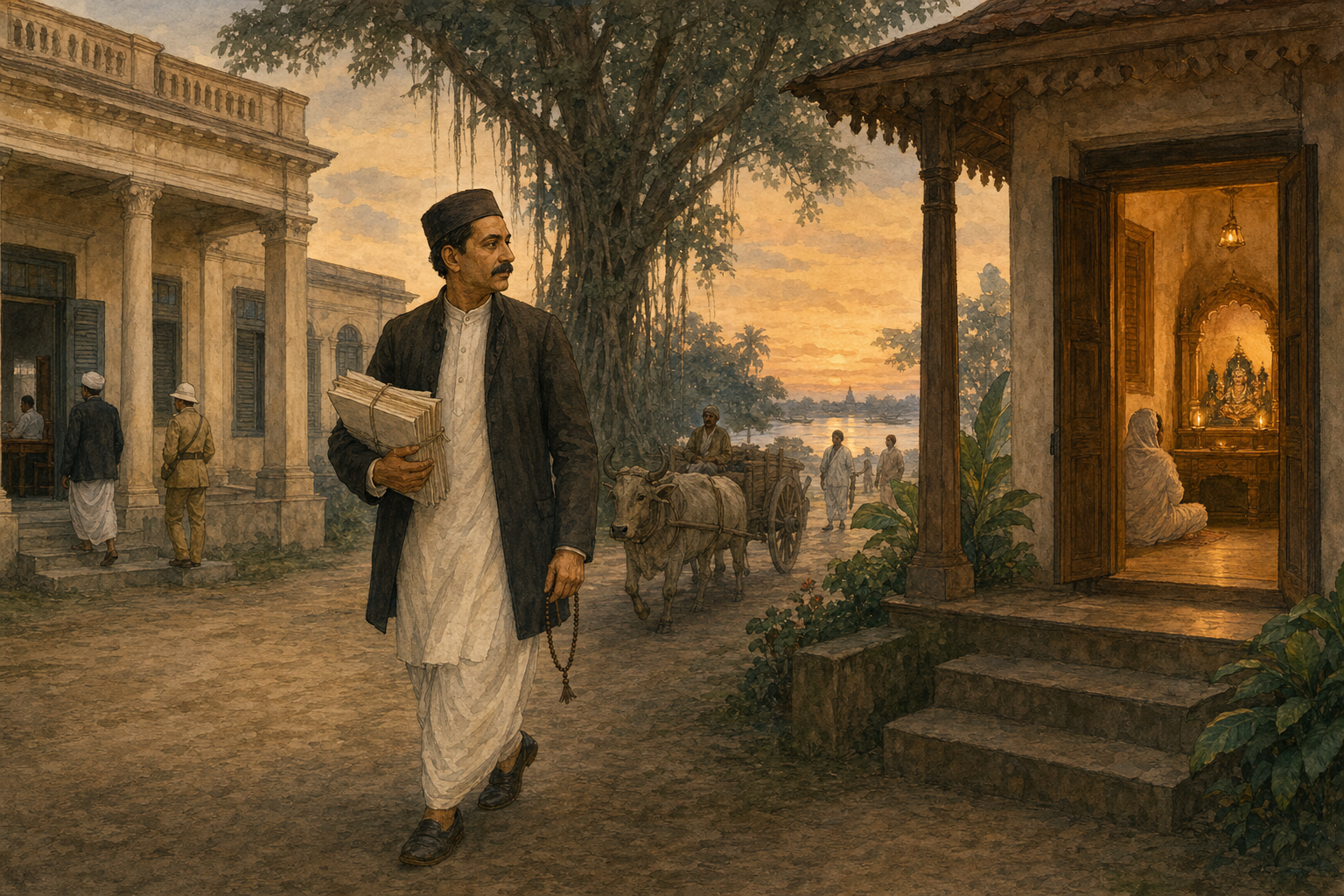
The biographical account reports that Kedaranatha experienced bereavement, the loss of family security, poverty, epidemic disease, administrative conflict, illness, and substantial household obligations. It also traces an unusually broad education shaped by Bengali culture, English-language study, comparative religious reading, public speaking, journalism, and early literary ambition. His work in Calcutta with an uncle involved in poetry and newspaper editing reportedly introduced him to libraries and print culture well before those tools became central to his religious mission.
This background helps explain the form of his later service. Editing taught the selection and ordering of material; administration required decisions under practical constraints; comparative study sharpened questions about authority and meaning; and family life made spiritual discipline answerable to recurring responsibilities. The sources do not portray these domains as accidental preliminaries to a supposedly more authentic religious life. They became capacities through which that religious life operated.
His example consequently differs from a simple narrative of renunciation. According to the biographical and remembrance articles, writing, worship, administration, teaching, pilgrimage, and family responsibility were integrated into one vocation. Yet the longer biography also gives an important caution: the severity of his personal schedule belonged to a particular life and historical setting. Its transferable lesson is disciplined attention and the ordering of responsibilities, not mechanical imitation of extraordinary austerity.
Bhakti as an ecology of relationship and discipline
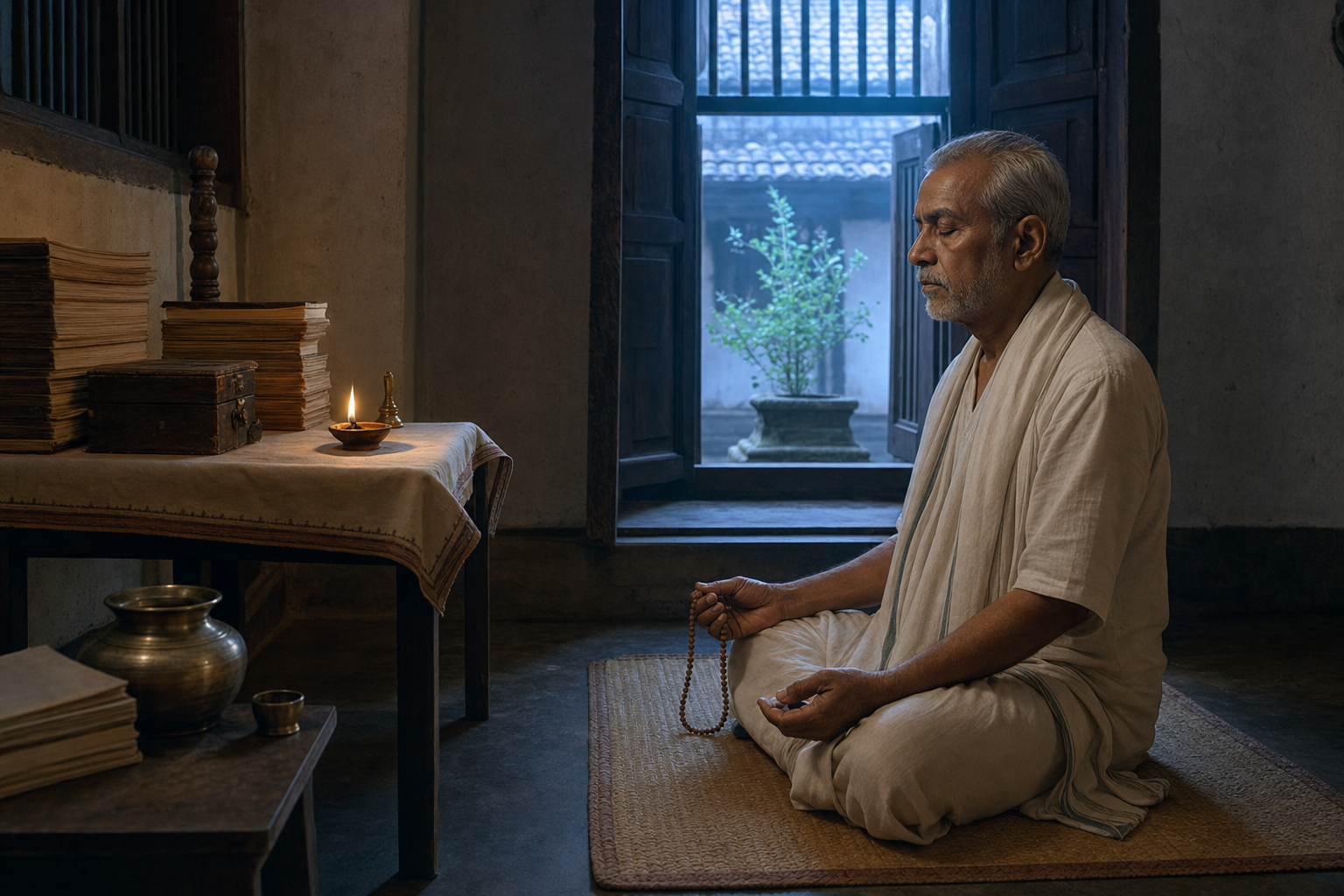
The article on Sri Sri Sva-niyama-dasakam approaches Bhaktivinoda through a composition traditionally presented as his final instructions. It describes twelve principal vows followed by a thirteenth verse declaring the fruit of faithful recitation. The source is appropriately cautious: the supplied text did not identify a manuscript, translator, printed edition, or source webpage, and its title appeared in variant forms. The claim that it was his final writing is therefore reported as a devotional attribution, not as an established chronological conclusion.
Even with that textual limitation, the vows clarify the spiritual center of the wider historical project. The first verse, as interpreted by the source, places the practitioner within an interdependent devotional environment consisting of the spiritual teacher, Sri Chaitanya, revealed teachings, sacred places, mantra, the holy name, sacred observances, scripture, and the community following Srila Rupa Goswami. Bhakti appears here not as a private feeling but as a way of life sustained by sound, text, place, time, guidance, and companionship.
The same study explains that renunciation, intellectual knowledge, and yogic discipline are evaluated according to whether they nourish loving service. This does not make learning, simplicity, or bodily discipline worthless; it denies them independence as ultimate goals. Rules acquire meaning by training attention for relationship, while service is presented as both the path and the desired fulfillment.
This theological structure illuminates Bhaktivinoda’s concern with conduct. A community cannot credibly teach divine love while treating ethical character as optional. Nor does spiritual formation depend upon determination alone: the hymn’s vocabulary gives a decisive role to divine grace and the mercy of Vaishnavas. Personal vows, communal support, and dependence upon grace thus function together rather than competing as alternative explanations of spiritual progress.
How texts, places, and networks became a mission
Key takeaways
- Recovery supplied continuity: the sources credit Bhaktivinoda with locating, publishing, and explaining neglected Gaudiya teachings rather than proposing a new religious system.
- Print expanded access: books, journals, editing, and printing enabled teachings to circulate beyond oral or locally restricted settings.
- Song joined doctrine with practice: devotional compositions carried theology into remembrance, worship, and congregational participation.
- Nama Hatta distributed responsibility: local gatherings gave householders and village communities active roles in chanting, study, guidance, and outreach.
- Mayapur anchored sacred memory: the effort to identify Sri Chaitanya’s birthplace connected historical investigation, pilgrimage, teaching, and institutional development.
- Succession extended the work: the biographical survey links his influence through his son Srila Bhaktisiddhanta Saraswati Thakura and subsequently Srila Prabhupada to the worldwide Krishna consciousness movement.
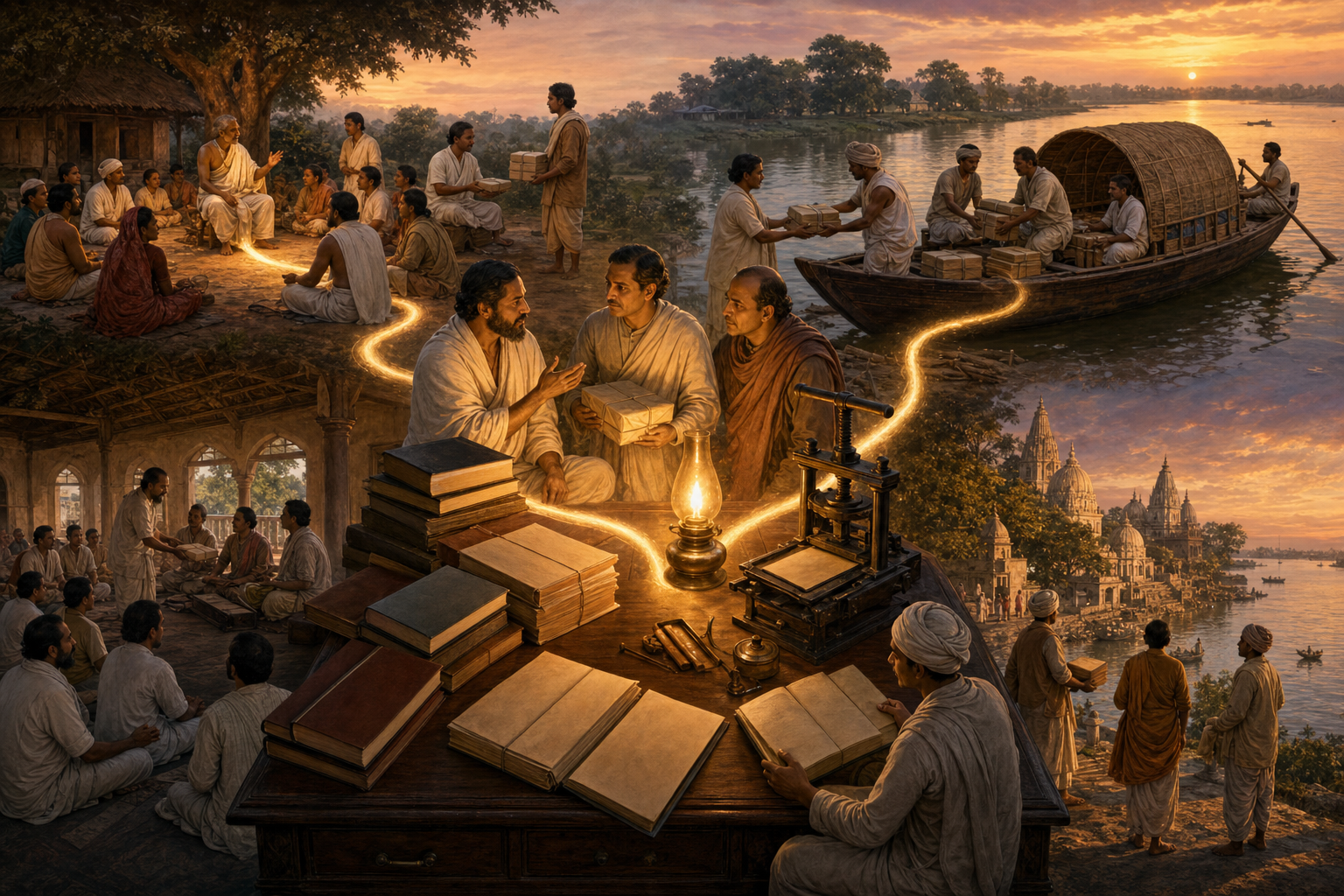
The significance of these contributions lies in their interaction. Publications could explain practices and establish shared reference points; songs could make teachings memorable and performable; local congregations could turn readers and listeners into participants; and sacred geography could give theological history a physical center. The remembrance article interprets Nama Hatta, the “marketplace of the holy name,” as a distributed congregational structure rather than a mission confined to scholars or monastics.
The same source reports that Bhaktivinoda examined geographical indications, older information, local testimony, and scriptural descriptions while identifying Mayapur as the place of Sri Chaitanya Mahaprabhu’s appearance. Gaudiya tradition further remembers the aged Jagannatha das Babaji responding with extraordinary joy and confirming the location. The source keeps the two forms of warrant distinct: geographical and documentary investigation addressed a historical question, while the saint’s response supplied devotional confirmation within the community.
Mayapur was therefore more than a recovered coordinate. In the theological understanding described by the source, a dhama is approached through remembrance, pilgrimage, worship, hearing, and service. Recovering the site made sacred history teachable through routes, gatherings, narratives, and institutions. Alongside publishing and Nama Hatta, it helped transform revival from an argument about the past into a reproducible pattern of communal life.
Manuscripts reveal how the legacy was actually made
The archival account adds a material dimension that institutional histories can obscure. It reports that the Bhaktivedanta Research Centre presented photographs of handwriting attributed to Bhaktivinoda, including a signature dated 16 February 1895, a letter of 22 October 1910 addressed to his son Lalita Prasada Thakura, and an original songbook described as containing 26 songs and poems. The identified pages include compositions that later lived through singing, memorization, printing, and communal worship.
The same article discusses the handwritten autobiography Svalikhita Jivani, reportedly composed in 1896 as a letter to Lalita Prasada, first printed posthumously in 1916, and checked against a scan of the manuscript when the Bengali text was republished in 2023. Those stages show that transmission is not automatic. A work moves through handwriting, custody, editing, typesetting, comparison, publication, and renewed interpretation. Corrections, insertions, line breaks, and variant readings can preserve decisions that a standardized edition conceals.
Attribution nevertheless depends on more than visual resemblance or a devotional caption. The archival study calls for catalogue records, provenance, custody history, comparison with securely dated writing, and attention to paper, ink, bindings, postal marks, and related documents. It also warns that compressed online images may be inadequate for technical conclusions. Devotional attachment can motivate preservation, but disciplined archival methods are needed to establish what an object can responsibly demonstrate.
This caution parallels the historical method advocated in the two biographical articles. Publications, appointments, correspondence, institutions, and geographical inquiries can be treated as historical claims subject to documentary assessment. Visions, providential interpretations, saintly recognition, and affirmations of an eternal sacred identity belong to the tradition’s theological testimony. Distinguishing these categories does not force one to erase either; it allows readers to understand what kind of claim is being made and why it matters to the community preserving it.
Bhaktivinoda’s legacy will remain most useful when preservation and practice continue to reinforce each other: manuscripts require careful custody, teachings require context, institutions require ethical character, and inherited forms require practitioners capable of making their purpose intelligible to another generation.

References
- DharmaRenaissance Blog — How Srila Bhaktivinoda Thakura Revived Gaudiya Vaishnavism for the Modern World
- DharmaRenaissance Blog — Rare Handwritten Treasures of Srila Bhaktivinoda Thakura Reveal a Living Legacy
- DharmaRenaissance Blog — Srila Bhaktivinoda Thakura’s Final Vows: 12 Timeless Principles of Bhakti
- DharmaRenaissance Blog — Remembering Srila Bhaktivinoda Thakura: The Vision That Carried Bhakti Worldwide