
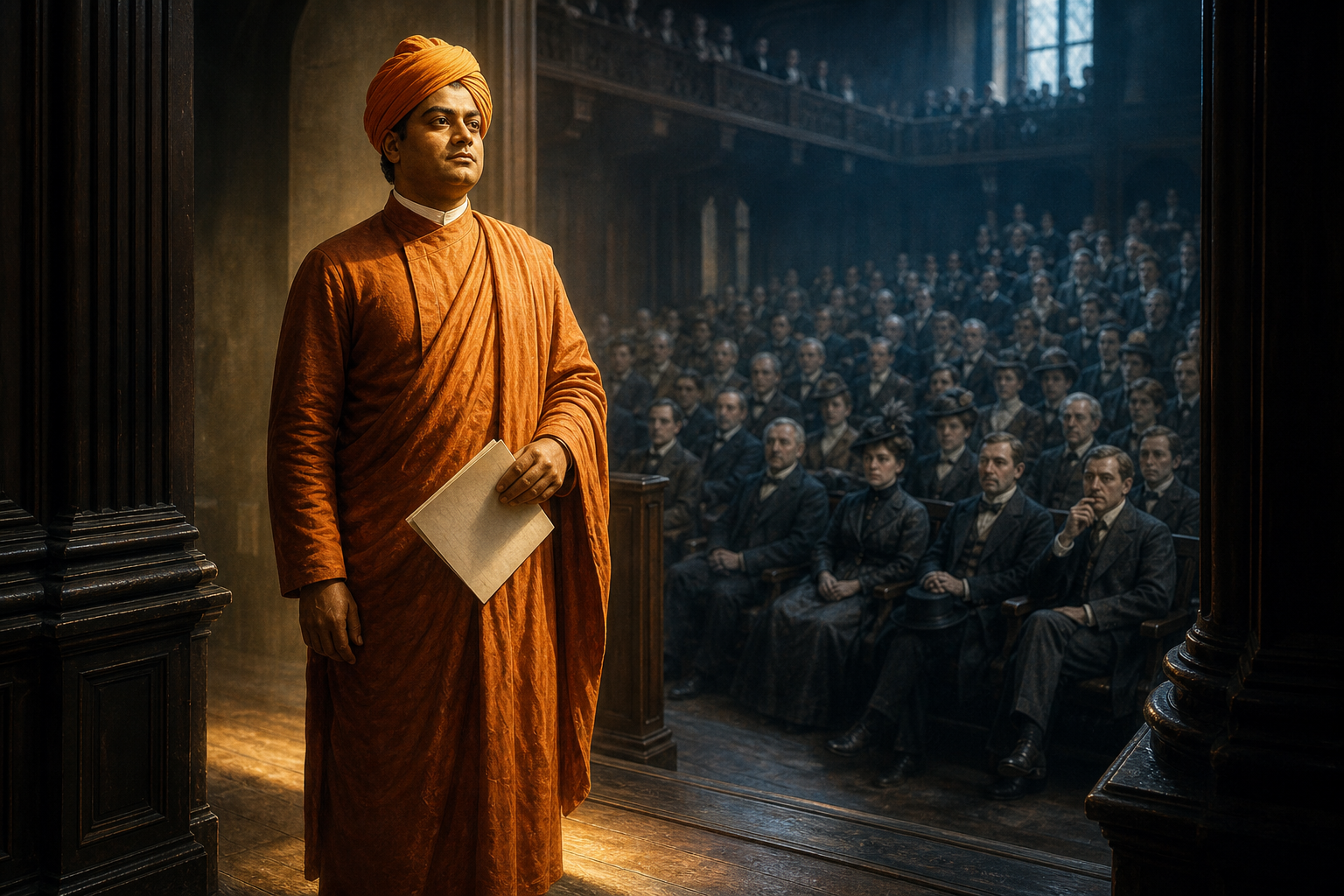
If you call Swami Vivekananda a warrior monk, the important question is not whether the title sounds inspiring. It is whether his conduct gives you a usable standard for defending Dharma when your tradition is misunderstood, patronized, or attacked.
His battlefield was public judgment. His weapons were civilizational confidence, disciplined speech, moral courage, and the refusal to let an opponent define Hindu Dharma before he had spoken. If you represent Dharma in a classroom, workplace, publication, or difficult conversation, that combination matters more than borrowed aggression.
The title names an ethic, not a costume
A monk turns first toward self-mastery. A warrior moves toward a challenge that cannot responsibly be ignored. Vivekananda joined the two roles: confrontation governed by restraint.
This distinction corrects a common mistake. Loudness is not courage, humiliation is not victory, and anger on behalf of Dharma is not automatically Dharmic. A person can win an exchange and still damage the cause by making resentment more memorable than truth.
Use three tests before calling any form of advocacy warrior-like:
- Purpose: Are you protecting truth and dignity, or trying to repair a wounded ego?
- Means: Are you using knowledge, reasoning, and self-command, or merely returning contempt?
- Result: Does the listener understand Dharma more clearly afterward, even if disagreement remains?
The last test is demanding. It shifts your attention from how forceful you felt to what your words actually accomplished. If people leave knowing only that you were angry, the defense failed at the point where a warrior monk would have exercised mastery.
Restraint does not mean timidity. You can name a falsehood plainly. You can reject a demeaning premise. You can expose a double standard. The discipline lies in attacking the error without making hatred of the person your method.
Chicago and Detroit reveal two forms of courage
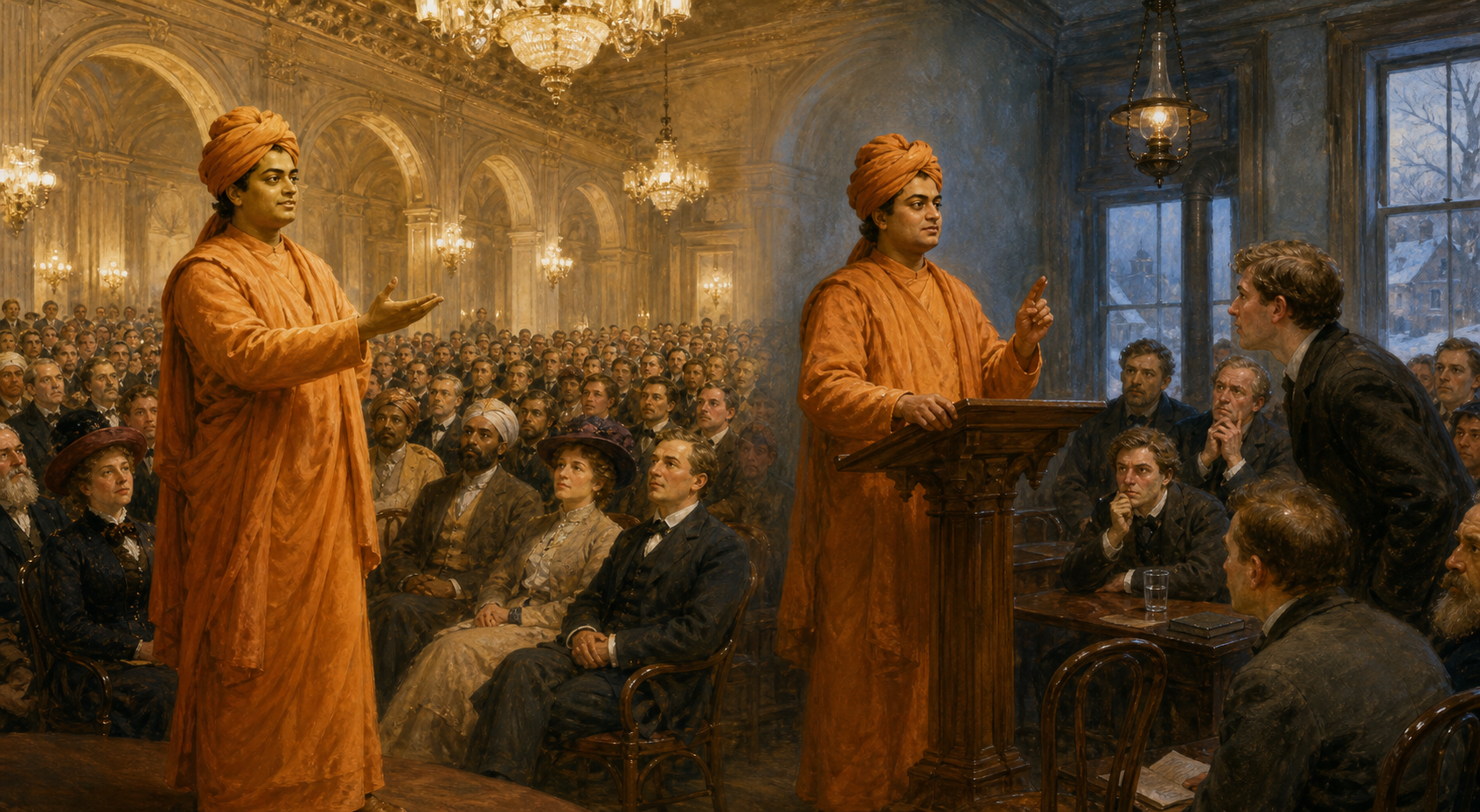
At the 1893 World’s Parliament of Religions, Vivekananda entered an environment in which Christianity was widely presumed superior and Hindu civilization was commonly approached through accusations of superstition and degrading ritual. His first achievement was therefore larger than delivering an impressive speech. He refused the assigned position of an embarrassed representative pleading for approval.
That refusal offers a practical lesson. When someone begins with a distorted definition of your tradition, answering inside that definition usually concedes too much. Before defending Hindu Dharma, inspect the frame of the question.
Suppose someone says, “Hinduism is only superstition.” An angry counterattack leaves the vague accusation intact. A disciplined response asks which doctrine, text, custom, or abuse is being discussed. It then distinguishes among those categories, states the relevant Dharmic principle positively, and applies the same evidentiary standard to every tradition in the conversation.
The sequence matters: define, distinguish, affirm, and only then rebut. It prevents you from spending an entire conversation denying another person’s caricature. It also makes evasion visible. A sweeping accusation often loses its apparent force when the speaker must identify a precise claim.
Detroit demanded a different kind of strength. There, Vivekananda faced concentrated opposition from Christian missionaries after the Parliament. He did not answer provocation in kind. He challenged Christians through the meaning and moral demands of Jesus rather than treating Christianity itself as an object of contempt.
This was not surrender. It was a sharper form of argument. If an opponent professes compassion, truthfulness, religious humility, or love of neighbor, you can ask whether the attack being made satisfies that professed standard. The question should be reciprocal, not theatrical: the same test must also be applied to your own conduct.
Notice what this method avoids. It does not reduce Dharma to a reaction against Christianity, nor does it require you to deny differences among religions. You can defend Hindu thought as true and valuable while recognizing a moral principle sincerely held by the person across from you. That keeps the encounter centered on truth rather than tribal hatred.
Civilizational pride becomes a duty of accuracy

Vivekananda carried pride in Bharat, its people, Hindu Dharma, and its civilization into settings where such confidence was not expected. In a letter to Alasinga Perumal dated 6 May 1895, he described that responsibility in unusually direct language:
“I am the one man who dared to defend his country and I have given them what they never expected from a Hindu.”
Swami Vivekananda, letter to Alasinga Perumal, 6 May 1895
The important word for your own conduct is “defend.” Defense requires more than emotional attachment. You must know what belongs to the tradition, what is a later social practice, what is a hostile misdescription, and what is a genuine failing that should not be hidden behind civilizational pride.
Apologetic shame and blind glorification are mirror errors. The first assumes that inherited criticism must be correct because it arrives in the language of modernity or Western authority. The second treats every criticism as an attack and every inherited practice as beyond examination. Neither position requires serious knowledge.
Before making a public defense of Bharat or Dharma, ask:
- Can I identify the exact claim I am defending, rather than speaking for an undefined civilizational whole?
- Do I know whether the claim concerns philosophy, scripture, ritual, history, or social conduct?
- Am I applying the same standard of evidence to Bharat and to the civilization being used as its comparator?
- Can I acknowledge a real wrong without accepting a false account of the entire tradition?
- What positive truth about Dharma should remain in the listener’s mind when the rebuttal is over?
That final question prevents reactive advocacy. A defense that only says what Hindu Dharma is not leaves your opponent’s agenda in control. State what it is: the principle, teaching, practice, or civilizational contribution you want the conversation to understand. Precision turns pride from a mood into a responsibility.
Use the warrior monk method in six steps

You do not need a public platform to practice Vivekananda’s discipline. Use the following method before your next difficult exchange, especially when a conversation concerns religion, Bharat, or civilizational history.
- Name the exact matter. Replace “They are attacking Hinduism” with one sentence identifying the disputed teaching, event, custom, or historical claim. If you cannot state the issue precisely, you are not ready to answer it.
- Find the hidden premise. Ask what must be assumed for the accusation to work. The premise may be that Western origin proves universality, that a civilization must be flawless to deserve respect, or that one social abuse defines an entire religious tradition. State the premise calmly.
- Recover the positive center. Write down the one Dharmic proposition you want the listener to remember. This keeps you from allowing rebuttal to consume the whole conversation.
- Make the necessary distinctions. Separate philosophy from custom, norm from violation, scripture from interpretation, and a civilization’s ideals from every act committed within it. Do not use distinctions to conceal wrongdoing; use them to prevent false generalization.
- Apply one standard to everyone. If a critic judges Hindu civilization by its worst conduct but another civilization by its highest ideals, identify the asymmetry. Then make sure you are not committing the reverse error.
- Control the ending. Once the claim, evidence, and principle are clear, stop. Endless replies often reward provocation and weaken a sound case. Your aim is not to secure a confession of defeat; it is to leave a truthful account on the record.
A useful preparation card has six lines: the claim, its hidden premise, the distinction required, your positive proposition, the fair question you will ask, and your exit sentence. Fill it out before a debate, interview, meeting, or online response. This small discipline prevents your first surge of anger from writing the argument for you.
For example, if someone claims that Hindu tradition has nothing to offer the modern world, do not reply with a catalogue of insults against the West. Ask what “modern” means in the claim and why value must have a Western origin. Request a specific Hindu teaching for examination. Then present the relevant Dharmic principle on its own terms. The exchange has moved from inherited hierarchy to a common standard of judgment.
You should also build an exit sentence in advance: “I have answered the specific claim and stated the standard I am using; I will leave the discussion there.” An exit is not a retreat when continued engagement would produce heat without clarity.
Key takeaways for defending Dharma
- Vivekananda’s warrior quality lay in courageous confrontation governed by monastic self-command.
- He refused to let a hostile or patronizing audience define Hindu Dharma before he presented it.
- Chicago illustrates the courage to reject an imposed civilizational inferiority; Detroit illustrates the discipline to face organized hostility without copying its methods.
- Civilizational pride is credible only when joined to knowledge, accuracy, consistent standards, and the ability to admit genuine wrongs.
- A strong defense leaves the listener with a positive truth about Dharma, not merely a record of your anger.
- The practical method is to define the claim, expose its premise, make exact distinctions, apply one standard, and end when clarity has been achieved.
Before your next difficult conversation, complete the six-line preparation card and read your response aloud. Remove every sentence whose only purpose is to wound. Keep the sentence that names the falsehood clearly, and keep the sentence that presents Dharma positively. That edit is a modest but real practice of the warrior monk’s discipline.
References
