
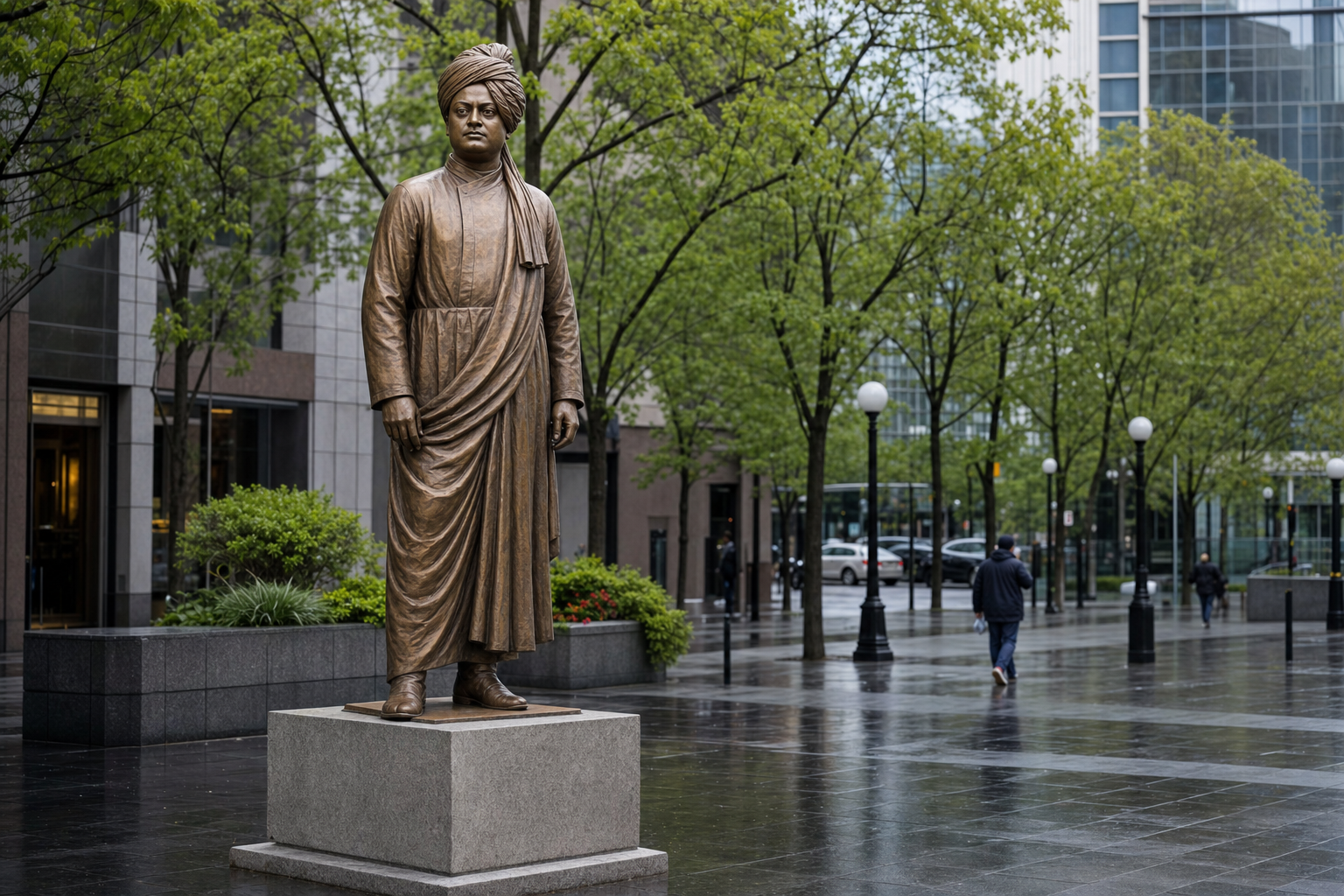
If you are trying to decide whether Seattle’s Swami Vivekananda statue is simply a proud diaspora symbol or something more consequential, look first at where it stands. The life-size bronze has been installed at Westlake Square in downtown Seattle, making Seattle the first U.S. city government to host a monument to Vivekananda.
That civic setting changes the meaning. Vivekananda is no longer encountered only in a temple, Vedanta centre, book, or commemorative gathering. He now meets commuters, shoppers, students, visitors, and people who may know nothing about him. If you visit, teach near it, or speak about it publicly, you can help turn that visibility into accurate learning, respectful dialogue, and seva.
Key takeaways
- This is the first monument to Swami Vivekananda hosted by a U.S. city government, not necessarily the first Vivekananda statue anywhere in the United States.
- The life-size bronze stands in Westlake Square, a prominent downtown public space within Seattle’s retail and transit corridor.
- The Indian Council for Cultural Relations gifted the monument, giving the installation a clear role in India-U.S. cultural diplomacy.
- Vivekananda should be presented as a Hindu monk and teacher of Vedanta whose ideas have wider interfaith relevance, not as a generic symbol detached from Hindu Dharma.
- The monument will matter most if families, schools, civic groups, and Dharmic organizations use it for education, dialogue, and service rather than treating the unveiling as the end of the work.
What Seattle has actually placed in public space
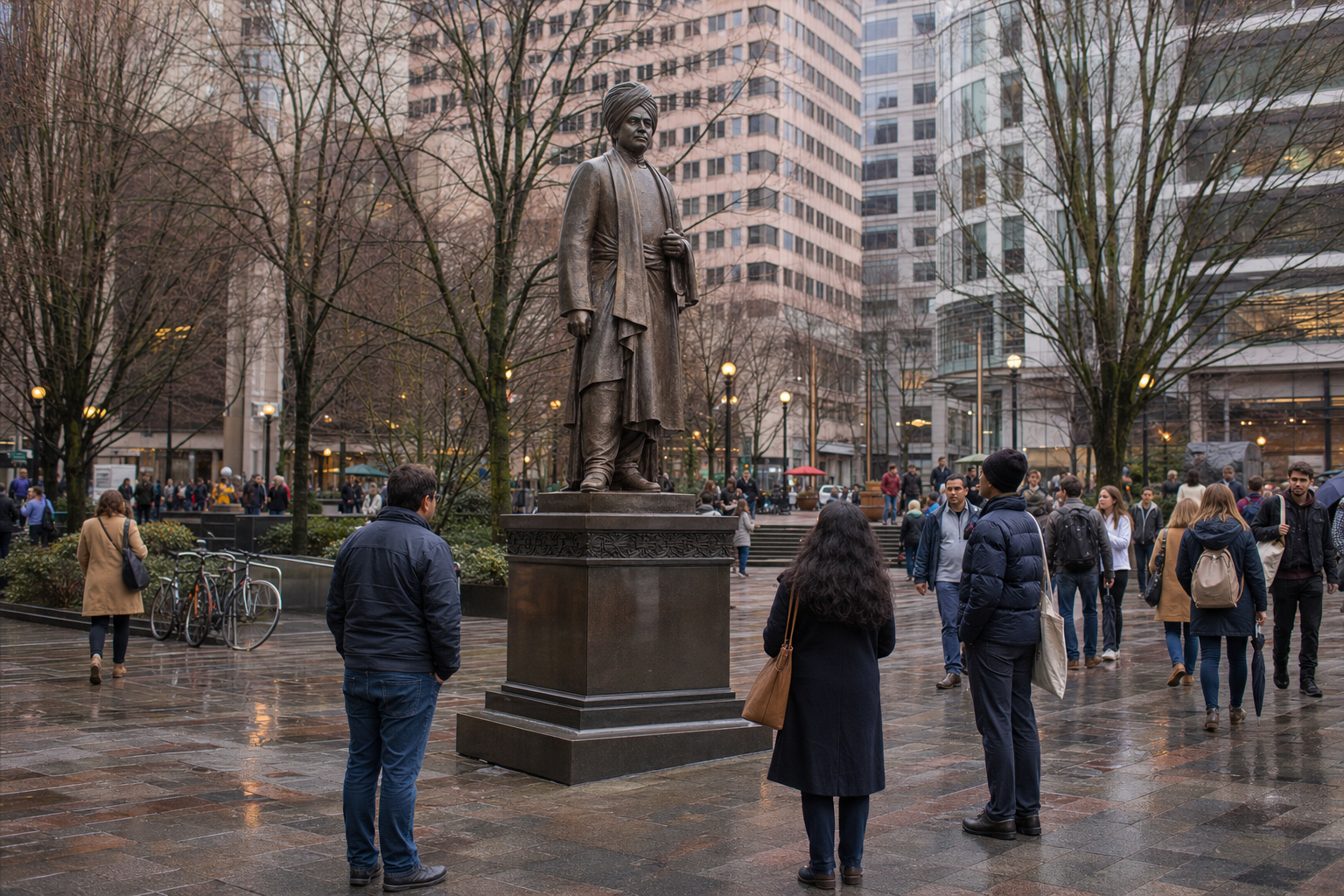
A city-hosted monument is different from a statue that merely happens to be located within city limits. Municipal hosting places a figure within shared civic space. It makes that figure available to the whole public and connects the installation to questions of access, interpretation, stewardship, and the city’s own cultural life.
Seattle’s mayor unveiled the monument with Consul General of India in Seattle Prakash Gupta, joined by city leaders and members of the Indian-American community. The ceremony therefore joined three constituencies that do not always meet around the same symbol: municipal government, Indian diplomacy, and a local community with a direct cultural connection to Vivekananda.
The Indian Council for Cultural Relations, or ICCR, gifted the statue. That detail matters. The installation is not only a local commemoration funded and interpreted in isolation. It is also an act of cultural diplomacy in which Bharat presents a spiritual teacher, rather than a commercial brand or political slogan, as part of its relationship with the American public.
Accuracy is especially important when you share the news. Keep these distinctions intact:
- Say first U.S. city-government-hosted Vivekananda monument. Do not shorten that to the first Vivekananda statue in America.
- Say the city hosts the monument. Do not assume that hosting settles every question about legal ownership, maintenance responsibility, or the terms of the gift.
- Say the statue is life-size and bronze. Do not add claims about its precise alloy, anchoring system, sculptor, cost, or seismic specifications unless you have official records.
- Say it has been installed at Westlake Square. Do not promise that its location, access conditions, or surrounding public-space arrangements can never change.
- Say Vivekananda’s message has civic and interfaith relevance. Do not imply that Seattle has adopted a particular theology or endorsed every interpretation made in his name.
A clean description you can reuse is: Seattle is hosting a life-size bronze statue of Swami Vivekananda at Westlake Square, the first monument to him hosted by a U.S. city government; the ICCR gifted it as a cultural link between India and the Pacific Northwest.
How to read the monument through civic and Dharmic lenses
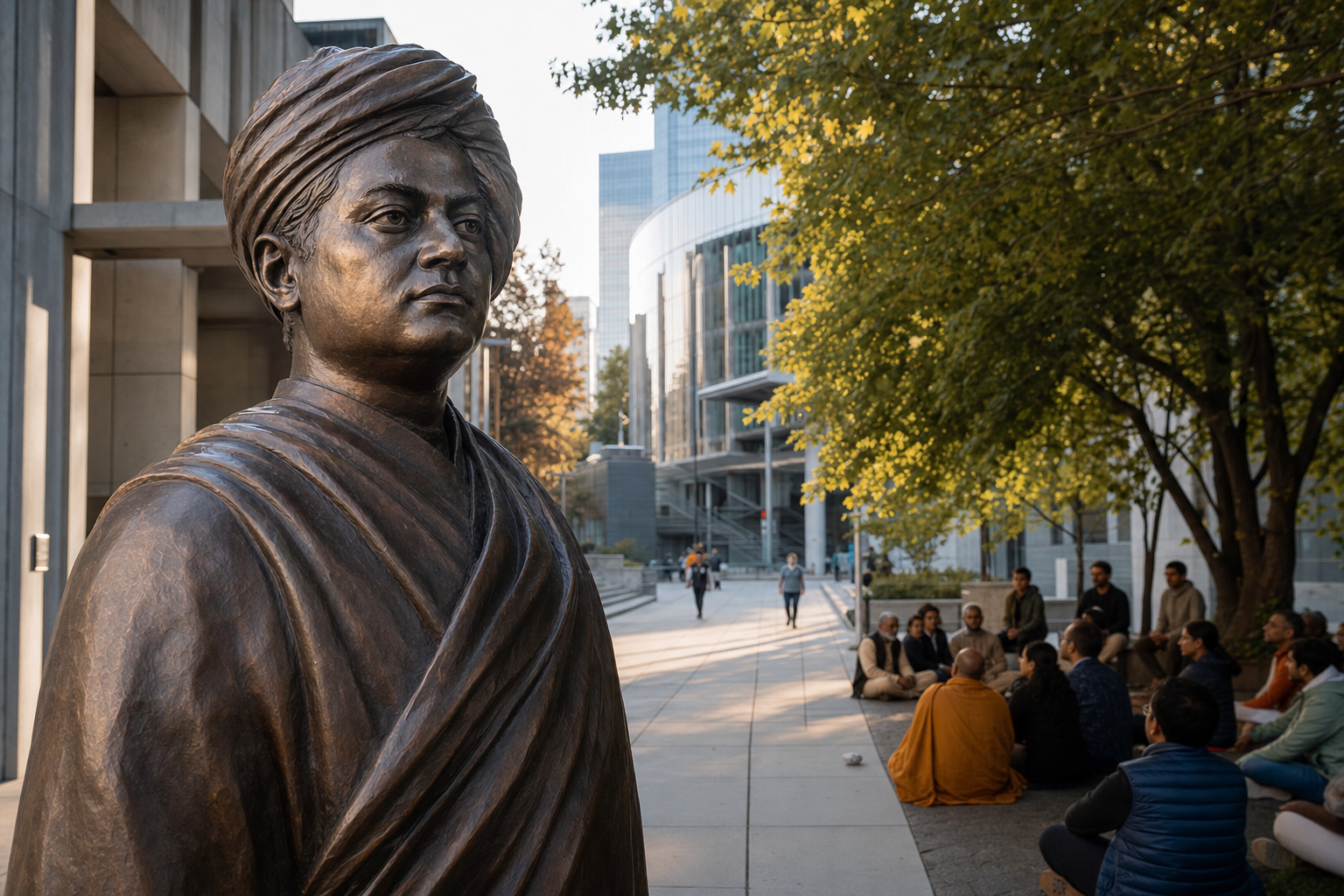
Westlake Square sits amid a busy retail and transit corridor. That location is part of the message. A person does not need to enter a religious institution, register for a lecture, or already identify with an Indian tradition to encounter Vivekananda. The statue interrupts ordinary urban movement with a basic question: who was this Hindu monk, and why does he belong here?
The shortest responsible answer begins in Chicago. Vivekananda addressed the Parliament of the World’s Religions in 1893 and brought a Hindu vision of universalism, mutual respect, and spiritual plurality into an American public forum. Seattle’s monument extends that American history from the lecture hall into the street.
His relevance should not be explained by stripping away his Hindu identity. Vivekananda spoke from Vedanta. His universalism was not the claim that every tradition is identical, that differences are embarrassing, or that a person must abandon a chosen form of worship. The more useful idea is that deep commitment to one’s own path can coexist with respect for another person’s path.
That distinction helps you read the statue without falling into either of two errors. One error treats Vivekananda as meaningful only to Hindus and therefore out of place in a common civic setting. The other turns him into a vague mascot for diversity, removing the Vedantic ground that made his message distinctive. Seattle’s placement is most intelligible when both truths remain visible: he was a Hindu monk, and his Hindu thought opened a serious conversation across religious boundaries.
The same care is needed when speaking of Dharmic unity. Hinduism, Buddhism, Jainism, and Sikhism are not interchangeable labels. They have distinct teachings, texts, communities, practices, and historical experiences. Yet they can meet around disciplined questions concerning compassion, self-mastery, service, truth, restraint, and respect for spiritual seeking. Vivekananda’s public presence can support that meeting without asking any tradition to dissolve itself.
If you organize a discussion at the statue, ask participants to answer from within their own traditions:
- What does respect require when agreement is impossible?
- How does your tradition connect spiritual practice with service to others?
- Which differences must remain visible for dialogue to be honest?
- When does tolerance become passive indifference, and what would active solidarity look like?
- How can a community express pride in its inheritance without turning pride into contempt for another community?
The ICCR gift also invites a sober reading of soft power. Bharat is making itself known through philosophical memory and cultural presence. Seattle, in turn, is allowing that presence to enter municipal space. This does not prove political agreement between the United States and India, measure public opinion, or settle any geopolitical dispute. It creates a civic opening through which people can learn about India on terms wider than elections, conflict, trade, or technology.
Turn a visit into learning, dialogue, and service
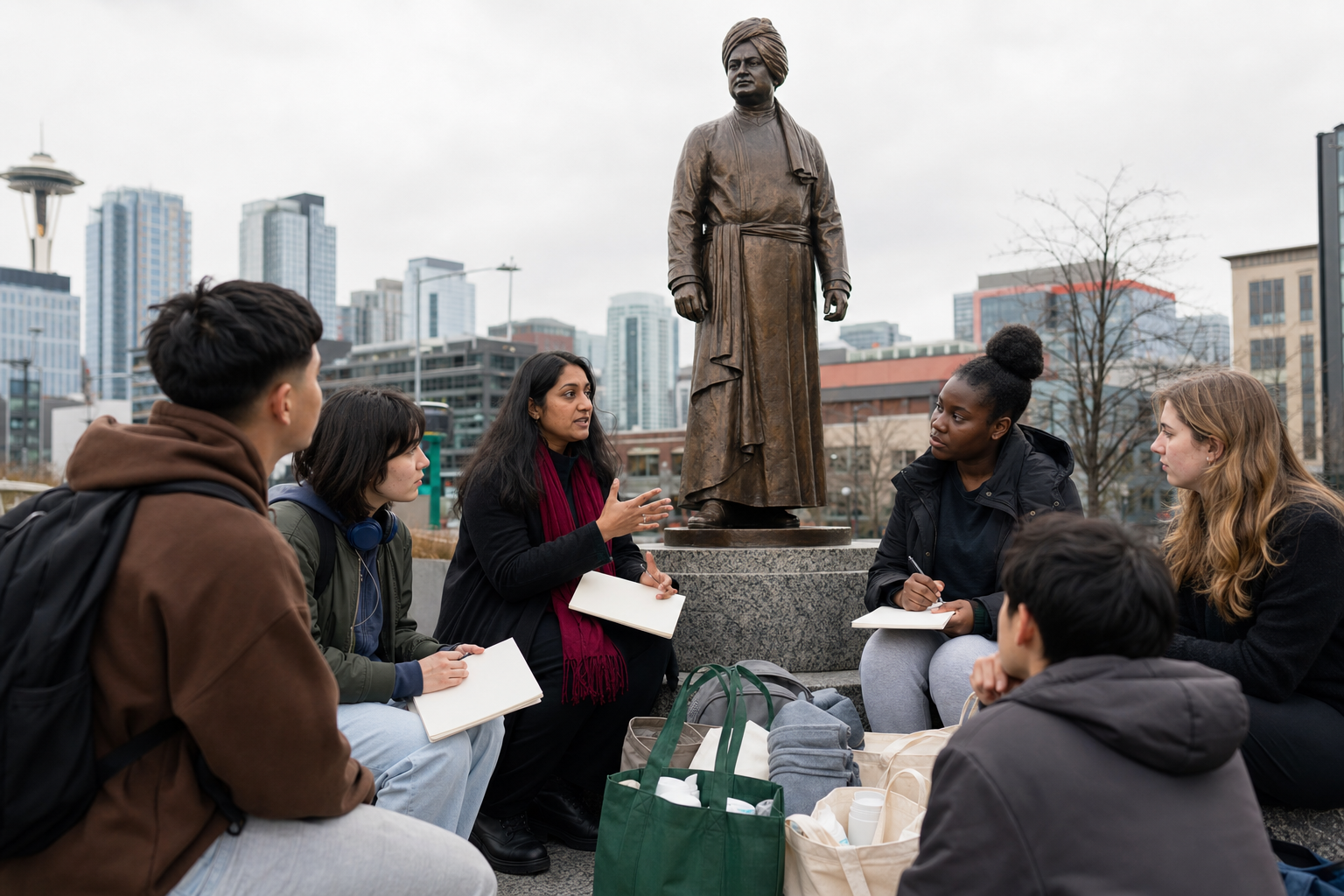
You do not need to design a formal seminar to make a visit worthwhile. Before making a special trip, confirm current access and event conditions through an official Seattle channel, since a downtown public space can be affected by construction, permitted events, or temporary restrictions. Once there, resist the urge to begin with a speech. Let the setting do some of the teaching.
A 20-minute family or school activity
- Observe for three minutes. Look at the figure, posture, bronze surface, pedestal, sightlines, and surrounding movement. If interpretive text is present, read its exact wording rather than paraphrasing from memory.
- Give four minutes of context. Explain that Vivekananda was a Hindu monk associated with Vedanta, that he spoke in Chicago in 1893, and that Seattle is the first U.S. city government to host a monument to him.
- Discuss for six minutes. Ask why placing him in a downtown square communicates something different from placing him inside a temple or cultural centre. Let each person identify one benefit and one challenge of teaching religion through public art.
- Choose a seven-minute next step. Write down one question to investigate and one act of service the group can complete within the following week. The service need not be branded as a Vivekananda event; the point is to connect admiration with conduct.
For younger children, keep the explanation concrete: this was a monk from India who taught that strength, compassion, respect, and service belong together. For older students, introduce the harder question: can a city honor a religious thinker without establishing a religion? The statue offers a practical case through which students can distinguish representation, recognition, endorsement, and education.
Useful programs for community organizations
The monument can support public walks, school curricula, university inquiry, dialogue circles, cultural exchange, and interfaith programs. The strongest formats give people something to do beyond listening to ceremonial remarks.
- A downtown history walk: use the statue as one stop in a wider exploration of how Seattle represents the communities connected to the city.
- A one-page student worksheet: include four boxes labeled observation, historical context, philosophical idea, and civic question.
- A Dharmic roundtable: invite Hindu, Buddhist, Jain, and Sikh participants to explain a shared ethical concern from their own traditions while naming genuine doctrinal differences.
- An interfaith dialogue: ask Christian, Jewish, Muslim, Dharmic, and other participants to examine how conviction and respect can coexist. Avoid making Vivekananda carry every tradition’s message for it.
- A lecture paired with seva: connect discussion of service to a local activity selected with a community partner. The service should answer a real need, not function merely as a photograph after the event.
- An oral-history project: invite Indian-American families to record what Vivekananda meant in their education, migration, or spiritual formation, while clearly labeling personal memory as memory rather than established history.
Photography has a place, especially for families whose children are seeing a figure from their cultural inheritance represented in a major American city. But add one accurate sentence when you share the image. A monument becomes educational when the photograph carries enough context to make another person curious.
Move from a successful unveiling to a lasting institution
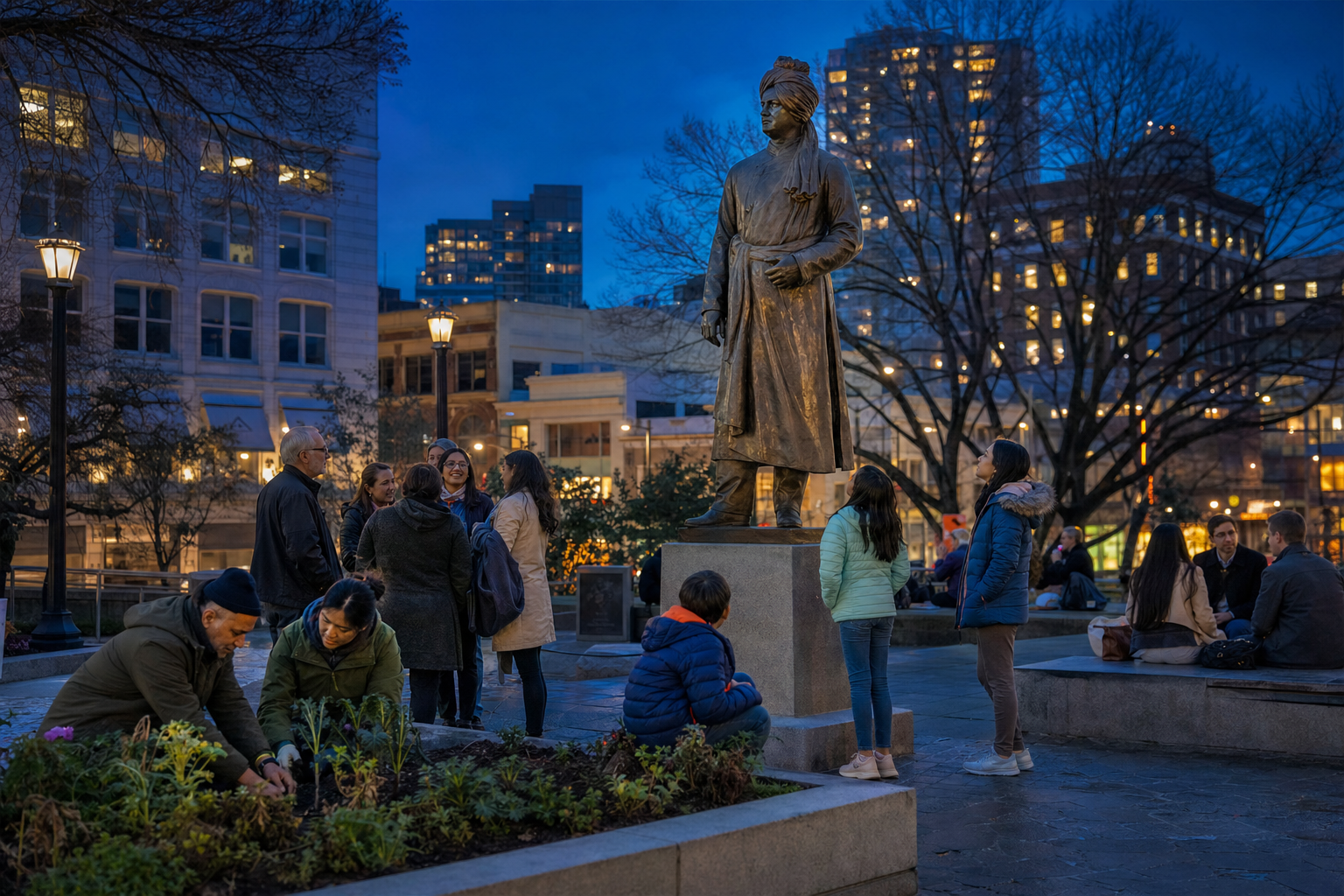
Bronze can give a statue physical durability. It cannot give the monument an enduring civic life. Without interpretation, repeated use, and stewardship, even prominent public art can fade into the visual background. The next measure of success is therefore not the size of the unveiling crowd. It is what residents can understand and do because the statue remains among them.
Community leaders can evaluate the installation through five practical questions:
- Interpretation: Can an uninformed passerby learn who Vivekananda was, why 1893 matters, what Vedanta means in this context, and who placed the monument?
- Accuracy: Does public programming preserve his identity as a Hindu monk while explaining the wider reach of his ideas?
- Participation: Are Indian-American families central to the monument’s life while schools, neighbors, other Dharmic communities, and interfaith partners are also welcomed?
- Practice: Do commemorations connect universalism and service to real civic conduct, or do they stop at praise and photography?
- Stewardship: Is it clear who handles maintenance, accessibility concerns, damage reports, interpretive material, and future programming?
If you want to pursue a similar monument in another city, prepare those answers before requesting approval. A credible proposal should identify the artwork’s provenance and ownership terms, the public purpose of the location, accessibility and sightline needs, structural and security responsibilities, long-term maintenance, and an education plan. Symbolic enthusiasm may open a municipal conversation, but unresolved stewardship can stall it.
Coalition design matters as much as engineering. Begin with people who understand Vivekananda’s Hindu and Vedantic context. Then widen participation to educators, public-art specialists, nearby residents, civic officials, other Dharmic communities, and interfaith partners. Give each participant a defined role. A coalition assembled only for a photograph will rarely sustain annual teaching, maintenance, or service.
If you are in the Seattle area, your next step can be modest: visit the statue with one other person, share the precise city-hosted distinction, discuss one of Vivekananda’s civic implications, and choose one act of service. If you live elsewhere, use Seattle’s example to draft a one-page proposal that joins cultural memory to public benefit. The monument will become more than a milestone when recognition leads to study, dialogue, and work.