

If you came away from the Madhya Pradesh UCC debate wondering whether the state’s civil law changed immediately, do not let a political slogan answer a legal question. The Assembly has passed a Uniform Civil Code bill, and Chief Minister Mohan Yadav joined that event to both a promise of equal treatment and an explicitly Hindu claim about political power.
Those are three different matters: legislative passage, the legal effect of the eventual code, and the rhetoric used to sell it. If you separate them, you can support civil equality, protect legitimate Hindu interests and still demand evidence that the enacted clauses will do what the government promises.
Assembly passage is not the same as an operative code

Passage by the Assembly establishes that a legislative majority approved the bill. It does not, by itself, answer every question that matters to a citizen: whether assent has been given, which text received assent, when each provision commences, whether implementation awaits rules, and how existing legal relationships will be treated.
That distinction matters because a UCC can reach intimate and consequential areas such as marriage, divorce, maintenance, adoption, guardianship, inheritance, succession and registration. The precise subjects vary with the actual text. A speech about the bill cannot tell you which definition, exception, transition rule or remedy will govern your own situation.
Yadav presented implementation as a route to freedom from discrimination and said Madhya Pradesh would stand with Goa, Uttarakhand and Assam in moving in this direction. Notice the timing built into that claim: the promised result comes after implementation. It is a political forecast, not proof that discrimination has already disappeared or that every provision is now enforceable.
Use a legally careful sentence when discussing the development: “The Madhya Pradesh Assembly has passed a UCC bill.” Do not silently upgrade that to “Madhya Pradesh’s UCC is now in force” unless the official assent, publication and commencement record establishes it. If you face an immediate decision involving family status, property or succession, rely on the authenticated legal text and qualified legal advice, not a legislative speech or a social-media summary.
Test equality in the clauses, not in the word “uniform”
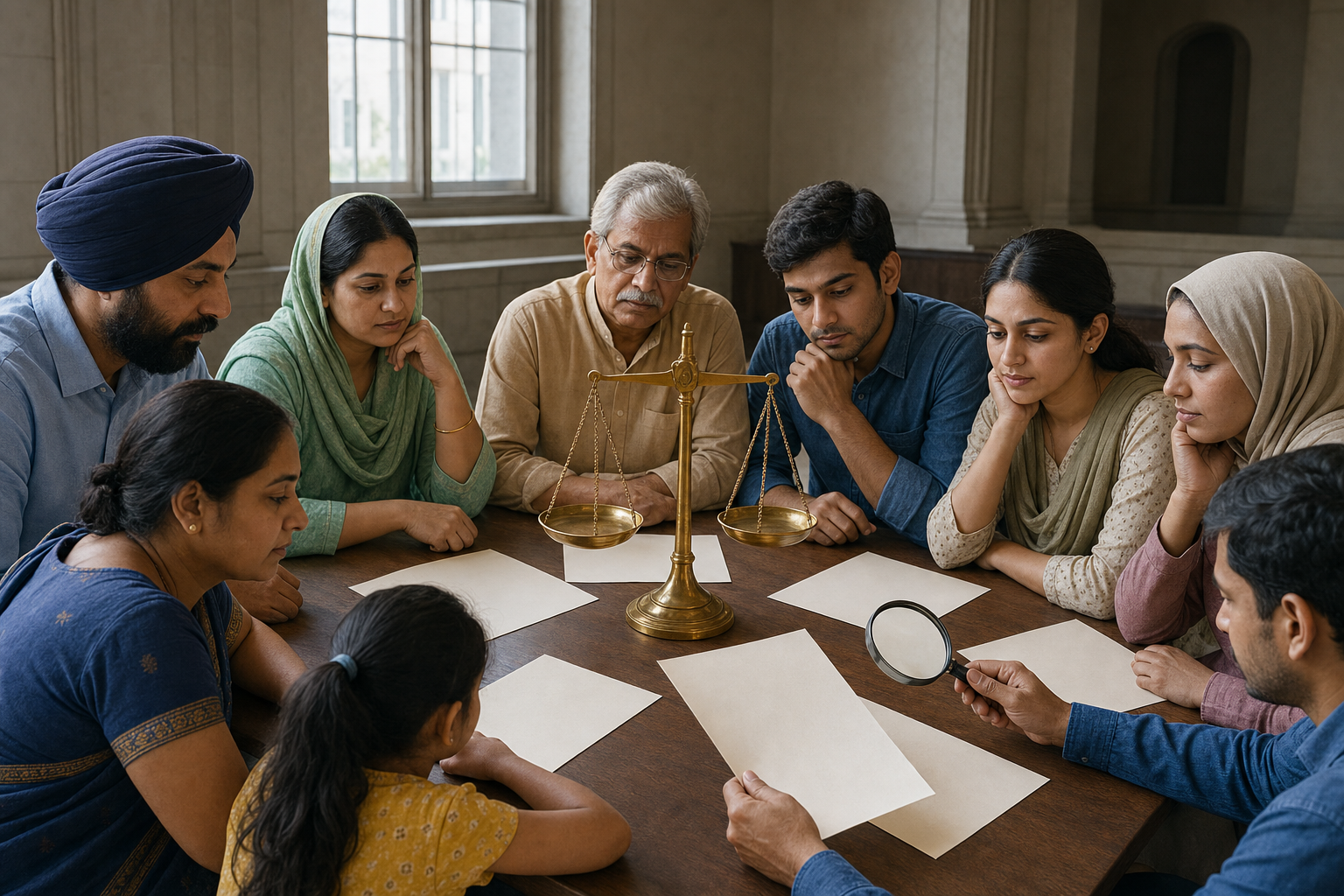
The strongest stated case for the bill is simple: citizens should not be placed on different civil-law scales merely because they belong to different religious communities. Yadav grounded that argument in the idea that equality is inherent in our culture and all are equal in the divine view. That is a recognisably Dharmic moral argument for impartial public law.
But “one rule” and “a just rule” are not synonyms. A uniform provision can be clear or vague, proportionate or punitive, carefully transitional or abruptly disruptive. Conversely, a narrowly framed exception is not automatically appeasement; it may protect a legitimate reliance interest, or it may create the very religious inequality the code claims to remove. You cannot know which until you read the provision and its justification.
When the official text is available, ask these concrete questions:
- Coverage: Who is governed by each provision, and how are residence, domicile, existing relationships and future acts treated?
- Equal rights and duties: Do similarly placed adults receive the same legal capacity, protection, obligation and remedy regardless of religion or sex?
- Exceptions: Is every exemption stated precisely, supported by a public reason and narrow enough not to swallow the promise of equality?
- Transition: What happens to marriages, adoptions, wills, nominations, settlements or proceedings created before commencement?
- Administration: Which authority registers, decides, investigates or penalises, and what review or appeal is available?
- Commencement: Does the provision begin upon publication, on a separately notified date or only after rules are issued?
This clause-by-clause method protects you from two shortcuts. The first is rejecting the bill merely because a Hindu political leader champions it. The second is assuming the bill must be fair because it carries the word “uniform.” A serious pro-Dharma judgement can approve one provision, challenge another and reserve judgement on a third.
The Hindu slogan changes what citizens hear
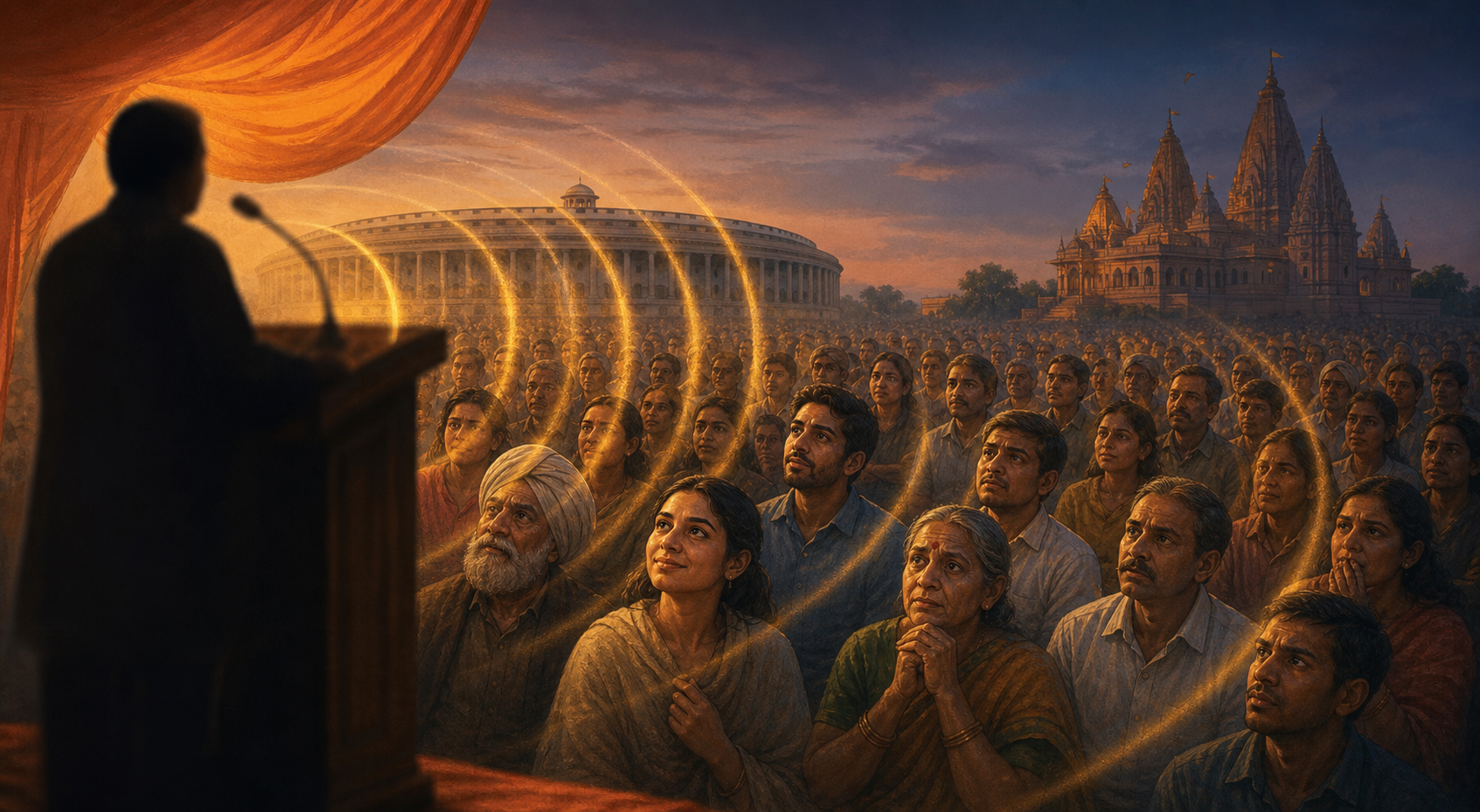
The most politically charged sentence did not describe a clause. It described who deserves to govern:
जो हिंदू की बात करेगा वही राज करेगा।
Mohan Yadav, Madhya Pradesh Assembly
The same intervention also used an inclusive civic register, arguing that the country should run under one Constitution from Ram to Rahim, Ravindra to Robin, Amar to Anthony and Akbar. It then attacked Congress for appeasement and Muslim vote-bank politics. The result is a speech operating in two registers at once: equal law for every citizen, and political legitimacy tied to speaking for Hindus.
A pro-Hindu reader should not be forced into either reflexive embarrassment or reflexive applause. Saying that Hindu concerns deserve an honest place in public life is legitimate. Hindus do not have to erase their civilisational identity before discussing law, nor should demands for equal treatment be dismissed merely because they arise from Hindu political experience.
The problem begins when a community-centred slogan substitutes for the legal case. If support for a particular bill becomes the test of whether someone “speaks for Hindus,” defects in drafting become harder to challenge. Critics can also portray a citizen-wide reform as an instrument of partisan victory or communal retaliation. That weakens the reform precisely where it needs the broadest legitimacy: in homes, registries, courts and administrative offices.
There is a sharper standard available. Ask whether the government can defend every provision without referring to the voter’s religion. Ask whether you would accept the same enforcement power in the hands of a party you oppose. Ask whether a Hindu, Muslim, Sikh, Jain, Buddhist or Christian citizen facing the same civil facts receives the same right, duty and remedy. A law that passes those tests does more for Hindu confidence than a slogan that lasts for one legislative debate.
Key takeaways
- The Madhya Pradesh Assembly’s passage of a UCC bill is an important legislative event, but passage alone does not establish that every provision is operative.
- The claim that implementation will end discrimination is a political promise. Its truth must be tested against the final clauses, exceptions, transition rules and enforcement system.
- Yadav combined a universal appeal to one constitutional order with an explicitly Hindu claim about who will govern. Those frames reinforce each other politically but are not logically identical.
- A pro-Hindu position can demand an end to religion-based legal asymmetry while still scrutinising the government’s drafting, procedure and use of power.
- If the code could affect an immediate personal or property decision, verify the authenticated text and commencement status and seek qualified legal advice.
Apply a Dharmic standard before taking a political side
You can turn the debate into a disciplined judgement with six steps:
- State the status accurately. Distinguish a passed bill from an assented Act, and an assented Act from provisions that have commenced.
- Obtain the operative documents. Read the official bill or Act, commencement material and any rules relevant to the issue you care about.
- Build a clause map. For each provision, record the subject, people covered, previous position, new rule, exemptions, transition, enforcement authority and start date.
- Run the equality test. Look for the same right, the same duty and the same remedy for people in materially similar circumstances.
- Run the restraint test. Check whether penalties and administrative discretion are proportionate, reviewable and limited by clear language.
- Judge rhetoric separately. Decide whether a slogan expresses a legitimate demand for Hindu representation, an electoral loyalty test, or both. Do not let that answer replace your reading of the law.
This approach does not ask you to become neutral about Hindu interests. It asks you to define those interests with greater care. Hindus benefit from a state that rejects selective standards, but they also benefit from predictable law, restrained power and reforms that remain defensible when governments change.
For now, describe the event as Assembly passage and keep claims about implementation conditional. Then insist on a code that is equal in text, fair in transition, restrained in enforcement and intelligible to the people expected to obey it. That is a stronger Dharmic response than either partisan silence or slogan-driven certainty.
References
- Hindu Post – Madhya Pradesh UCC bill passage and Chief Minister Mohan Yadav’s Hindu political remark