
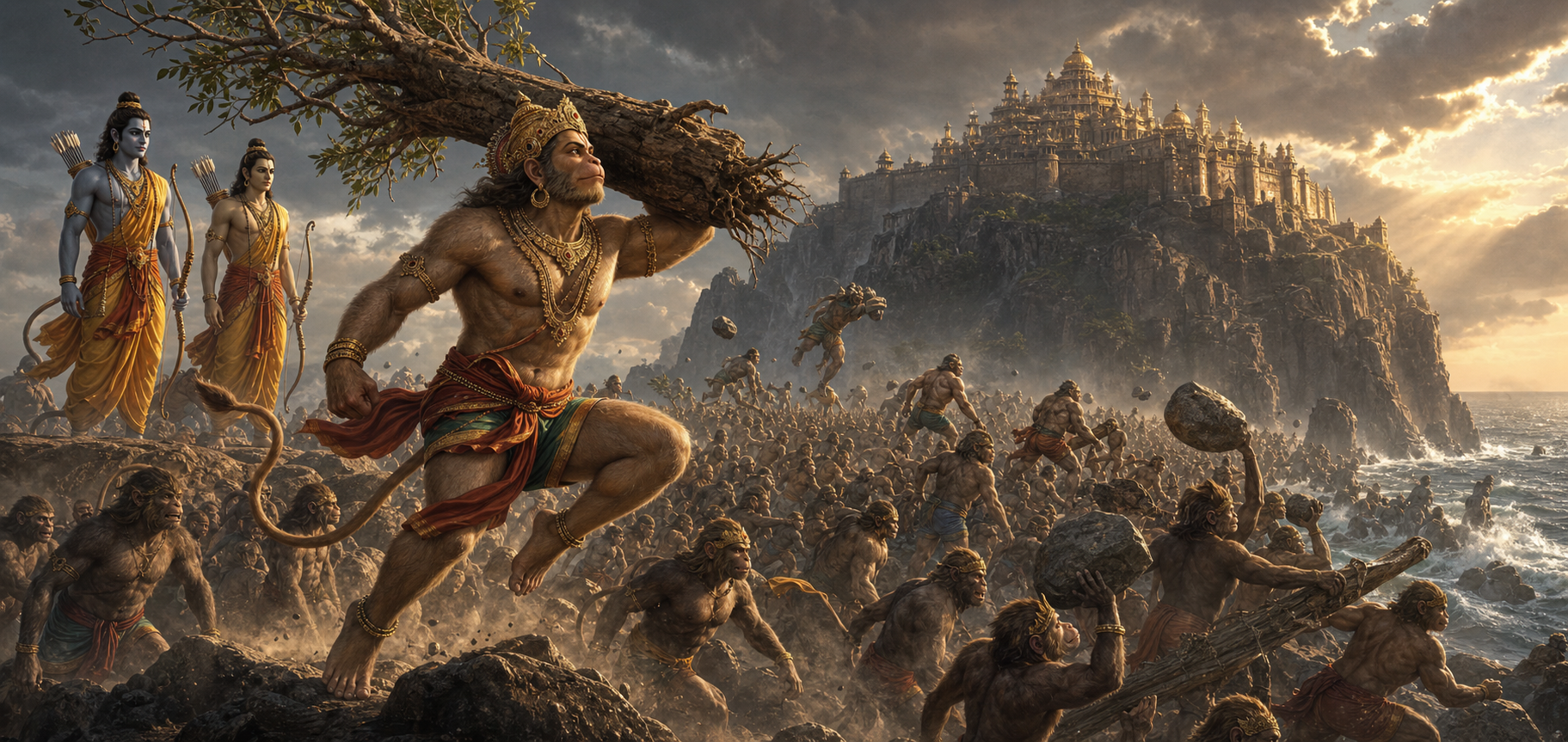
If you have ever paused during the Lanka campaign and wondered why Rama’s formidable allies do not carry bows, you have noticed something important. The apparent gap in their equipment is not a gap in the story’s military logic.
The Vanaras fight through embodied strength, extraordinary movement, environmental improvisation and psychological force. Read them on those terms, and their warfare reveals how the Ramayana brings radically different kinds of power into the service of one dharmic purpose.
A missing bow does not mean missing military power
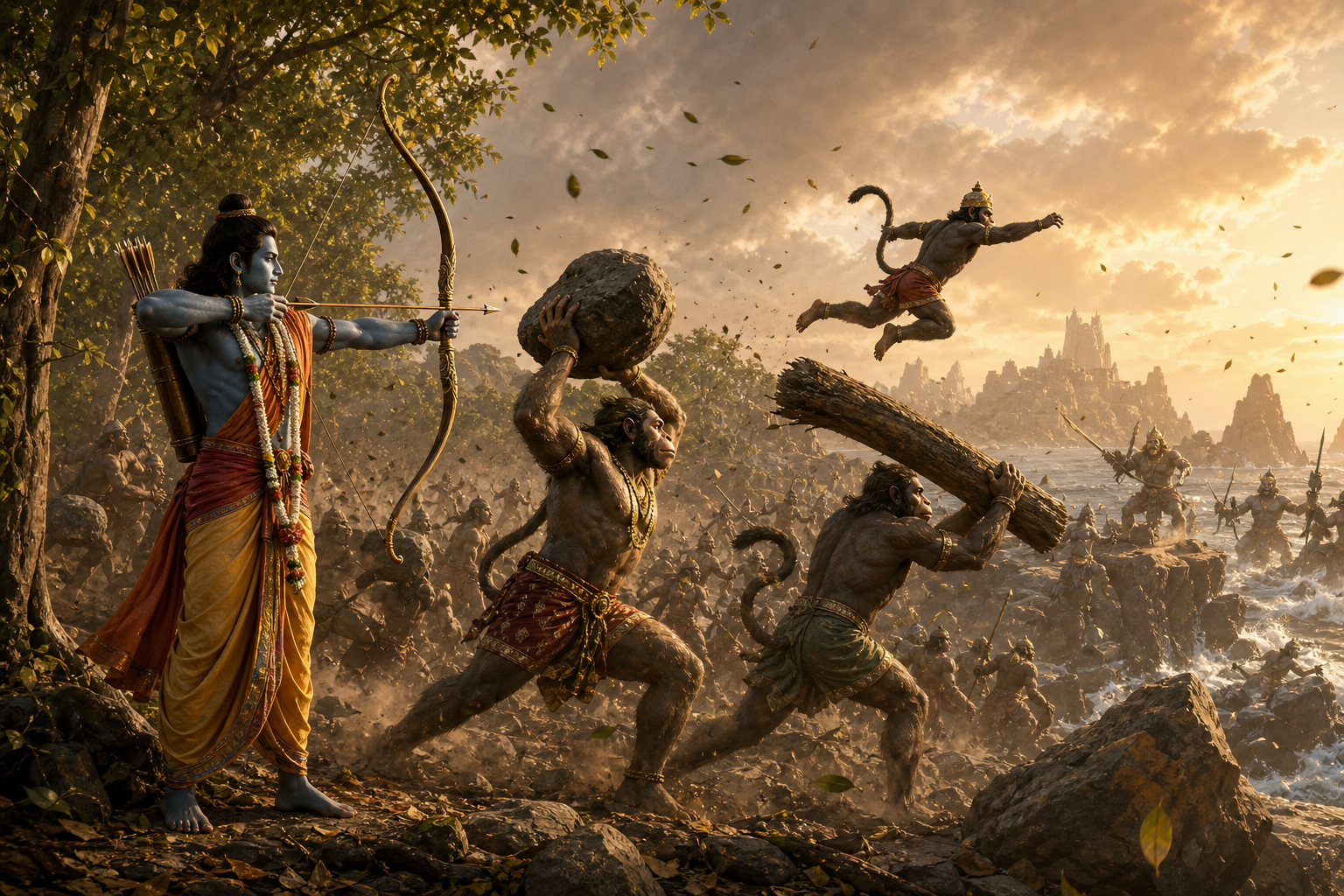
A modern reader can easily treat the bow as a measure of advancement. An army with ranged weapons appears sophisticated; fighters using their bodies and whatever the landscape provides can appear primitive. That assumption does not survive contact with the Vanaras’ demonstrated abilities.
The contrast is deliberate: although the Vanaras possess immense power, they do not reach for bows and arrows. Vali could lift mountains. Hanuman crosses the ocean in a single extraordinary leap. Angad plants his foot in Ravana’s court so firmly that the assembled warriors cannot move it. None of these feats depends on a manufactured weapon.
These examples establish the scale on which Vanara capability operates. The body is not merely the platform carrying a weapon; the body is itself the principal instrument of movement, impact, endurance and intimidation. A bow extends an ordinary fighter’s reach. A Vanara’s extraordinary body changes what reach, distance and obstruction mean in the first place.
This gives you the first rule for reading Vanara warfare: separate armament from combat power. Count neither bows nor blades before asking what a combatant can actually do. If a warrior can cross an otherwise prohibitive space, lift an immense natural object or become physically immovable before an enemy court, a conventional inventory will badly understate his power.
It is also worth avoiding the opposite error. The Vanaras’ lack of bows does not prove a historical claim about metallurgy, training or access to technology. The relevant evidence is narrative: the Ramayana distinguishes their mode of action from Rama’s. Speculation about a technological deficiency adds an explanation the story does not need.
Body, landscape and momentum form one weapon system
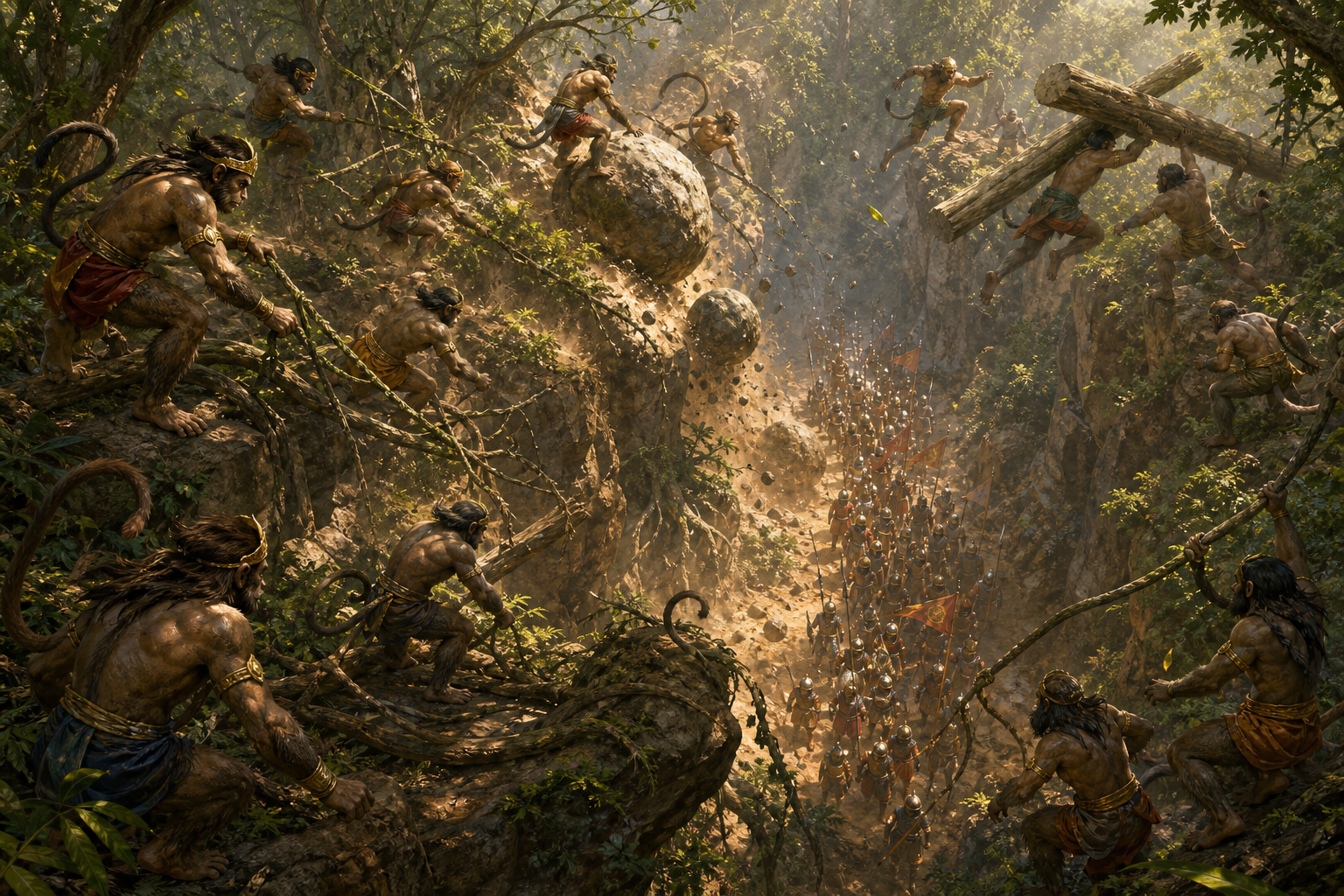
In modern military language, we might call the Vanara mode a weapon system made of physical capacity, mobility, terrain and momentum. That is an analogy for understanding the action, not a claim that the epic uses modern doctrine.
Physical capacity comes first. A fighter whose strength is vastly beyond the ordinary does not need a separate implement for every task. The same arms can climb, carry, seize, strike and hurl. The distinction between fighter, transport and weapon becomes far less rigid.
Mobility is equally important. Hanuman’s ocean-crossing leap should not be reduced to an athletic marvel. It shows that an obstacle which would halt ordinary movement does not necessarily halt Vanara action. When you read a campaign episode, ask whether the decisive advantage is the ability to injure an enemy from farther away or the ability to reach a place that should be unreachable. Vanara power often begins by cancelling the obstacle itself.
The landscape then becomes available for immediate use. Rocks, trees and other natural masses suit fighters whose strength allows them to lift, uproot or throw what an ordinary soldier could not manage. Their environment is therefore not just background scenery. It is a changing store of leverage, cover, elevation, mass and impact. The forest warrior carries less because the surroundings can be converted into action.
Momentum ties these elements together. A bow favours controlled projection across distance. Vanara warfare favours rapid closing, overwhelming physical pressure and the conversion of movement into impact. In tactical terms, it resembles shock action: the purpose is not merely to trade blows but to disrupt the enemy’s ability to maintain position and order.
Angad’s immovable foot reveals another dimension. The incident takes place in Ravana’s court rather than amid a general clash, yet it functions as a display of power directed at enemy confidence. No arrow has to be released. The inability of Ravana’s warriors to move one planted foot turns physical stability into a message: the opposing force may be stronger than the court is willing to admit.
Vali’s mountain-lifting strength should be read carefully as well. It provides a benchmark for the magnitude associated with Vanara power; it does not mean that Vali marches in Rama’s Lanka army. Keeping that distinction prevents a common reading mistake: combining every Vanara feat into one undifferentiated battlefield roster.
Rama and the Vanaras succeed through asymmetry
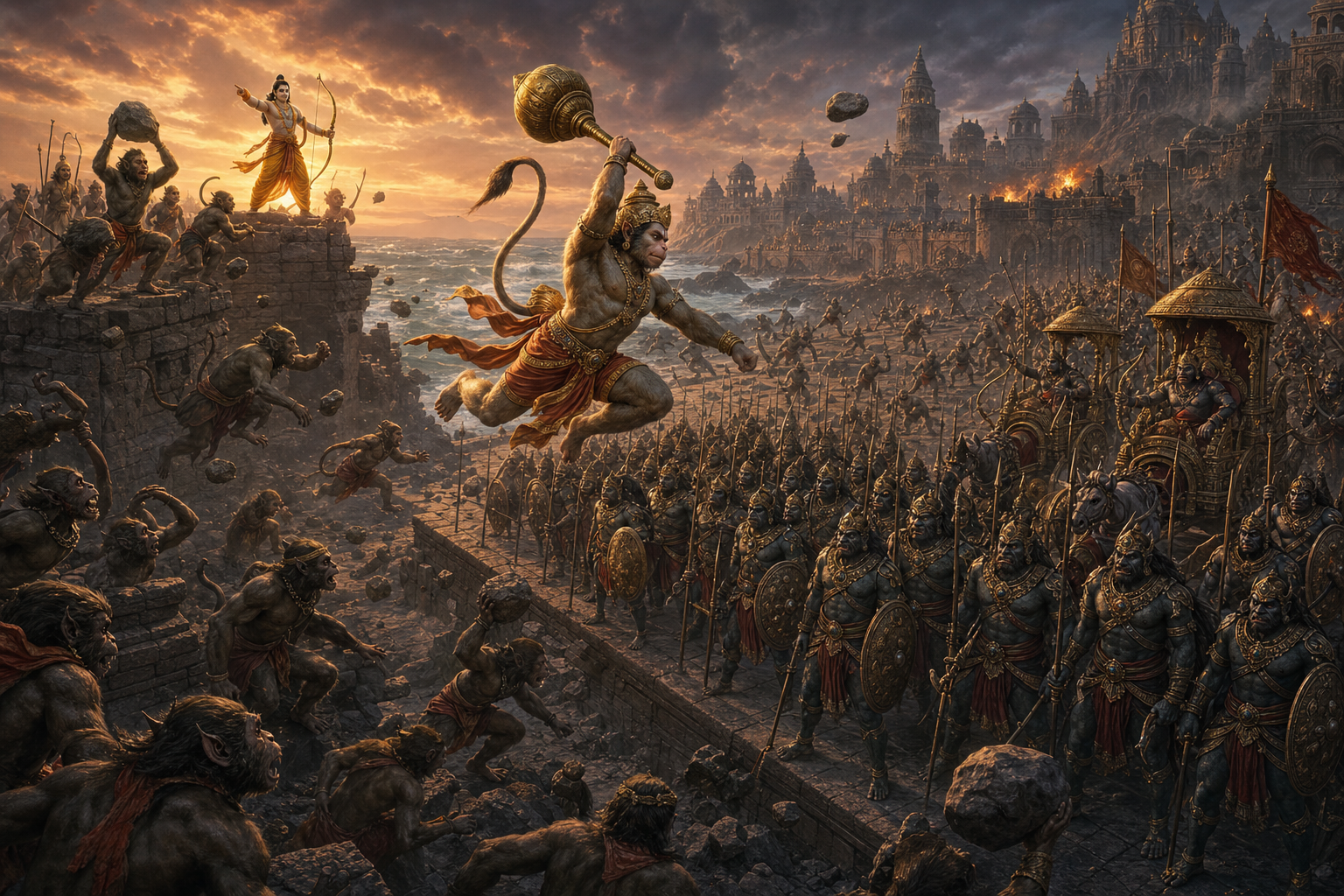
Why does Rama not simply turn his allies into copies of himself? Because the alliance becomes more capable when its members retain different strengths. Rama’s bow represents range, aim and discriminating force. The Vanaras contribute exceptional access, movement, mass and close physical pressure. Uniform equipment would not automatically improve that combination.
This is asymmetry in its clearest form: one side does not answer every enemy capability with the same capability. It solves the underlying problem by another route. Distance can be answered with an arrow, but it can also be answered by a body able to traverse the distance. A fortified position can be attacked with a specialised machine, but extraordinary strength can make natural mass serve the immediate purpose. An enemy’s confidence can be challenged by injury, but it can also be challenged by a controlled demonstration that exposes his warriors’ impotence.
The useful question, then, is not, “Why do all of Rama’s allies lack Rama’s weapon?” Ask, “Which obstacle can each ally remove that the others cannot remove in the same way?” That shift takes you from an equipment catalogue to an analysis of the coalition.
It also clarifies why the Vanaras must remain recognisably Vanara. If every ally fought with the same tools, at the same range and in the same style, the alliance would become visually and narratively flat. Their distinct mode of combat allows the Ramayana to show unity without sameness. Cooperation does not require the erasure of svabhava, the characteristic nature through which a being acts.
You can apply this lens beyond a single battle. Whenever the epic brings different beings into a shared undertaking, look for complementarity before hierarchy. Difference may indicate a division of responsibility rather than a ranking from advanced to backward.
Raw strength becomes dharmic only through its direction
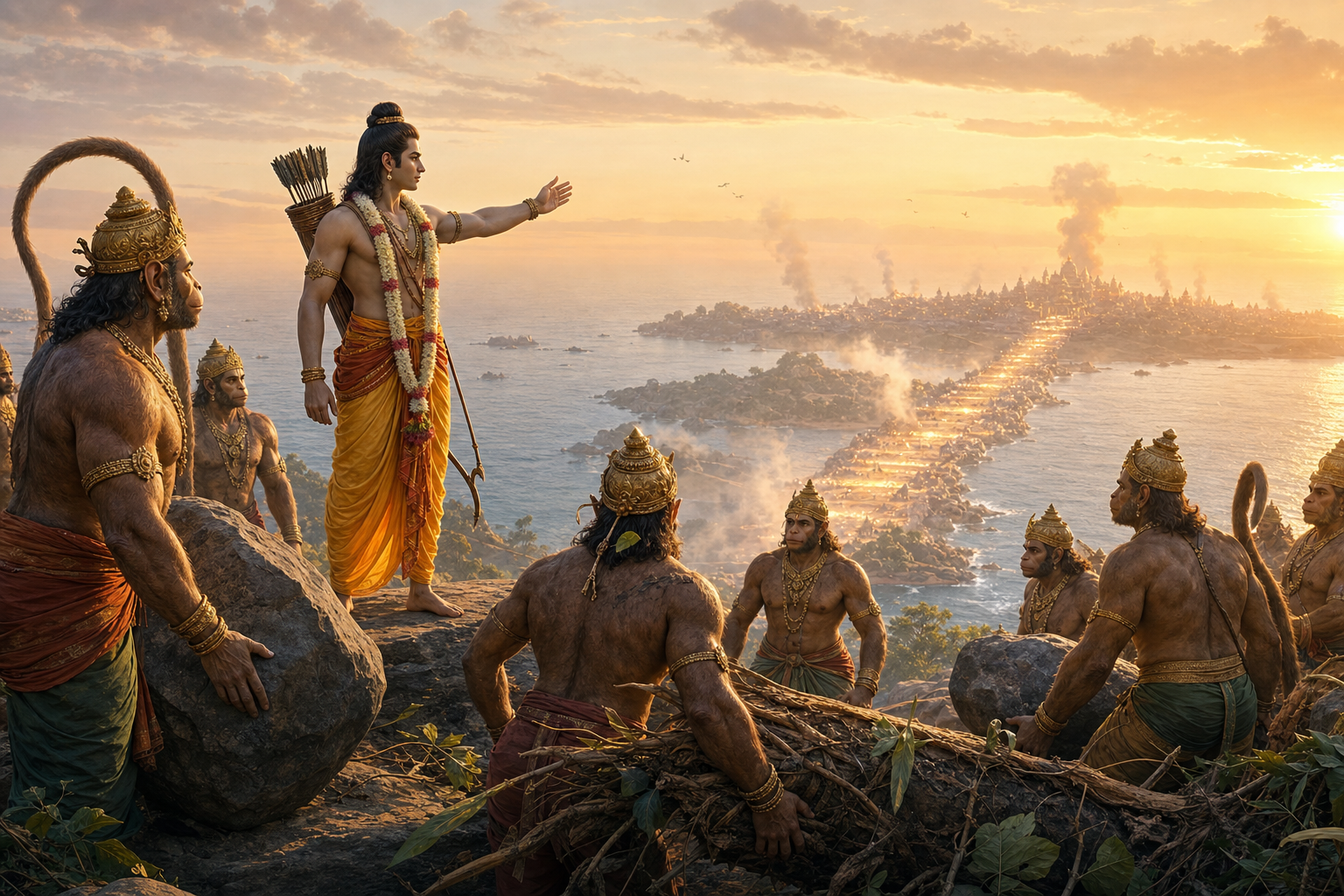
The Vanaras’ bodily force should not be romanticised as righteous merely because it is natural. Strength is capacity, not moral proof. Vali’s immense power, for example, establishes might without settling every question of dharma surrounding its use. The Ramayana repeatedly asks what power serves, who governs it and whether it remains within a rightful purpose.
This distinction matters because a shallow symbolic reading can turn the conflict into “natural good” against “civilised evil.” The contrast is not so simple. Lanka has order, command and formidable martial resources. The Vanaras possess elemental force. Neither material sophistication nor closeness to the forest independently establishes righteousness.
The moral transformation occurs when great but varied powers accept a common direction under Rama’s cause. Hanuman’s mobility is not admirable merely because it is astonishing. It becomes meaningful through fidelity, discernment and service. Angad’s strength is not just an occasion for spectacle. Its restraint and purpose determine what the display communicates.
This is one reason the absence of bows matters spiritually as well as tactically. The Vanaras do not need to abandon their nature and imitate Rama’s outward form in order to participate in his mission. Their distinctive capacities are disciplined and offered. Dharma coordinates difference; it does not demand mechanical uniformity.
At the same time, do not dissolve the warfare into allegory alone. The clashes, feats and physical risks belong to the narrative world. A symbolic meaning can deepen the action without cancelling its literal force. The soundest reading holds both levels together: these are mighty combatants in an epic war, and their way of fighting also reveals something about strength placed under dharmic command.
Key takeaways for reading Vanara battle scenes
- Do not use weapon ownership as a shortcut for capability. Measure the Vanaras by the obstacles they overcome and the effects they produce.
- Treat the body as part of the armament. Strength, movement, stability and endurance perform functions that ordinary warriors assign to separate tools.
- Notice when terrain changes from obstacle to resource. A landscape that limits conventional troops can supply leverage and mass to fighters able to manipulate it.
- Read the alliance by complementary roles. Rama’s ranged precision and Vanara mobility are different answers to different battlefield problems.
- Separate might from righteousness. Extraordinary power becomes dharmically significant through its purpose, restraint and alignment, not through spectacle alone.
- Keep interpretation at the right level. Tactical analogy can clarify the action, and symbolism can clarify its meaning, but neither should be mistaken for unsupported historical reconstruction.
On your next reading of a Vanara episode, identify the obstacle before looking at the weapon. Ask what blocks the mission, whose characteristic strength removes that block, and how the action remains answerable to Rama’s purpose. That three-part test will show you more than counting arrows ever could.
References
