
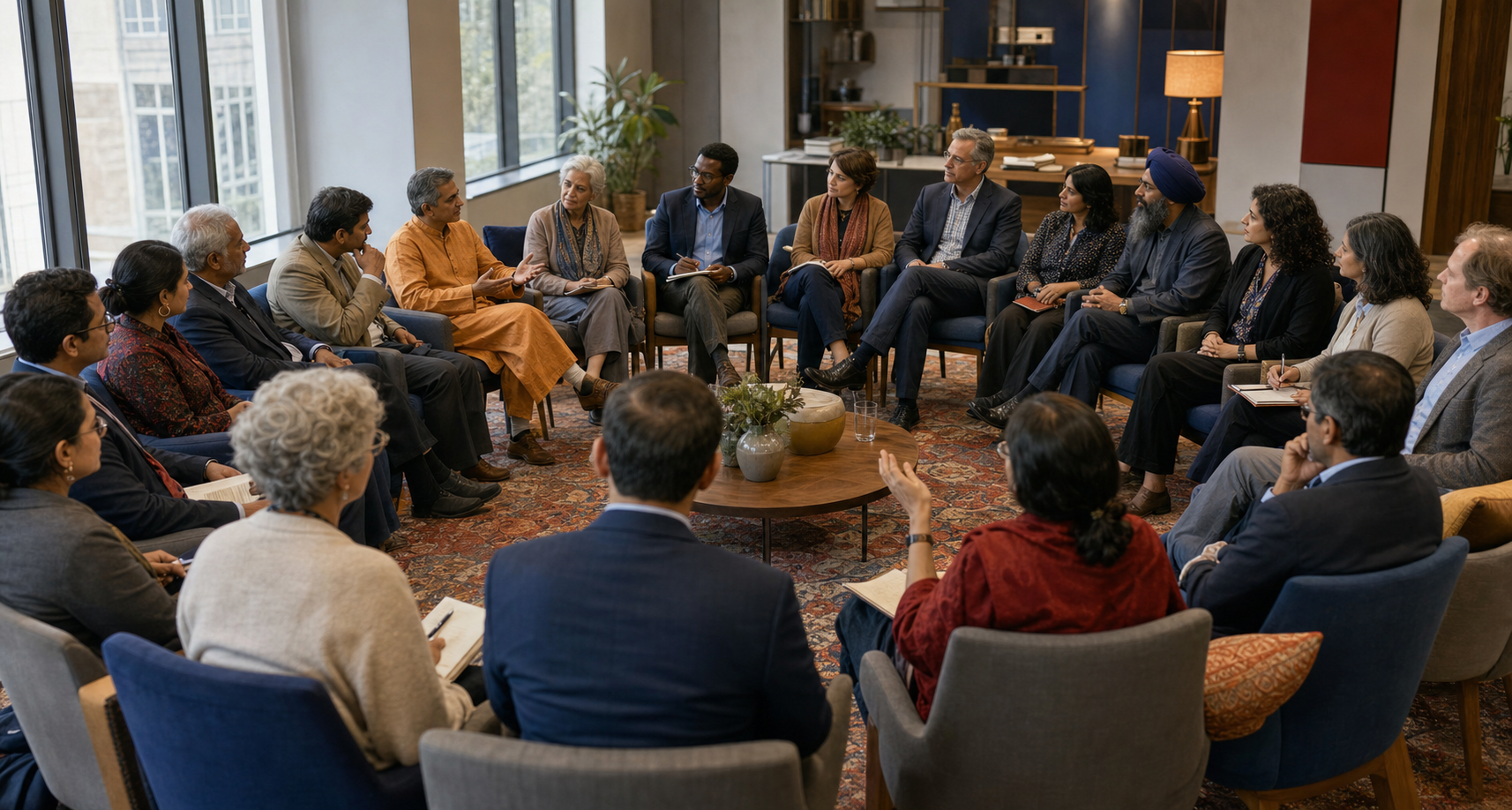
If you are trying to decide whether the RSS’s April 2026 outreach in the United States was a diplomatic breakthrough, a public-relations exercise, or something in between, start with a narrower conclusion. It was a meaningful expansion of audience, but it was not proof of American endorsement.
That distinction matters because civilisational engagement is built through repeated scrutiny, not conferred by a prestigious invitation. If you want to understand what changed, and what should happen next, look past the venue and examine the quality of translation, questioning, reciprocity, and follow-through.
What changed when the conversation moved beyond the diaspora
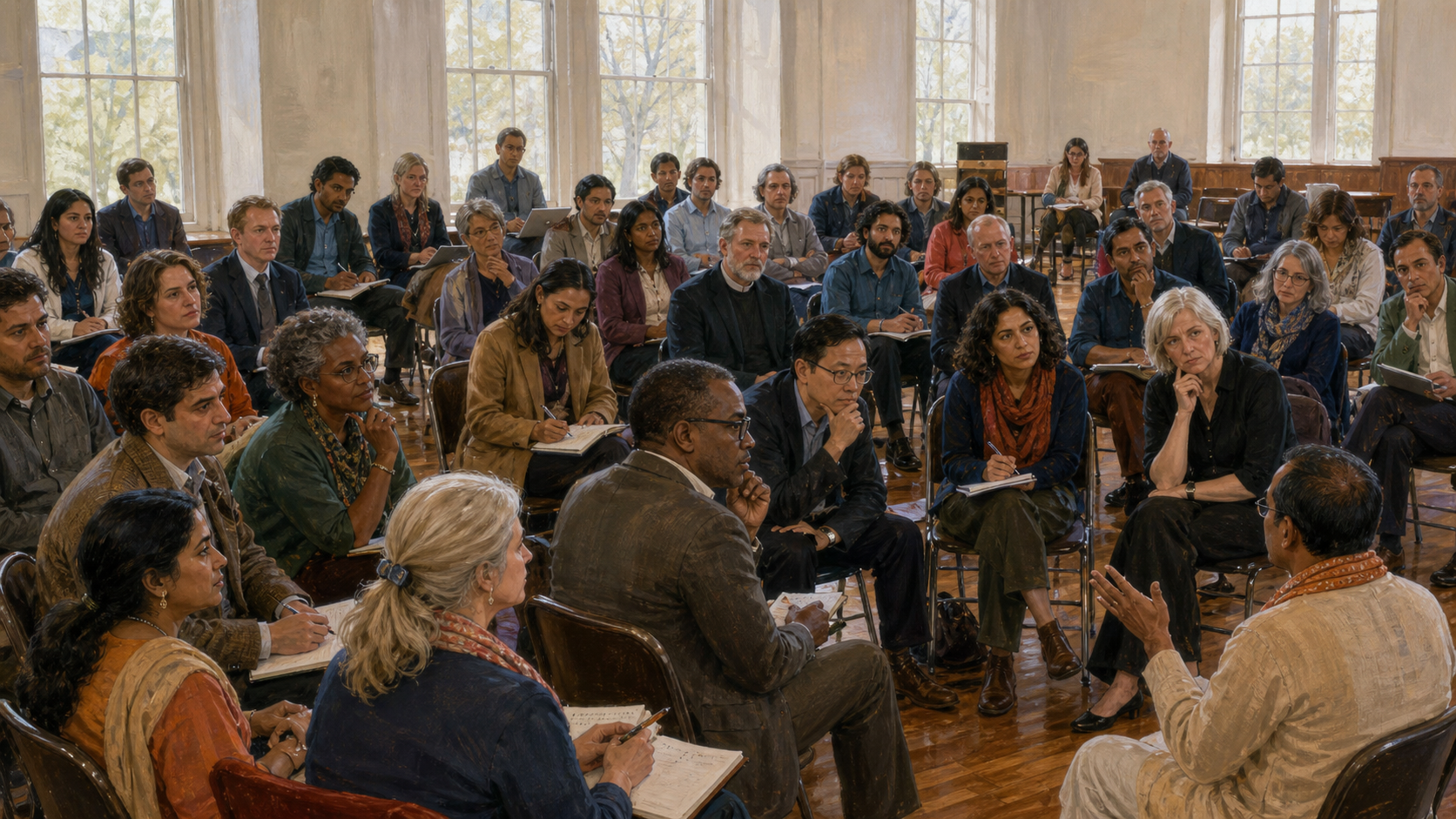
During the RSS centenary year, General Secretary Dattatreya Hosabale visited the United States in April 2026 and participated in interactions at the Hudson Institute and Stanford University. Senior RSS functionaries had engaged overseas audiences before, especially the Indian diaspora in the post-independence period, but these meetings widened the field toward American academic and policy circles.
The shift in audience is more important than the prestige of the names. A diaspora gathering may begin with shared memories, cultural references, or familiarity with Hindu vocabulary. An American policy or university setting cannot assume any of those things. Terms such as dharma, Hindu, nation, civilisation, pluralism, and secularism have to be explained across different intellectual histories.
This creates a harder but more productive test. Can an RSS representative explain an Indian civilisational position without reducing it to familiar Western labels? Can an American interlocutor question that position without assuming that Western political categories are universally self-explanatory? If both sides have to clarify their premises, the encounter has moved beyond community reassurance.
Do not make either of the common interpretive leaps. An appearance at Stanford University or the Hudson Institute does not mean that every scholar, host, or institutional body accepts the RSS’s views. Institutions contain many people and positions, and an invitation can indicate curiosity, disagreement, or a willingness to listen. But continuing criticism does not make the meeting meaningless either. Access creates an opportunity to test arguments; it does not predetermine the result.
Civilisational dialogue requires translation without surrender

A civilisational argument fails when it becomes either a slogan or an apology. The speaker must make indigenous concepts intelligible without pretending that they are merely Indian versions of Western concepts. The listener must remain open to unfamiliar categories without suspending critical judgment.
You can test any such exchange with a simple translation discipline:
- Name the indigenous term. Do not conceal it behind a convenient English substitute.
- Give it a working meaning. Explain its moral, social, philosophical, or spiritual range in the context being discussed.
- Show its practical consequence. State what changes in public reasoning if the concept is taken seriously.
- State its boundary. Identify what the concept does not prove and which political or social questions it leaves open.
Consider dharma. Translating it simply as religion can import assumptions shaped by church membership, exclusive creed, and institutional authority. Yet leaving dharma untranslated and unexplained turns it into an insider’s password. A useful account should describe the relevant sense of dharma, show how it informs conduct or social order, and acknowledge that Hindu, Buddhist, Jain, and Sikh uses of related language are not identical.
The same care is needed with Bharat as a civilisation. Civilisational language can refer to inherited memory, sacred geography, cultural continuity, intellectual traditions, and patterns of social life. It does not by itself settle questions about state power, borders, constitutional rules, or citizenship. Keeping those levels distinct prevents both supporters and critics from treating every cultural claim as an unstated policy programme.
The RSS must also remain distinct from the civilisation it discusses. It can articulate an influential organisational understanding of Hindu society, but it is not a synonym for every Hindu or for the entire Dharmic family. American interlocutors should not treat one organisation as the sole voice of Hindu civilisation. RSS supporters, in turn, should not treat every disagreement with the organisation as a rejection of Hinduism, Bharat, or dharma.
Hard questions are part of dialogue, not evidence of its failure

Some Western academic and media portrayals apply the label Hindu supremacist to the RSS, while its supporters regard that description as a serious distortion produced by limited information, entrenched bias, and inadequate understanding of Hindu philosophical traditions. Those are competing interpretations, not a dispute that can be resolved by repeating either label more forcefully.
If you encounter such a charge, move from the label to a proposition that can be examined. Ask:
- Which exact statement, policy, action, or organisational practice is being criticised?
- Is the claim descriptive, alleging what the RSS is, or predictive, alleging what its ideas could produce?
- Does the evidence represent an official position, a particular functionary, an affiliated body, or an unaffiliated supporter?
- What does the critic mean by supremacy, and what evidence would distinguish it from cultural confidence, majoritarian politics, religious nationalism, or ordinary conservatism?
- Has the RSS’s response answered the underlying concern, or only objected to the terminology?
This method places a burden on both sides. An RSS representative should explain how civilisational solidarity relates to equal citizenship, political power, religious difference, and the dignity of minorities. A critic should define the standard being applied, use evidence in context, and remain willing to revise a category that does not fit Indian realities. Neither sympathetic self-description nor hostile classification should receive automatic immunity from scrutiny.
That is not false equivalence. Claims vary in quality, and evidence still has to be weighed. It is simply the discipline required for a conversation in which Indian concepts can question Western frameworks while Indian organisations remain answerable for their own statements and conduct.
Key takeaways: five signs that the engagement is becoming durable

- Continuity: Look for further exchanges, responses to unresolved questions, and relationships that continue after a prominent visit. A single appearance demonstrates access, not sustained influence.
- Reciprocity: RSS speakers should translate their ideas for American audiences, but American participants should also examine the assumptions built into their own political and academic vocabulary.
- Specificity: Productive discussion replaces labels with defined claims, primary context, and answers that can be checked. Vague accusations and equally vague declarations of civilisational greatness do not deepen understanding.
- Plurality: Interlocutors should distinguish the RSS from the whole of Hindu society and distinguish Hindu traditions from other Dharmic traditions, while still allowing discussion of shared civilisational inheritances.
- A public trace: Where recordings, transcripts, essays, or written responses become available, use them to assess what was actually argued. Where no record is available, describe the outcome as unknown rather than filling the silence with triumph or suspicion.
These signals protect you from confusing reputation with substance. The important question is not whether a familiar institution supplied a stage. It is whether participants left behind clearer concepts, better-framed disagreements, and questions that later exchanges can answer.
How you can discuss the visit without overstating it
If you are a diaspora organiser, student, writer, or ordinary reader sharing this development, your language can either improve the conversation or turn it into another loyalty test. Use four practical rules.
- Separate fact, interpretation, and prediction. The meetings and the widening of the intended audience are factual. Claims that the RSS has gained American legitimacy, transformed academic opinion, or permanently corrected its image require further evidence.
- Use institutional names narrowly. Say that an interaction occurred at a named institution. Do not turn that into an endorsement by the institution, American academia, or the United States.
- Translate before you defend. When a listener challenges a term such as dharma or civilisation, define the term and its limits before alleging prejudice. A misunderstanding may reveal bias, but it may also reveal that the explanation was incomplete.
- Ask critics for the object of criticism. Request the exact claim and evidence rather than arguing against a general atmosphere of disapproval. Then address the strongest specific concern directly.
If you help organise a future forum, circulate definitions before the event, preserve time for unscripted questions, and invite written clarification afterward. Include participants able to distinguish theology, history, social organisation, and state policy. Those subjects overlap, but treating them as interchangeable is one of the quickest ways to produce heat without understanding.
The April 2026 visit opened a wider room for the RSS; it did not finish the argument inside that room. The next useful step is to demand the same thing from advocates and critics: precise language, contextual evidence, reciprocal scrutiny, and enough continuity for each side to answer what it did not answer the first time.
References
