
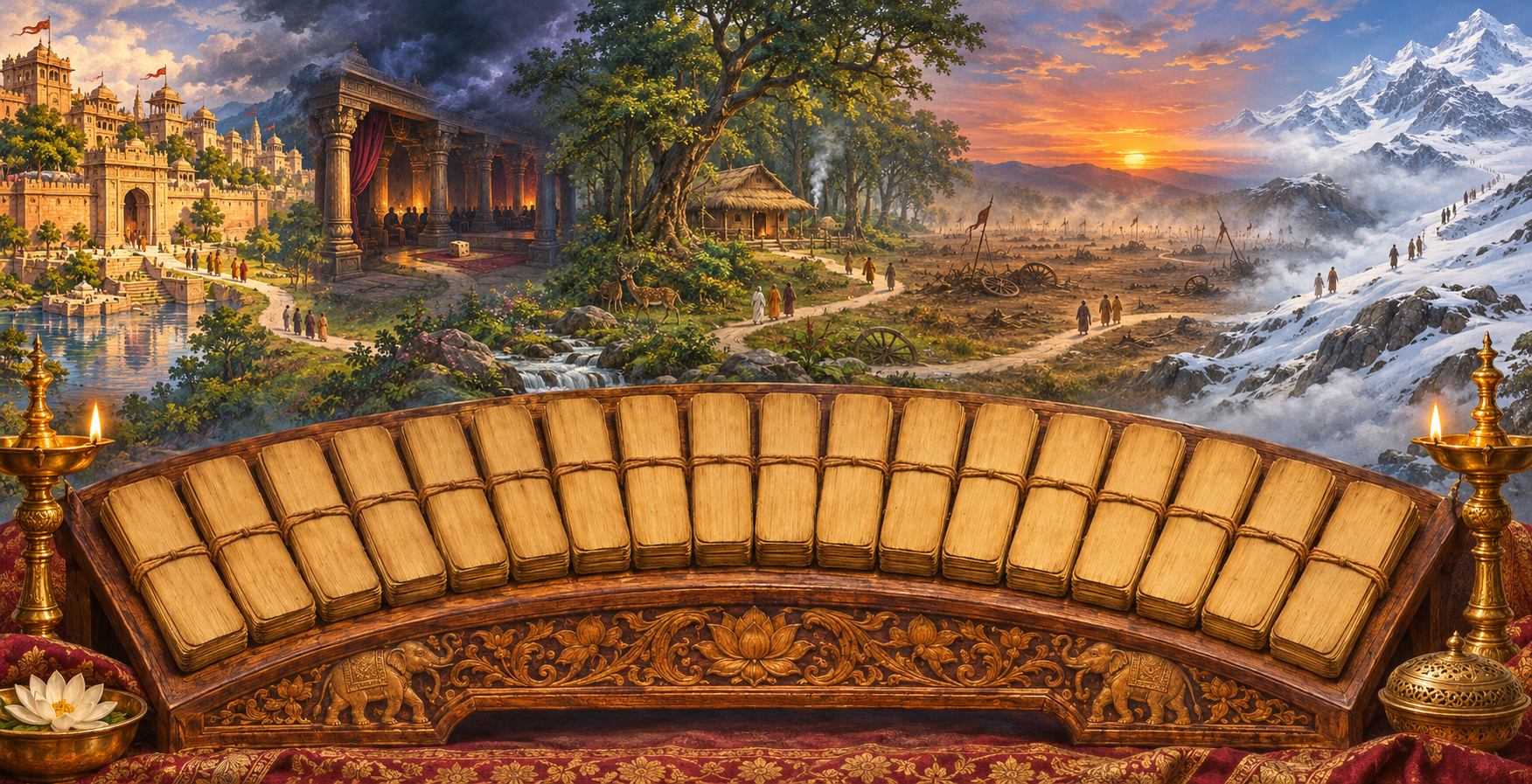
You may know the central figures of the Mahabharata and still lose your place once you begin reading. A family crisis can open into an embedded story, a debate on duty, a pilgrimage, or a long discourse on kingship. Without a map, those changes can feel like detours, while the war can appear to be the whole point.
Use the eighteen parvas as your route map. They move from origins and courtly power through exile, failed peacemaking, war, grief, instruction, restoration, withdrawal, and renunciation. Once you see that movement, you can read particular episodes without mistaking one episode for the message of the entire epic.
A map of all 18 parvas
A parva is a major division or book of the Mahabharata. Spellings can vary between transliterations, but the sequence is the reliable anchor. The five larger movements used below are a reading aid, not an additional canonical division.
| Parva | Place in the larger movement | What it does | A question to carry while reading |
|---|---|---|---|
| 1. Adi Parva | Origins | Establishes ancestry, relationships, inheritances, rivalries, and the conditions from which the central conflict grows. | Which later choices are already being shaped by inherited obligations and grievances? |
| 2. Sabha Parva | Court and crisis | Moves the conflict into assemblies, sovereignty, ceremony, competition, and the dice game that transforms rivalry into dispossession. | What does public power reveal about private weakness? |
| 3. Vana Parva | Exile | Slows the outward action during forest life and expands the epic through encounters, teachings, pilgrimages, and stories within the story. | How can dharma be sustained when status, security, and ordinary social roles have been stripped away? |
| 4. Virata Parva | Concealment and return | Tests the Pandavas through concealed identities before they return to public political life. | Can discipline survive humiliation, danger, and the inability to act openly? |
| 5. Udyoga Parva | Failed settlement | Gathers negotiations, competing claims, alliances, counsel, and preparations as the possibility of peace narrows. | Why does peace fail even after the likely cost has become visible? |
| 6. Bhishma Parva | War | Begins the battlefield sequence and contains the Bhagavad Gita, placing a profound inquiry into action and duty at the threshold of combat. | How should a person act when duty, kinship, grief, and moral uncertainty collide? |
| 7. Drona Parva | War | Shows the conflict intensifying as restraints weaken and the human cost grows. | What changes when victory begins to justify methods that would once have been resisted? |
| 8. Karna Parva | War | Brings loyalty, identity, rivalry, fate, and long-carried commitments into a decisive phase. | When does fidelity become noble, and when does it bind someone to a destructive course? |
| 9. Shalya Parva | War’s end | Brings the main battlefield struggle toward its exhausted conclusion. | What can victory mean when almost everything that gave victory value has been spent? |
| 10. Sauptika Parva | War’s aftershock | Extends violence beyond the expected limits of battle through a night attack driven by vengeance. | Where does vengeance go when the formal occasion for fighting should already be over? |
| 11. Stri Parva | Grief | Turns from warriors and strategy to the women who mourn, making the cost of the conflict impossible to treat as an abstraction. | Whose suffering disappears when war is told only through the decisions of combatants? |
| 12. Shanti Parva | Instruction and government | Confronts the crisis of ruling after catastrophe and opens extensive teaching on duty, kingship, order, emergency, and liberation. | What must a victorious person learn before becoming fit to exercise authority? |
| 13. Anushasana Parva | Instruction and conduct | Continues ethical instruction by moving from broad principles toward duties, conduct, generosity, and disciplined practice. | How does an admired principle become repeated conduct rather than occasional sentiment? |
| 14. Ashvamedhika Parva | Restoration | Addresses sovereignty and the difficult work of re-establishing political order after devastation. | Can public order be rebuilt without pretending that the past has been repaired? |
| 15. Ashramavasika Parva | Withdrawal | Follows members of the older generation as palace life gives way to retreat, age, separation, and relinquishment. | What does letting go require from people whose identities were formed by family and court? |
| 16. Mausala Parva | Dissolution | Shows destruction reaching the world associated with Krishna and removes any easy assumption that the victors can preserve the old order indefinitely. | What remains of worldly success when dissolution reaches the side that survived the war? |
| 17. Mahaprasthanika Parva | Renunciation | Follows the Pandavas as they relinquish rule and undertake their final journey. | What remains when authority, possession, companionship, and achievement must be released? |
| 18. Svargarohana Parva | Final testing and resolution | Completes the journey through testing, reversal, and a spiritual horizon larger than worldly appearances. | How are ordinary judgments of success, failure, reward, and righteousness transformed at the end? |
Do not try to memorize every event before reading. Memorize the movement: formation, conflict, consequence, instruction, and release. That is enough to tell you why a passage is where it is.
What the sequence teaches that a plot summary misses
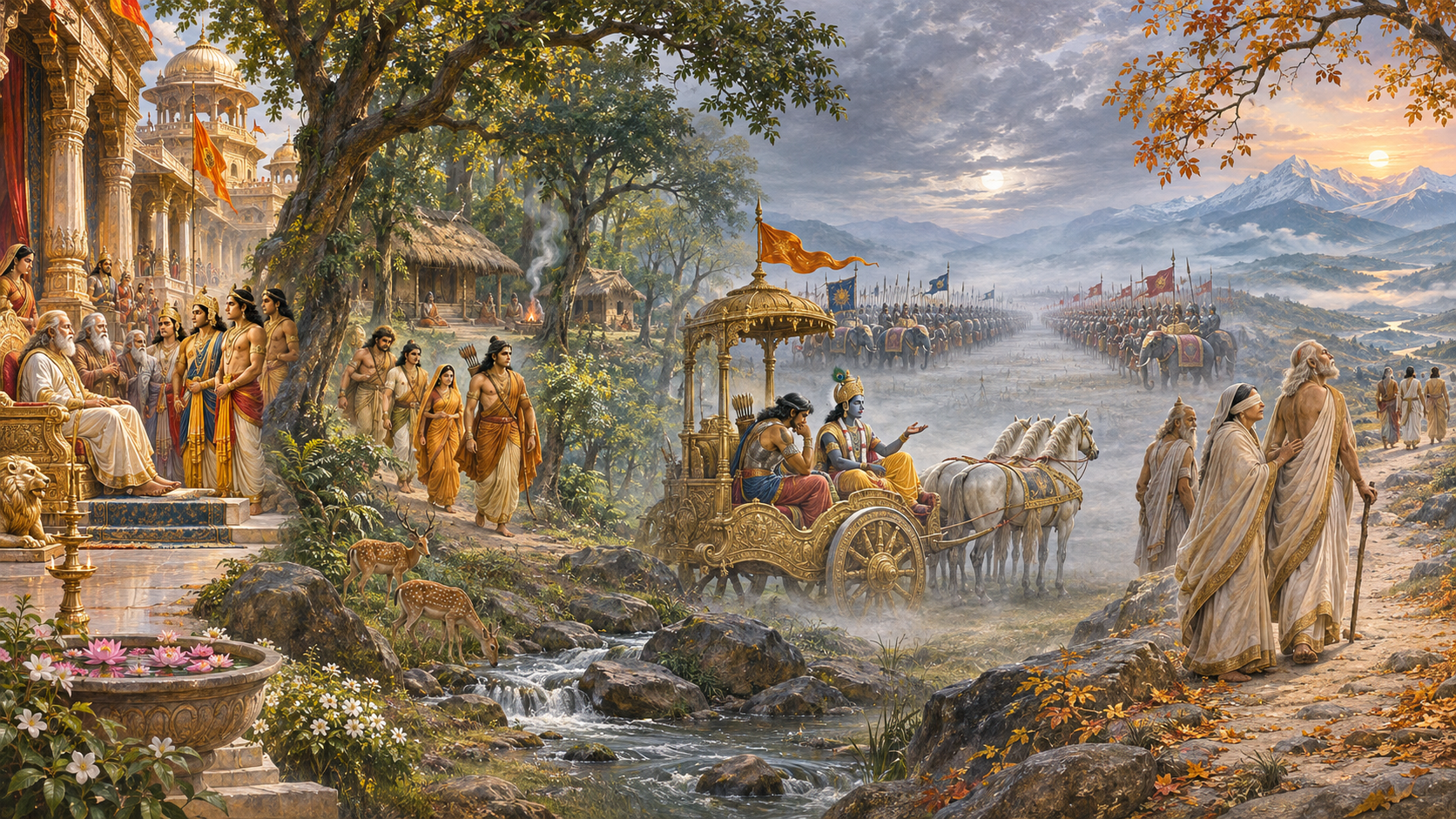
The placement of the parvas is itself an interpretation of the conflict. Five parvas bring you to the battlefield. Five form the combat sequence, including its night-time aftershock. Eight remain after that. The war is central, but it is not the epic’s final measure of meaning.
Causation comes before combat
Adi Parva gives the conflict a history. Sabha Parva shows how status, desire, humiliation, and defective judgment turn tension into disaster. Vana and Virata make you live with the consequences before anyone reaches the battlefield. Udyoga then makes room for counsel and attempted settlement.
This order prevents a common misreading: war does not simply arrive because one side is wicked and the other is strong. It becomes possible through accumulated decisions, tolerated wrongs, binding loyalties, political calculations, and failures to accept restraint. When you read, keep asking where a later catastrophe was still preventable. The answer may be several parvas earlier.
Reflection surrounds action
The Bhagavad Gita appears in Bhishma Parva before the battle fully unfolds, when action itself has become morally difficult. Shanti and Anushasana appear after the destruction, when action has produced consequences that cannot be undone. The epic therefore places instruction on both sides of the central ordeal: first, how to act amid conflict; later, how to govern and live after action has altered the world.
If you read the Gita by itself, remember its structural location. It answers a crisis at the threshold of action, not every question raised by the war’s aftermath. Stri, Shanti, and Anushasana are essential to the larger inquiry because grief, responsibility, and reconstruction ask different questions from those asked before combat.
Victory does not close the moral account
Stri Parva follows the combat sequence immediately. This is not a decorative lament placed after the real story. It changes the reader’s field of vision. Strategy gives way to bereavement, and the language of victory is tested against those who must live with its price.
Shanti Parva then refuses to let sovereignty function as a simple reward. Authority becomes a burden requiring knowledge, discipline, and moral formation. If you jump from the battlefield directly to restoration, you miss a decisive turn: surviving a struggle does not by itself make someone ready to rule after it.
Five themes to track across the whole epic
The broad contrast between the Pandavas and the Kauravas gives a first-time reader an entry point. The Kauravas’ jealousy, deceit, enmity, and pride plainly matter, while Krishna and the Pandavas provide crucial counterpoints. But a useful reading cannot stop at sorting everyone into good and bad. The structure keeps asking what happens when knowledge, desire, loyalty, role, and consequence pull in different directions.
Dharma becomes visible when duties conflict
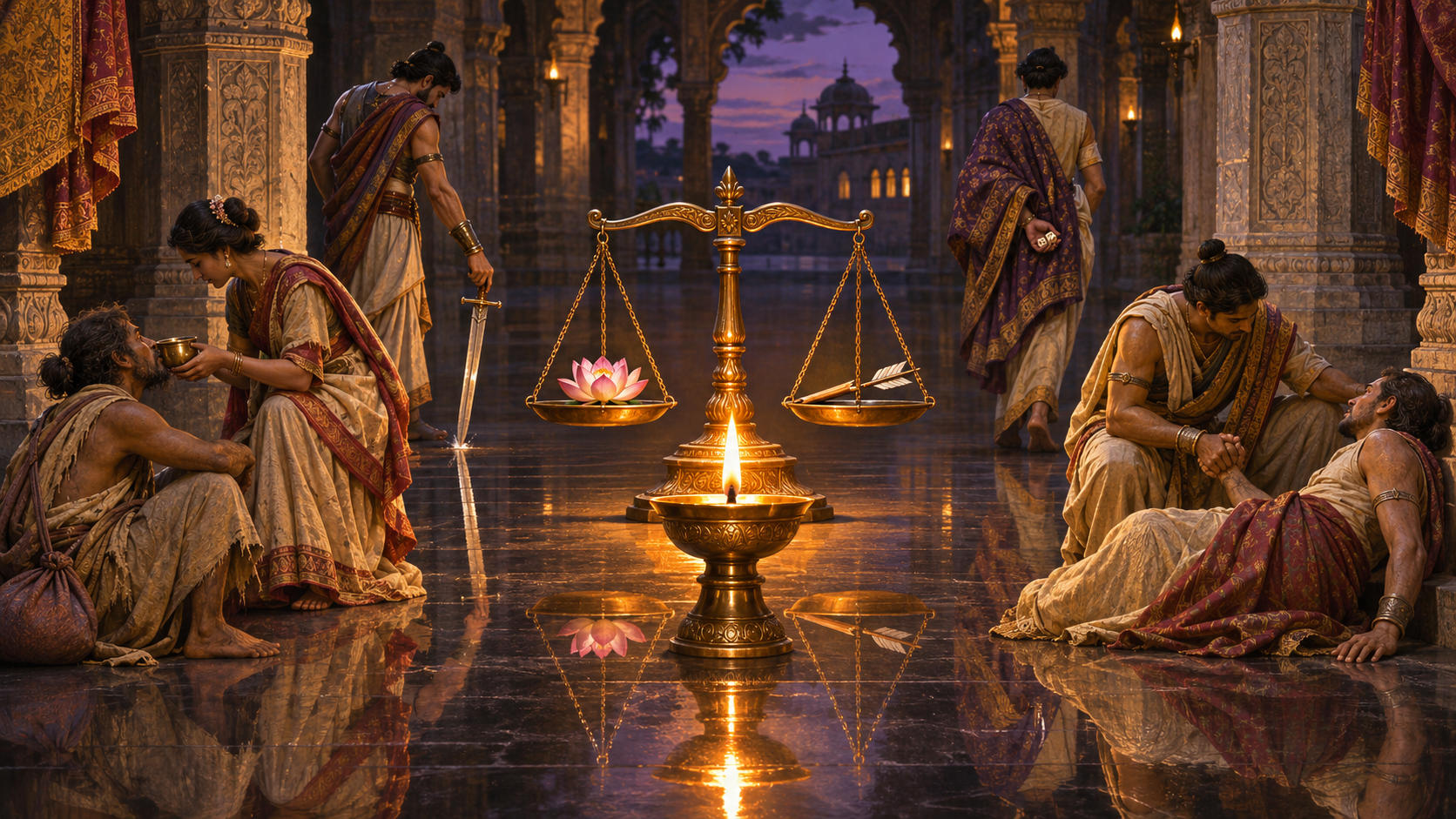
Dharma is not presented merely as a slogan that settles every problem on contact. A person can face duties to kin, ruler, promise, guest, teacher, dependent, and the wider social order at the same time. The hard cases arise when honoring one obligation appears to injure another.
When a character invokes dharma, write down the role from which that claim is being made. Then ask who bears the cost of that interpretation and what alternative duty is being set aside. This keeps a noble word from ending the inquiry too early.
Power magnifies failures of self-rule
Sabha Parva is especially important because it connects command over others with command over oneself. Courtly splendor, reputation, rivalry, and public honor do not create wisdom. They can enlarge the consequences of envy, pride, anger, or attachment when those impulses remain undisciplined.
Watch what happens whenever private desire acquires institutional force. A resentment held by one person becomes more dangerous when a court ratifies it, allies enable it, or respected figures remain passive. That pattern lets you read the political scenes as examinations of character expressed through systems, not merely as palace intrigue.
Counsel matters only when someone can receive it
The epic repeatedly gives space to warning, argument, negotiation, and moral instruction. The presence of good counsel does not guarantee a good decision. A listener may understand the words and still be unable to loosen pride, fear, loyalty, or desire enough to act on them.
As you read Udyoga Parva, distinguish between lack of knowledge and refusal of knowledge. That difference matters. More explanation can help the first problem; it may do little against the second. The question is not only who offered the wisest advice, but what made the hearer receptive or resistant.
Consequences belong to the action
The later parvas prevent you from isolating a heroic deed from everything that follows it. Stri makes grief part of the meaning of battle. Shanti and Anushasana make government part of the meaning of victory. Ashramavasika, Mausala, Mahaprasthanika, and Svargarohana place worldly achievement inside mortality, loss, dissolution, and spiritual judgment.
For every major choice, record both its immediate result and its delayed result. A decision that succeeds tactically may fail relationally, politically, or spiritually. The parva structure trains you to lengthen the time over which an action is judged.
Renunciation completes the political story
The Mahabharata does not end with possession of a kingdom. Its final movement takes status and security away again. That ending changes how you read the ambitions of the opening books: authority may have to be defended and responsibly exercised, but it cannot be the permanent ground of identity.
Do not treat the last parvas as a brief epilogue after the important events. They test whether the reader has mistaken restoration for completion. The final question is not simply who rules. It is what can be carried beyond rule, loss, and death.
A practical way to read without losing the thread
You do not need to read every part at the same speed. You do need to preserve the order of the moral movement. The following method works whether you are reading a complete translation, following a traditional recitation, or studying selected passages.
- Anchor the parva before the passage. Before reading, write one phrase beside the title: origins, court, exile, diplomacy, war, grief, instruction, restoration, withdrawal, dissolution, or renunciation. When an embedded story begins, this phrase reminds you of the larger question it may be serving.
- Separate event, counsel, and embedded narrative. Mark whether the passage advances the main action, presents an argument, or tells another story as a mirror or warning. Do not dismiss the last two as interruptions. Ask why this teaching or tale has been placed at this particular pressure point.
- Keep a decision ledger. For each turning point, record the conflict, the duty claimed, the alternative rejected, the immediate result, and the delayed result. This is more useful than a list of characters because it exposes the moral mechanism of the story.
- Slow down at the hinges. Sabha changes rivalry into dispossession. Udyoga changes dispute into war. Stri changes victory into grief. Shanti changes survival into responsibility. If one of those transitions feels abrupt, reread the end of the earlier parva before continuing.
- Test moral labels against actual choices. Calling one side righteous and the other unrighteous may orient you, but it should not prevent close judgment. Ask what each person knew, what pressures were present, what was chosen, and who paid for it.
- Finish the aftermath. Do not stop when the battlefield narrative ends. Reading through grief, instruction, restoration, withdrawal, and the final journey is what turns a war chronicle into a sustained inquiry into dharma.
If you are approaching the Mahabharata with a particular question, use a focused route while keeping the full sequence in view:
- For action and moral conflict: read Udyoga before Bhishma, then read Stri afterward. You will see the failed alternatives before action and the human consequences after it.
- For kingship and public duty: begin with the grief of Stri before entering Shanti and Anushasana. This keeps governance connected to the damage it must answer.
- For power and its limits: place Sabha beside Ashvamedhika. The first shows power amid rivalry and vulnerability; the second shows sovereignty being reconstructed after devastation.
- For renunciation: read Ashramavasika, Mausala, Mahaprasthanika, and Svargarohana as one continuous movement from withdrawal to dissolution and final testing.
- For the roots of the conflict: read Adi and Sabha together, then use later consequences to revisit the assumptions and decisions established there.
A focused route is a doorway, not a replacement for the whole. Return each selected parva to its position in the eighteen-part arc before drawing a conclusion from it.
Key takeaways
- The eighteen parvas are not simply containers for episodes. Their sequence moves the reader from causes to choices, consequences, responsibility, and relinquishment.
- Only the middle of the epic is devoted to the combat sequence. Five parvas prepare for it, and eight follow it, so the Mahabharata cannot be reduced to its war.
- The Bhagavad Gita addresses duty at the threshold of action; Stri, Shanti, and Anushasana address grief, rule, and conduct after action has changed the world.
- The most useful reading question is not only who was right. Ask which duty was claimed, which duty was displaced, who bore the cost, and when the full consequence appeared.
- The final parvas are essential. By ending with withdrawal and transcendence rather than possession, they place political victory inside a larger Dharmic horizon.
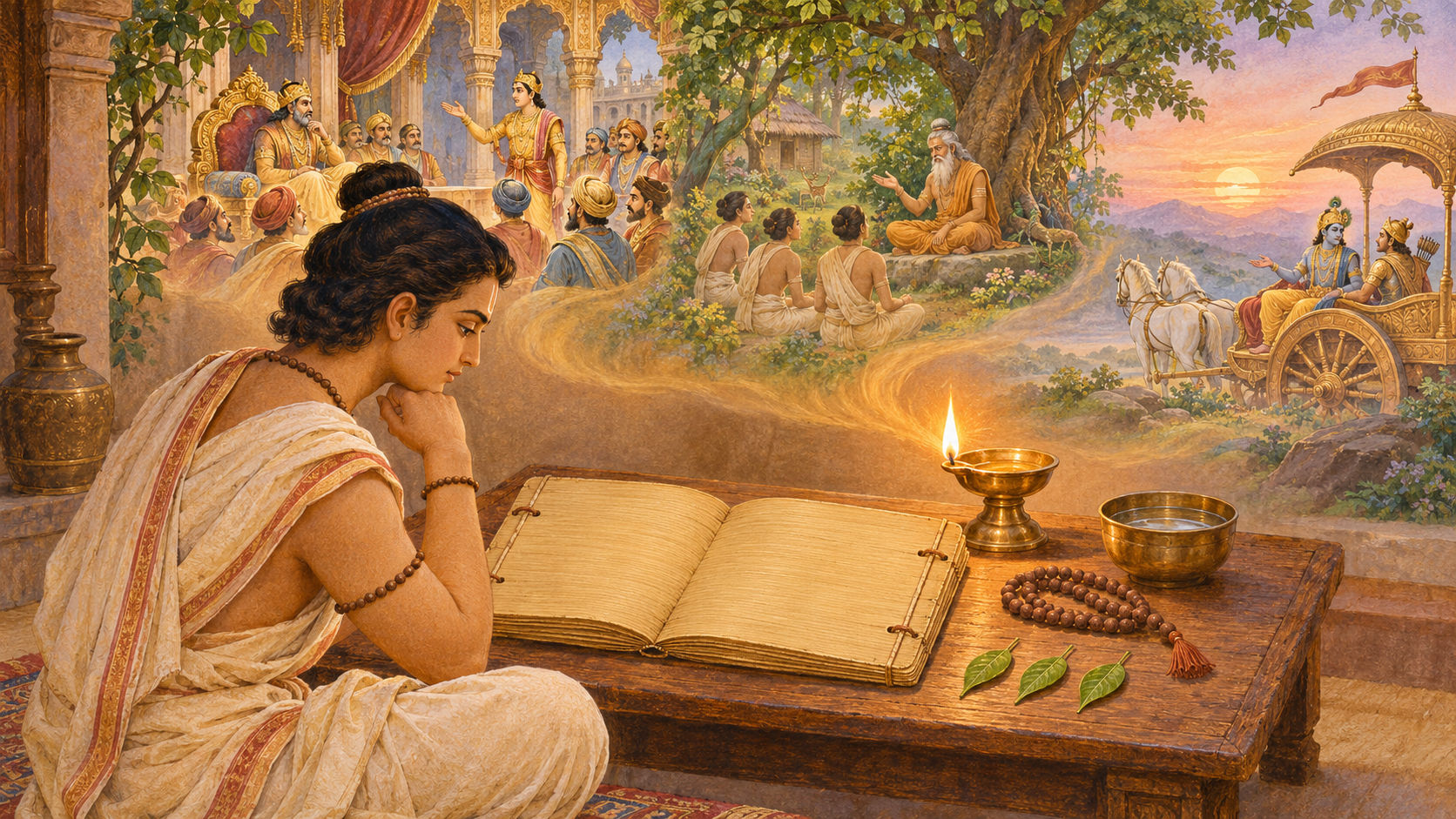
Open your edition at its contents page before your next reading session. Mark the larger movement beside each of the eighteen titles, then carry one question from the table into the passage. That small habit turns an intimidating mass of stories into a structured inquiry whose parts illuminate one another.
References

Leave a Reply
You must be logged in to post a comment.