
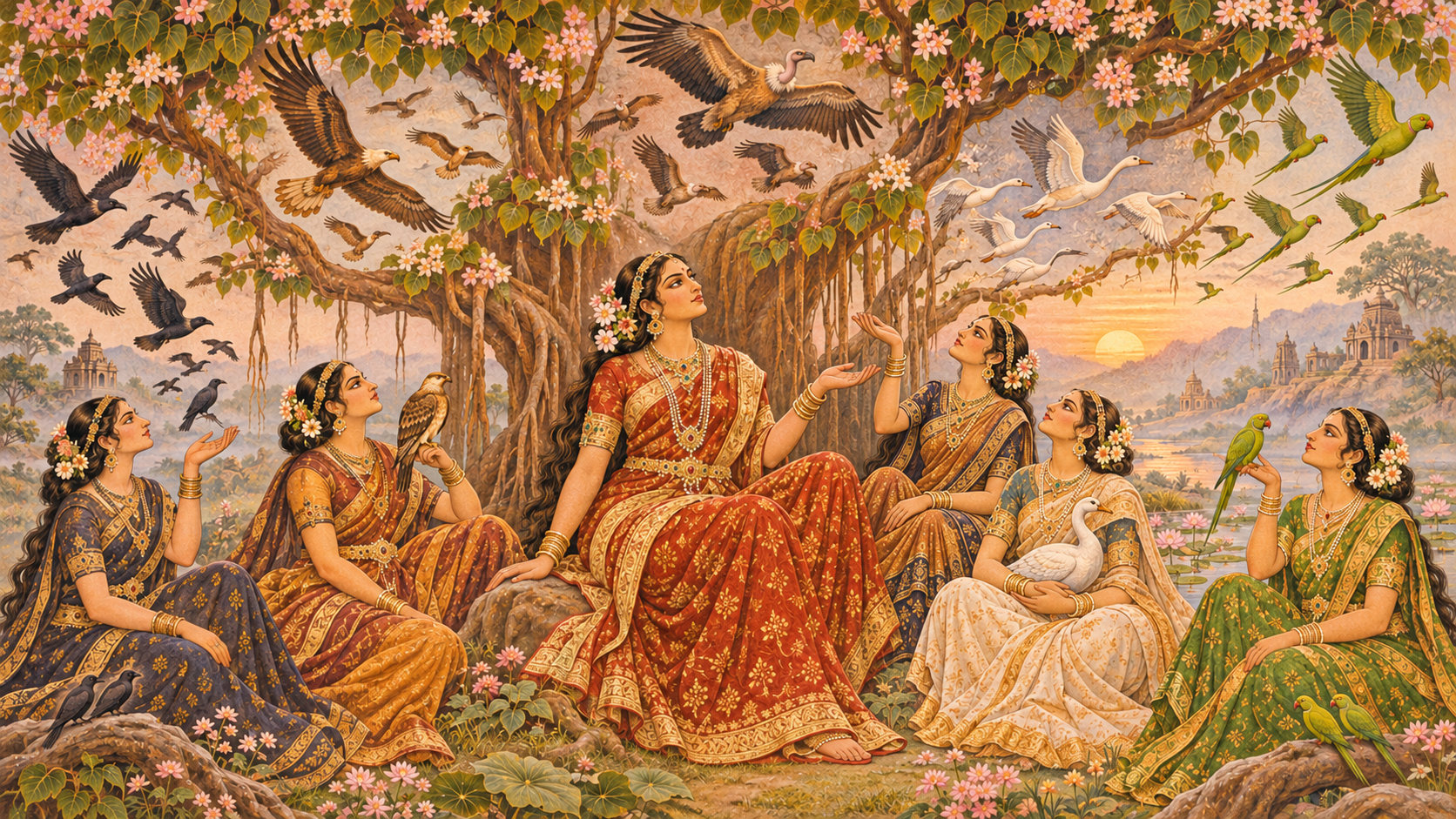
You may encounter Tamra as one name inside a dense Mahabharata genealogy and wonder why she matters. The short answer is that she is the maternal hinge in the epic’s account of bird origins: one ancestral line passes through her five daughters and opens into multiple avian branches.
The names become much easier to understand when you stop treating them as an isolated list. Trace the levels of descent instead. That simple change reveals what the genealogy is doing, why the five daughters are essential, and how to explain the account without confusing sacred cosmology with modern zoology.
Place Tamra inside the larger family tree
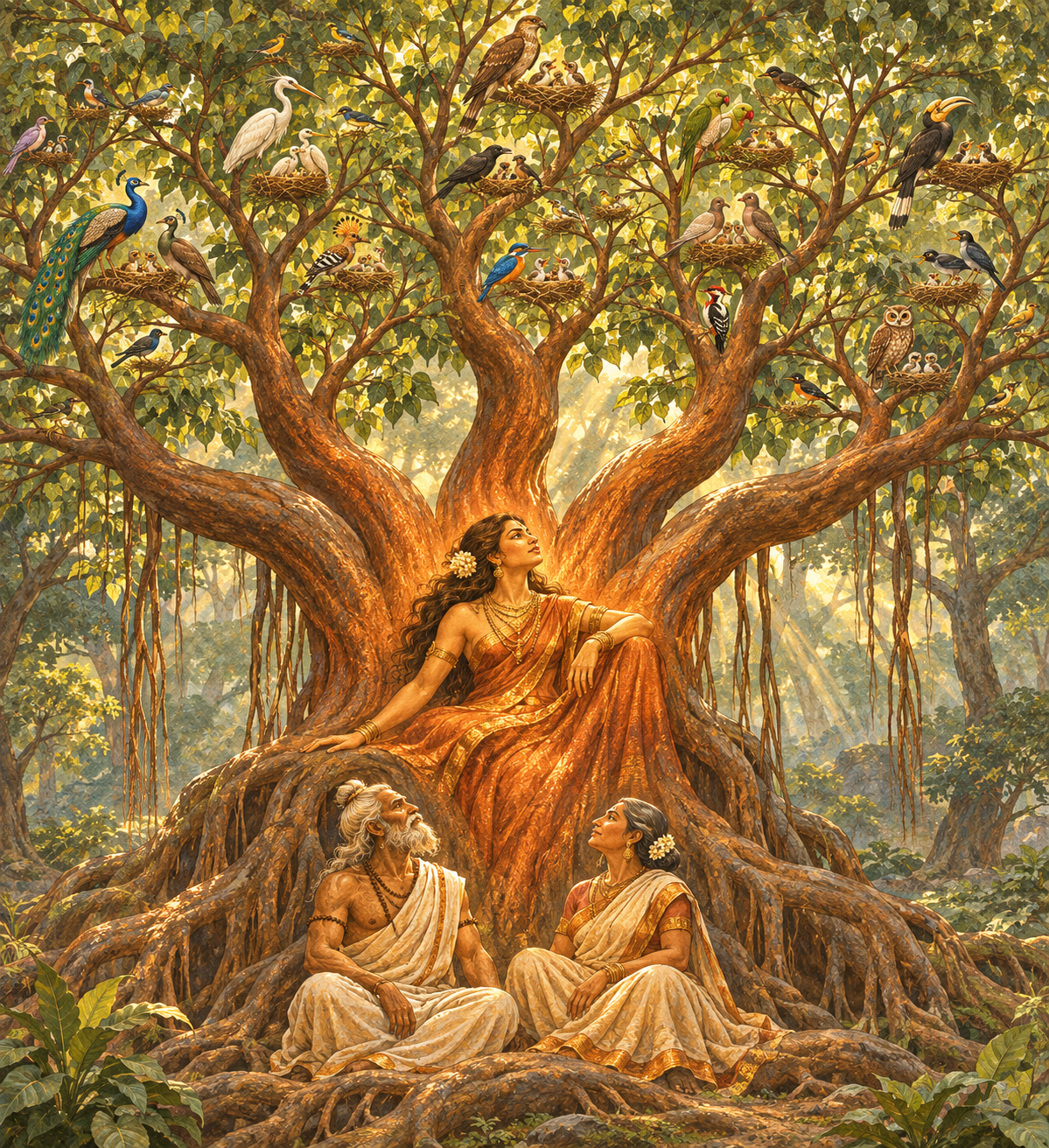
Tamra’s branch belongs to the Adi Parva, within the Sambhava Parva, in chapter 60. The surrounding genealogy encompasses sages, human beings, animals, birds, and lines of descent connected to Brahma. Tamra therefore does not enter the narrative as the heroine of a detached bird story. She occupies one branch of a much larger account of generation and relationship.
That context changes how you should read her. A list of bird ancestors can appear arbitrary when removed from the Sambhava Parva. Inside the full genealogy, however, the progression is intelligible: creation is narrated through descent, broad ancestral lines divide into narrower branches, and different kinds of beings receive a place within the same ordered world.
Use this sequence when you make notes:
- Begin with Brahma and the chapter’s broad genealogical frame.
- Locate Tamra as the ancestral mother of the avian branch under discussion.
- Place her five daughters on the next level rather than writing their information in one continuous sentence.
- Put the bird lineages beneath the appropriate daughter.
- Return to the surrounding genealogy and compare this branching pattern with the chapter’s treatment of other beings.
This method prevents a common mistake: remembering that Tamra is associated with birds while losing the actual structure of the relationship. Her significance lies not merely in appearing near a list of birds, but in connecting them through a maternal genealogy.
Why Tamra’s five daughters are structurally important
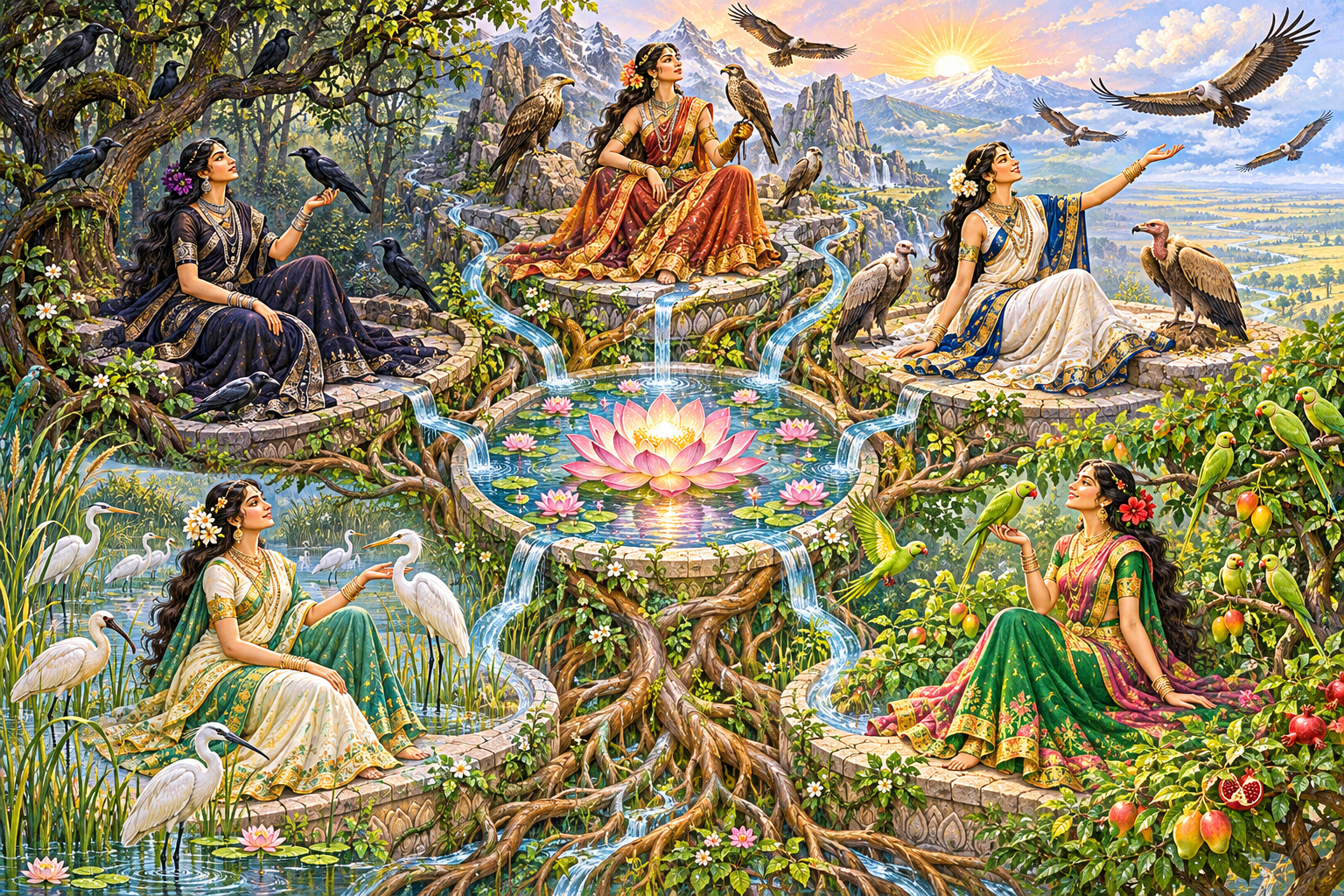
The five daughters form the middle layer of the family tree. Tamra stands above them as the shared maternal figure; the avian lines unfold below them. If you omit this middle generation, the account collapses into a loose catalogue. If you preserve it, you can see how the epic organizes plurality through kinship.
- Tamra: the ancestral mother anchoring this part of the genealogy.
- Five daughters: the branch points through which the single maternal line divides.
- Avian descendants: the differentiated bird lineages placed beneath those branches.
This three-level map is more useful than memorizing a string of proper names. It shows both unity and differentiation. The birds do not appear as unrelated additions to creation; they belong to lines of descent. At the same time, shared ancestry does not erase distinction, because the five daughters preserve separate branches within the larger family.
The maternal sequence also deserves attention in its own right. Tamra and her daughters are not decorative figures surrounding the supposedly important bird names. They carry the architecture of the account. A retelling that jumps directly from a remote creator to individual birds removes the very relationships by which this part of the Sambhava genealogy is constructed.
Read the genealogy as cosmology, not modern taxonomy
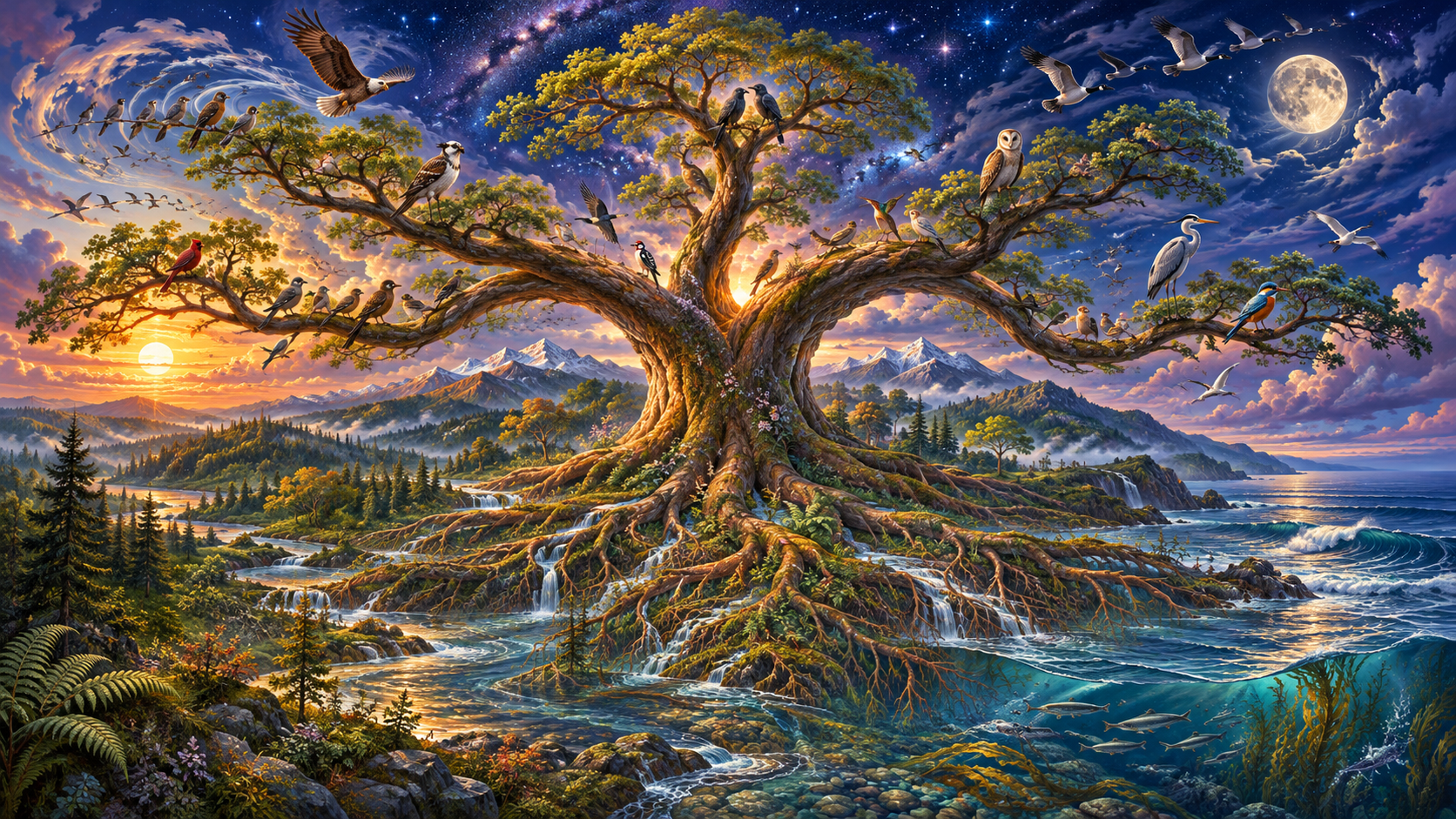
A Mahabharata genealogy and a modern biological classification do not ask the same question. Modern taxonomy classifies organisms through scientific criteria and evidence. Epic genealogy narrates origins through ancestry, relationship, and position within a created order. Treating one as though it were an unsuccessful version of the other produces a category error.
This distinction lets you discuss the account with both fidelity and intellectual clarity. Say that the Mahabharata narrates bird origins through Tamra and her daughters. Do not turn that theological and genealogical statement into an unsupported claim about contemporary ornithology. Conversely, do not dismiss the genealogy merely because it is not written as a field guide. Its subject is the place of birds in an interconnected cosmos, not the laboratory classification of species.
The form itself carries meaning. Birds are not scenery placed around a human story. They are given ancestry and a position inside the same expansive history of beings that includes sages, humanity, and other creatures. You need not manufacture a separate ecological doctrine to recognize the implication: avian life is represented relationally rather than as an anonymous mass outside the sacred order.
Keep the distinction explicit when speaking to children, students, or readers unfamiliar with epic cosmology. A clear formulation is: this is how the Mahabharata situates birds within its genealogy of creation. That wording neither reduces the account to fantasy nor misrepresents it as a scientific classification.
How to study or teach the account accurately
You can avoid most confusion by separating what the genealogy states from what you infer from it. The stated framework includes Tamra, her five daughters, their connection to bird origins, and their place in the broader Sambhava genealogy. Reflections about kinship, sacred order, or humanity’s relationship with other life can be valuable, but label them as interpretation rather than placing them silently into the text.
Four habits make a retelling more reliable:
- Give the textual location. Identify the Adi Parva and Sambhava Parva before discussing the family tree. Chapter 60 is the supplied location, while the parva names help a reader find the context.
- Draw the hierarchy. Put Tamra on one line, the five daughters on the next, and the avian descendants beneath them. Indentation exposes errors that disappear inside prose.
- Do not improvise missing names. If you cannot verify a daughter or descendant in the edition before you, leave a blank in your chart until you can. A neat but invented family tree is worse than an incomplete one.
- Distinguish genealogy from species identification. Do not assign a traditional name to a precise modern species unless the text or a dependable commentary justifies that identification.
It also helps to read beyond Tamra’s immediate branch. The chapter’s wider movement among sages, humans, animals, and birds shows that avian origins are one part of a comprehensive genealogical vision. Reading only the bird lines can answer who descends from whom, but reading the surrounding material answers the larger question: why is this genealogy here?
If you are preparing a lesson, give learners the blank three-level tree before supplying the names. Ask them to place each figure by relationship. This turns a difficult list into an exercise in close reading and makes it immediately apparent that the five daughters, not merely the final bird groups, organize the material.
Key takeaways
- Tamra is the maternal anchor of the Mahabharata’s bird genealogy in this part of the Sambhava Parva.
- Her five daughters are essential branch points, not incidental names between Tamra and the avian descendants.
- The account belongs to a wider genealogy embracing sages, humans, animals, birds, and lines associated with Brahma.
- The most accurate reading treats it as epic cosmology and sacred genealogy, not as a substitute for modern biological taxonomy.
- A three-level family tree is the clearest way to study, teach, or verify the relationships.
When you next open the Sambhava Parva, keep a blank page beside it. Write Tamra at the top, give each daughter her own branch, and add descendants only as you verify them. You will come away with more than a remembered list: you will see how the Mahabharata gives birds a lineage within its larger vision of life.
References

Leave a Reply
You must be logged in to post a comment.