

You may have looked at Krishna climbing onto Yashoda’s shoulder and wondered whether the scene is simply affectionate or whether it carries a deeper teaching. It carries both. Its tenderness is not decoration added to theology; the tenderness is the theology.
This image gives you a practical way to approach the Divine when formal prayer feels distant. It holds infinity and intimacy together: Krishna is not less divine when he plays with his mother, and Yashoda’s ordinary act of carrying him is not spiritually small.
The paradox is the heart of the scene

Krishna is contemplated as Narayana, the one who sustains the universe. Yet in this moment, the cosmic sustainer freely enters a child’s playful dependence upon his mother. The apparent contradiction is precisely what makes the scene spiritually fruitful.
The point is not that Narayana stops being Narayana or that divine awareness is destroyed. Krishna’s greatness is spacious enough to include nearness, play and dependence. His power does not need to announce itself at every moment. He can set majesty in the background without surrendering it.
This corrects a common assumption about reverence. We often imagine that the greater God is, the farther away God must be. Distance then starts to look like holiness. Krishna and Yashoda reveal another possibility: divine greatness can be expressed through the freedom to become approachable. Intimacy does not cancel transcendence; it shows that transcendence is not imprisoned by grandeur.
Notice which image of God governs your own prayer. Is the Divine mainly an examiner, a distant ruler or a provider called upon during difficulty? Those approaches may contain real reverence or need, but they can make devotion transactional. Before presenting your next request, hold two truths together: the One you approach sustains everything, and that same One permits loving closeness. Then ask not only, What do I need? but also, What care can I offer?
Yashoda shows what vatsalya-bhava asks of a devotee
In bhakti, bhava is the devotional disposition through which a person relates to the Divine. Vatsalya-bhava is the tenderness of parental love. The devotee does not merely seek protection from God; the devotee responds as though called to attend, comfort, nourish and protect the beloved form of God.
Yashoda therefore represents more than maternal affection. She models devotion that makes itself available. She does not need to solve the paradox of infinity before receiving Krishna. Her role in the scene is immediate and embodied: the child comes close, and the mother becomes his support.
This reversal is central to the symbolism. Metaphysically, the Divine supports Yashoda and the whole cosmos. Devotionally, Yashoda supports Krishna. Bhakti can hold both directions without reducing either one. The devotee depends completely upon God, yet love allows the devotee to serve God as though the beloved were waiting to be cared for.
That attitude can change your daily worship. Instead of measuring prayer by the intensity of an emotion or the size of a request, give devotion a concrete form. Prepare the place of worship carefully. Make an offering without haste. Complete a family responsibility without demanding recognition. Keep a promise that no one else will applaud. These acts do not purchase divine favour. They train attention to move from self-concern toward loving service.
Vatsalya-bhava must also be distinguished from possession. Parental language can become controlling when care turns into the claim that the beloved exists for us. Yashoda’s closeness does not exhaust Krishna’s identity. He is intimately hers, yet he remains Narayana. Applied to your own devotion, that means you may love God personally without shrinking the Divine to your preferences, anxieties or social identity.
A useful test is simple: does your devotion make you more attentive without making you more possessive? Tenderness should deepen care while leaving room for mystery.
The shoulder symbolizes embodied trust and willing service
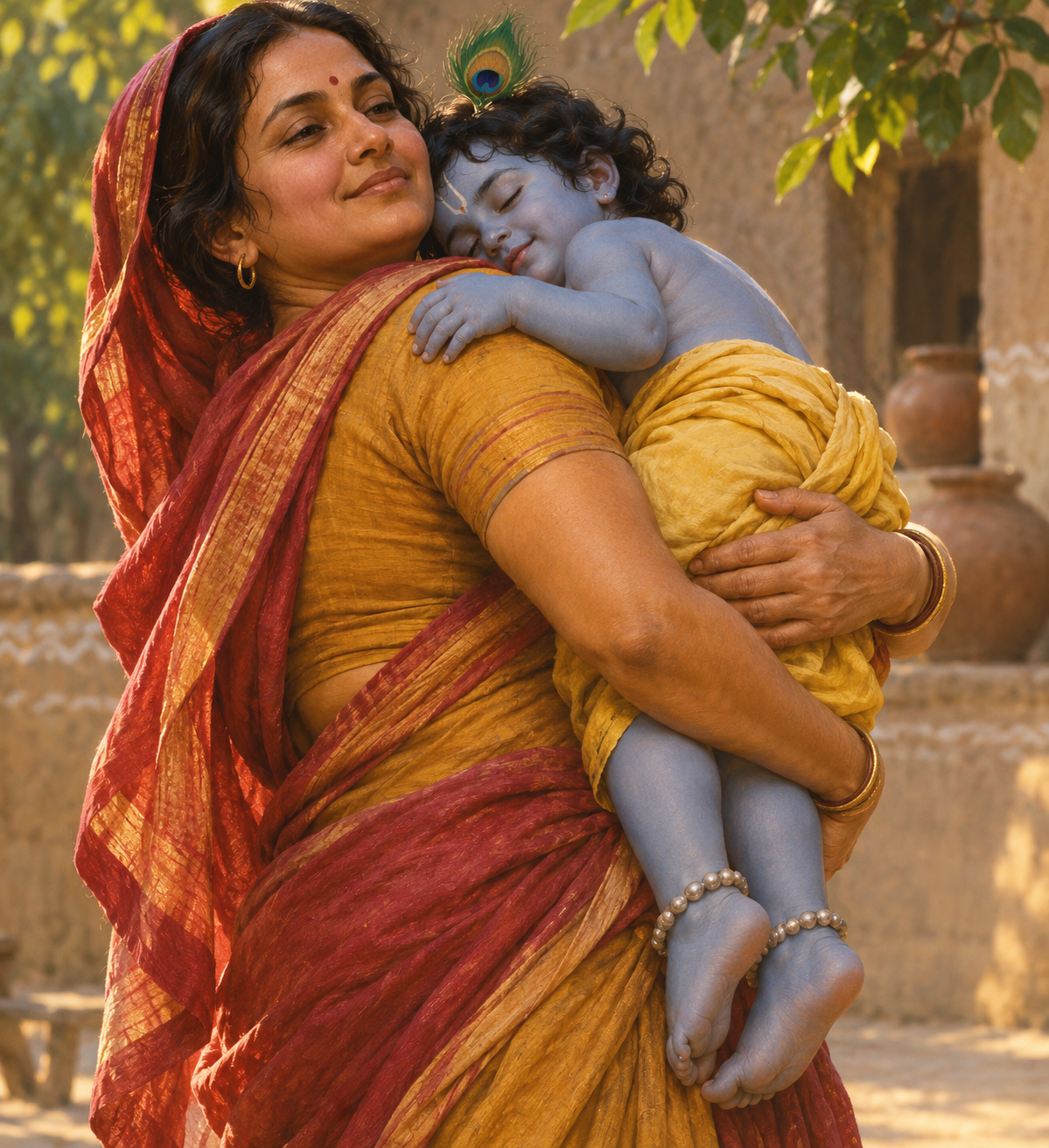
A shoulder is not a distant pedestal. It is part of the body used to carry, steady and bring another being close. Read symbolically, Yashoda’s shoulder turns devotion from an idea into a capacity: love becomes willing to bear the nearness of the beloved.
Krishna’s movement matters as well. He climbs toward his mother. The initiative is not represented only as human effort straining upward toward an inaccessible heaven. The Divine chooses relationship. In this scene, grace can be contemplated as Krishna making himself light enough to be received and familiar enough to be loved without fear.
There is a subtle correction here for anyone who thinks spiritual seriousness must feel heavy. Yashoda does not carry the universe as a grim cosmic burden. She carries the playful child who comes to her. The distinction matters. Devotion does not require you to imagine that everything depends upon your strength. It asks you to receive the form of responsibility that love has actually placed before you.
Ask what your own shoulders are carrying. Some duties belong there; others are attempts to control outcomes, preserve an image or prove spiritual worth. The scene invites you to put down performance while retaining service. Replace one dramatic promise with one quiet, repeatable act of care. The smaller act is often the better spiritual discipline because you can perform it faithfully after the first emotion has passed.
The same symbol also speaks to trust. A child who climbs onto a mother’s shoulder assumes welcome. You do not have to manufacture childish behaviour to learn from that movement. You can approach prayer without rehearsing an impressive identity. Knowledge, status and eloquence may remain useful, but they need not stand between you and the Divine.
Use the scene as a practical contemplation
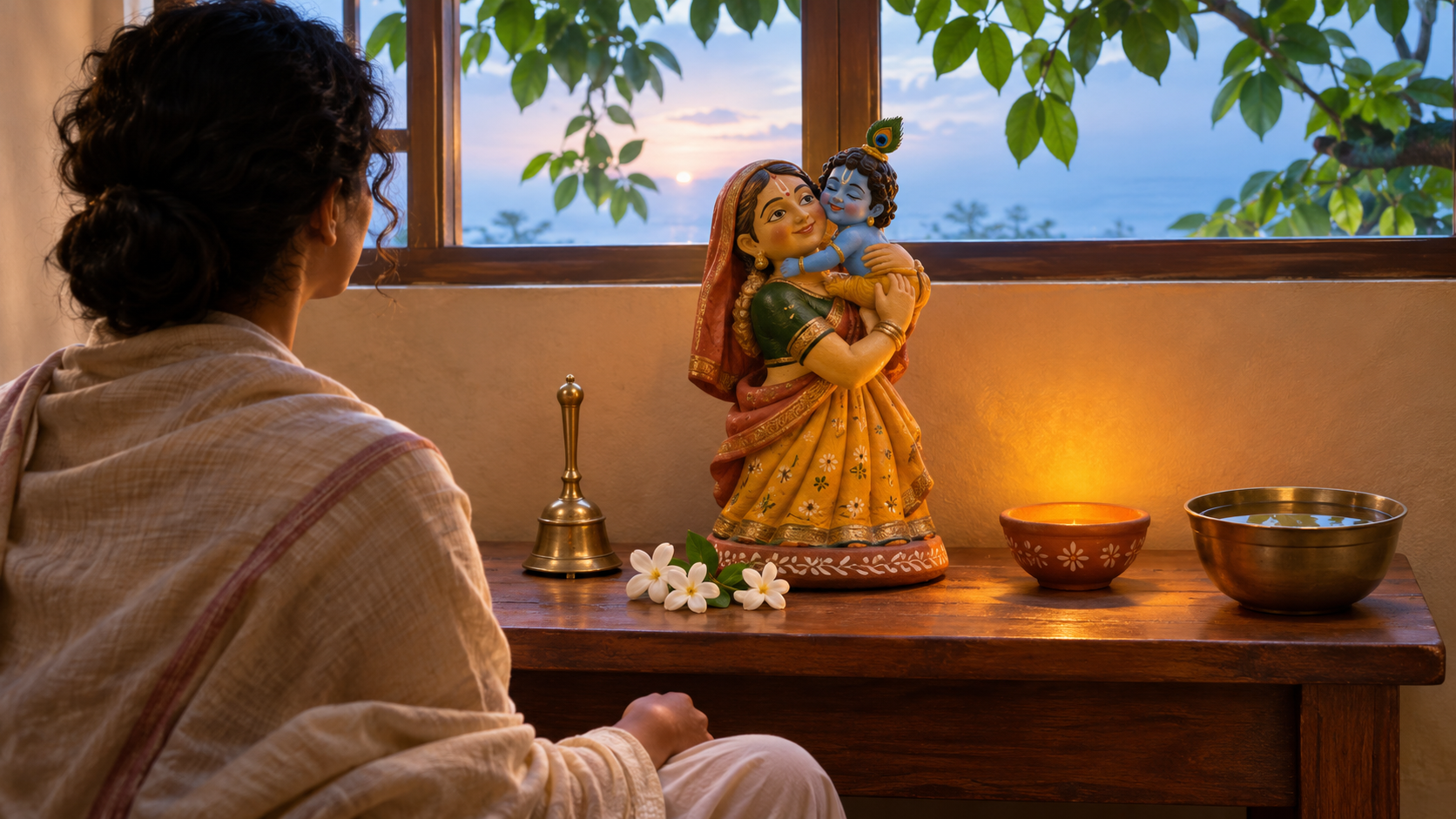
You can contemplate Krishna and Yashoda before a picture, a murti or simply the remembered scene. Keep the practice plain enough that the symbolism remains visible.
- Hold the two truths together. Remember Krishna as Narayana, the sustainer of the universe, and Krishna as the child approaching his mother. Do not discard either side to make the image easier.
- Attend to the movement. Picture Krishna climbing rather than remaining remote. Let the initiative of divine closeness interrupt the idea that prayer depends entirely upon your ability to reach upward.
- Attend to Yashoda’s response. Her shoulder becomes available. Ask what availability would mean in your circumstances: patient attention, an unhurried offering, a duty completed well or a neglected relationship treated with greater care.
- Notice your resistance. You may find majesty easier than tenderness, or affection easier than reverence. Do not force an emotion. Name the side you habitually avoid and remain with the complete image.
- Let contemplation become seva. Choose one fitting act of service and complete it without turning it into a display. This gives the meditation a bodily consequence.
If words are helpful, you might pray: May my devotion become tender enough to serve and spacious enough not to possess. This is not a formula that guarantees a particular feeling. It is a way of aligning your intention with the relationship the scene portrays.
Do not judge the contemplation by whether you produce sweetness on command. The image also works by exposing your habits. If you can accept an all-powerful God but resist a playful one, you may have confused solemnity with reverence. If you enjoy the child but ignore Narayana, you may have reduced devotion to sentiment. The practice is to keep infinity and innocence in view at the same time.
Key takeaways
- Krishna’s closeness to Yashoda does not diminish his divinity; it shows that divine greatness is free to become intimate.
- Yashoda embodies vatsalya-bhava: devotion expressed as attentive, parental care rather than bargaining for a result.
- Her shoulder can be read as a symbol of embodied service, while Krishna’s climb expresses freely offered divine closeness.
- The scene corrects two errors at once: treating God as permanently distant and treating loving familiarity as permission to possess or diminish the Divine.
- You can apply the symbolism by joining contemplation to one quiet, repeatable act of seva.
The next time you encounter Krishna on Yashoda’s shoulder, pause before moving on to another image or prayer. Hold the paradox long enough for it to change one action: receive the Divine with tenderness, then make yourself available for the care that is already yours to give.
References

Leave a Reply
You must be logged in to post a comment.