
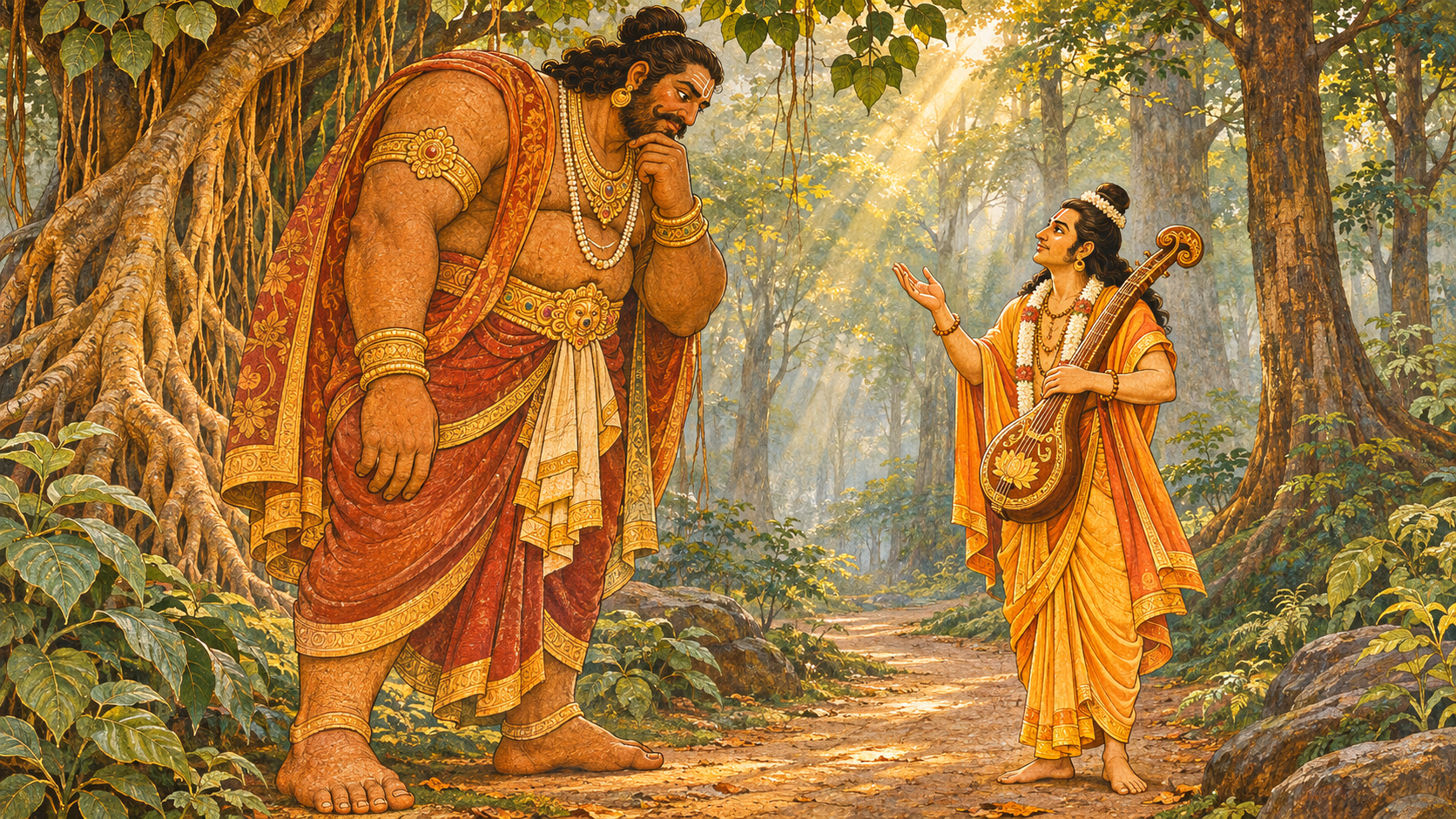
If you remember Kumbhakarna only as the sleeping giant who eventually fights beside Ravana, a lesser-known encounter asks you to look again. Before reducing him to size, appetite, allegiance, or fate, the Malayalam Ramayana tradition places him within reach of a sage.
In Thunchathu Ezhuthachan’s Malayalam Adhyatma Ramayanam, Kumbhakarna crosses paths with Narada while wandering through a forest. The meeting is brief, but its spiritual challenge is precise: can truth still address someone whose loyalties and consequences already seem fixed?
The encounter changes the moral frame
Narada and Kumbhakarna appear to belong on opposite sides of the moral landscape. Narada is the travelling sage associated with divine remembrance, counsel, and the movement of truth from one place to another. Kumbhakarna is Ravana’s giant brother, remembered for extraordinary sleep, formidable strength, and participation in Lanka’s war.
Yet the forest encounter does not begin with a battlefield category. It begins with two beings meeting. That difference matters. A battlefield asks who must be resisted. A spiritual encounter asks whether the person before you can still hear what is true. Dharma may eventually require firm opposition, but it does not require us to deny another person’s capacity for recognition.
This is why the meeting should not be treated as a decorative episode between more famous events. Narada’s presence makes Kumbhakarna morally addressable. He is not merely an obstacle awaiting destruction. He is someone to whom wisdom can come.
You can apply that distinction whenever you are tempted to make a person’s worst association their complete identity. First decide what conduct must be opposed. Then ask a separate question: is there still a truthful word this person needs to hear? Confusing those questions produces either sentimentality, which overlooks wrongdoing, or contempt, which assumes that counsel is pointless.
Grace offers truth, not immunity from consequence

The word grace is easily misunderstood. It does not mean that actions cease to matter. It does not convert destructive loyalty into dharma, erase karma, or make accountability cruel. Grace means that access to truth is not reserved for people who already appear pure.
That is the difficult balance in Narada’s encounter with Kumbhakarna. If we focus only on Kumbhakarna’s place beside Ravana, we may conclude that wisdom has nothing left to say to him. If we focus only on the dignity implied by Narada’s attention, we may soften the consequences of Kumbhakarna’s choices. The Dharmic reading holds both truths together: a person may be worthy of counsel and still responsible for what he does after receiving it.
This distinction is useful well beyond the Ramayana. When loyalty pulls you toward an unrighteous act, do not ask only whether the people involved are family, friends, leaders, or benefactors. Ask three more exact questions:
- What action is being demanded of me?
- Who will bear the harm if I comply?
- Am I calling obedience a virtue because disagreement would be costly?
Those questions separate affection from duty. You can love a person without making every demand from that person righteous. You can acknowledge a debt without surrendering moral judgement. And you can receive a warning without pretending that hearing it has already changed you.
Read the episode in its proper textual home

The encounter belongs specifically to Thunchathu Ezhuthachan’s Malayalam Adhyatma Ramayanam. That textual home should be named whenever the episode is taught, quoted, or retold. The Ramayana lives through a large family of tellings, languages, devotional settings, and regional memories. A scene found in one telling should not automatically be presented as though every recension narrates it in the same way.
Naming the version is not pedantry. It preserves the richness of the tradition. It also prevents two common mistakes: dismissing a regional episode because it is unfamiliar, or claiming a false uniformity for the whole Ramayana tradition.
A sound way to discuss this meeting is simple: identify Ezhuthachan’s Malayalam Adhyatma Ramayanam, describe the forest encounter without adding dialogue you cannot verify, and then mark your spiritual interpretation as interpretation. That discipline protects both shraddha and accuracy.
It also helps you notice what the placement itself communicates. Narada does not meet an abstract category called evil; he meets Kumbhakarna. Kumbhakarna does not encounter an impersonal proposition; he encounters a sage. Dharmic instruction is often personal in this way. Truth reaches a particular being at a particular moral threshold, and the next choice remains that being’s own.
Key takeaways
- Narada’s meeting with Kumbhakarna appears in Thunchathu Ezhuthachan’s Malayalam Adhyatma Ramayanam and should be identified with that telling.
- The encounter presents Kumbhakarna as someone who can be addressed by wisdom, not merely as a giant to be defeated.
- Grace does not cancel karma, responsibility, or the consequences of allegiance.
- Compassion and moral clarity are not opposites: you can offer counsel while refusing to excuse harmful conduct.
- The episode becomes personally useful when you examine where loyalty is pressuring you to silence your knowledge of dharma.
Carry the lesson into your next hard conversation

Narada’s example is not permission to lecture everyone you judge to be wrong. The meeting points instead to disciplined speech: recognise the person, say what is true, and do not confuse speaking with controlling the outcome. Counsel becomes vanity when its purpose is to display your superiority. It serves dharma when it gives another person a real opportunity to see and choose.
Before your next difficult conversation, write down one sentence under each of these three headings: the conduct I cannot endorse; the truth I need to say; the dignity I must not deny. If you cannot keep those statements separate, wait before speaking. Anger will otherwise turn conduct into identity, while attachment may turn compassion into excuse.
Then apply the encounter inward. Ask where you already know the right course but are waiting for loyalty, habit, fear, or convenience to make the decision for you. The useful response to Narada’s meeting is not admiration from a safe distance. It is to recognise the counsel that has reached you and make the next choice before circumstance makes it on your behalf.
References

Leave a Reply
You must be logged in to post a comment.