

Within the Kishkindha Kanda, Pampa Sarovara is the setting where the Ramayana changes direction. Rama arrives in sorrow after Sita’s abduction, but the landscape soon becomes associated with Shabari’s patient devotion, Hanuman’s discerning service and Sugriva’s alliance.
The available DharmaRenaissance account brings literary emotion, sacred geography, bhakti and political action into one frame. Reading those strands together explains why Pampa matters not simply as a remembered lake, but as the threshold between bereavement and a purposeful search.
Key takeaways
- Pampa marks the narrative transition from Rama’s solitary anguish to an organized search supported by Hanuman, Sugriva and the vanara community.
- The beauty of the lake intensifies Rama’s awareness of Sita’s absence, making the landscape an expression of emotional truth rather than decorative scenery.
- Shabari and Hanuman represent complementary forms of bhakti: steadfast waiting and intelligent, courageous service.
- The association with Anegundi, Hampi, Rishyamuka Hill and the Tungabhadra region belongs to a layered textual, regional and pilgrimage tradition, not to a simple claim of modern cartographic certainty.
From wandering sorrow to an organized search

The source account places Rama and Lakshmana in the Pampa region after Sita has been abducted and their search has become defined by uncertainty. This position in the narrative is essential: Pampa is neither the origin of the crisis nor its resolution. It is the interval in which grief begins to acquire direction.
That change emerges through the wider Kishkindha landscape. According to the account, Sugriva is living near Rishyamuka Hill in fear of Vali when he notices the approaching brothers and sends Hanuman to discover who they are. Hanuman’s meeting with Rama creates the connection through which the search for Sita can move beyond anguished wandering and into coordinated action.
The resulting relationship with Sugriva is grounded in two unresolved wrongs. Rama seeks Sita, while Sugriva seeks restoration after being driven from his kingdom by Vali. Their alliance therefore joins personal need to reciprocal responsibility. Pampa’s narrative importance lies in this conversion: suffering that could isolate each figure instead becomes the basis of trust, obligation and cooperation.
The lake’s stillness consequently stands beside a major acceleration in the epic. The setting does not erase Rama’s grief or treat it as an obstacle to duty. It allows grief to be acknowledged before new relationships give it a practical course. In this reading, purposeful action is not the denial of sorrow but one possible outcome when sorrow remains aligned with dharma.
Why Pampa’s beauty deepens the pain of separation

The DharmaRenaissance article describes the Pampa scene through clear water, lotuses, flowering trees, birds and the fragrance of spring. These details do not function merely as an inventory of natural beauty. Because Rama is separated from Sita, surroundings conventionally associated with vitality and union repeatedly call attention to what is missing.
This reversal gives the episode much of its psychological force. A beautiful place does not necessarily console a grieving person; it can make absence more vivid by recalling earlier companionship or anticipated joy. Pampa externalizes that experience. The natural world continues to flourish, while Rama encounters it through longing.
The episode also prevents an overly abstract understanding of dharma. Rama’s fidelity includes vulnerability, remembrance and tenderness. His anguish is not portrayed as the disappearance of moral purpose. Lakshmana’s presence, as interpreted by the source, further shows that compassionate support need not dismiss pain in order to encourage endurance.
The source places Pampa within a broader pattern of meaningful waters in the Ramayana. The Sarayu is connected with Ayodhya and royal dharma; the Ganga with sanctity, passage and purification; and the Godavari region with forest life before Sita’s abduction. Pampa has a different narrative function: it marks the passage from bereavement toward alliance. The comparison shows that sacred waters in the epic are not interchangeable symbols. Each helps organize a distinct moral and emotional stage of the journey.
Shabari, Hanuman and the widening meaning of bhakti

Pampa’s devotional significance becomes clearer when Shabari and Hanuman are considered together. The source connects Shabari with Matanga Rishi’s hermitage and recounts her steady expectation that Rama would arrive, following her guru’s assurance. Her devotion is expressed through patience, humility and readiness rather than status, wealth or public display.
Hanuman embodies a more outwardly active form of devotion. Sent by Sugriva to assess the strangers near Rishyamuka, he approaches Rama and Lakshmana with careful observation, courteous speech and restraint. The account emphasizes the union of bhakti with viveka, or discernment: Hanuman’s reverence does not bypass judgment but works through intelligence, clarity and an ability to serve effectively.
Together, the two figures prevent devotion from being reduced to a single temperament. Shabari demonstrates fidelity sustained across waiting; Hanuman demonstrates recognition translated into action. One prepares faithfully for an encounter, while the other helps turn an encounter into a mission. In both cases, inner orientation becomes visible through conduct.
Sugriva adds a further dimension. He enters the relationship as a fearful and injured figure rather than an idealized helper without needs of his own. The alliance facilitated by Hanuman therefore expands bhakti into a social and ethical field: attention, trust and mutual responsibility connect Rama’s purpose with the struggles of others. Pampa is sacred not only because devotion is remembered there, but because devotion begins to build the relationships required for consequential action.
Reading Pampa as text, terrain and living memory
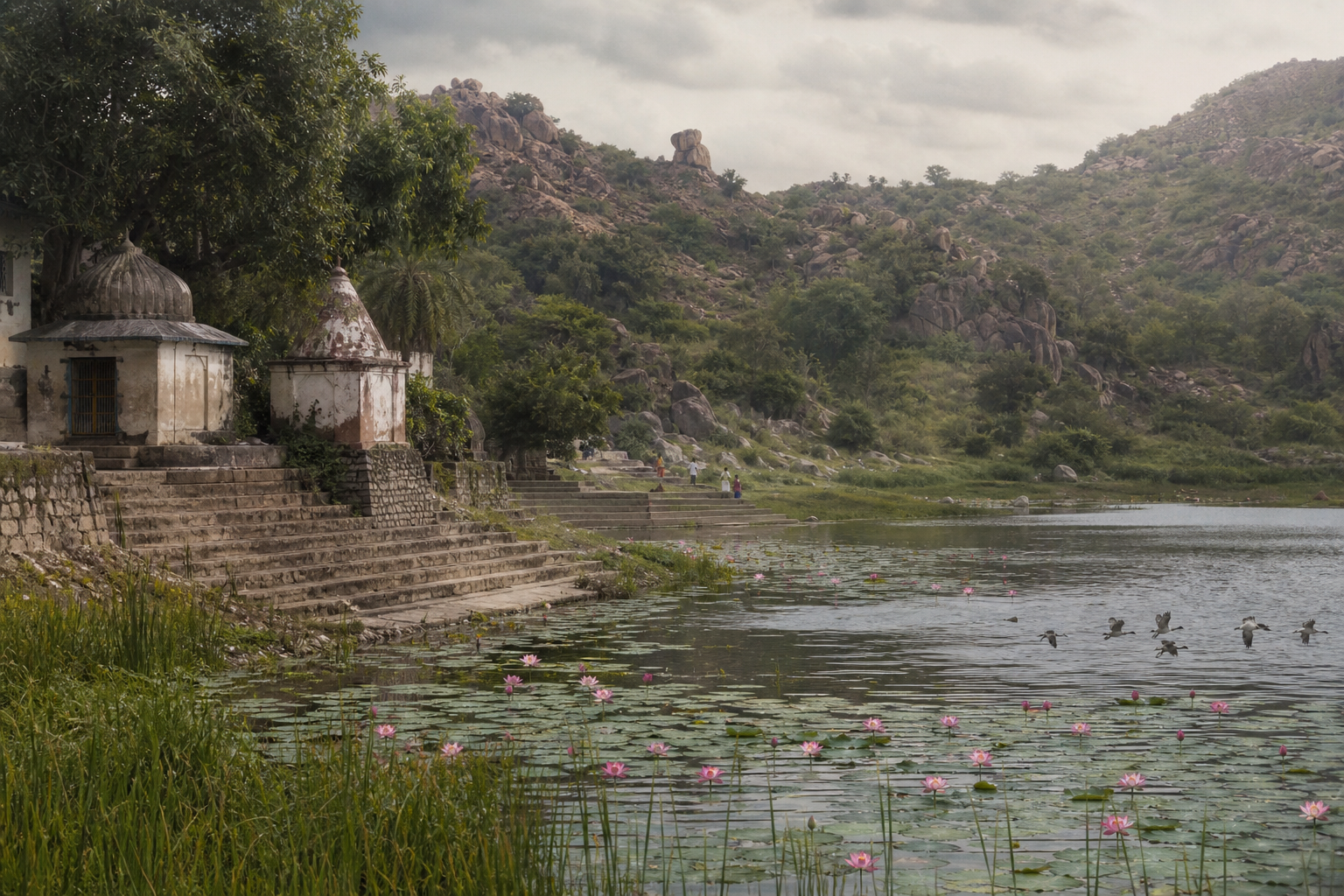
The source traditionally associates the Pampa and Kishkindha landscape with present-day Anegundi and Hampi in Karnataka. Within that regional understanding, Pampa Sarovara is remembered in relation to Rishyamuka Hill, Matanga Rishi’s hermitage and the riverine world of the Tungabhadra. The same area also carries later layers of temple tradition and Vijayanagara heritage.
These overlapping associations require careful language. The source itself cautions that Ramayana geography has been transmitted through textual description, oral memory, regional identification and pilgrimage practice. A sacred landscape can therefore possess continuity without functioning like a modern survey map. Treating every traditional identification as either exact cartography or meaningless legend would flatten the way such places are actually remembered.
Pampa is best approached through the interaction of several kinds of meaning. In the epic, it structures a decisive narrative passage. In devotional interpretation, it gathers the memories of Shabari and Hanuman. In regional tradition, it belongs to the Kishkindha terrain around Anegundi and Hampi. In pilgrimage, water, hills, hermitage traditions and routes allow narrative memory to be encountered spatially rather than through recitation alone.
This layered approach also explains why the lake remains more than a backdrop. Sacred geography joins story to place while leaving room for historical caution, local continuity and theological interpretation. Future study can deepen that understanding by keeping the Ramayana’s literary descriptions, regional traditions and lived pilgrimage practices in dialogue. Such an approach allows Pampa to remain spiritually meaningful while inviting careful inquiry into how landscapes carry narratives across generations.
References
Editorial note: The supplied source set contained one article. This synthesis therefore connects the literary, devotional, geographic and pilgrimage dimensions within that account without claiming independent cross-publication corroboration.
- DharmaRenaissance Blog – Pampa Lake in the Ramayana: Sacred Waters, Exile, and the Power of Devotion