
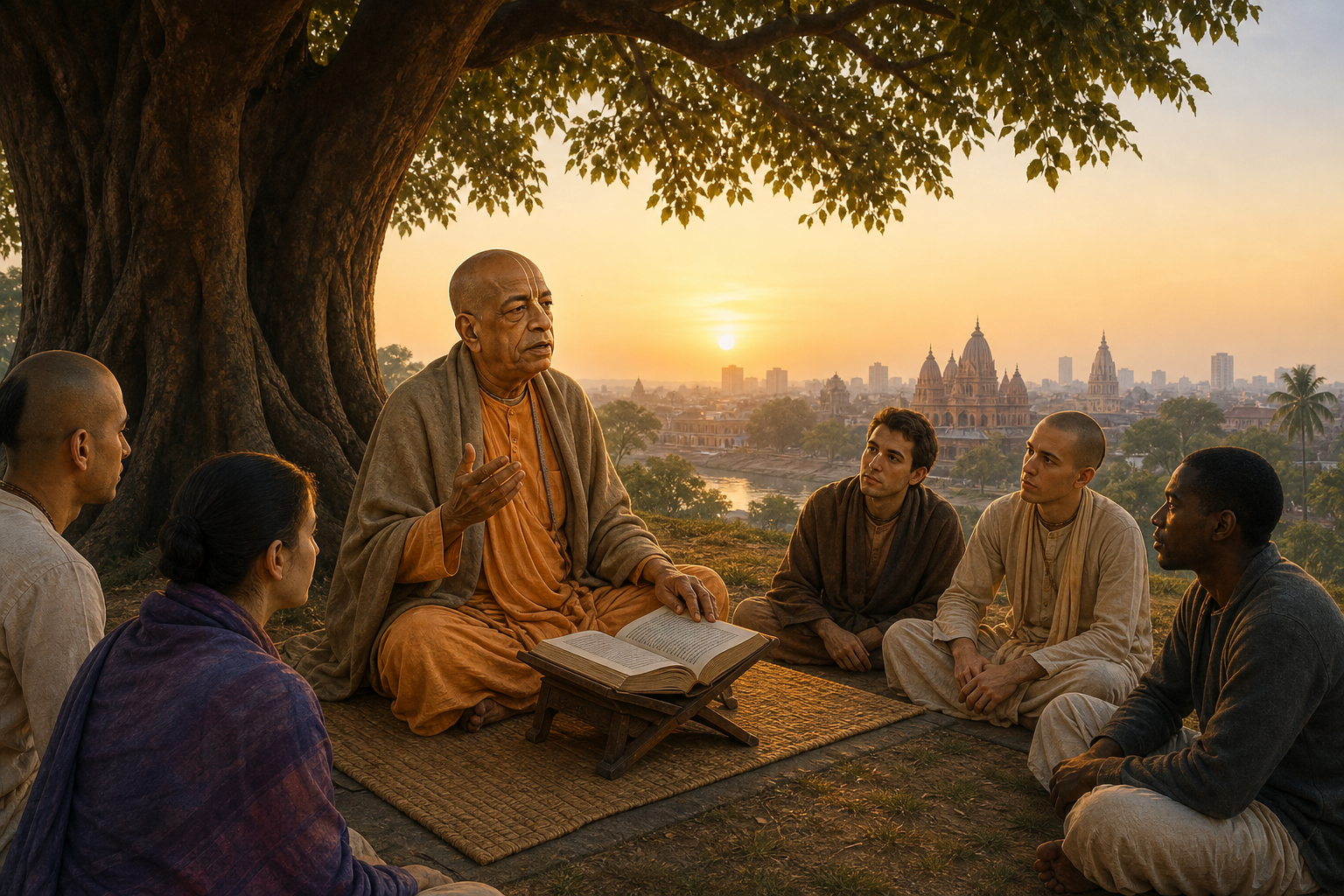
Srila Prabhupada’s living legacy is easily obscured when it is reduced to biography, memorable quotations or institutional history. The three source articles place his significance at a more demanding intersection: scriptural wisdom must guide power, devotional teachings must become a way of life, and reverence for the guru must mature into responsible service.
Read together, the sources offer a practical standard for evaluating that legacy. Its vitality is found not only in what followers remember, but in how well individuals and communities learn to hear, practise, serve, transmit and remain accountable to the principles they have received.
A legacy formed through teaching, practice and transmission
The sources approach Srila Prabhupada from three different directions. The article on his Delhi discourse examines a scriptural teaching about wise rule and moral counsel. The reflection on Srila Prabhupada-lilamrita presents his life as an expression of guru-seva, sacrifice and intercultural transmission. The retreat article explores the communal environment in which bhakti is experienced through chanting, hearing, sanctified food, service and disciplined routine.
Together, these perspectives reveal a coherent movement from principle to embodiment. Scripture supplies the standard; the teacher communicates it; practices train the individual; and community gives those practices social continuity. Remove any one dimension and the legacy becomes thinner. Philosophy without practice can remain abstract, practice without understanding can become habitual, and institutional continuity without accountability can drift away from its founding purpose.
The biographical article reports that Srila Prabhupada was born as Abhay Charan De in Calcutta in 1896 and travelled to the West in 1965 at an advanced age with limited material resources. It places his mission within the guru-shishya tradition and reports that he acted upon an instruction from Bhaktisiddhanta Sarasvati Thakura to communicate Krishna consciousness in English. The same source presents his later work as extending across translation and commentary, community formation, kirtan, prasadam distribution, worship and study.
That framing guards against treating his achievements as the isolated success of a charismatic personality. In the source’s account, Srila Prabhupada understood himself as a servant within a parampara, or line of transmission. His originality therefore lay not in detaching himself from tradition, but in carrying its teachings into unfamiliar cultural settings through practices that people could enter directly.
The evidentiary limits of the material should also be kept clear. The retreat article says that its original prompt consisted only of a brief Facebook-linked reference and an image, while the biographical article says that its immediate material contained an episode title and thumbnail. Their discussions are consequently best read as contextual and theological interpretations, not as detailed reports of the particular retreat or episode to which those prompts referred.
Hearing is the link between spiritual wisdom and authority
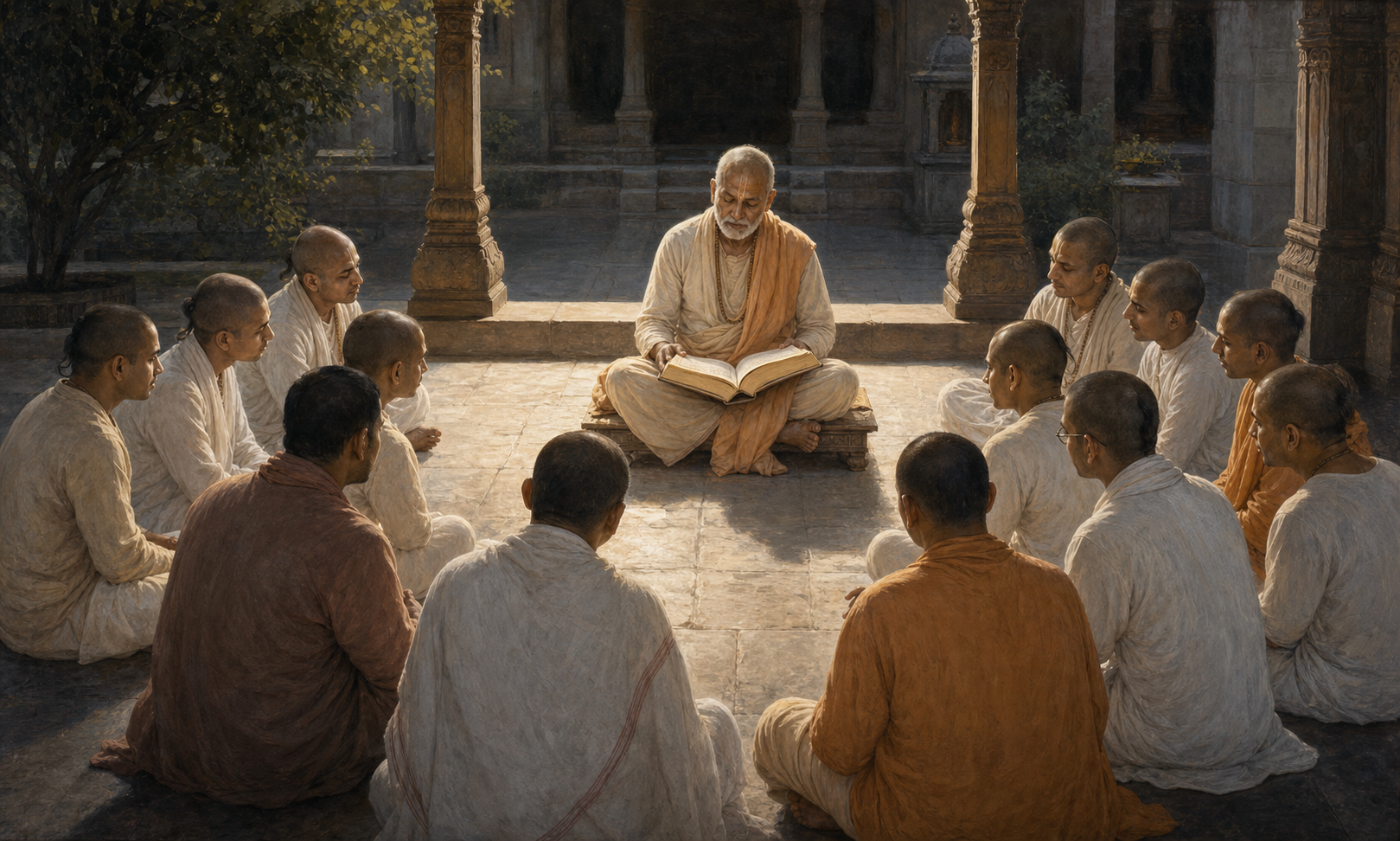
The Delhi lecture article reports that on November 16, 1971, Srila Prabhupada spoke in Delhi on Srimad-Bhagavatam 4.14.14, from the account of King Vena. In the verse as presented there, sages approach a troubled ruler and ask him to hear instruction intended to increase his ayuh, sri, bala and kirti: longevity, prosperity, strength and good reputation.
The important feature is not simply that spiritual advisers correct a king. It is how they begin. According to the article, the sages address him respectfully and frame their counsel in terms of his genuine welfare. Their courtesy does not erase the seriousness of his conduct, nor does their opposition become a pursuit of personal power. The episode thus joins two qualities that public argument often separates: firmness about moral limits and a sincere desire to uplift the person being corrected.
The article reads the passage as a lesson in rajadharma, but its scope extends beyond formal government. Parents, teachers, executives, judges, temple administrators and community organisers all exercise entrusted authority. In each setting, the decisive question is whether the person holding power remains teachable. Authority becomes dangerous when it can issue instructions but cannot receive correction.
This emphasis on hearing also connects governance with bhakti. Spiritual practice begins by making attention receptive to something beyond personal impulse. The same discipline is needed in leadership: to listen before defending, to distinguish principled counsel from rivalry, and to accept that office does not place its holder above moral responsibility. The source’s interpretation of King Vena therefore complements the biographical article’s account of parampara. Both portray legitimate authority as accountable to wisdom that it did not invent.
In a democratic or institutional setting, this principle also reaches those who select, support or imitate leaders. A culture that prizes spectacle and dominance will reproduce those traits in its authorities. A culture that honours restraint, truthfulness and service gives teachable leadership room to develop. Srila Prabhupada’s reported exposition consequently treats social decline as more than a failure at the top; it is also a failure of the values cultivated throughout a community.
Devotional practice turns inheritance into lived culture
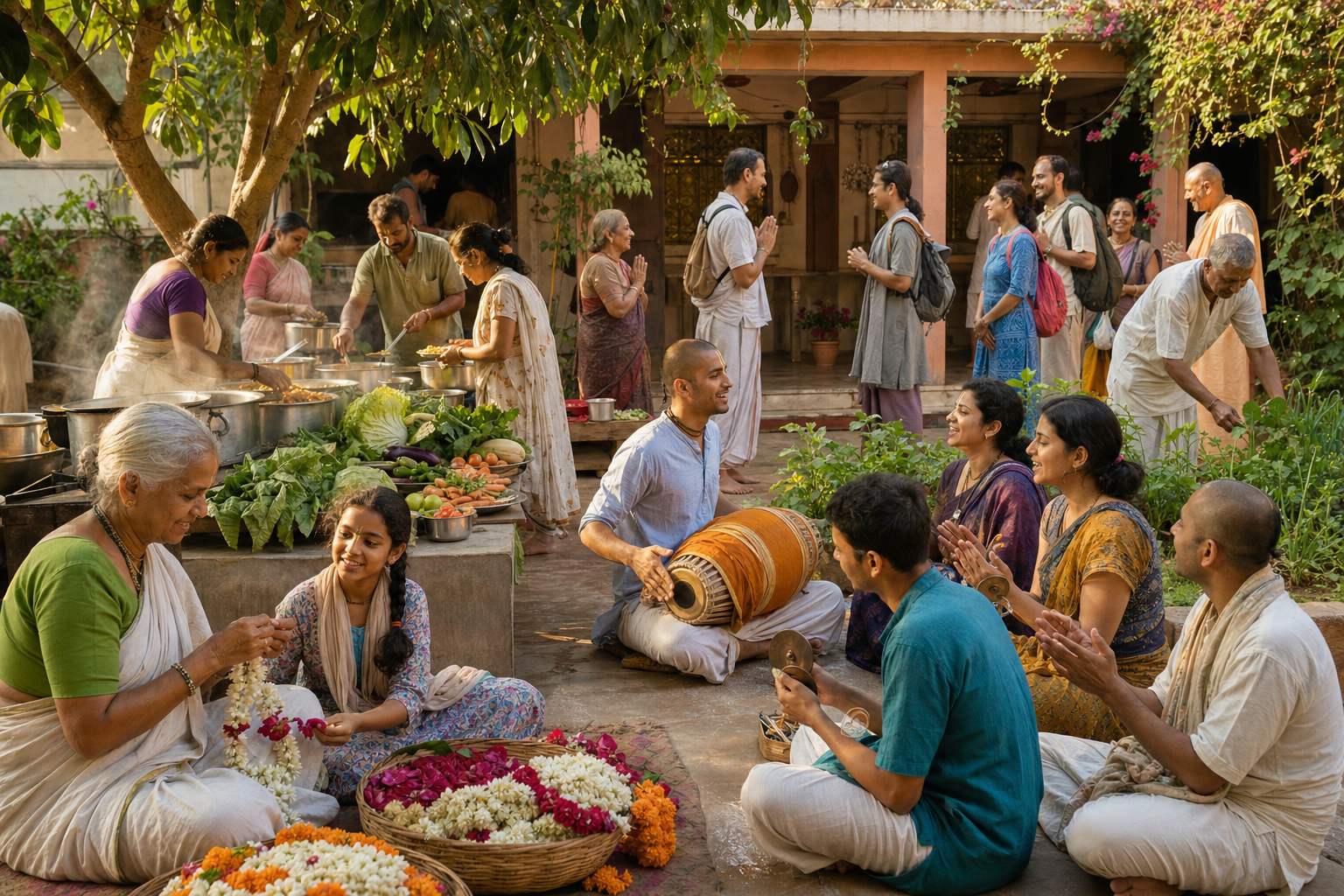
The retreat and biographical articles converge on a second theme: teachings survive when they acquire a repeatable form. Both describe a devotional culture shaped by sacred sound, scriptural hearing, prasadam, service and community. These are not merely supporting activities around a philosophical message. They are the means by which the message enters the use of time, the training of attention, the treatment of food and the quality of relationships.
The retreat article portrays a well-ordered bhakti gathering as a concentrated environment of sadhana and satsanga. Regular times for chanting, study, meals, rest and service temporarily replace the fragmented rhythm of ordinary life. Its analysis is useful beyond the retreat itself: structure can protect attention, while repetition joined to intention can help remembrance become dependable rather than occasional.
Kirtan illustrates the accessibility of this model. The biographical article reports that Srila Prabhupada communicated Krishna bhakti through approachable practices including the Hare Krishna maha-mantra, Bhagavad Gita study, prasadam and association with devotees. It further describes kirtan moving into parks, streets, temples, homes and universities. The retreat article adds that congregational chanting allows people with different backgrounds and levels of learning to participate together.
Accessibility, however, is not the same as shallowness. The retreat article warns in effect that devotional mood needs the depth of scriptural understanding if it is to outlast a temporary high point. The biographical article makes a parallel claim by describing bhakti as trained feeling rather than sentimentalism. In their shared account, emotion is welcomed but educated through hearing, chanting, remembrance, worship, service and surrender.
Prasadam and seva extend the same education into material and social life. The retreat article interprets sanctified food as a practice of gratitude and interdependence, and service as a safeguard against turning a spiritual gathering into a consumer experience. Preparing meals, cleaning, welcoming newcomers or assisting others makes community a field of shared responsibility. The participant does not merely receive inspiration; the participant helps sustain the conditions in which others can be nourished.
This is a central measure of a living legacy. A tradition remains alive when its teachings can be practised in a temple, retreat, household or journey without losing their governing purpose. Its external settings may vary, but the inner movement remains recognizable: distracted attention is gathered, the ego is displaced from the centre, and ordinary actions are redirected toward remembrance and service.
Guru-seva requires fidelity, adaptation and accountability

The Srila Prabhupada-lilamrita article treats biography as spiritually instructive rather than merely chronological. The language of lila and amrita presents a dedicated life as a source of nourishment, while concrete accounts of hardship and perseverance show what service can demand. The source particularly emphasises the image of an elderly Vaishnava sannyasi entering an unfamiliar environment without guaranteed support, yet continuing a mission received from his teacher.
Its discussion of cultural translation is equally important. It reports that Srila Prabhupada retained the central claims and disciplines of Gaudiya Vaishnavism while offering accessible points of entry through chanting, study, food and association. This suggests that fidelity and adaptation need not be opposites. Fidelity protects the purpose of a tradition; adaptation helps that purpose become intelligible and practicable in a new setting.
The sources also prevent guru-seva from being confused with uncritical institutional loyalty. The biographical article explicitly observes that spiritual organisations operate within human history, face pressures and require reform. The Delhi lecture article supplies the corresponding ethical principle: authority must hear qualified counsel and remain subject to dharma. Combined, they imply that preserving a founder’s legacy may sometimes require candid correction, careful reform and resistance to the misuse of entrusted power.
This is not a rejection of reverence. It is reverence made responsible. Admiration looks backward at what a teacher accomplished; guru-seva asks what the disciple must now embody and transmit. On that standard, the strength of a community is visible in its scriptural seriousness, quality of practice, care for people, willingness to hear correction and ability to serve without making service a vehicle for status.
The articles also locate this legacy within a wider dharmic ecology. Each notes, while acknowledging theological differences, that Hindu, Buddhist, Jain and Sikh traditions share concerns such as self-discipline, ethical conduct, restraint, compassion and freedom from ego-centred existence. Srila Prabhupada’s specifically Gaudiya Vaishnava mission need not be blurred into a generic spirituality to participate in that larger conversation. Respectful coexistence becomes more credible when practitioners are deeply rooted in their own discipline and capable of recognising sincere discipline in others.
Key takeaways
- Srila Prabhupada’s legacy joins scriptural teaching, personal discipline, accessible devotional practice and community formation; none of these elements is sufficient in isolation.
- The King Vena discourse, as reported by the Delhi lecture article, presents teachability as a condition of legitimate authority and respectful correction as a form of moral responsibility.
- Kirtan, scriptural hearing, prasadam, routine and seva make bhakti portable, participatory and capable of shaping everyday conduct.
- Guru-seva is best measured by faithful transmission, integrity and accountability, not by admiration or institutional continuity alone.
The future of this legacy will be determined wherever inherited teachings meet present choices: in the way leaders receive counsel, communities care for participants, practitioners order their days and institutions respond to correction. If remembrance continues to produce disciplined hearing and generous service, Srila Prabhupada’s teachings will remain active rather than commemorative.
References
- DharmaRenaissance Blog — Srila Prabhupada’s Powerful Lesson on Wise Rule, Dharma, and Inner Strength
- DharmaRenaissance Blog — A Powerful Bhakti Retreat That Deeply Nourishes Community and Inner Growth
- DharmaRenaissance Blog — Srila Prabhupada Lilamrita: Powerful Lessons in Bhakti, Service, and Guru-Seva