
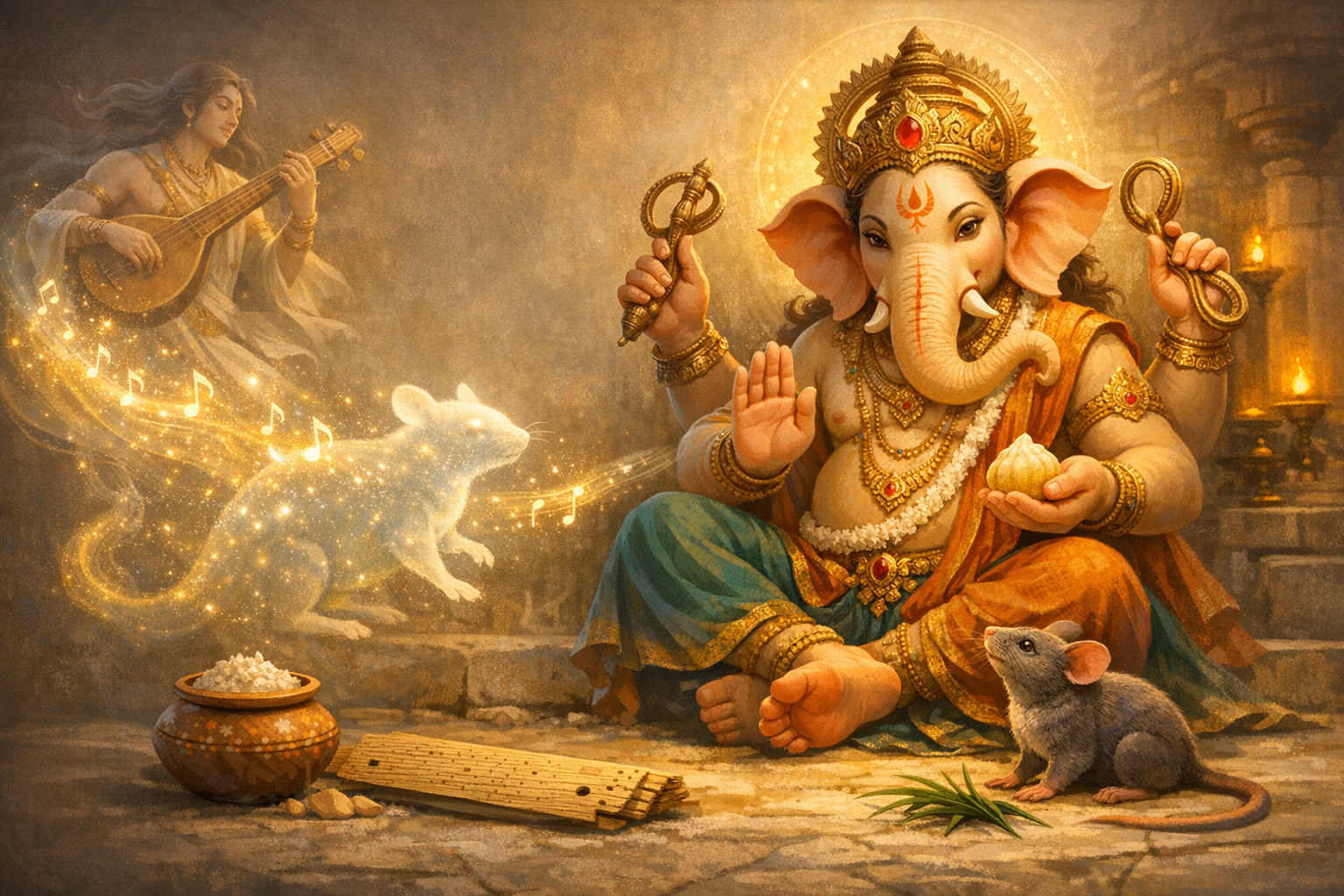
The narrative of Krauncha, the celestial gandharva whose pride precipitated a profound transformation into Ganesha’s mouse vahana (Mooshika), illustrates how dharmic traditions encode ethical insight within mythic form. Presented across Puranic literature and regional retellings, the episode integrates aesthetics, ethics, and iconography: an accomplished musician’s hubris, a sage’s curse, the chaos of unrestrained appetite, and the compassionate discipline of GaneshaVighneśvara, the remover of obstacleswho redirects disruptive force into sacred service.
Gandharvas in classical Hindu thought embody mastery over sound, rhythm, and emotive nuance; they sing in the courts of the devas and sustain cosmic harmony through music. Within this milieu, Krauncha is portrayed as exceptionally gifted, a virtuoso whose confidence crosses into self-importance. The tale foregrounds a subtle but central dharmic concern: when aesthetic brilliance lapses into arrogance, the very gift meant to elevate consciousness can fracture communal and moral balance.
Accounts vary in detail but cohere around a shared structure. Provoked by slight or disrespectoften inadvertent yet tinged by hauteurKrauncha incites the ire of a rishi. In several regional tellings, a sage such as Vāmadeva pronounces a curse that reconfigures Krauncha’s refined musical identity into the form of a mouse, a creature emblematic of stealth and unchecked consumption. The transformation dramatizes a descent from the celestial to the instinctual, from harmony to compulsion.
As Mooshika, Krauncha’s energies, now stripped of art’s discipline, manifest as restlessness and appetite. Some versions situate his havoc within an āśrama, others in subterranean realms (Pātāla), but all emphasize the same motif: capacities once attuned to beauty and order, when ungoverned, gnaw at foundationsgrain stores, manuscripts, sacrificial implementssignifying the erosion of knowledge, sustenance, and sacred practice.
The turning point comes when Ganesha intervenes. With pasha (noose) and aṅkuśa (goad)the symbolic instruments of gentle restraint and precise guidanceGanesha subdues Mooshika’s turbulence without annihilating its vitality. Subjugated yet not destroyed, Krauncha regains moral agency by pledging service, becoming Ganesha’s vahana. The very force that once undermined ritual order is reoriented to bear wisdom; in this realignment, the narrative encodes a core principle of Dharma: transformation surpasses suppression.
Textual memory for Ganesha’s association with the mouse is widespread. The Ganeśa Purāṇa and later digests such as the Mudgala Purāṇa refer to Ganesha’s multi-faceted forms and attributes; the Skanda Purāṇa and regional Sthala-Purāṇas reinforce his role as Vighneśvara and the presence of Mooshika in temple iconography. While the precise identity of the cursing sage and the locale of Krauncha’s descent vary, the symbolism remains internally consistent across tellings.
Philologically, the Sanskrit root mūṣ (to steal) underlies Mūṣika (mouse), evoking the mind’s proclivity to pilfer attention and resolve. In that light, Mooshika signifies acquisitive impulsesnibbling at focus, time, and intention. Ganesha’s composure beside, or astride, the mouse represents sovereignty over those impulses; disciplined awareness neither demonizes desire nor indulges it, but harnesses it toward purposeful action.
Iconographically, Mooshika appears near Ganesha’s feet, often gazing at a modaka (sweet) or bowl of offerings. The scale asymmetrycolossal divinity, diminutive vehiclevisualizes ethical hierarchy: the higher self governs the lower appetites. The aṅkuśa (guiding spur) and pasha (binding noose) complement the scene, signifying calibrated intervention: what is wayward is guided; what is excessive is gently bound. South Indian bronzes and North Indian stone reliefs alike sustain these visual cues, ensuring continuity from liturgy to public art.
Ethically and psychologically, Krauncha’s fall maps artistic ego onto universal experience. The musician’s pride mirrors a familiar arc: competence engenders acclaim; acclaim drifts into entitlement; and entitlement invites a corrective. Many readers recognize in Krauncha the moment talent outruns humility. The tale reassures that the remedy is not erasure of capacity but its consecrationMooshika does not vanish; Mooshika serves.
Within devotional life, the image acquires pedagogical clarity. During Ganesh Chaturthi and daily pūjā, devotees encounter the mouse’s alert posture near the modaka, recalling that joy (ānanda) is properly won when appetite is governed by wisdom. Durva grass offerings, mantras such as “Vakratunda Mahākāya,” and the simple placement of the mouse in household icons embed doctrine in practice: obstacles are approached through patience, right action, and steady remembrance rather than force alone.
Comparative dharmic lenses broaden this insight. In Buddhism, the discipline of Vinaya trains attention away from grasping and agitationan ethos resonant with Ganesha’s serene mastery over Mooshika. Jain teachings emphasize ahiṃsā and aparigraha, redirecting desire into harmlessness and restraint. Sikh thought warns against haumai (ego), urging remembrance (nāam) and seva to humble the self. Across these traditions, agency is not crushed but refined; the tale of Krauncha and Ganesha aligns with a shared civilizational grammar of taming the mind to liberate compassionate action.
Variations in the corpus enrich, rather than diminish, coherence. Some regional accounts present the vahana as a fierce asura subdued and converted to service; others retain the gandharva-to-mouse arc. Puranic storytelling often accommodates multiple etiologies to illuminate a single teaching: the lower naturebe it monstrous or merely undisciplinedcan be integrated into Dharma under wise guidance.
Intertextual parallels clarify the logic of vahana symbolism more generally. Kārttikeya’s peacock overcomes serpentine fear; Durgā’s lion stands for courage controlling violence; Sarasvatī’s swan discriminates between essence and dross. Ganesha’s mouse completes this semiotic field: discernment and steadiness harness the stealthy, scattered mind, converting propensity into purpose.
For students of culture and ritual, the Krauncha motif underscores how narratives migrate from scripture to sculpture to social habit. Temple processions, children’s stories, and classical performances subtly transmit an ethical technology: acknowledge appetite; befriend discipline; offer capacity in service. Such transmission fosters unity across communities by foregrounding practice over polemic and transformation over triumphalism.
Historically, the endurance of Mooshika in Ganesha iconography attests to a widely shared intuition: obstacles are not merely external events but internal patterns. By dramatizing the redirection of Krauncha’s brilliance, the tradition invites a constructive reading of personal struggle. What gnaws today can carry tomorrowif yoked to wisdom.
Ultimately, Krauncha’s journey from celestial stage to sacred service is not a descent but a refinement. The gandharva’s music, once self-regarding, becomes seva; the mouse’s hunger, once indiscriminate, becomes attentiveness at the Lord’s feet. In the presence of Ganesha, power and appetite are not enemies of the good; when disciplined, they become its vehicle.
Inspired by this post on Hindu Blog.
