
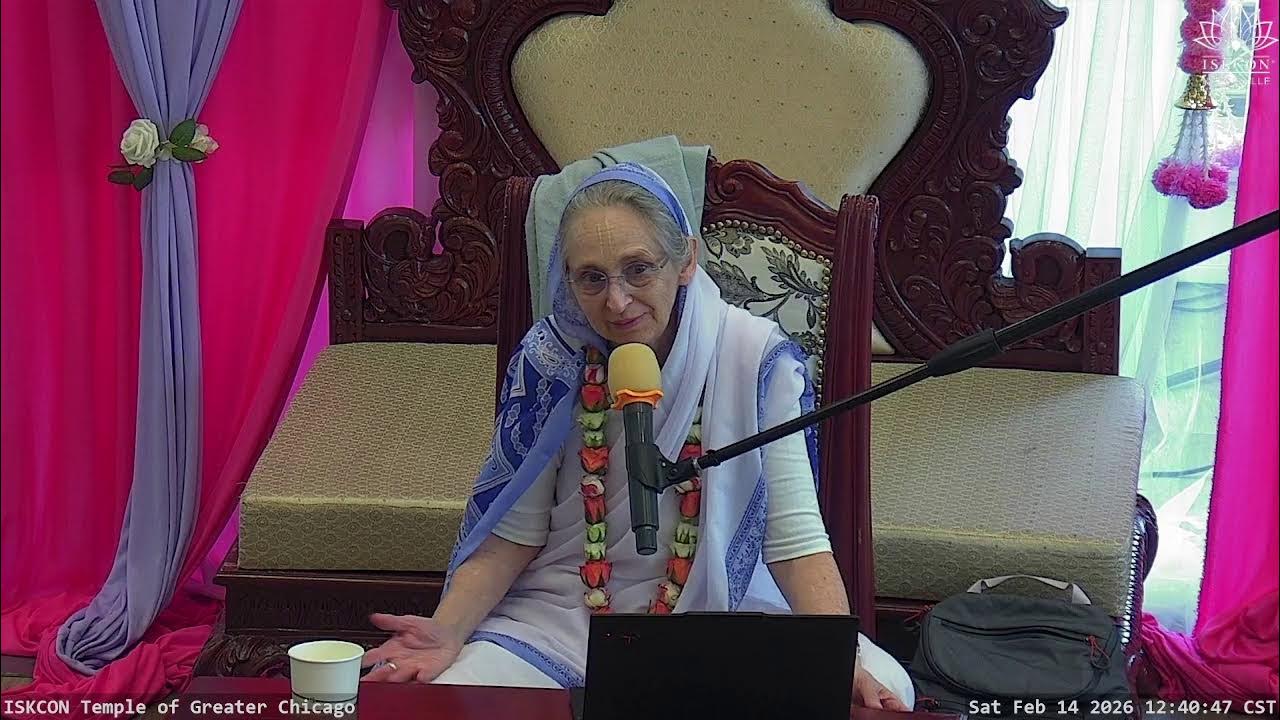
On 14 February 2026 in Naperville, HG Urmila Mataji conducted an intensive seminar on Vaiṣṇava etiquette, foregrounding three interdependent virtuesrespect, forbearance, and patience. The session framed these qualities as practical disciplines that stabilize relationships, refine daily conduct, and cultivate a culture of care within devotional communities.
Aligned with Srila Prabhupada’s vision of harmonious, service-oriented communities, the curriculum emphasized that etiquette is not mere formality but a structured path to internal refinement and communal well-being. Participants examined how consistent etiquette transforms individual interactions into collective strength, enabling congregations to function as resilient networks of trust, empathy, and accountability.
At its core, Vaiṣṇava etiquette (sadachara) functions as a living social framework. It translates values into behavior through predictable, humble, and compassionate responses. Rather than prescribing rigid codes, it offers an adaptable grammar of conduct that reduces friction, honors the dignity of others, and directs attention to sevaservice that nourishes the whole community.
The seminar situated these virtues within a scriptural arc familiar to the bhakti tradition. Respect was related to the practice of offering honor to others without seeking it for oneself, forbearance to the steadiness and tolerance exemplified by saintly conduct, and patience to the sustained devotion described in texts such as the Bhagavad-gita (12.13–20), Nectar of Instruction (Upadesamrita), Nectar of Devotion (Bhakti-rasamrita-sindhu), and Hari-bhakti-vilasa. This triangulation grounded daily etiquette in canonical sources while clarifying its application to contemporary life.
Respect emerged as the keystone. In community life, respect is expressed through careful speech, attentive listening, and mindful acknowledgment of others’ service. The seminar discussed forms of address that convey dignity, the importance of recognizing elders and teachers, and the need to welcome newcomers with warmth and clarity. By centering respect, devotees create psychological safety, enabling honest dialogue and cooperative problem-solving.
Forbearance was presented as a stabilizing force in moments of strain. It integrates humility with emotional regulation, allowing practitioners to pause before reacting, to interpret others’ intentions charitably, and to remain focused on shared purpose. Forbearance does not bypass justice or truth; rather, it creates the inner space in which truth can be spoken without harshness and fairness can be pursued without resentment.
Patience was explored as long-horizon devotion in action. Communities grow unevenly; individuals mature at different speeds; misunderstandings require time to resolve. Patience allows the culture to evolve through steady practicesdaily sadhana, regular satsanga, constructive feedback, and incremental improvements to service systemswithout the volatility of impulsive shifts or personality-driven conflicts.
These principles were translated into concrete etiquette behaviors. Participants reviewed how intentional greetings, timely responses to messages, punctuality for services, and unobtrusive assistance in temple spaces all communicate respect. Likewise, measured tones in discussion, acknowledgement of diverse service roles, and the habit of asking clarifying questions before offering critique all embody forbearance and patience.
Special attention was given to speech discipline, a traditional hallmark of Vaiṣṇava etiquette. The seminar reinforced speaking truthfully, beneficially, and at the right time, while avoiding gossip, sarcasm, and public shaming. This approach protects reputations, preserves unity, and maintains the sanctity of relationships, especially where differences of opinion inevitably arise.
Conflict resolution was addressed through a clear, compassionate process. When friction emerges, devotees are guided to engage privately first, seek mutual understanding, and, if needed, invite a trusted senior to facilitate resolution. Where offense has occurred, sincere apology, restitution where appropriate, and an agreed pathway forward help restore trust. This method guards against escalation while honoring both truth and kindness.
The seminar also discussed conscientious digital conduct. Because tone can be easily misread online, participants were encouraged to slow down responses, avoid public disputes, and move sensitive topics to private, voice-based conversations when possible. Clear community norms around digital etiquetteespecially in group chats and public postshelp prevent avoidable misunderstandings.
Leaders and service coordinators received frameworks for modeling etiquette. By setting expectations, offering periodic training, acknowledging exemplary conduct, and de-escalating tensions early, leaders serve as cultural anchors. Regular check-ins, clear service descriptions, and transparent decision-making further support an atmosphere where respect, forbearance, and patience become the community’s default settings.
Participants consistently reported that the seminar made abstract virtues practical. Several noted that simple yet consistent behaviorssuch as timely gratitude for others’ efforts, calm clarification in meetings, and non-defensive listeningdramatically improved the quality of daily interactions. Others observed that families and friend groups benefited from the same etiquette principles, blurring the line between “temple conduct” and life conduct.
While grounded in Vaiṣṇava theology, the seminar highlighted resonances across dharmic traditions to encourage unity in spiritual diversity. The cultivation of forbearance parallels the Buddhist perfection of patience (kshanti), aligns with the Jain emphasis on kshama and ahiṃsā, and harmonizes with Sikh virtues such as nimrata (humility) and daya (compassion). Recognizing this shared ethical substrate strengthens bonds among Hindu, Buddhist, Jain, and Sikh communities and advances collective well-being.
To sustain progress, the session recommended integrating etiquette into routine community life: brief reflections at the start of meetings, periodic study of key texts, and small, measurable commitments to speech and service etiquette. Communities that normalize gentle feedback and appreciative inquiry tend to resolve issues faster and retain more volunteers over time.
The seminar proposed pragmatic indicators to assess cultural health without reducing spiritual life to metrics. Signs of growth include fewer escalated disputes, faster resolution cycles, an uptick in collaborative service, broadened participation across age groups, and testimony from members who feel seen, heard, and supported. These indicators help leaders tune practices while keeping devotion at the center.
Throughout the program, HG Urmila Mataji emphasized that etiquette is the daily choreography of devotion: it protects relationships, reveals character, and keeps service joyful. When respect, forbearance, and patience become habitual, communities naturally reflect Srila Prabhupada’s vision of cooperative spiritual liferooted in compassion, strengthened by discipline, and illuminated by love.
In summary, the Naperville seminar provided a rigorous, textually anchored, and practice-focused roadmap for cultivating Vaiṣṇava etiquette. By making virtues observable and repeatable, it offered devotees and leaders a common language for building trust, a reliable method for handling disagreement, and a unifying ethos that resonates across the wider dharmic family.
Inspired by this post on Dandavats.
