
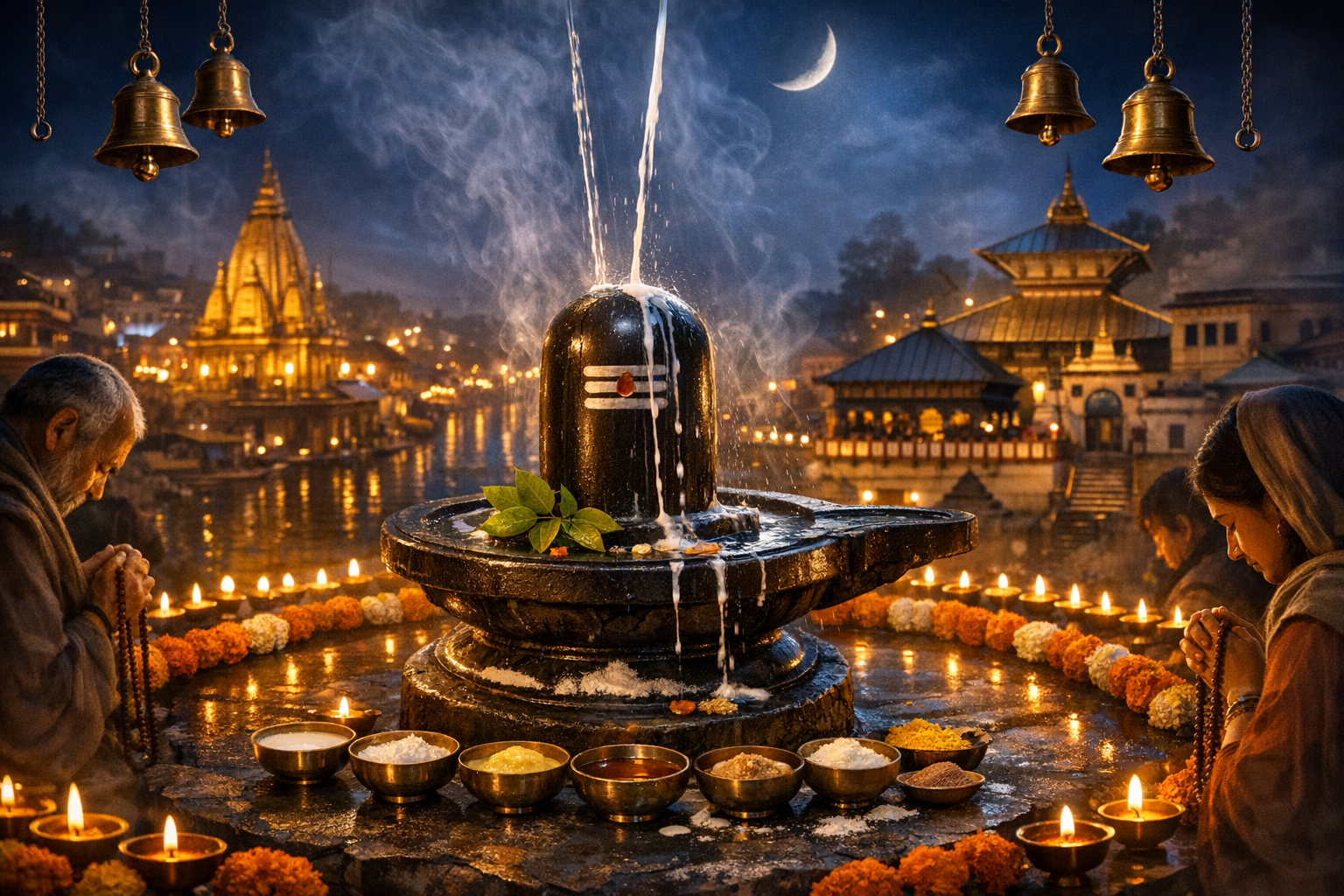
On the sacred night of 15 February 2026, the subcontinent held its breath in stillness as lakhs of devotees in India and Nepal observed Maha Shivaratri with all-night vigils, resonant mantra-japa of “Om Namah Sivay,” and abhisheka to the Shivalinga. From the ghats of Varanasi to the banks of the Bagmati in Kathmandu, the atmosphere combined profound interiority with meticulous ritual practice, embodying a civilizational rhythm that bridges antiquity and the present.
Maha Shivaratri falls on Krishna Paksha Chaturdashi, the lunar fortnight’s penultimate night, when the moon wanes to a sliver and the cosmos appears at its quietest. Shaiva Agamas and Puranic sources such as the Linga Purana and Shiva Purana describe this vigil as the most auspicious time for Nishita Kaal worshiparound midnightwhen devotees perform a sequence of offerings to the aniconic Shivalinga while contemplating the formless Absolute. The night’s austerity is not merely symbolic; it is a disciplined sadhana aimed at purifying intention and steadying attention.
Across key pilgrimage centersKashi Vishwanath in Varanasi, Mahakaleshwar in Ujjain, Somnath on the Saurashtra coast, Srisailam in the Nallamala hills, and Lingaraj in Bhubaneswartemple bells marked the four prahars of the night. In Nepal, the Pashupatinath Temple in Kathmandu welcomed an immense flow of pilgrims and ascetics, its courtyards enlivened by devotional music, yogic contemplation, and the age-old rhythms of a mela that unites communities across the Indo-Nepal cultural corridor.
Ritual practice followed a well-attested cadence. The abhisheka proceeded with water and Panchamritamilk, curd, ghee, honey, and sugarfollowed by vibhuti, sandal paste, and sacred bilva leaves (Aegle marmelos). Each element carries layered meanings described in Shaiva texts: water as clarity, milk as nurturing purity, ghee as tejas, honey as cohesion, and sugar as the sweetness of realized knowledge. Bilva is offered for its tri-foliate symbolism aligned with Shiva’s triune powers and the three gunas to be transcended through sadhana.
Mantra recitation sustained the vigil’s inner focus. The Panchakshari“Om Namah Sivay”was intoned in unison alongside Sri Rudram from the Yajurveda and the Maha Mrityunjaya Mantra. Many observed a vrata of silence during segments of the night, using breath awareness and japa-mala counting to anchor attention. The four-prahar scheme often included Rudrabhishekams and Lingodbhava darshana near midnight, underlining the metaphysical insight that the formless emerges as form and returns to the formless.
Fasting practices were widespread and mindful. Devotees undertook nirjala, phalahara, or satvik upavasa according to capacity, aligning dietary restraint with the mind’s one-pointedness. Regional vrat foodssuch as sabudana, kuttu, and singhara preparationswere consumed in moderation, while many sustained the vigil (jagaran) with devotional singing and meditative sitting rather than stimulants, keeping the night’s austerity intact.
In Varanasi, the confluence of temple worship and sacred geography shaped an immersive experience. Long but well-managed queues to the Kashi Vishwanath Mandir facilitated darshan, while Ganga-side bhajans and disciplined crowd movement preserved the sanctity of the old city’s narrow lanes. In Ujjain, the renowned bhasma aarti of Mahakaleshwar drew practitioners of tantra and yoga alongside families maintaining age-old household vows. Coastal Somnath witnessed ocean breezes carrying snatches of stotra recitations late into the night.
Kathmandu’s Pashupatinath hosted one of the largest gatherings in the Himalayan region. Sadhus from diverse ascetic lineages traveled across borders to participate, renewing a transregional Shaiva fellowship that predates modern nation-states. Bridge crossings, temporary shelters, medical aid posts, and designated prayer avenues created a functional order amid the devotional surge, ensuring that darshan remained accessible while safety and cleanliness were prioritized.
Civic agencies and temple boards implemented layered logistics for 2026: multi-lane queue systems, drinking-water stations, mobile clinics, lost-and-found counters, and night-time lighting on key routes. Volunteer groups guided elders and children, while public announcements encouraged patience, eco-conscious offerings, and respect for local regulations. Digital channels supplemented access through live darshan streams, allowing those at a distance to synchronize prayers with Nishita Kaal puja.
Beyond scale and spectacle, Maha Shivaratri 2026 reaffirmed a distinctive Dharmic ecology. The ethos of vigil, self-discipline, and inner quiet resonates across Hinduism, Buddhism, Jainism, and Sikhismtraditions that, in their own ways, emphasize meditation, ethical restraint, and remembrance of the Divine. Many families from these communities joined temple precincts as cultural participants or chose to observe the night at home through contemplative reading, naam-smaran, or silent meditation, underscoring unity in spiritual diversity.
Historically, Shiva’s presence in the sacred geographies of the subcontinent is exceptionally deep. Archaeological and textual studies point to continuous streams of Shaiva worship over millennia, with the Shivalinga’s aniconic form providing a unifying symbol that transcended regional aesthetics. From the rock-cut shrines of peninsular India to the Kathmandu Valley’s pagoda tradition, the civilizational archive displays both continuity and adaptation, confirming the capacity of Dharmic traditions to receive, reinterpret, and renew.
Philosophically, Shiva’s iconography conveys a concise metaphysics. As Nataraja, Shiva embodies the cosmos in motion through the five actssrishti (emanation), sthiti (sustenance), samhara (withdrawal), tirobhava (concealment), and anugraha (grace). The Lingodbhava narrative compresses this insight into a single revelatory moment: the infinite revealing itself beyond measure or form, inviting the practitioner to realize the Self (atman) as not-other than Brahman. Such reflection often animated the 2026 vigil, where devotees balanced external ritual with interior vichara (inquiry).
Calendaric precision contributed to the solemnity of the night. While regional almanacs (panchangs) may name the lunar month as Magha or Phalguna depending on amanta or purnimanta reckoning, the tithi alignmentKrishna Paksha Chaturdashiremained the decisive criterion. Temples announced location-specific Nishita Kaal windows for midnight puja, mindful of time-zone differences, thus synchronizing thousands of individual vratas into a shared liturgical arc.
Musical and literary traditions deepened the experience. Ragas associated with the Shaiva repertoire, kirtan and bhajan sampradayas, and stotra recitation from works such as the Shivamahimna Stotra and Shivanandalahari animated congregational devotion. In regions like Tamil Nadu, nightlong darshans at Chidambaram and other temples echoed with verses honoring Shiva Nataraja, where dance and music complemented philosophical exposition.
For many households, the 2026 observance was also emotionally resonant. Elders passed down the cadence of Sri Rudram to younger voices; children remained awake through their first jagaran, clutching prayer beads as lamps flickered. The scent of bilva leaves and sandal recalled earlier generations, making the vigil both ancestral remembrance and living practice.
Environmental mindfulness formed a practical ethical thread. Temples and municipalities encouraged biodegradable offerings, water conservation during abhisheka, and responsible disposal of ritual remnants. Many communities organized post-festival cleanliness drives, translating reverence for sacred spaces into tangible stewardship of rivers, streets, and temple courtyards.
Cultural hospitality remained evident throughout. In border districts and pilgrimage towns, local residents offered warm guidance to visitors navigating unfamiliar lanes and languages. Food distribution centers provided satvik meals for those observing gentler fasts, ensuring that devotion could be sustained without compromising health.
In Kathmandu, the convergence of Shaiva ascetics, domestic pilgrims, and international visitors highlighted Nepal’s pivotal role in the Himalayan sacred network. As the night progressed, the Bagmati’s banks filled with quiet meditation, kirtan circles, and clusters of seekers contemplating the deeper message of Maha Shivaratri: to let the mind grow still enough to recognize the substratum of awareness that outlasts change.
Across India’s plains and plateaus, 2026 also demonstrated how modern civic capacity can serve ancient ritual. The integration of public health advisories, crowd analytics, and transport scheduling enabled an event of immense scale to retain its contemplative core. Notwithstanding the volume of movement, temples preserved unhurried spaces for darshan, rudrabhisheka, and private prayer.
The shared Dharmic fabric was unmistakable. The emphasis on ahimsa in Jainism, the centrality of meditation in Buddhism, the discipline of naam-simran in Sikh traditions, and the bhakti-yoga and jnana-yoga pathways in Hinduism intersect on this vigil as complementary routes toward inner clarity. Maha Shivaratri 2026 thus became a lived lesson in unitydiverse practices converging around the values of restraint, remembrance, and compassion.
By dawn, as bells announced the closing arcs of worship, the vigil’s philosophical promise felt renewed: austerity flowering as joy, silence transmuting into insight. In homes and temples alike, devotees concluded their vrata with gratitude, carrying forward the night’s equipoise into daily life. The refrain lingered in memory long after the lamps had dimmedan abiding “Om Namah Sivay,” quietly guiding thought, word, and deed toward auspiciousness.
Inspired by this post on Struggle for Hindu Existence.
