
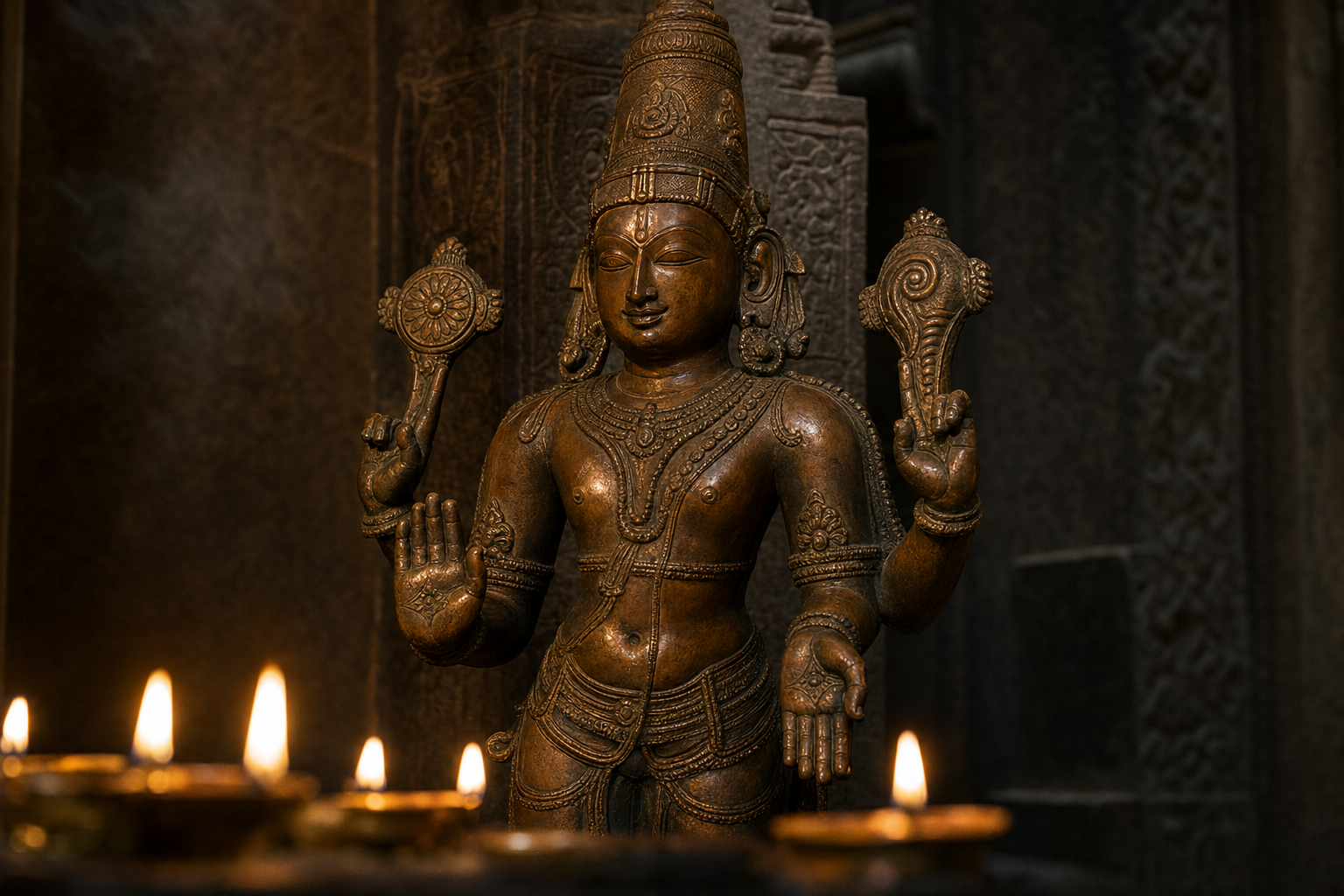
If you have looked at a temple bronze in the light of a deepam and wondered whether it was made of gold, you are seeing more than an alloy. You are seeing a surface shaped by casting, finishing, abhishekam, incense, flame, cloth and human touch.
That distinction matters when the murti needs care. A bright surface is not automatically a healthy one, and a dark surface is not automatically dirty. Before anyone reaches for a scouring pad or metal polish, you need to know whether you are removing a harmful deposit or erasing a stable ritual patina.
Begin with the alloy, not the apparent colour
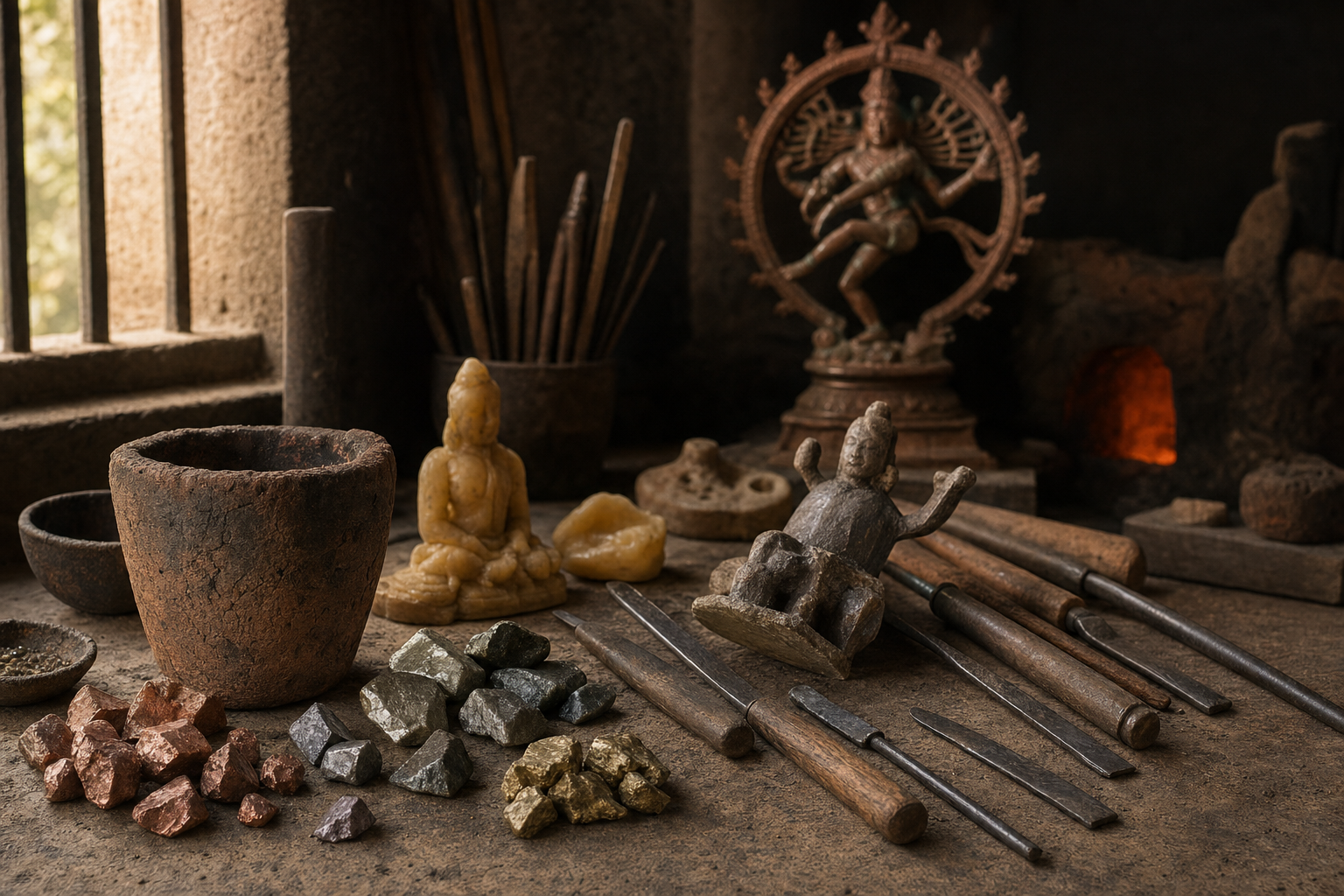
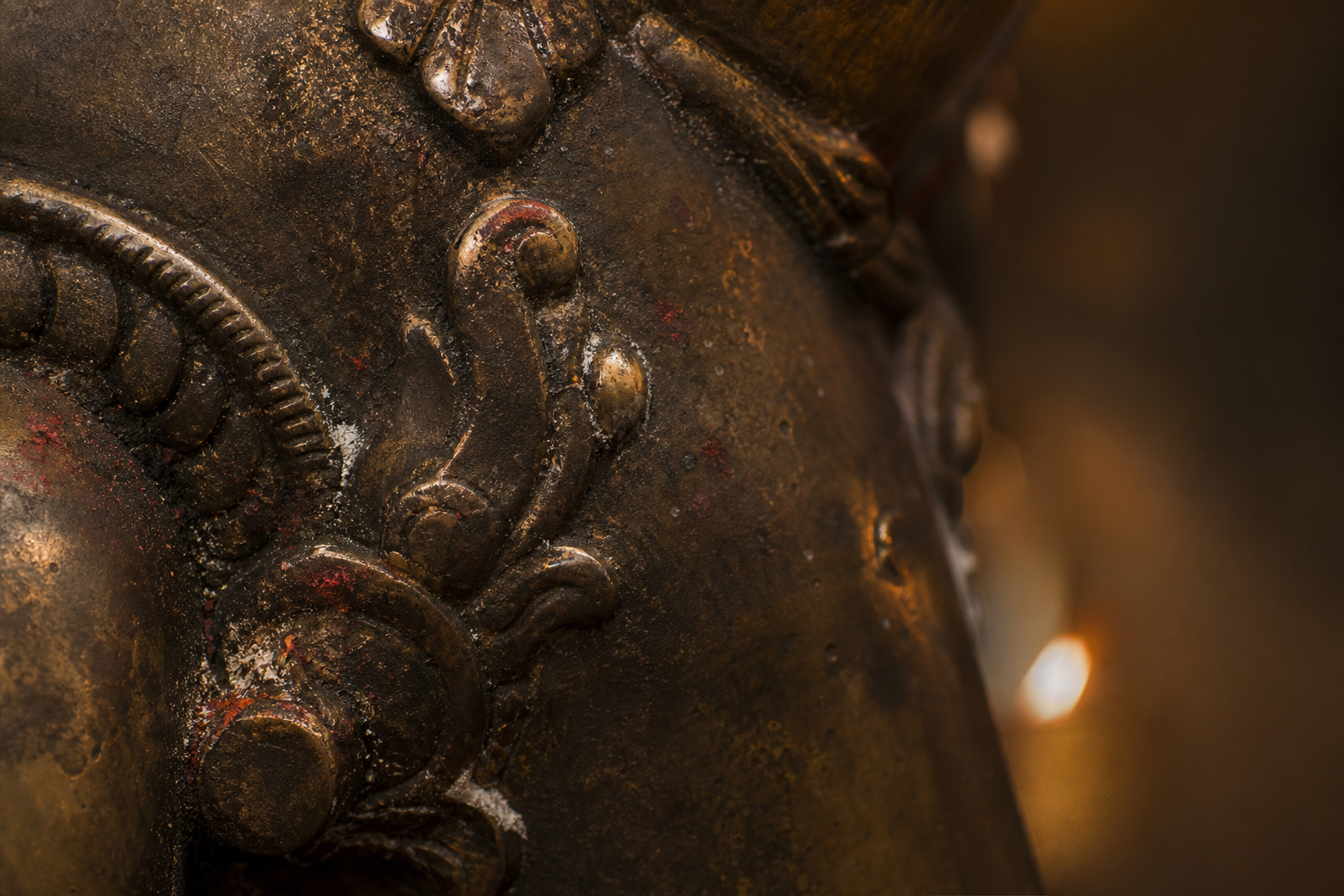
The golden appearance of most temple bronzes does not require gold plating. It usually arises from a combination of copper-rich metal, a finely finished surface, a thin oxide layer and repeated ritual care. Lamp light then strengthens the yellows and reds already present in the metal.
Many South Indian bronzes contain a high proportion of copper, often above 85–90%, with smaller quantities of tin and lead and, in some cases, zinc. That range is a historical tendency, not a recipe by which every murti can be identified. Composition varies by region, period, workshop and intended use.
Each alloying element changes what you see. Copper provides the underlying red-gold warmth. Zinc shifts the colour toward a brighter yellow, which is why polished brass can resemble gold so strongly under oil lamps. Tin tends to deepen red and brown tones. Lead does not produce the golden colour, but it improves the flow of molten metal and can reduce casting porosity, helping the finished surface take a smoother polish.
The devotional word panchaloha should not be treated as an assay report. Gold and silver may be included for ritual significance, yet their quantities can be too small to control the visible colour. Nor does the name establish that five metals are present in equal proportions. A murti described as panchaloha may still owe nearly all of its optical character to copper and its principal alloying elements.
Gilded details do occur, but they are not the usual explanation for a uniformly warm temple bronze. Localised gilding may produce a deliberate contrast around ornaments, garments or sacred marks. If such accents might be present, do not use an abrasive test or scrape an inconspicuous area. Colour alone cannot establish composition, and a seemingly minor test can permanently remove an original surface.
Why worship can create a warm, stable surface
The surface begins taking shape before the murti enters a sanctum. In lost-wax casting, an image modelled in beeswax or plant wax is enclosed in refractory clay. Heating removes the wax, and molten alloy fills the resulting cavity through planned channels. The wax carries fine modelling into the mould, allowing ornaments, expressions and bodily movement to emerge with exceptional delicacy.
After casting, filing, scraping and fine abrasion remove irregularities. Traditional organic-acid pickling can clear heavy oxides, while polishing reduces microscopic roughness. A smooth surface produces concentrated highlights instead of scattering light in every direction. That is one reason the shoulder of a Nataraja or the calm face of a Somaskanda can remain legible in the subdued light of a garbhagriha.
Copper alloys then react with their environment. A very thin and even layer of cuprous oxide, Cu2O, may appear warmly golden when the film is extremely thin, even though a thicker accumulation looks red-brown. The effect is not simply a matter of colour. Film thickness, surface smoothness and the direction of the light all influence what your eye receives.
Ritual life continuously modifies this surface. Panchamrita brings milk, curd, ghee, honey and sugar into contact with the metal. Water rinses remove soluble residue. Tamarind or lemon may be used at times to dislodge stubborn oxides through mild organic acidity. Vibhuti and other ritual powders can contain fine mineral matter that gently burnishes the surface during wiping. Oils and aromatic resins leave extremely thin, water-resistant films that deepen the colour and slow direct contact with moisture.
Deepam, karpūram and incense contribute in another way. Fine soot and resinous aerosols settle on the murti, after which routine wiping removes much of the deposit. A soft cloth carrying traces of ash or other minute particles acts as a very gentle polishing medium. Repeated over years, this cycle can keep rough, patchy oxidation in check while preserving the fine modelling beneath it.
Touch also leaves a readable pattern. The hands, feet and shoulders of an utsava murti may become more lustrous because those points are repeatedly handled, dressed, carried and wiped. Do not assume that such uneven lustre is a defect. It may be a truthful map of procession, darshan and seva.
Patina is not dirt, and brilliance is not condition
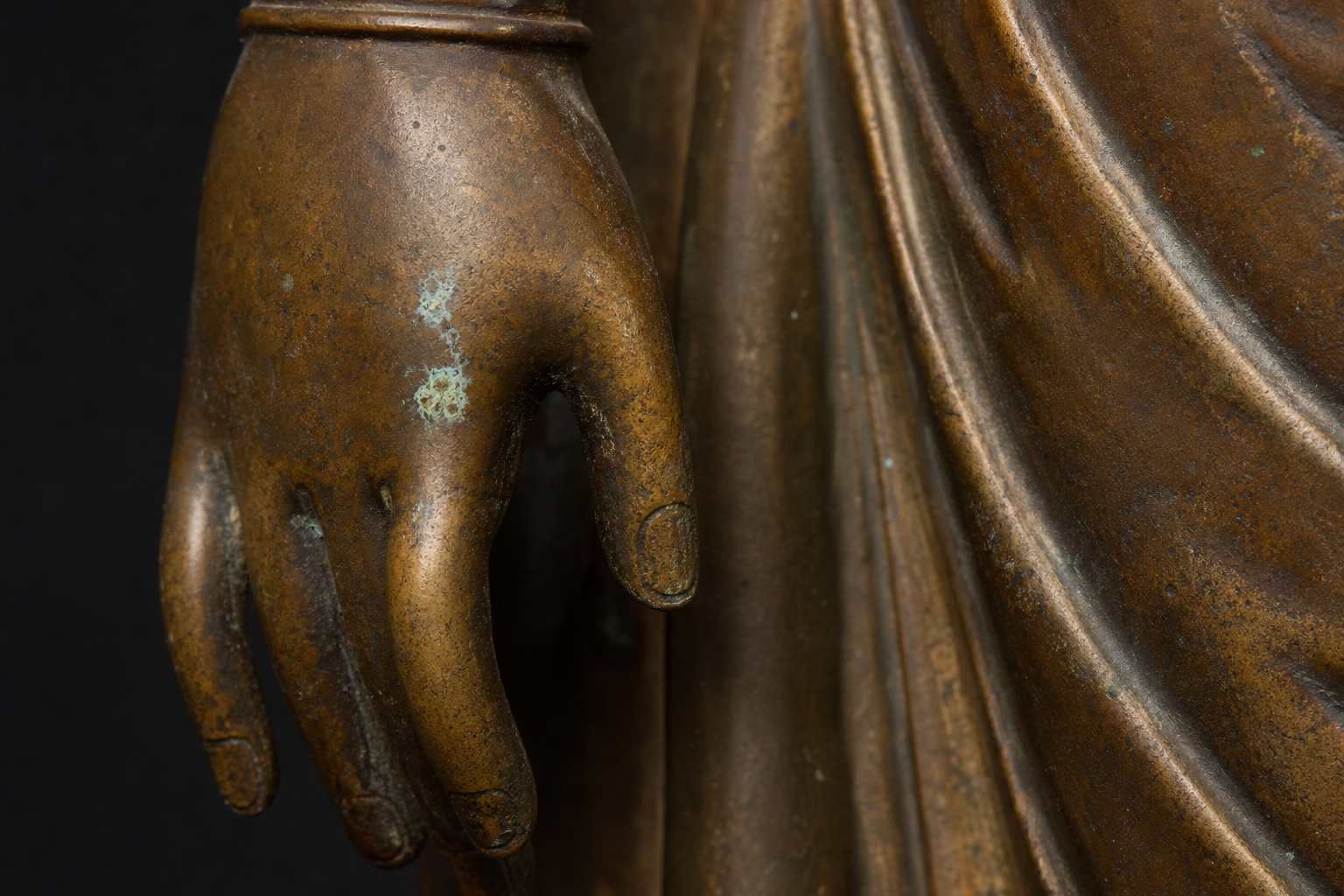
Three different things are often collapsed into the word tarnish. A deposit is material resting on the surface. A stable patina is a relatively settled surface layer created through reaction and care. Active corrosion is a continuing destructive process. They may overlap visually, so a cleaning decision should never be based on whether the murti looks bright enough for a photograph.
An even, adherent, warm surface with more lustrous high-contact areas is generally consistent with a living ritual patina. Its variations can carry information about how the murti has been worshipped. Polishing every part to the same mirror finish would erase that evidence and create a surface the image may never historically have possessed.
Fresh ritual residue is a different matter. Panchamrita, paste or water left in recesses can retain moisture. The appropriate response is complete but gentle rinsing, followed by thorough drying, rather than forceful brightening of the underlying metal. Pay particular attention to jewellery, folds, joined components and other places where liquid can remain after the visible surfaces look dry.
Chlorides, standing moisture and abrasive scouring are the clearest avoidable risks. Chlorides can participate in the corrosion cycle commonly called bronze disease. A rough scouring material scratches the metal, increases surface roughness and makes later deposits harder to remove evenly. The first practical rule is therefore simple: never use salt-containing cleaners, an uncertain water source or aggressive abrasives merely because the murti has become darker.
Patchiness does not by itself prove that destructive corrosion is present. It can reflect thicker oxide, residual paste, oil, old surface treatment or differences in handling. If a localised change repeatedly returns after careful rinsing and drying, appears unstable, or is accompanied by visible loss of the metal surface, stop experimenting. A conservator experienced with historic copper alloys should examine it before more material is removed.
A safer ritual-care sequence for temple committees
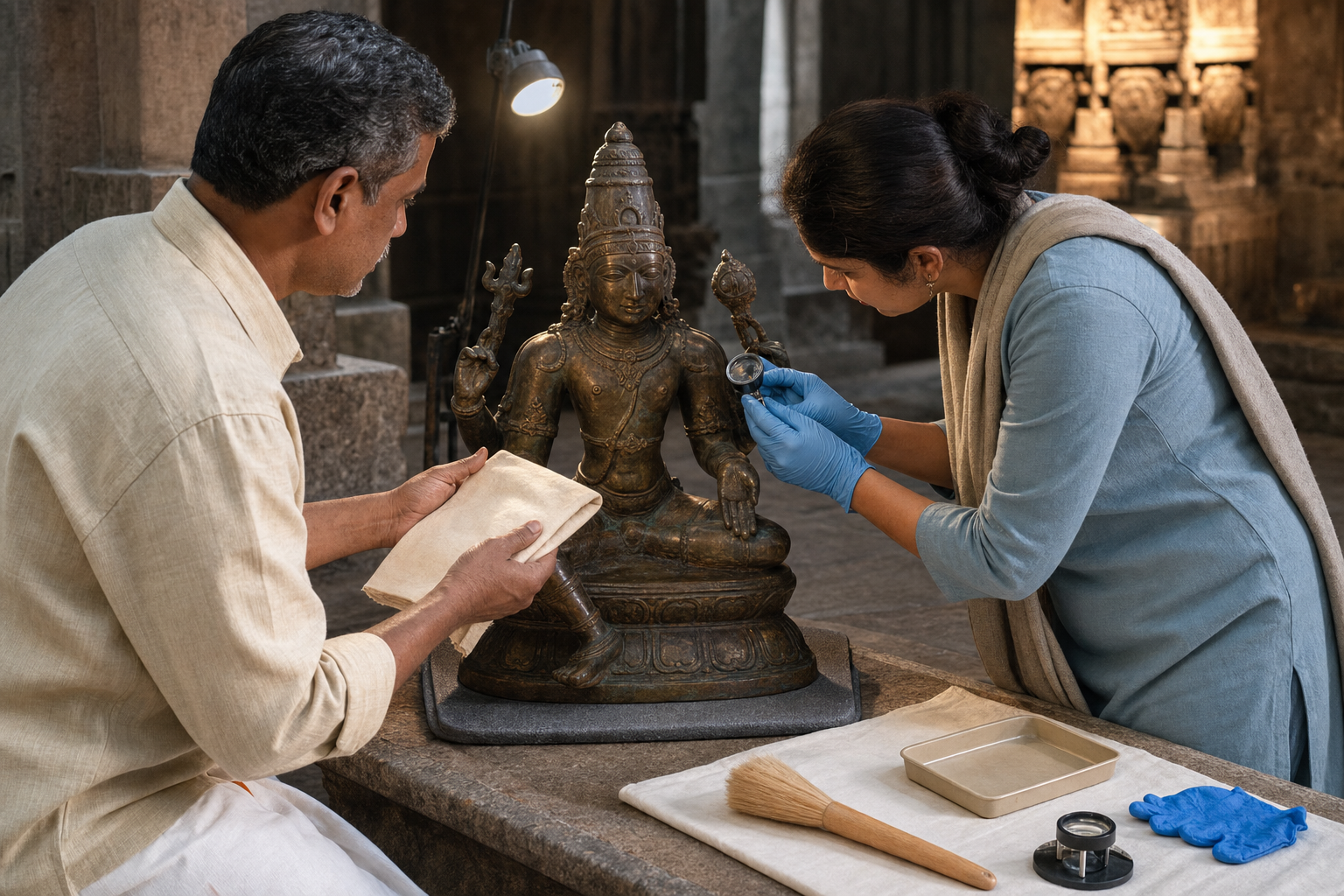
There is no responsible universal formula for cleaning every temple bronze. Alloy composition varies, and the same treatment can behave differently on a high-copper bronze, a zinc-rich brass, a previously coated surface or a gilded detail. A committee can still adopt a clear sequence that protects both ritual requirements and material integrity.
- Establish the ritual requirements first. Record which substances the relevant tradition requires, which are optional and how the murti is normally rinsed, dried, dressed and stored.
- Document the existing surface before changing it. Photograph the front, back, base, recesses and high-contact areas under similar lighting. Note local gilding, old repairs, existing scratches and variations in lustre. This gives you a baseline if a change later appears.
- Use clean water for routine rinsing. Water quality matters because chloride contamination increases corrosion risk. If the water supply is uncertain, the committee should resolve that question rather than compensate with more frequent polishing.
- Remove ritual residues without trying to expose bright metal. Use soft cloths and gentle handling. Do not use a scouring pad, harsh mineral powder or mechanical polishing merely to make all areas match.
- Treat tamarind or lemon as a targeted oxide-removal step, not an automatic part of every cleaning. Mild organic acids can lift thicker oxide, but unnecessary or prolonged contact also changes the surface. Follow an established temple procedure, rinse the acid away completely and do not improvise a stronger mixture.
- Dry the entire murti thoroughly. Check recesses, ornaments and the underside instead of judging only the visible face. Standing moisture can undo the benefit of an otherwise careful abhishekam.
- If the tradition calls for oil, sandalwood or another anointment, apply only the intended thin layer. A subtle film can repel moisture and deepen the colour; a heavy accumulation can trap dirt, obscure detail and complicate the next cleaning.
- Review changes over time. Compare the surface with the earlier photographs. Recurring local deterioration, suspected gilding, a failing repair or visible loss of detail belongs with a qualified metals conservator, working in coordination with the temple’s ritual authorities.
This sequence does not turn puja into laboratory work. It gives priests, trustees, sthapatis and conservators a shared record of what was done and why. That record is especially valuable when duties pass to a new archaka or committee and an inherited practice can no longer be traced.
The living surface is part of the sacred history
A museum often tries to hold an object in a defined condition. A living temple asks something more complex of its metal images: they must be bathed, clothed, touched, illuminated and carried while remaining sound enough to serve future generations. The answer is not to freeze the murti outside ritual life. It is to understand which ritual cycles stabilise the surface and which accidental exposures place it at risk.
The same ethic appears in different forms across Dharmic traditions. Buddhist copper-alloy images receive the atmosphere of butter lamps and incense before careful wiping. Jain images undergo jal abhishek and anointment. Sikh care for sarabloh and liturgical metalware likewise treats disciplined maintenance as an expression of reverence. The materials differ, but the governing principle is recognisable: sacred matter is entrusted to repeated, attentive care.
This is why the glow should not be reduced to an imitation of gold. Its deeper meaning lies in the way modest substances—water, milk, ghee, ash, sandalwood, oil and cloth—gradually leave the mark of worship. The radiance is not simply wealth displayed on a surface. It is seva made visible.
Key takeaways
- A gold-like temple bronze is usually not evidence of gold plating; copper-rich alloy, zinc where present, fine finishing, thin oxide and lamp light can produce the appearance.
- Panchaloha is a sacred metallurgical category, not a guarantee of five equal metal proportions.
- An even, adherent patina and brighter high-contact areas can record ritual life rather than neglect.
- Clean water, complete rinsing, thorough drying and thin traditional anointments support preservation.
- Chlorides, standing moisture and abrasive scouring are preventable threats.
- Mild traditional acids should be targeted and controlled, never used simply to chase maximum brightness.
- When a local change keeps returning or metal appears to be deteriorating, pause cleaning and obtain copper-alloy conservation advice.
At the next care review, begin by photographing the murti and writing down the current abhishekam, rinsing and drying sequence. That small act gives the temple a practical baseline—and makes it far easier to preserve the glow without polishing away the history that created it.