

You find a passage from the Ramayana online, then open a printed edition and cannot locate it under the same heading. Or one reference calls a Mahabharata division a book while another calls it a parva. The immediate suspicion is that somebody has quoted carelessly or changed the text.
Often, the real problem is simpler: the quotation, the structure that locates it, and the edition that presents it have been collapsed into one thing. Once you separate those layers, you can find passages more reliably, compare editions fairly, and understand transmission without treating either perfect uniformity or wholesale corruption as the only possibility.
Start with the address, not the isolated quotation
A scriptural passage needs an address. The name of the work alone is rarely enough. Long texts are arranged into major divisions, smaller sections, chapters, and sometimes numbered verses. A translation may also rename or regroup these units for its readers.
When you save, share, or evaluate a passage, record its location from the edition actually in front of you. Use this sequence:
- Name the work: Ramayana, Mahabharata, Vedas, or another identified text.
- Preserve the work’s major structural term, such as kanda or parva, instead of replacing every division with the generic word book.
- Add the smaller locator supplied by that edition, such as a chapter or verse number.
- Record the translator, editor, publisher, or digital collection when known.
- If you found the passage in a retelling rather than a translation, label it as a retelling.
This creates a usable citation: work, major division, lower-level location, edition. If another reader cannot find the wording, they can now test whether the difference comes from translation, numbering, organization, or a genuinely different textual form. Without the edition, a verse number can look precise while still being insufficient.
Kanda and parva reveal two different epic architectures

Kanda and parva should not be treated as decorative Sanskrit alternatives for the same English label. The Ramayana is conventionally organized through kandas, while the Mahabharata is organized through parvas. Each term belongs to the internal architecture of its epic.
| Epic | Major division | What the division helps you follow |
|---|---|---|
| Ramayana | Kanda | A broad narrative book or stage within the epic’s movement |
| Mahabharata | Parva | An articulated major section or turning movement within the larger whole |
The distinction matters when you read. A kanda gives you a large narrative setting. A parva helps you notice how an immense narrative is joined and redirected through successive sections. The table of contents is therefore not merely packaging added by a publisher. It provides a map of how the work expects its material to be encountered.
An English edition may call both units books. That translation can be convenient, but it hides useful information. Keep the original structural label beside the translated one in your notes. Write Ramayana, kanda, chapter rather than reducing the location to Ramayana, book, page. For the Mahabharata, retain parva even if the cover or contents page also supplies a volume number.
Do not extend this distinction into a universal rule for every Hindu scripture. Kanda and parva explain the organization of these epics; they are not a complete classification system for the Vedas, Puranas, or every text honored within the many Hindu traditions.
Transmission preserves a text through more than copying
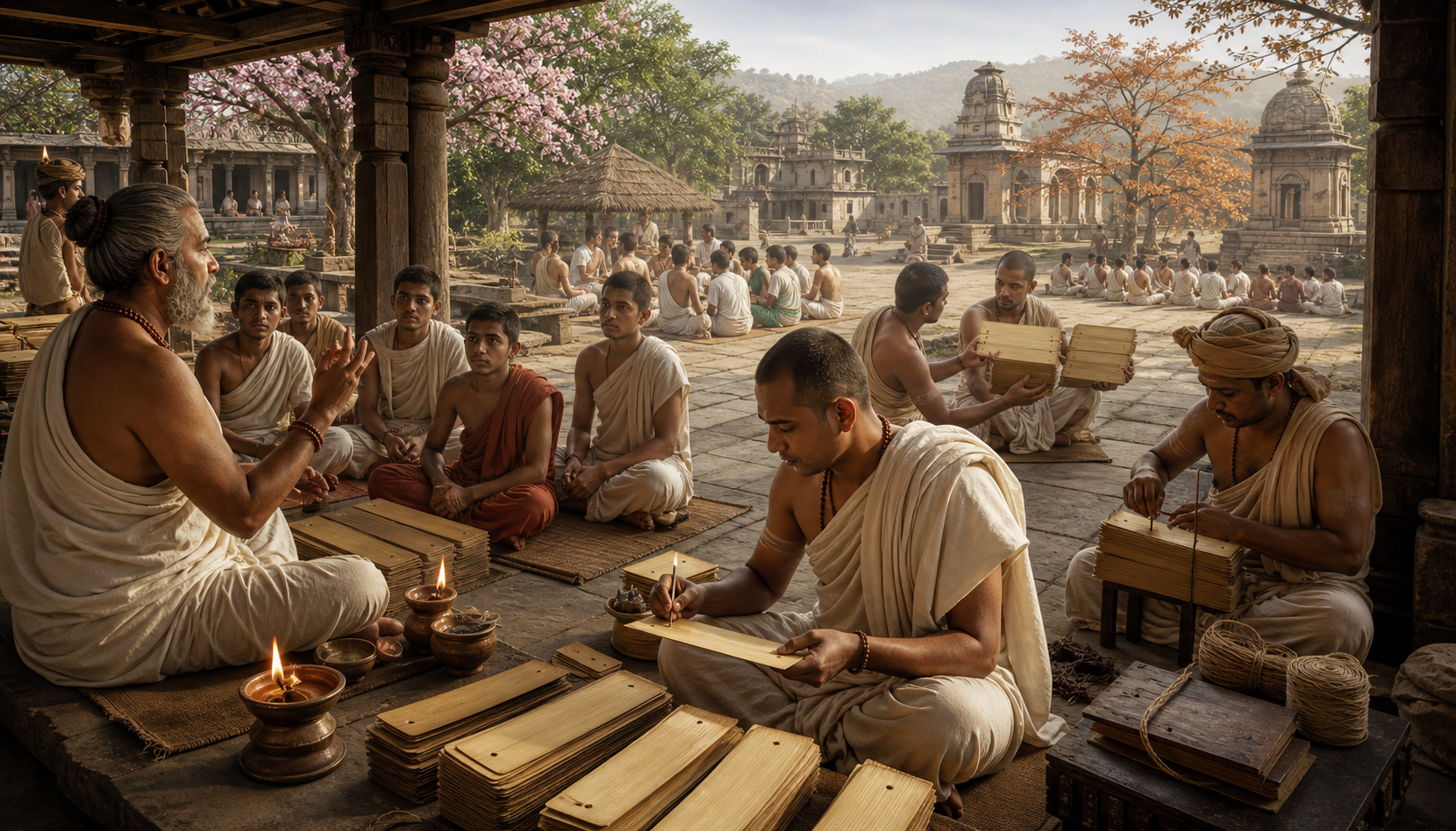
Modern readers often imagine transmission as a manuscript being copied, printed, and digitized. Hindu traditions carried sacred knowledge through a wider chain of practices: memorization, recitation, teaching, compilation, manuscript copying, commentary, public narration, performance, translation, and print. The Vedas are especially associated with disciplined oral preservation, while the epics have also lived through narration and retelling alongside textual transmission.
Preservation and variation can therefore coexist. A tradition may guard wording carefully in one setting while allowing explanation, performance, or retelling to respond to another audience. Calling every difference corruption erases those distinctions. Calling every version identical erases them too.
When two presentations differ, identify the layer before deciding what the difference means:
- Wording: If the episode, sequence, and teaching remain stable but the sentences differ, you may be looking at translation choices.
- Organization: If the same material appears under different chapter boundaries or numbers, check the edition’s table of contents and editorial conventions.
- Interpretation: If explanatory claims differ while the underlying passage remains recognizable, separate commentary from the transmitted passage.
- Retelling: If events, characterization, or emphasis have been reshaped, treat the work as an adaptation or retelling unless it identifies itself as a direct translation.
These are diagnostic clues, not automatic verdicts. To establish a substantial textual difference, you need editions that disclose what they are translating or reproducing. A screenshot, quotation card, or unattributed web paragraph cannot settle that question.
This layered approach also protects a living tradition from a false choice. You do not have to claim that every presentation is verbally identical in order to take continuity seriously. Nor do you have to dismiss continuity because teaching, compilation, and interpretation were carried by generations of people. You simply have to name the layer you are examining.
Veda Vyasa names a responsibility, not just an author line
The modern title page trains us to ask for one author, one completed manuscript, and one publication date. That model is useful for a contemporary book, but it can misdescribe an inherited sacred corpus.
A traditional understanding treats Veda Vyasa as a recurring title and speaks of 28 compilers of the Vedas. The familiar sage associated with the Mahabharata and the Puranas remains central within tradition, but the title also points to an enduring function: arranging, dividing, compiling, and handing knowledge forward.
The number belongs to a traditional chronology; it should not be presented as a modern biographical count established by ordinary archival documentation. Its interpretive importance lies in what the tradition says a Vyasa does. Compilation is not a lesser, mechanical activity. In a civilizational setting, ordering a body of knowledge so that it remains teachable is itself a form of preservation.
Three reading errors follow when Vyasa is forced into a modern author category:
- Compiled becomes invented. A compiler may organize and transmit inherited material without claiming to have originated every part of it.
- A title becomes one simple biography. A recurring responsibility can be obscured when every reference is treated as an identical modern personal name.
- Structure becomes secondary. Division and arrangement are treated as editorial decoration even though they help make a large corpus teachable and memorable.
When you encounter the statement that Vyasa authored or compiled a work, pause over the verb. Ask whether it means composition, collection, arrangement, transmission, or a traditional attribution that includes several of these functions. That one question prevents a surprising amount of confusion.
Use this method when reading across editions

You do not need specialist training to compare responsibly. You do need a disciplined sequence.
- Decide what you are trying to verify. Locating an episode, comparing exact wording, and tracing an interpretation are three different tasks.
- Classify what is in front of you. Is it a translation, abridgment, commentary, performance transcript, devotional retelling, or unattributed extract? Do not demand word-for-word correspondence from unlike forms.
- Fix one edition as your base. Read its preface and contents page, then use its structural labels consistently. Page numbers alone are fragile because they change between printings and formats.
- Build the full address. Record the work, kanda or parva where applicable, the smaller division, and the edition. Copy enough surrounding context to show what the passage is doing.
- Compare structure before sentences. First confirm that both versions place you in the same episode and narrative movement. Only then compare wording.
- State the result at the right strength. Say that two translations phrase a passage differently when that is all you have shown. Reserve claims about textual alteration for evidence that goes beyond a difference in English wording.
Key takeaways
- A passage is easiest to verify when its citation includes the work, internal division, smaller locator, and edition.
- Kanda is the characteristic major division of the Ramayana; parva is the characteristic major division of the Mahabharata.
- Translation, organization, commentary, and retelling are different transmission layers. A difference at one layer does not automatically prove a difference at every layer.
- Veda Vyasa can denote a traditional compiling responsibility, not merely a modern-style author name.
- Structure is part of how sacred knowledge is remembered, taught, navigated, and handed forward.
The next time you save a scriptural passage, add one line above it: work, internal division, lower-level location, and edition. That small habit turns an attractive quotation into something you can return to, test, and study within its proper place.
References
- Hindu Blog — Difference Between Parvas And Kandas In Hindu Scriptures
- Hindu Blog — Why Veda Vyasa is a Title and Not a Personal Name In Ancient Hinduism
