
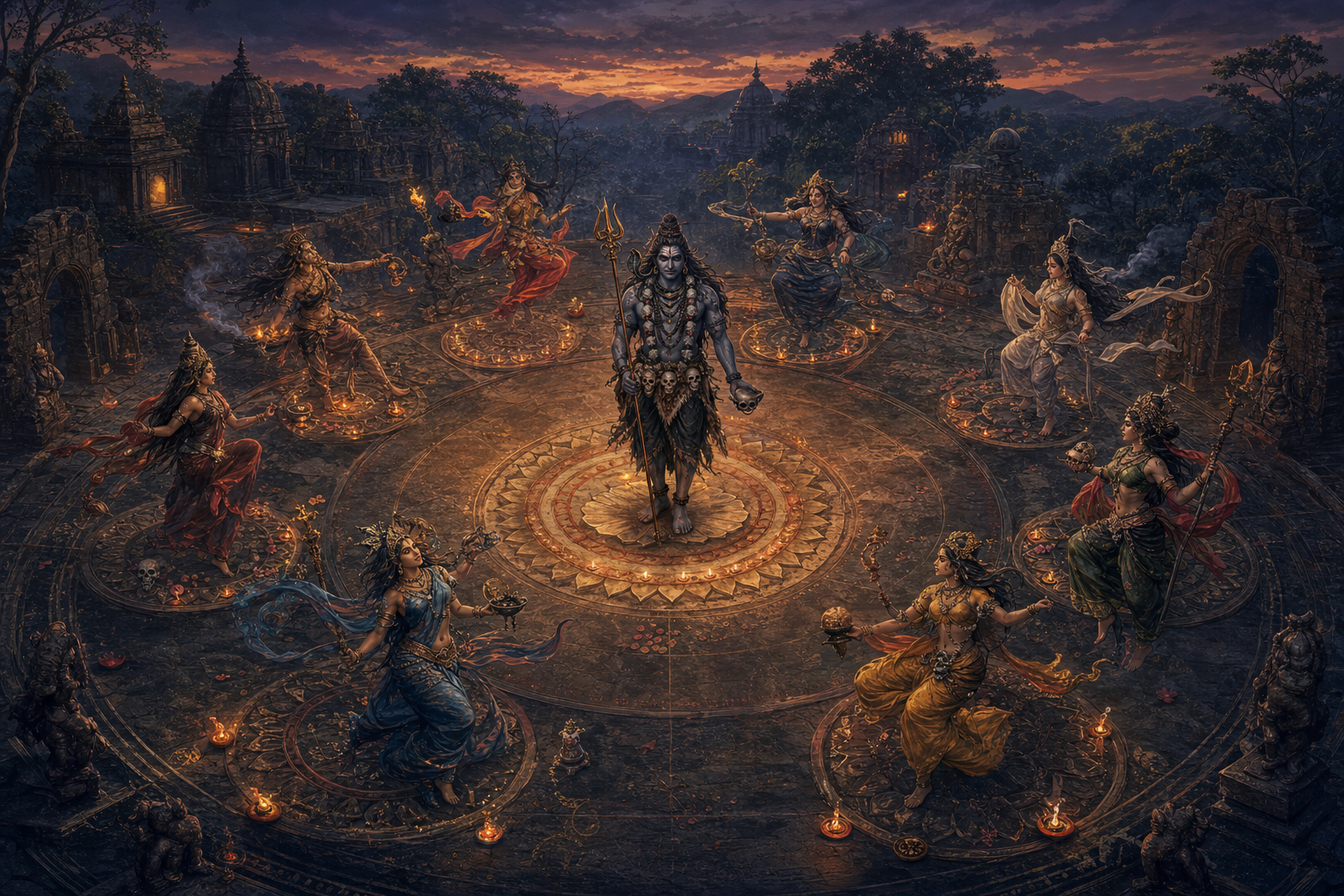
Early Śaiva Tantra is often presented as a finished diagram: eight Bhairavas guard eight directions while sixty-four Yoginīs occupy an orderly circle. The source material points to a more layered history. Early scripture, later classifications, regional ritual systems, sacred geography, and modern syntheses preserve related structures without supplying one universally authoritative chart.
Understanding that distinction makes the mandala more intelligible. Its importance lies not only in identifying deities but also in seeing how Tantric traditions coordinated awareness and power, centre and boundary, masculine and feminine forms, and the outer landscape with the ritualized body.
The earliest evidence is a textual world, not a fixed chart

The most substantial early textual anchor among the sources is the Brahmayāmala, also called the Picumata. The account in Brahmayamala Tantra Revealed identifies it as an early goddess-oriented scripture associated with the Śaiva Mantramārga and, more specifically, the Vidyāpīṭha division of the Bhairavatantras. It reports that scholars generally place the work’s core around 650–750 CE, while allowing for multiple chronological layers.
The same source describes a work of more than twelve thousand verses and 104 chapters whose principal witness is an eleventh-century Nepalese palm-leaf manuscript. The interval between the proposed age of the textual core and the date of that manuscript matters: composition, compilation, copying, and later interpretation are different stages in a scripture’s history. The source also notes that only selected chapters have received full critical editions and annotated translations, limiting how confidently the whole work can be summarized.
The evidence surrounding the other titles is less concentrated. Ashtabhairava Tantra Explained cautions that “Ashtabhairava Tantra” often serves as an umbrella designation for overlapping texts, manuals, iconographic systems, temple traditions, and oral teachings rather than the title of one universally accepted scripture. Skanda Yamala Tantra Explained makes a comparable methodological point: material attributed to the Skandayāmala survives through manuscript titles, quotations, ritual digests, and traditional classifications, but not as one securely reconstructed primordial text.
These cases prevent a common historical shortcut. The early Brahmayāmala can document a formative Bhairava- and Yoginī-centred ritual environment, but it should not automatically be treated as the source of every later eightfold or sixty-fourfold arrangement. Conversely, a later classification may preserve older ritual concepts without proving that all of its correspondences existed together at the beginning.
Bhairava defines the field; the Yoginīs make it dynamic
Across the Ashtabhairava and sacred-geometry accounts, Bhairava is associated with fierce protection, time, dissolution, ascetic power, sacred boundaries, and the destruction of ignorance. His fearsome appearance is not presented as moral evil or uncontrolled anger. It gives visible form to the vigilance required at thresholds where fear, mortality, attachment, and disorder are confronted rather than concealed.
This helps explain Bhairava’s role as a kṣetrapāla, the guardian of a consecrated field. Such a field may be a shrine, city, ritual enclosure, pilgrimage landscape, body, or disciplined condition of consciousness. Directional Bhairavas do more than occupy compass points: they establish the perimeter within which ritual relationships become ordered and intelligible.
The Yoginīs represent another dimension of that field. Sacred Geometry Revealed emphasizes that the historical word “Yoginī” can denote a female practitioner, an accomplished woman, a divine or semidivine being, a member of a goddess circle, or a manifestation of Śakti. In the sixty-four-Yoginī context, it generally refers to differentiated divine powers whose forms can encompass beauty, danger, nourishment, protection, sovereignty, death, and transformation.
The relationship is therefore more subtle than a hierarchy of male guardians commanding female attendants. The sources instead support a complementary model: Bhairava establishes or witnesses a field of awareness, while the Yoginīs express its mobile and transformative capacities. Consciousness without power would remain inactive; power without an integrating field would lack ritual orientation.
The Mātṛkās, or Mother Goddesses, frequently mediate this relationship. One widely transmitted scheme pairs seven clearly named Mātṛkās and a variable eighth goddess with the eight principal Bhairavas, while each mother may organize an octad of Yoginīs. The sacred-geometry account specifically notes disagreement over the eighth position, where Mahālakṣmī, Narasiṃhī, or Yogeśvarī may appear. Rather than being a defect, this instability reveals that several textual and regional systems developed around a shared ritual grammar.
How eight becomes sixty-four without producing one universal list
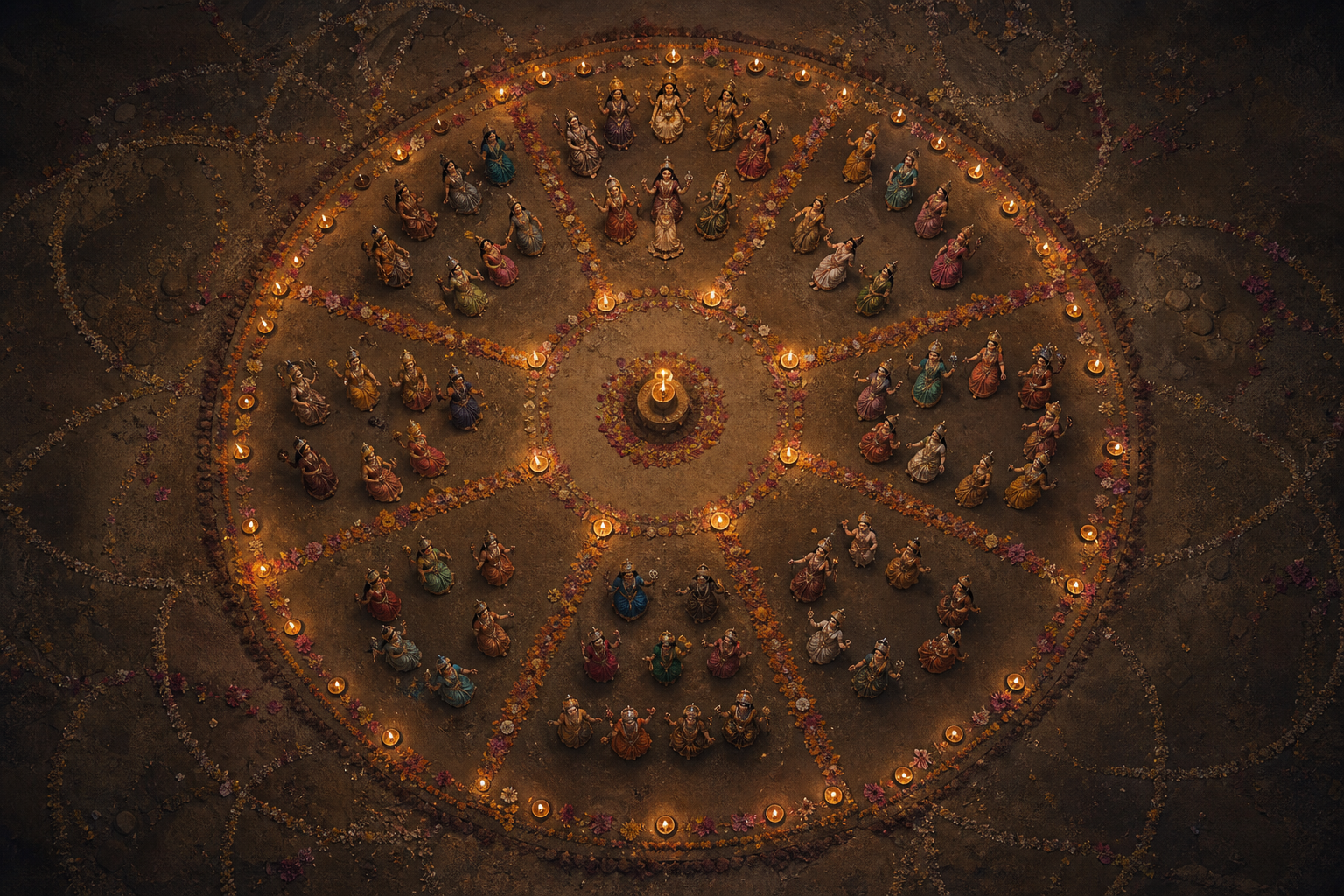
Both Ashtabhairava Tantra Explained and Sacred Geometry Revealed describe the attraction of the formula 8 × 8 = 64. Eight accommodates the cardinal and intermediate directions, creating a complete perimeter. Sixty-four then permits each principal field to unfold into eight more specialized powers. The arithmetic is meaningful because it holds plurality within an ordered whole.
A common modern sequence names Asitāṅga, Ruru, Caṇḍa, Krodha, Unmatta, Kapāla, Bhīṣaṇa, and Saṃhāra as the eight Bhairavas, beginning in the east and proceeding through the intermediate and cardinal directions to the northeast. Both sources warn, however, that regional manuals, manuscripts, temple traditions, and living lineages can vary in sequence, spelling, colour, attribute, consort, and direction. The sequence is consequently a useful map, not a universal historical control list.
The sixty-fourfold expansion can also be constructed in more than one way. One classification gives each principal Bhairava eight subordinate Bhairavas, producing sixty-four fierce forms. Another arranges sixty-four Yoginīs as eight octads associated with the Mātṛkās and, through them, with the Bhairavas. A further model allows sixty-four Bhairavas and sixty-four Yoginīs to be paired. These systems share an eightfold architecture while differing in their theological mechanics.
The recurrence of sixty-four elsewhere in Indian classifications does not establish that all such sets came from one source or encode an identical doctrine. As the sacred-geometry article observes, the number also appears in accounts of arts, accomplishments, ritual seats, Tantras, and extraordinary capacities. Its recurrence is better read as evidence that sixty-four became an effective number for imagining comprehensive but organized diversity.
From diagram to temple, landscape, and ritual body

A mandala in these traditions is not primarily an illustration. Its centre, gates, circuits, directional positions, and boundary define a ritual environment in which divine powers are invoked and related. The centre represents concentrated presence; the perimeter differentiates and protects that presence. A Bhairava or Shiva may occupy the centre in one system, while a goddess may be sovereign in another. Geometry supplies relationships rather than imposing one theology on every lineage.
The Ashtabhairava account extends this logic into sacred geography. It reports a study of the Kāśī Khaṇḍa describing eight Bhairavas established in the eight quarters to protect Kāśī. In that interpretation, Varanasi can be encountered as a living mandala: shrines, routes, circumambulation, and a spiritual centre participate in one protected landscape.
The Skandayāmala discussion offers the complementary movement inward. It describes nyāsa as the installation of mantras, deities, phonemes, sacred sites, or powers upon and within the practitioner. In pīṭha nyāsa, pilgrimage places become an interior sacred geography. The body is not discarded as an obstacle; it is ritually reimagined as a consecrated field corresponding to the outer landscape.
The Brahmayāmala provides the strongest source-based warning against turning this symbolism into a free-standing modern visualization exercise. Its reported religious world integrates mandala, mantra, initiation, vows, disciplined observance, deity installation, and Yoginī worship. Knowledge is powerful because it is transmitted and embodied through exact procedures, not because a diagram has been detached from its ritual setting. Historical understanding therefore does not confer authorization to reproduce restricted or technically demanding rites.
For non-initiated readers, the most defensible value is interpretive. The mandala demonstrates how early Tantric communities could treat direction, sound, deity, body, and landscape as mutually informing dimensions of practice. Its fierce figures communicate disciplined engagement with boundaries and impermanence, while its Yoginī circles prevent sacred order from being mistaken for static uniformity.
Key takeaways
- The Brahmayāmala supplies an important early textual witness to a goddess-oriented Bhairava tradition, but it does not establish every later eight-by-eight chart.
- “Ashtabhairava Tantra” and “Skanda Yamala” can designate historically layered bodies of authority rather than single, fully recoverable books.
- Bhairavas, Mātṛkās, and Yoginīs are connected through several related arrangements; no surviving roster should automatically be universalized.
- The equation 8 × 8 = 64 expresses ordered differentiation, not merely a census of deities.
- A Tantric mandala can coordinate ritual space, sacred geography, and the consecrated body, while remaining inseparable from initiation and disciplined procedure in its original settings.
Further manuscript editing and comparison of regional systems can clarify where these arrangements intersect and where they remain distinct. Preserving those distinctions will make future study of Bhairava and the Yoginīs more historically credible without diminishing the mandala’s theological depth.
References
- DharmaRenaissance Blog — Ashtabhairava Tantra Explained: Eight Fierce Guardians, Mandala, and Sadhana
- DharmaRenaissance Blog — Brahmayamala Tantra Revealed: An Essential Guide to Early Yogini Traditions
- DharmaRenaissance Blog — Sacred Geometry Revealed: How Eight Bhairavas and 64 Yoginis Shape the Tantric Cosmos
- DharmaRenaissance Blog — Skanda Yamala Tantra Explained: Textual History, Sacred Anatomy, and Living Legacy