
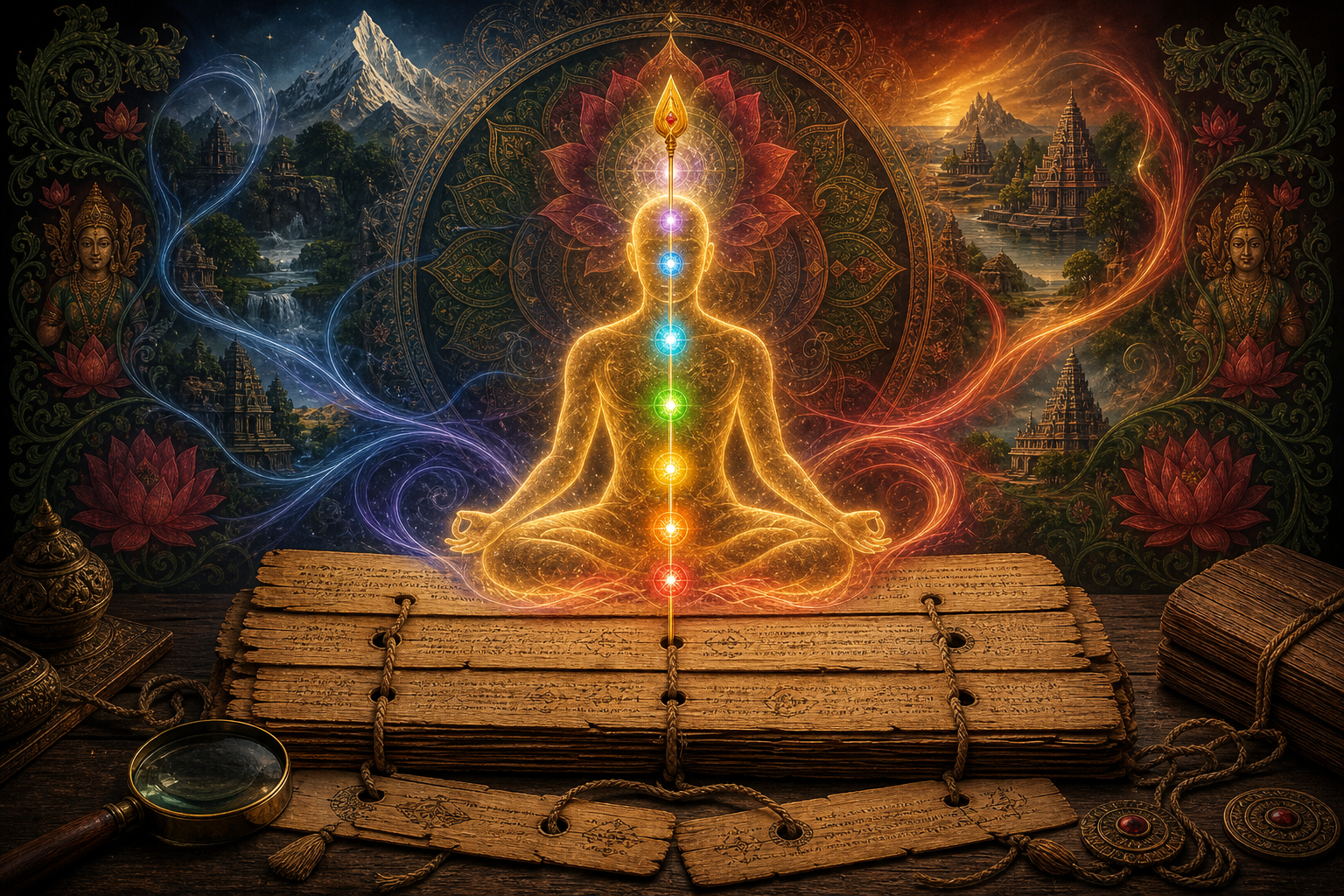
The Skanda Yamala Tantra is best approached as a remembered scriptural authority whose surviving traces illuminate Hindu Tantra without yielding a single, complete book. Its significance lies in the relationship among manuscript evidence, ritual transmission, sacred embodiment, and Skanda’s ethic of disciplined power.
A careful reading must therefore separate what is historically documented from what lineages transmit and what modern interpreters draw from the tradition. That distinction protects both scholarship and devotion.
What the surviving record can actually establish
No widely accepted critical edition currently reconstructs one complete, original Skanda Yamala. The title survives through manuscript descriptions, quotations, ritual compilations, traditional classifications, and lineage teachings. Such evidence shows that the authority was remembered and used, but it does not prove that every later attribution came from one stable document.
The supplied source account reports that a French Institute of Pondicherry catalogue records a Bhadrakali installation procedure attributed to the Skandayamala. That procedure appears within a working collection containing materials related to consecration, mandala worship, fire ritual, expiation, and temple installation. The source also cites research preserved by the Oxford Research Archive stating that Chandeshvara, an early-fourteenth-century Maithila scholar and minister, based a Navadurga worship procedure on a Skandayamala.
These traces do not recover the entire scripture. They do, however, place Skandayamala authority within medieval ritual life and connect it firmly to Shakta worship as well as the wider Shaiva-Shakta world.
Why the title reaches beyond a single deity
Yamala can mean a pair or conjunction, and in Tantric interpretation it commonly evokes complementary realities such as consciousness and power, knowledge and action, or Shiva and Shakti. It is also the name of a scriptural class, although traditional lists of the Yamalas vary. The label should not be mistaken for a uniformly fixed canon.
Skanda is revered as Kartikeya, Kumara, Subrahmanya, Muruga, and Shanmukha: the divine commander associated with courage, intelligence, and purposeful action. Yet a Skanda title does not make the material exclusively a manual of Muruga worship. Its connections with Bhadrakali and Navadurga suggest a ritual network in which Skanda can serve as deity, revealer, guardian, and bridge between Shaiva and Shakta traditions.
This interconnectedness is a strength of Sanatana Dharma. Distinct forms of the divine can retain their own identities while participating in a larger sacred order, allowing sectarian diversity to become a source of civilizational depth rather than division.

Sacred anatomy turns geography into responsibility
Contemporary exposition attributes a form of pitha nyasa to the Skanda Yamala. Nyasa is the ritual placement of mantra, deity, sacred sound, site, or power upon the body. Pitha nyasa extends this principle by correlating pilgrimage centers with subtle bodily centers, making the practitioner an inner map of sacred geography.
The source transmits a sequence running from Shrigiri at Muladhara through Kamarupa, Oddiyana, Kedara, Dvaraka, and Jalandhara, culminating in Purnagiri at Sahasrara. This mapping should be treated as a teaching preserved under Skanda Yamala authority, not as a universal chakra system. Tantric correspondences differ across texts and lineages, and familiar modern yoga models should not be projected backward without manuscript support.
Its theological meaning is nevertheless clear: the body need not be rejected as spiritually inferior. It can be consecrated as a field of worship. Skanda then embodies the joining of jnana, discerning knowledge, with kriya, effective action. Martial imagery becomes an inward discipline directed against fear, anger, inertia, deception, and misuse of power rather than hostility toward other communities.
Key takeaways
- The Skanda Yamala survives as a textually plural authority rather than an easily reconstructed single volume.
- Its strongest reported historical traces connect it with Bhadrakali installation and Navadurga worship.
- Sacred-body mappings attributed to it require textual caution because Tantric systems vary by lineage.
- Skanda’s enduring symbolism unites intelligence, courage, self-command, and dharmic responsibility.
How to preserve the tradition without flattening it
Responsible study begins by distinguishing the Skanda Yamala from the Skanda Purana, Tamil Kanda Puranam traditions, and later manuals associated with Skanda. Claims should be traced to identifiable manuscripts, quotations, colophons, or clearly named lineage transmissions. Devotional interpretation remains meaningful, but it should not be presented as settled textual history.
Advanced mantra, nyasa, breath, installation, and protective practices traditionally depend on initiation and qualified guidance. A trustworthy teacher should combine lineage competence with ethical restraint, consent, and freedom from manipulation. Secrecy cannot justify abuse.
The wider Dharmic family also benefits from precision. Hindu, Buddhist, and Jain communities historically shared forms such as mantra, mandala, visualization, and sacred geography while maintaining distinct doctrines. Sikh tradition arose later and should not be inserted into Yamala history, yet its emphasis on disciplined courage and responsible service offers a meaningful ethical point of conversation. Unity grows through mutual respect and truthful comparison, not through claims that every path is identical.
Future manuscript cataloguing, comparison, editing, and translation can clarify the Skanda Yamala further. Until then, intellectual humility remains the soundest guardian of this living Hindu inheritance.
