
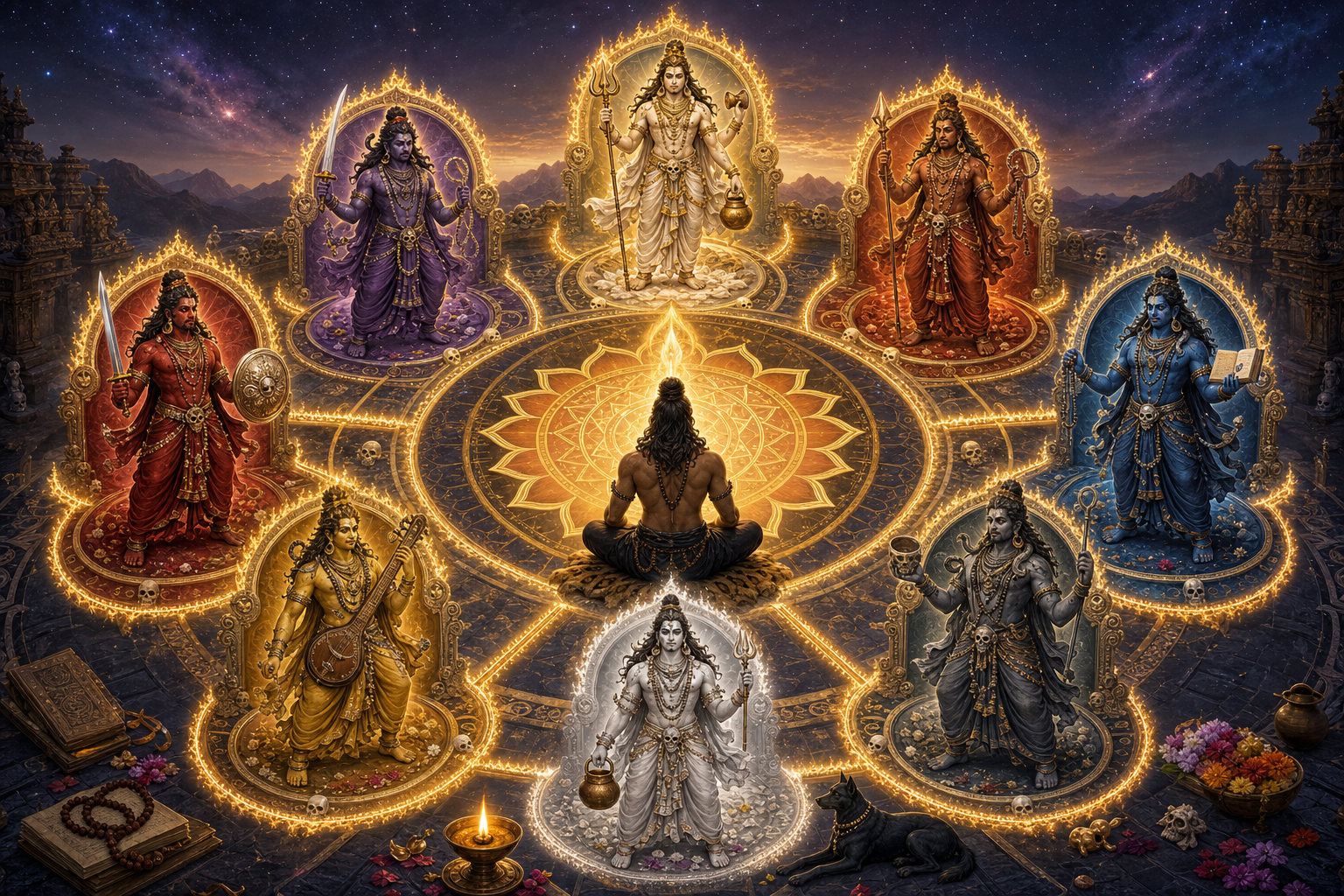
Skulls, flames, weapons, serpents, and cremation grounds make Bhairava’s world look severe. Within Shaiva and Shakta traditions, however, this imagery speaks less about uncontrolled violence than about vigilance before fear, pride, mortality, and change.
The Ashtabhairava framework places eight forms of Bhairava around a sacred center. Understanding it requires attention to both its coherent spiritual vision and the regional differences that keep it a living Hindu tradition.
A family of traditions, not one uniform scripture
Ashtabhairava joins aṣṭa, meaning eight, with Bhairava, the formidable manifestation of Shiva. The source discussion from Hindu Pad presents the term as a broad synthesis of texts, mandalas, mantras, temple customs, iconography, and oral instruction. It should not automatically be treated as the title of one scripture preserved everywhere in a single recension.
This distinction explains why lists can differ without making the tradition incoherent. Puranic sacred geography, Tantric ritual manuals, stotras, later iconographic compilations, and regional worship serve different purposes. One source may identify shrines, another prescribe ritual, and another describe colors, weapons, vehicles, or divine partners.
Eight guardians as a sequence of inner discipline
A common modern arrangement reported by the source pairs each direction with a Bhairava and a Matrika. Its spiritual meanings are best read as contemplative prompts, not promises of automatic worldly results.
- East: Asitanga with Brahmi. Dawn suggests beginning, clarity, and creative action guided by knowledge.
- Southeast: Ruru with Maheshvari. Books, rosaries, and musical imagery connect learning with sustained, transformative practice.
- South: Chanda with Kaumari. Martial emblems signify courage directed against hesitation, disorder, and destructive habits.
- Southwest: Krodha with Vaishnavi. Sacred fierceness becomes the disciplined protection of a legitimate boundary, not revenge.
- West: Unmatta with Varahi. The setting sun evokes the loosening of rigid identity without glorifying recklessness or mental distress.
- Northwest: Kapala with Indrani. The skull confronts mortality, pride, wasted effort, and attachment to status.
- North: Bhishana with Chamunda. Terrifying form gives fear a visible place within a larger protective order.
- Northeast: Samhara with a variable goddess pairing. Often linked with Chandi or Chandika, this form represents the responsible ending of an exhausted cycle.
Together, the Bhairava-Matrika pairs express the unity of awareness and power, Shiva and Shakti. They also turn fierceness inward: the true field of struggle is undisciplined desire, fear, false certainty, and conduct that departs from dharma.
How the mandala joins space, consciousness, and community
The four cardinal and four intermediate directions form a complete ritual perimeter. Placing guardians around it creates an ordered field whose center serves as the integrating principle. The source also notes that the Kāśī Khaṇḍa describes eight Bhairavas protecting the eight quarters of Kāśī, allowing sacred geography itself to be understood as a living mandala.

An eight-by-eight classification expands the principal guardians into sixty-four Bhairavas. This structure is associated with the 64 Yoginis, although surviving names and groupings are not uniform. The enduring idea is the partnership of protective awareness and transformative energy, not one universally binding chart.
Dharmic civilizational unity works in a similar way: coherence need not erase plurality. Hindu, Buddhist, Jain, and Sikh traditions retain distinct doctrines and practices, while self-restraint, courage, compassion, service, and responsibility provide genuine ground for solidarity. Even related fierce figures, such as Buddhist Vajrabhairava, should be respected within their own theological settings.
Practice requires lineage, ethics, and proportion
Formal Bhairava sadhana can involve purification, intention, lineage remembrance, nyasa, mandala visualization, invocation, offerings, japa, meditation, and ritual closure. Directional sealing, or digbandhana, gathers attention and marks a consecrated boundary. It should not be interpreted as making a place physically invulnerable.
Mantras containing bija syllables require particular care because pronunciation, eligibility, visualization, repetition, and concluding procedures may vary by lineage. An online formula is documentation, not universal authorization. Likewise, chakra correspondences can be meaningful within a transmitted system without becoming a fixed map for all Hindu traditions.
Householders can honor Bhairava through temple worship, Shiva remembrance, recognized stotras, ethical discipline, and guidance from a trustworthy teacher. Care for dogs, traditionally associated with Bhairava, becomes especially meaningful when expressed as responsible service to living animals. Spiritual practice should complement, never replace, medical, psychological, legal, or practical help.
Key takeaways
- Ashtabhairava names an eightfold ritual and theological tradition rather than one universally fixed book.
- The mandala orders sacred space while presenting a disciplined path through knowledge, courage, fear, mortality, and release.
- Regional differences in directions, goddesses, vehicles, and mantras belong to the tradition’s vitality.
- Fierce symbolism supports dharmic responsibility only when joined to restraint, compassion, and qualified instruction.
Studied with textual care and devotional humility, the eight guardians can strengthen a confident Hindu understanding of Tantra while encouraging the wider dharmic family to protect its shared heritage without flattening its many paths.
