
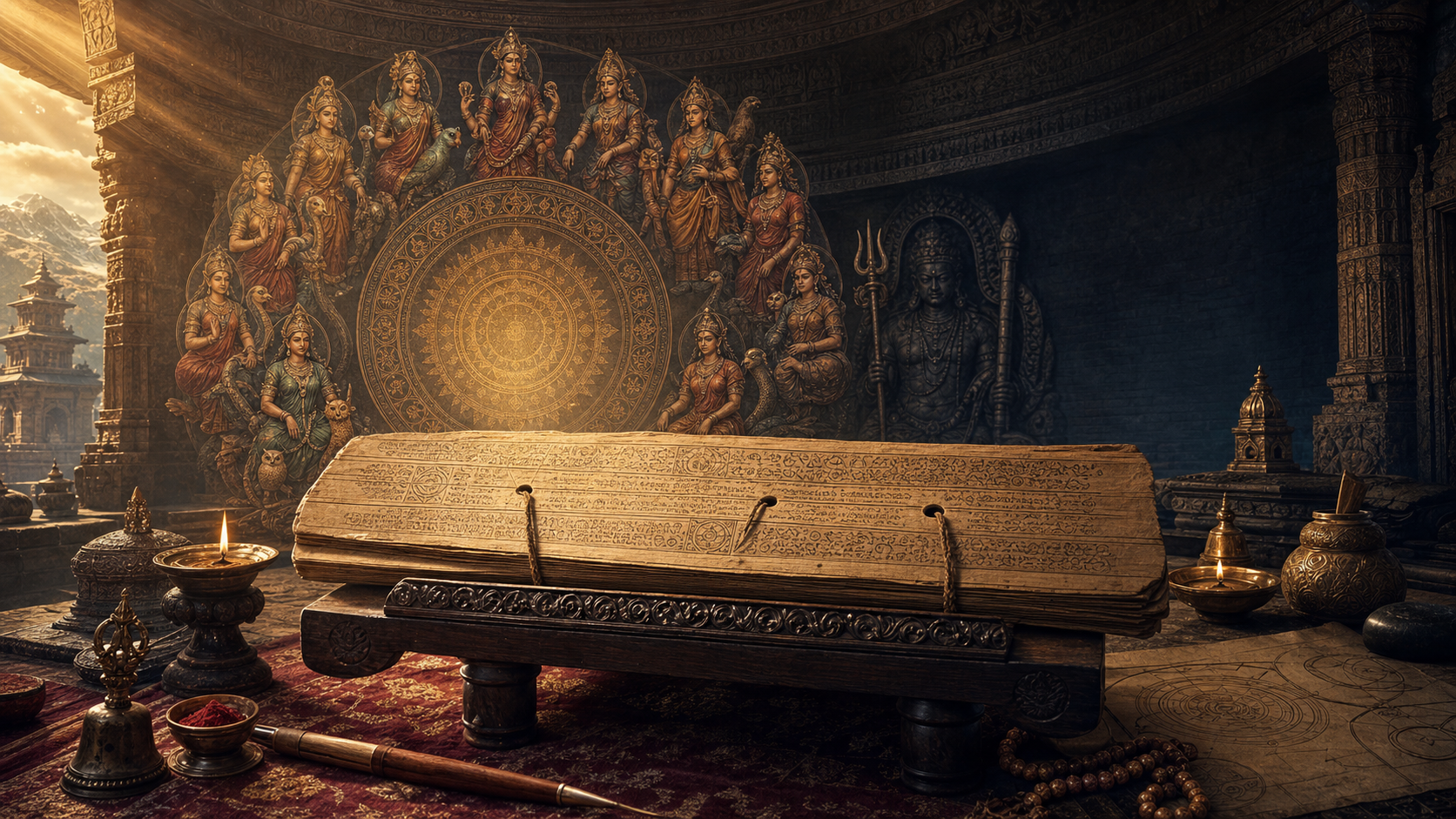
The Brahmayamala Tantra, also known within the scripture as the Picumata, opens a rare window onto an early goddess-centered current of Shaiva Tantra. Its importance lies not in offering techniques for casual experimentation, but in showing how an initiatory community joined revelation, disciplined practice, the body, and divine power.
Read historically, the work also challenges familiar stereotypes. It preserves austerity alongside transgression, worldly aims alongside liberation, and a powerful feminine theology within a carefully regulated ritual order.
A scripture preserved across several centuries
The source article, drawing on modern critical-edition and manuscript research, reports that scholars generally place the Brahmayamala’s core between about 650 and 750 CE. The text presents itself as revelation associated with the Vidyapitha division of the Bhairavatantras and the Shaiva Mantramarga, or Path of Mantras. Its authority rests on transmission through Bhairava, the Goddess, initiated teachers, mantras, and vows rather than on a named human author.
Its principal surviving witness is much later: an eleventh-century Nepalese palm-leaf manuscript. The source describes a work of more than 12,000 verses arranged in 104 chapters in the modern critical edition. One catalogued codex contains 344 folios in Newari script and names Jayakarajiva as scribe and Pasupatisthana as the place of copying.
This gap between composition and surviving copy matters. Scholars must reconstruct older textual layers from language, ritual organization, related scriptures, and institutional history. The irregular scriptural Sanskrit often called aisa adds another difficulty: an elegant translation may conceal damaged readings, grammatical uncertainty, or editorial judgment. Only selected chapters have received full critical editions and annotated translations, so broad claims about the entire scripture remain provisional.
How mantra, Goddess and Yogini form one ritual world
In the Picumata, sacred knowledge is embodied rather than merely discussed. Mantra gives a deity sonic presence; mandala gives the divine assembly spatial order; nyasa installs sacred powers on the body; mudra expresses ritual action; and visualization provides an inward form. Initiation, secrecy, timing, diet, vows, and the teacher’s authority hold these elements together.
Shakti in this setting means more than an abstract energy. It can indicate divine agency, a goddess, the efficacy of mantra, or the power through which ritual transformation occurs. Yoginis likewise resist a single modern definition. The text presents them as members of divine clans, guardians of knowledge, dangerous presences, and bestowers of siddhis. Those promised accomplishments are historically important as scriptural aims, but the scripture’s supernatural claims should not be presented as empirically verified facts.
Key takeaways

- The Brahmayamala is an initiatory Shaiva scripture, not a modern meditation manual.
- Its Goddess theology coordinates sound, body, sacred space, and disciplined conduct.
- Its Yogini systems are more complex than a fixed list of 64 Yoginis.
- Textual promises of siddhis should be distinguished from independently established outcomes.
Tantra here means differentiated discipline
Popular accounts often make transgression the essence of Tantra. The Brahmayamala presents a more demanding picture. According to the source, chapter 45 distinguishes the talaka, who undertakes tightly regulated transgressive observances, from the carubhojin, whose discipline requires vegetarianism, chastity, and ascetic restraint. A mixed category combines selected features of the two.
The contrast shows that a single scripture could assign markedly different paths according to initiation, qualification, vows, and purpose. Even its boundary-crossing practices were not licenses for unrestricted behavior. Preliminary vratas imposed repeated observances, dietary rules, and prescribed conduct.
Sexual and mortuary rites therefore require especially careful treatment. The source describes practices involving partners, bodily substances, cremation grounds, and a severe rite of the pit. Their historical setting does not settle modern questions of consent, gendered power, health, or legality. Theological reverence for feminine power should not be confused automatically with social equality for human participants.
A distinct tradition within a shared Dharmic landscape
The Brahmayamala is a major witness to early Shakta-Shaiva history, but it cannot stand for Hinduism as a whole. Its practices differ from Vedic domestic rites, temple devotion, Vedanta, Vaishnava bhakti, and Shaiva Siddhanta. That diversity is itself a Dharmic strength: traditions can share commitments to disciplined practice, liberation, sacred knowledge, and teacher-guided formation without collapsing into one uniform system.
Later Buddhist Yoginitantras developed parallels in deity circles, mandalas, mortuary imagery, ritual vocabulary, and the pursuit of accomplishments. Jain communities also engaged aspects of Yogini-related culture. These connections indicate exchange, adaptation, and a shared civilizational environment, not identical doctrines. Sikh tradition belongs to a later setting and should not be projected backward into this scripture. Dharmic unity is served best by recognizing genuine relationships while respecting the integrity of Hindu, Buddhist, Jain, and Sikh paths.
A responsible way to approach the Picumata
Modern readers should begin with critical editions and annotated translations, not unattributed verses or simplified diagrams. Composition date must be separated from manuscript date; the text’s claims must be separated from historical evidence; and early bodily practices should not be forced into standardized modern chakra schemes. Claims of influence on later Kaula, Kashmiri Shaiva, or Vajrayana systems require comparison passage by passage.
The scripture itself assumes initiation, preparatory disciplines, vows, a teacher, and differentiated competence. Its hazardous rites are therefore unsuitable for uninitiated imitation. Continued preservation, editing, and careful study offer the sounder path: they can deepen appreciation of India’s plural sacred inheritance without turning an esoteric archive into either spectacle or a do-it-yourself manual.
