
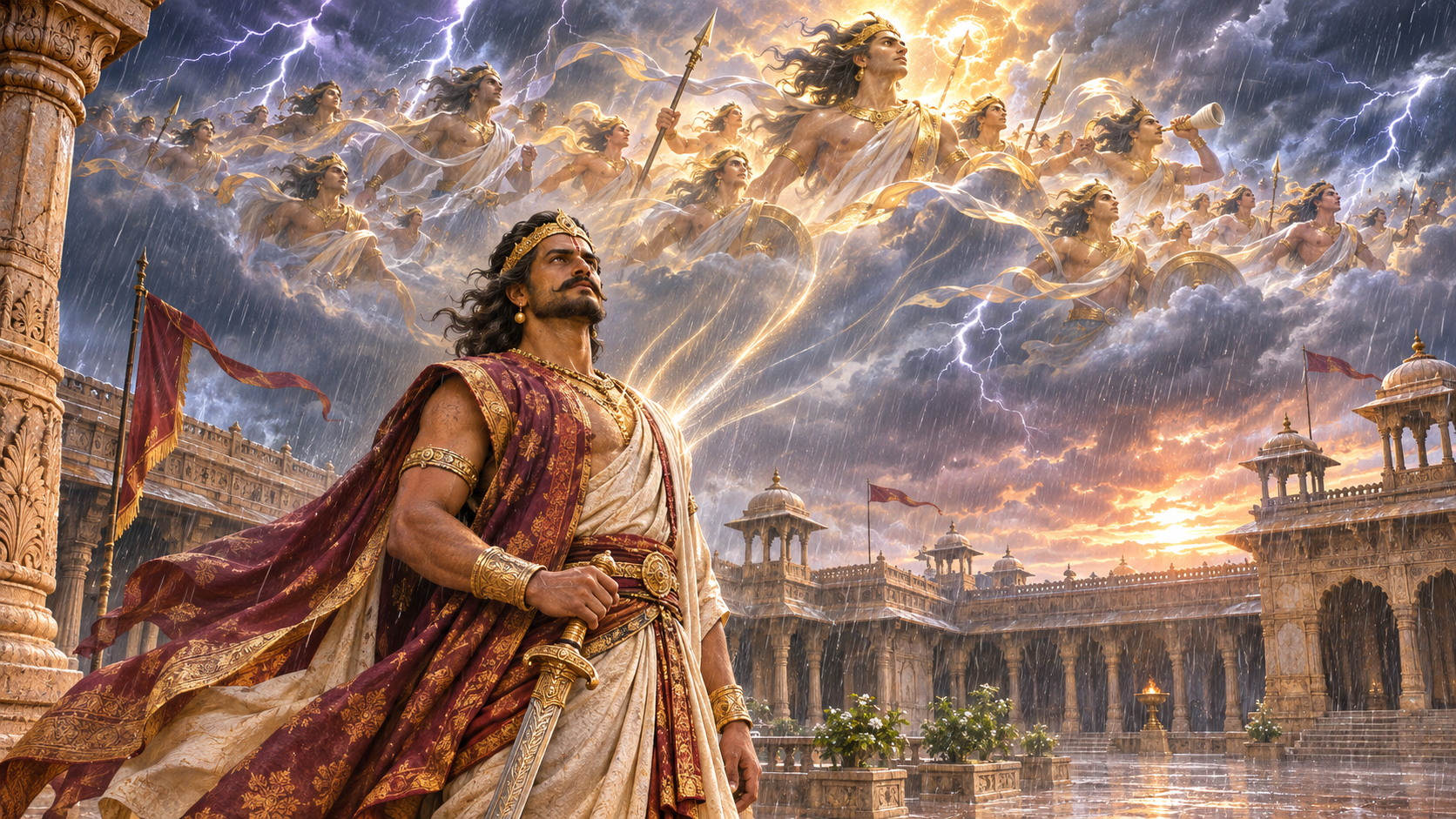
If you have encountered the claim that Drupada was born from the Maruts and wondered how a human king can have a divine origin, the wording of the Mahabharata resolves much of the difficulty. Drupada appears in the human world, but the power manifested through him is traced to portions of a divine collective.
You do not have to choose between calling him a man and calling his origin divine. The epic is speaking on two levels at once. Keeping those levels distinct will help you understand both Drupada and similar birth accounts elsewhere in the Mahabharata.
The direct answer: Drupada was born from the Maruts
Chapter 61 of the Sambhava Parva, within the Adi Parva, presents a long account of the births of kings, rulers, courtiers, and warriors. Drupada’s origin belongs to this larger mapping of divine powers into human lives; it is not introduced merely as an ornamental title added to an otherwise ordinary description.
Within that account, Drupada is identified as a Rajarshi and distinguished among those skilled in the use of weapons. The Mahabharata then traces his appearance in the world of human beings to portions of the Maruts. If your question is simply which divine beings stand behind Drupada’s birth, the answer is the Maruts.
Three elements deserve to be preserved whenever you repeat the account. Drupada is born in the human world. His origin is connected to portions rather than the totality of the divine beings. Those portions come from the Maruts in the plural. Removing any one of these elements produces a less accurate version of the claim.
What birth from divine portions means
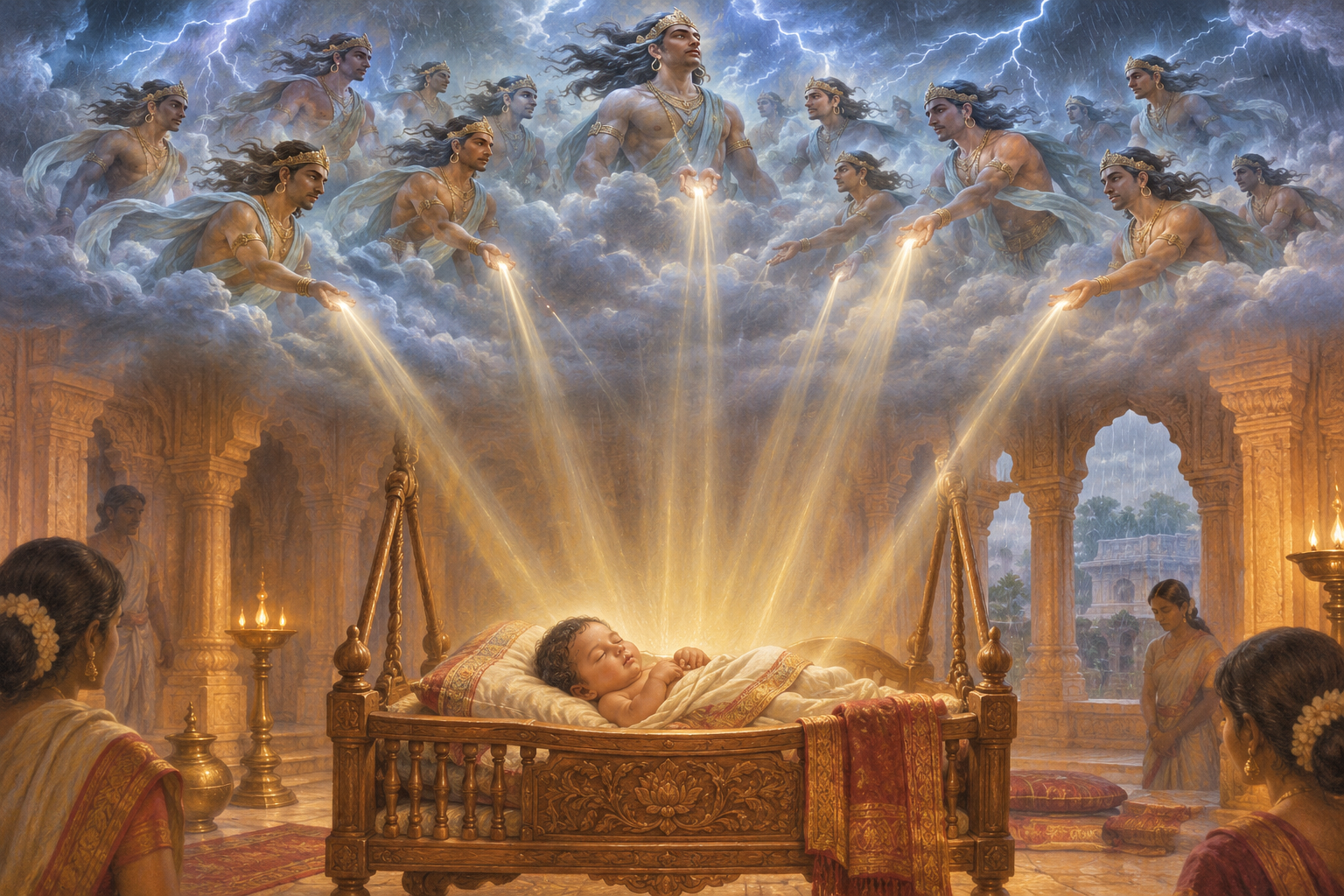
The phrase does not ask you to erase Drupada’s humanity. It gives his human life a second coordinate: sacred provenance. On one level, he is a king acting among other human beings. On another, the capacity embodied in him has a divine origin. The two descriptions serve different purposes and can stand together.
The reference to portions is especially important. A portion is not the whole. The wording therefore preserves a distinction between Drupada and the Maruts even while connecting them. It does not require you to identify everything about Drupada with everything about the Maruts, nor does it imply that the divine collective ceased to exist when he was born.
This is also stronger than saying that the Maruts merely favoured or blessed him. Blessing describes assistance given to someone who is already separate. Origin from divine portions describes participation in the source of the earthly character himself. If you replace the birth claim with the softer language of patronage, you lose the point of the passage.
At the same time, the account does not provide a modern biological explanation of birth. Its concern is metaphysical identity: what kind of power has entered the human order through this person? Read it on that level before asking it to answer questions it was not framed to answer.
Why the Marut connection matters for Drupada
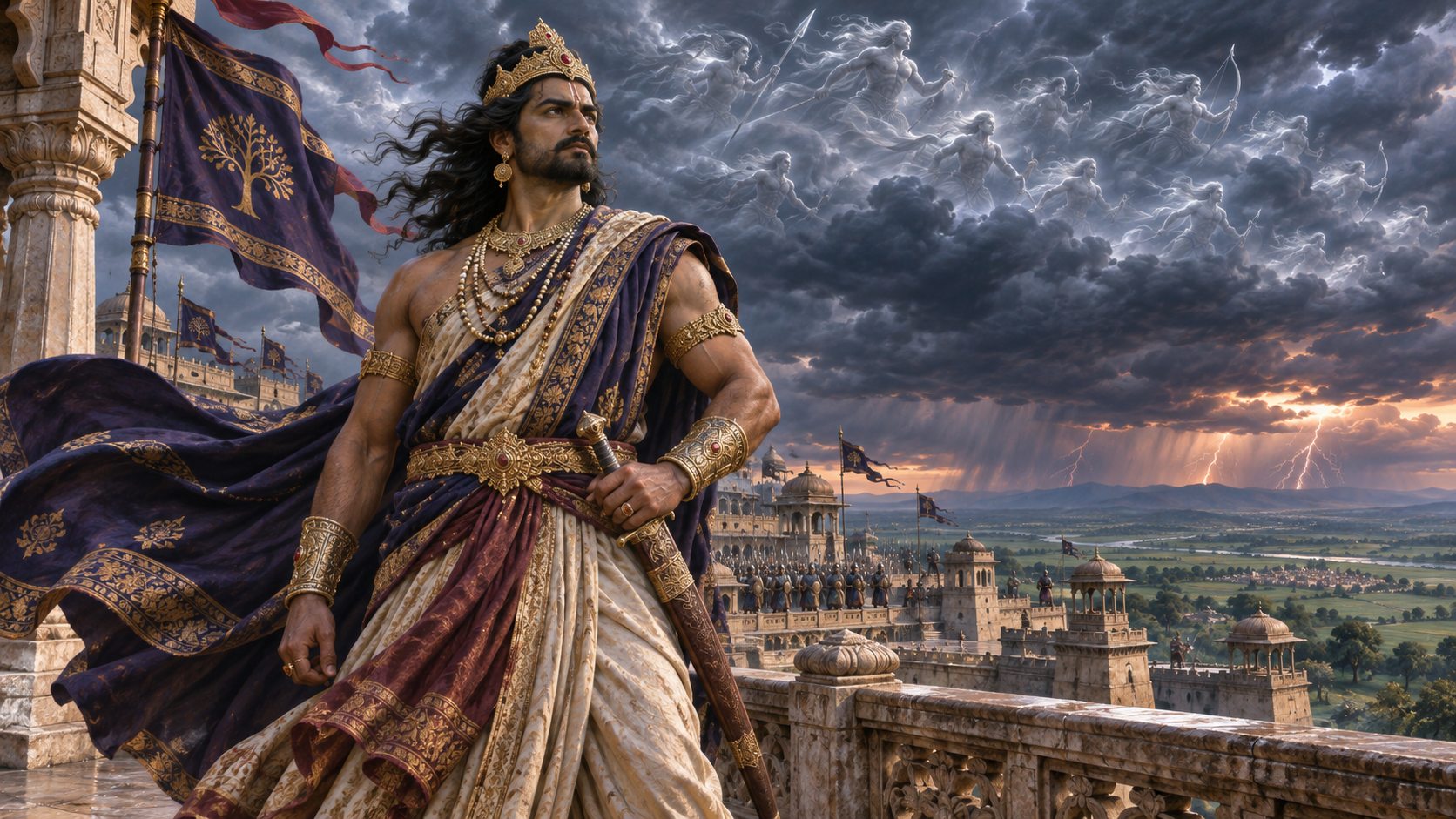
The Maruts are known in the Dharmic tradition as a collective of storm deities. Their symbolism carries movement, force, intensity, and a martial quality. Drupada, meanwhile, is singled out for excellence in the use of weapons. The association therefore gives theological depth to the martial distinction attached to his name.
We should still separate a direct statement from an interpretation. Drupada’s derivation from portions of the Maruts is the direct claim. Reading his warrior capacity in the light of Marut force is a reasoned interpretation of that claim. The distinction matters because it lets you draw meaning from the passage without pretending that every implication was explicitly explained there.
The title Rajarshi adds another dimension. Drupada is not introduced only as a fighter. He bears royal standing together with elevated sacred dignity. His profile therefore joins kingship, martial skill, and divine provenance. None of those elements should be allowed to erase the others.
When you meet Drupada later in the epic, use the Marut origin as a lens rather than a complete explanation. Notice where royal and martial power becomes visible, but continue to distinguish inherited capacity from chosen conduct. Divine endowment can explain why a character possesses unusual stature; it does not make every decision inevitable.
Four common misreadings to avoid
Reducing the account to decorative praise
Drupada’s origin appears within a structured catalogue of births. That setting gives the statement an explanatory role: it tells the audience what divine power is represented in the human order. You may interpret the theology in different ways, but treating it as an empty compliment fails to account for its placement.
Turning a portion into complete identity
The account does not simply declare that Drupada is the Maruts in their entirety. It connects him to portions of them. That qualification allows genuine divine participation without collapsing the human king and the divine collective into one undifferentiated identity.
Using divine origin as moral immunity
A sacred origin is not a verdict that every later act must be righteous. It identifies an endowment, power, or cosmic affiliation. Drupada still acts within the field of human responsibility. If you assume that divine birth automatically validates every decision, you turn a clue about character into an excuse that the wording itself does not provide.
Forgetting that the Maruts are a collective
The plural form is not incidental. Drupada is not described here as deriving from one unnamed storm deity. His origin comes from parts of the Maruts. Preserve that collective dimension rather than retelling the account as though a single divine patron had simply selected him.
Key takeaways for reading Drupada’s origin
- The Mahabharata connects Drupada’s human birth to portions of the Maruts.
- The account occurs in Chapter 61 of the Sambhava Parva in the Adi Parva, amid a wider catalogue of significant births.
- Drupada remains a human king; divine provenance and human existence operate as complementary levels of description.
- The word portions prevents you from equating Drupada with the complete being of the Maruts.
- The Marut connection illuminates his exceptional martial capacity but does not make every later action predetermined or morally faultless.
On your next reading of the Adi Parva, make two short notes beside Drupada’s name: divine source – the Maruts; human manifestation – a Rajarshi distinguished in weaponry. Return to those notes whenever he appears. Ask what reflects his inherited power and what remains a decision for which he must answer. That simple distinction keeps his divine origin meaningful without allowing it to swallow his human character.
References

Leave a Reply
You must be logged in to post a comment.