

If someone you know says an intimate relationship has become a chain of sexual threats, money demands, and pressure to change her faith, your first task is not to debate labels. Help her reduce the immediate danger, retain control over disclosure, preserve evidence, and reach appropriate legal and professional support.
Two cases in Uttar Pradesh show why that response must be careful. In Noida, a woman alleges that intimate recordings, threats, demands for money, and pressure to embrace Islam became interconnected forms of control. In Sonbhadra, a pregnant woman alleges sexual exploitation and conversion pressure, followed by threats from the accused man’s relatives even after he was jailed. These are allegations awaiting legal determination, but they identify risks that families and community workers should know how to handle.
What these allegations show, and what they cannot prove
The decisive issue is coercion. A religious choice is meaningful only when the person remains free to accept, reject, or reconsider it without being threatened with violence, exposure, abandonment, financial loss, or the publication of intimate material. An interfaith relationship is not itself evidence of wrongdoing. The relevant conduct is deception, blackmail, sexual compulsion, extortion, intimidation, or an attempt to make conversion the price of safety.
In Noida, the woman says she first met the accused in 2011 and initially rejected marriage because of their religious differences. She alleges that she later accepted the prospect of a court-registered marriage after being assured that she would not need to convert. According to her account, that assurance changed after the relationship became sexual and substantial sums had passed to the accused: approximately Rs 75 lakh from her and more than Rs 1.25 crore from her sisters, exceeding Rs 2 crore in total. She further alleges that explicit recordings made without her knowledge were used to demand sex, conversion, and silence. The accused has been arrested, and the investigation remains underway.
In Sonbhadra, the woman alleges that a promise of marriage was used to facilitate months of sexual exploitation and that she became pregnant. After the accused man was jailed in a case initiated by her mother, his brother and other relatives allegedly continued pressing her to convert before marriage and threatened to kill her if she refused. Police registered an FIR against four relatives under anti-conversion provisions and other sections.
The procedural status matters. An arrest is not a conviction, and an FIR is not a judicial finding of guilt. The accused and every other named person retain the right to a fair investigation and trial. At the same time, the preliminary nature of a case is not a reason to dismiss a complainant, expose her identity, or leave her unprotected while the facts are examined.
These two cases also cannot establish how common such conduct is, prove an organised conspiracy, or justify collective blame against Muslims. They can support a narrower conclusion: when intimate images, sexual access, money, marriage, family pressure, and religious conversion become linked through threats, authorities must examine the entire chain of conduct rather than treating each element as an isolated disagreement.
Recognise when a relationship has become a system of control

No single disagreement about marriage or religion proves a crime. The warning is the progressive loss of meaningful choice. A person may appear to be agreeing while trying to prevent an intimate video from reaching her family, recover a large sum of money, avoid violence, or secure support during pregnancy. That is why observers should examine leverage and timing, not merely ask whether a relationship once appeared voluntary.
Key takeaways
- Watch for changed terms. An assurance that no conversion is required, followed later by conversion becoming a condition of marriage or safety, is a material change. Save the messages that show both the original assurance and the later demand.
- Treat intimate-image threats as an immediate safety issue. Do not wait for a video or photograph to be published. Preserve the threat without forwarding the intimate file through family or community groups.
- Map financial demands across the family. If money came from sisters, parents, or several accounts, record every transfer separately. A partial account may hide the scale and sequence of the alleged extraction.
- Do not assume one arrest ends the pressure. The Sonbhadra allegations show why relatives, intermediaries, phone calls, and visits after an arrest must be documented and reported.
- Separate belief from compulsion. A genuine conversion is a matter of conscience. A conversion demanded under threat of exposure, violence, or other harm should be treated as alleged coercion requiring investigation.
Past consent does not create permanent consent. Agreeing to a relationship, sexual contact, financial assistance, or a possible marriage at one point does not surrender the right to refuse later sex, reject conversion, demand repayment, or end contact. Families sometimes miss this distinction and ask why the woman did not leave sooner. A better question is what leverage made leaving appear dangerous.
How to help without increasing the danger
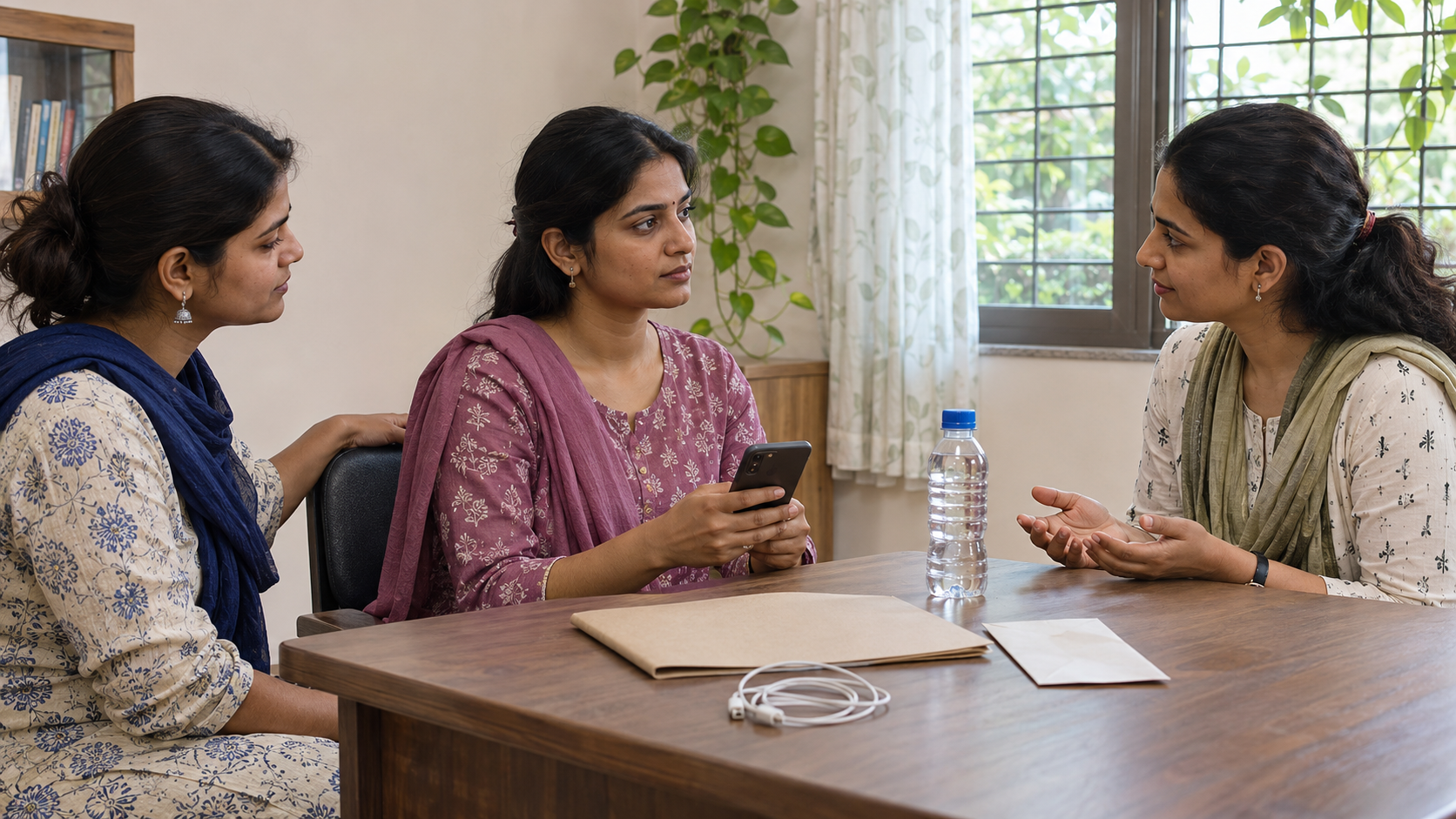
If you are the first person she tells, your conduct can either preserve her options or narrow them. Use the following sequence as a practical starting point, then let a qualified lawyer, police officer, medical professional, or victim-support professional adapt it to her circumstances.
- Check immediate safety first. Ask whether the accused or any relative knows her present location, has issued a recent threat, is expected to arrive, or has access to her home or devices. If danger is immediate, contact the police emergency service and move to a place the threatening person cannot readily access. Do not arrange a private confrontation.
- Let her control who is told. Identify one trusted support person and avoid broadcasting the disclosure to relatives, religious groups, journalists, or social media. Sudden public exposure can intensify retaliation and reproduce the humiliation threatened by a blackmailer.
- Create a factual chronology. Record when contact began, what was promised about marriage and religion, when sexual or financial demands changed, when threats began, which relatives became involved, and what happened after any police action. Use exact dates where known and honest ranges where they are not. Keep firsthand events separate from assumptions.
- Preserve original digital material. Retain messages, call logs, voice notes, emails, payment requests, bank records, filenames, account notifications, and threats. Keep an unedited copy and a separate working copy. Cropping a screenshot may remove useful context, while deleting an embarrassing conversation may destroy evidence that explains the coercion. Do not keep engaging merely to obtain more threats, and do not enter another person’s account without permission.
- Handle intimate material with exceptional care. Record where a file is stored, when it appeared, and who threatened to publish it, but do not circulate the image or video as proof. Ask the investigating officer or lawyer how it should be transferred. Every unnecessary copy increases the risk of further victimisation.
- Secure accounts on a trusted device. Change passwords for accounts she controls, review recovery addresses and signed-in devices, and enable multi-factor authentication. Preserve existing evidence before making changes. If money was transferred or account access may be compromised, contact the relevant bank and retain statements, transaction identifiers, beneficiary details, and correspondence.
- Seek the right professional help promptly. Police and a lawyer can address threats, sexual offences, financial allegations, privacy violations, and conversion-related claims. Medical care is important when pregnancy, injury, sexual assault, or reproductive-health concerns are involved; urgent care should never be postponed merely to collect evidence. Psychological support may help the complainant manage the effects of prolonged threats, but it is not a substitute for physical safety or legal assistance.
- Document pressure that continues after an arrest. Record every new caller, visit, message, intermediary, demand, and threat. The alleged conduct of one person and the later conduct of relatives may involve distinct facts. Do not meet an intermediary alone or accept an informal settlement without independent legal advice.
Do not promise a particular legal outcome. You can promise something more useful: that you will help preserve the facts, respect her decisions, avoid public exposure, and accompany her while qualified professionals assess the case.
A pro-Dharma response must be exact, not inflammatory

A Dharmic response should protect dignity, truth, and justice at the same time. Supporting a Hindu complainant does not require exaggerating what is known. In fact, exaggeration weakens her position by giving critics an easy reason to disregard serious, documentable allegations.
- Use procedural language accurately. Say that a person has alleged conduct, that police have registered an FIR, that an accused has been arrested, or that an investigation is underway. Do not turn those stages into a claim that guilt has already been judicially established.
- Protect the woman’s identity. Do not publish her name, address, workplace, photograph, pregnancy details beyond what is necessary, or any information that allows hostile users to identify her. Never repost the intimate material at the centre of an allegation.
- Preserve numerical qualifiers. In the Noida case, the amounts are the complainant’s approximate figures. Presenting them as audited or judicially proved would go beyond what is currently established.
- Focus on conduct rather than communal identity. An interfaith friendship or marriage is not proof of coercion. Secret recording, sexual blackmail, threats, financial extraction, and making conversion a condition imposed through fear are the behaviours requiring scrutiny.
- Reject vigilantism. Threatening the accused, approaching relatives as a crowd, publishing addresses, or staging a forced confrontation can endanger the complainant, contaminate evidence, and obstruct lawful accountability.
- Demand a complete investigation. Authorities should examine communications, money trails, intimate-image allegations, conversion demands, threats, and the role of every alleged participant. They should also assess whether the complainant needs protection from retaliation while the case proceeds.
- Update the public record. If charges change, evidence contradicts a claim, a court grants relief, or a final judgment is delivered, community publications should report that development with the same care given to the initial allegation.
If you are helping someone now, begin with three concrete acts: place her beyond the reach of an immediate threat, stop the unnecessary circulation of private material, and prepare a dated inventory of messages, transactions, people, and incidents for professional review. Let due process determine guilt. Let dharma govern how carefully you protect the vulnerable while the truth is established.
References
- Hindu Post — Syed Mohd Rizwan Ahmed Arrested for Rape, Rs 2 Crore Blackmail and Coercing a Hindu Woman into Islamic Conversion: Noida, UP
- Hindu Post — सोनभद्र: गर्भवती हिंदू युवती पर इस्लाम कबूलने का दबाव, शोषण का आरोपी सलीम कुरैशी जेल में; भाई समेत 4 पर FIR

Leave a Reply
You must be logged in to post a comment.