

You may want disciplined study of Vaiṣṇava philosophy without stepping away from work or family for a multi-year degree. The English-language programme at Bhaktivedanta College Budapest offers a middle path: spend one semester, or take an individual course, while learning in a devotional setting beside the ISKCON Budapest temple.
The next semester begins on 1 February 2027. Before you apply, look carefully at the credential, course mix, residential component and housing arrangements. Those details determine whether this is the right form of bhakti education for you, rather than simply an attractive few months abroad.
Key takeaways
- The next in-person English-language semester begins on 1 February 2027, and applications remain possible in December.
- You may pursue the full semester or express interest in an individual course.
- The spring curriculum includes the Bhagavad-gītā, Upaniṣads, Upadeśāmṛta, introductory bhakti-yoga, sustainability and a residential experience in Krishna Valley.
- Students receive a Certificate on Bhakti Philosophy & Living Traditions and documentation of the ECTS credits they earn. This should not be confused with enrolment in a BA or MA degree.
- The College stands beside the ISKCON Budapest temple, giving you access to temple programmes, festivals, kīrtana and prasādam as well as academic resources.
- Accommodation is limited. A possible temple stay is subject to an initial assessment period with the temple community, so you should keep a separate housing option available.
What the English semester actually offers
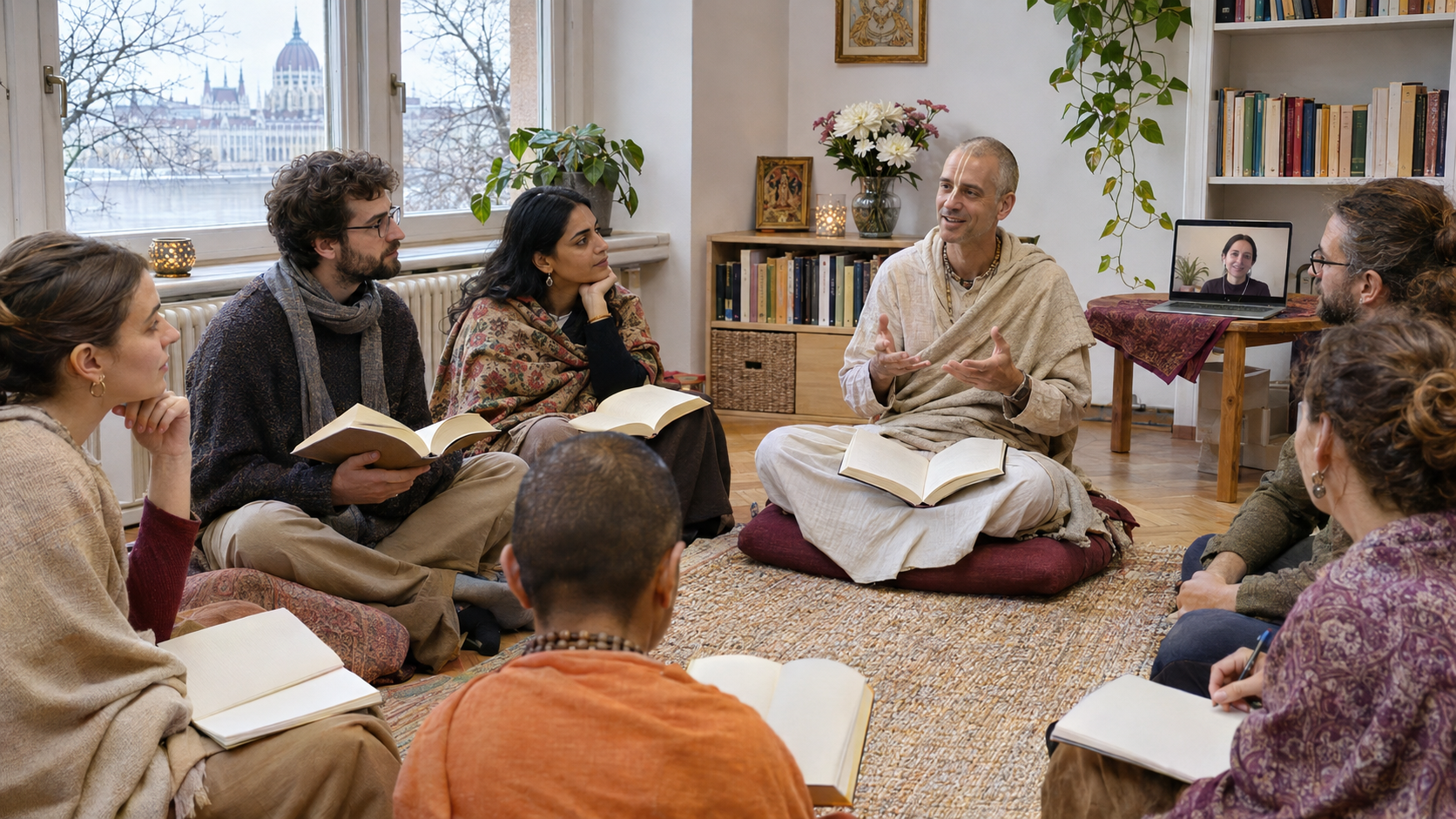
Bhaktivedanta College is a state-accredited Hungarian higher-education institution that has operated for more than 20 years. Its BA and MA programmes in Vaiṣṇava Theology and Yoga Studies are taught in Hungarian. The English-language semester is a separate, shorter opportunity created for international students who cannot commit to an entire degree.
That distinction matters. Institutional accreditation tells you something important about the academic setting, but it does not turn a semester certificate into a degree. At the end of your studies, you receive the Certificate on Bhakti Philosophy & Living Traditions together with documentation of the ECTS credits you completed.
If you need those credits for another programme, send the proposed course details to your home or prospective institution before enrolling. ECTS documentation makes the academic work legible, but it does not by itself guarantee that another institution will count the credits toward its qualification. Ask what documentation the College supplies and what your receiving institution requires.
The classes are taught by a mixture of established Vaiṣṇava scholars, including professors with doctorates and decades of teaching experience, and newer educators. The English programme is relatively small, so its intended character is discussion-based and personal rather than that of a large lecture hall. If close access to teachers is one of your reasons for travelling, ask how many students are expected and how seminars, assignments and consultations will work in the courses you select.
Scriptural and philosophical study
The spring 2027 curriculum includes Bhagavad-gītā: The Path to Spiritual Enlightenment, Upaniṣads, Upadeśāmṛta and Introduction to Bhakti-Yoga. The College generally treats autumn as the more introductory semester, while spring includes opportunities for greater philosophical depth.
A sensible selection begins with your present level, not with the number of prestigious titles you can fit into a timetable. If your devotional reading has been largely private or informal, the introductory bhakti-yoga and Bhagavad-gītā courses may give you the conceptual structure needed for the more concentrated texts. If you already study systematically, ask for syllabi and prerequisites so that you can identify where the Upaniṣads or Upadeśāmṛta course moves beyond material you know.
Do not choose a full load until you know the weekly timetable, reading expectations, assessment method and ECTS value of each course. A semester becomes spiritually thin when academic overcommitment leaves no time to digest the texts, participate in community life or maintain your own sādhana.
Applying Rūpa Goswami’s teachings to contemporary life
Inner Sustainability connects teachings associated with Rūpa Goswami’s Nectar of Instruction to questions of sustainability. This makes it distinct from a course concerned only with environmental technique. It asks how a person’s habits, relationships and spiritual discipline bear upon the ability to live sustainably.
If that applied dimension attracts you, ask for the assessment format. A reflective seminar, textual essay and practical project demand different kinds of work. Knowing the format will help you decide whether this course complements your scriptural study or simply adds another obligation to an already crowded semester.
Residential learning in Krishna Valley
Living with the Monks in Krishna Valley moves part of the education out of Budapest. Krishna Valley is a rural devotional community and ecological project approximately two hours from the city. The residential course gives students direct exposure to devotional community life and sustainable living beyond the classroom.
Treat this as a real residential commitment, not an ordinary day excursion. Before registering, request the dates, duration, travel arrangements, accommodation conditions, daily schedule, physical requirements and anything you must bring. Also ask which costs are included. These details are especially important if you have dietary, mobility, work or family constraints.
Temple and community life are part of the decision

The College is located next to the ISKCON Budapest temple. You can attend kīrtanas and festivals, participate in temple life, share prasādam with the community and use the College library and its academic resources. For a devotee who normally studies alone, that combination can join three things often kept separate: śāstric learning, association and daily practice.
Proximity, however, is an opportunity rather than a complete plan. Decide before arrival what you want the semester to change in your life. You might choose one question to pursue across your courses, establish a sustainable reading discipline or learn how philosophical study can strengthen daily sādhana. A defined intention helps you avoid spending several stimulating months collecting impressions without integrating them.
You should also distinguish access to temple life from any formal obligations attached to a particular housing arrangement or course. Ask which programmes are optional, which academic sessions require attendance, whether residents undertake service, and what standards govern temple accommodation. Do not assume that being a College student automatically answers those questions.
The international character of the programme is another part of the experience. Students have already come from Turkey, Doha, Sweden and Bhutan. That diversity can broaden a discussion of how Vaiṣṇava practice is lived in different social settings. It also means that language ability, devotional background and familiarity with ISKCON customs may vary. Arrive prepared to ask sincere questions without treating your own local practice as the universal norm.
Test the practical fit before you commit

A good philosophical programme can still be the wrong choice if its dates, housing or credential do not meet your needs. Work through these checks before paying fees or booking non-refundable travel.
- Confirm the complete calendar. The spring term starts on 1 February 2027, but you still need the final teaching date, examination or assessment period, orientation schedule and Krishna Valley dates. If you have employment or family duties, ask whether any class requires attendance outside the ordinary weekly timetable.
- Choose between one course and the full semester. State your preferred scope when you contact the College. Request the timetable and workload before combining courses, especially if you plan to work remotely or maintain obligations at home.
- Clarify what the credential can do for you. If your aim is personal formation, the certificate and ECTS record may be sufficient. If you need formal progression, credit transfer or evidence for another institution, obtain written confirmation from that institution before enrolling.
- Secure a housing plan and a backup. Accommodation is limited. Some students live separately, while temple accommodation may be available subject to an initial assessment period with the community. Ask when housing can be confirmed, what the arrangement costs, what it includes and what happens if a temple stay does not continue.
- Build a complete budget. Use the official English-course page for current fees and deadlines, then account for housing, travel, local transport, food not included in your arrangement, course materials and the residential component. Request the payment and cancellation terms in writing.
- Check the travel rules that apply to you. Entry and stay requirements depend on your own circumstances. Confirm the relevant official requirements before purchasing non-refundable travel, and ask the College which enrolment documents it can provide.
- Assess the devotional environment honestly. The temple, kīrtana, festivals, prasādam and Krishna Valley experience are central advantages for many applicants. If you want a purely detached academic study of religion, however, this deliberately participatory Vaiṣṇava setting may not be what you are seeking.
Housing deserves particular attention because enthusiasm can make a provisional possibility feel like a confirmed room. It is safer to hold a realistic separate-accommodation option until you receive clear terms. Do not book a flight on the assumption that the temple will necessarily house you for the entire semester.
Apply with the important questions already in view

Applications for the spring semester are still possible in December, but that is not a reason to delay. The programme is small and accommodation is limited. Contact the College as soon as you know you are seriously interested, even if you still need answers before making a final commitment.
Your first message to info@uni-bhakti.hu should make it easy for the International Office to give you a useful response. Include:
- whether you want the full spring semester or one or more individual courses;
- the course titles that interest you most;
- a short account of your previous study of Vaiṣṇava texts or bhakti-yoga;
- whether you need assistance finding accommodation;
- whether you would like to be considered for temple accommodation;
- whether you need ECTS documentation for another institution;
- your questions about dates, workload, assessment, fees, Krishna Valley and application documents.
A concise opening can be as simple as: “I am interested in the spring 2027 English-language programme, beginning 1 February. I would like to study [course names] and am considering [the full semester/an individual course]. Please confirm the application deadline, timetable, total fees, accommodation options and documentation of ECTS credits.” Add the personal details needed to explain your questions, but do not bury the request beneath a long spiritual autobiography.
Before accepting a place, obtain clear answers to five points: your approved courses, complete dates, total academic fees, housing status and the documents you will receive after completion. If a reply leaves one of those points uncertain, ask again. Administrative clarity protects the time you are setting aside for spiritual study.
If February is too soon, the next autumn semester is scheduled to begin on 1 September 2027 with a wider course selection. The College is also planning online courses from autumn 2027, but a plan is not yet the same as an available timetable. Ask for confirmation before organising your year around an online option.
If the spring dates work, the devotional environment suits you and you can secure housing, write to the College now with your preferred courses and the checklist above. If credit recognition or accommodation remains uncertain, resolve that point first. A semester dedicated to bhakti deserves a foundation sturdy enough to let you concentrate once the teaching begins.
References
- Dandavats — A Semester of Bhakti in Budapest
- Bhaktivedanta College Budapest — Courses in English
- Bhaktivedanta College Budapest — Official website

Leave a Reply
You must be logged in to post a comment.