
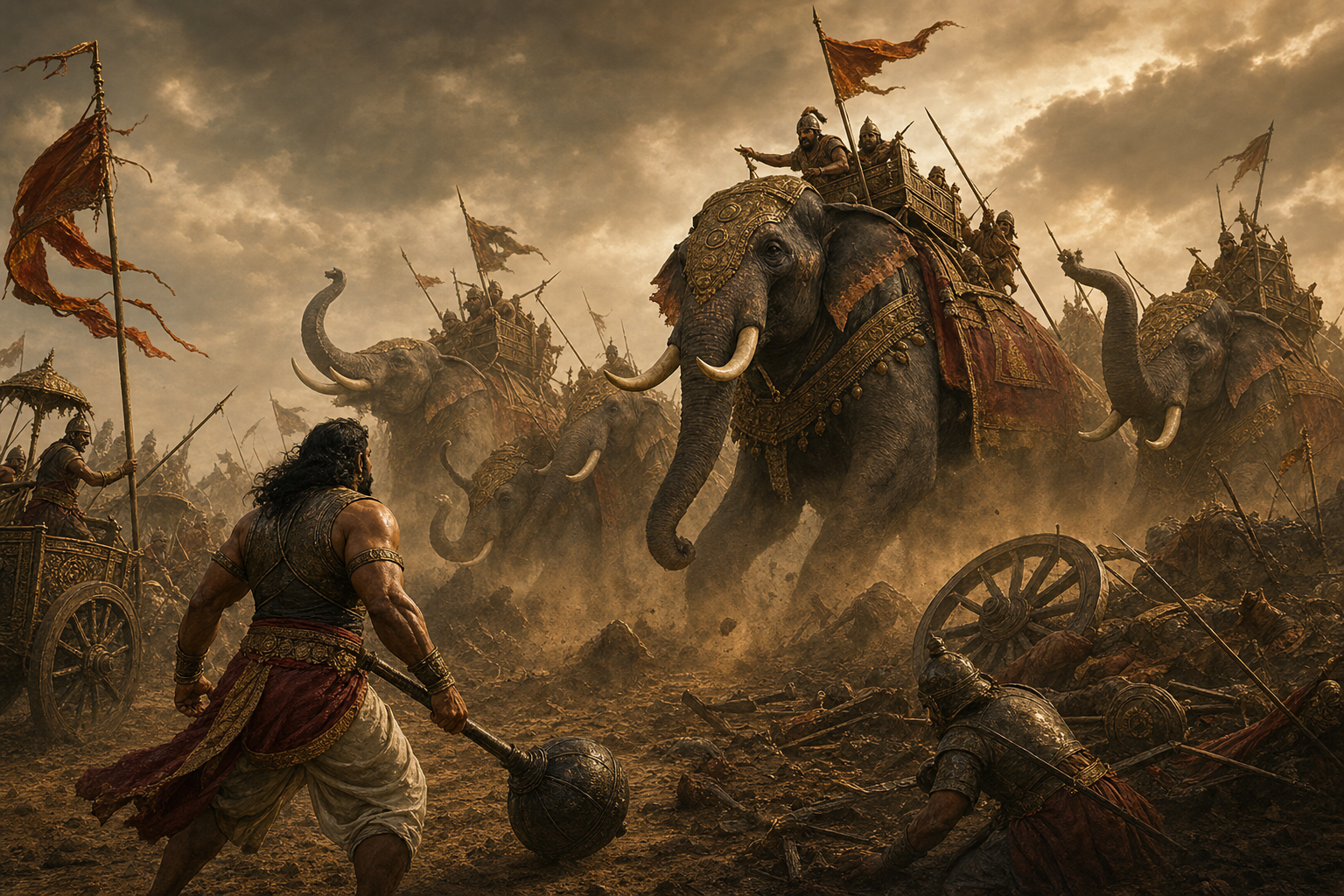
If you are trying to understand why Bhima’s clashes with war elephants matter, do not reduce them to a strong man defeating large animals. The more useful question is how disciplined force breaks a weapon whose power depends on coordination – and what dharma demands when breaking it requires terrible violence.
You will get more from these episodes if you read them on three levels at once: as battlefield tactics, as failures of command and control, and as moral tests. That approach reveals both Bhima’s skill and the Mahabharata’s refusal to pretend that a necessary victory is therefore a spotless one.
The elephant corps was a system, not merely a wall of animals
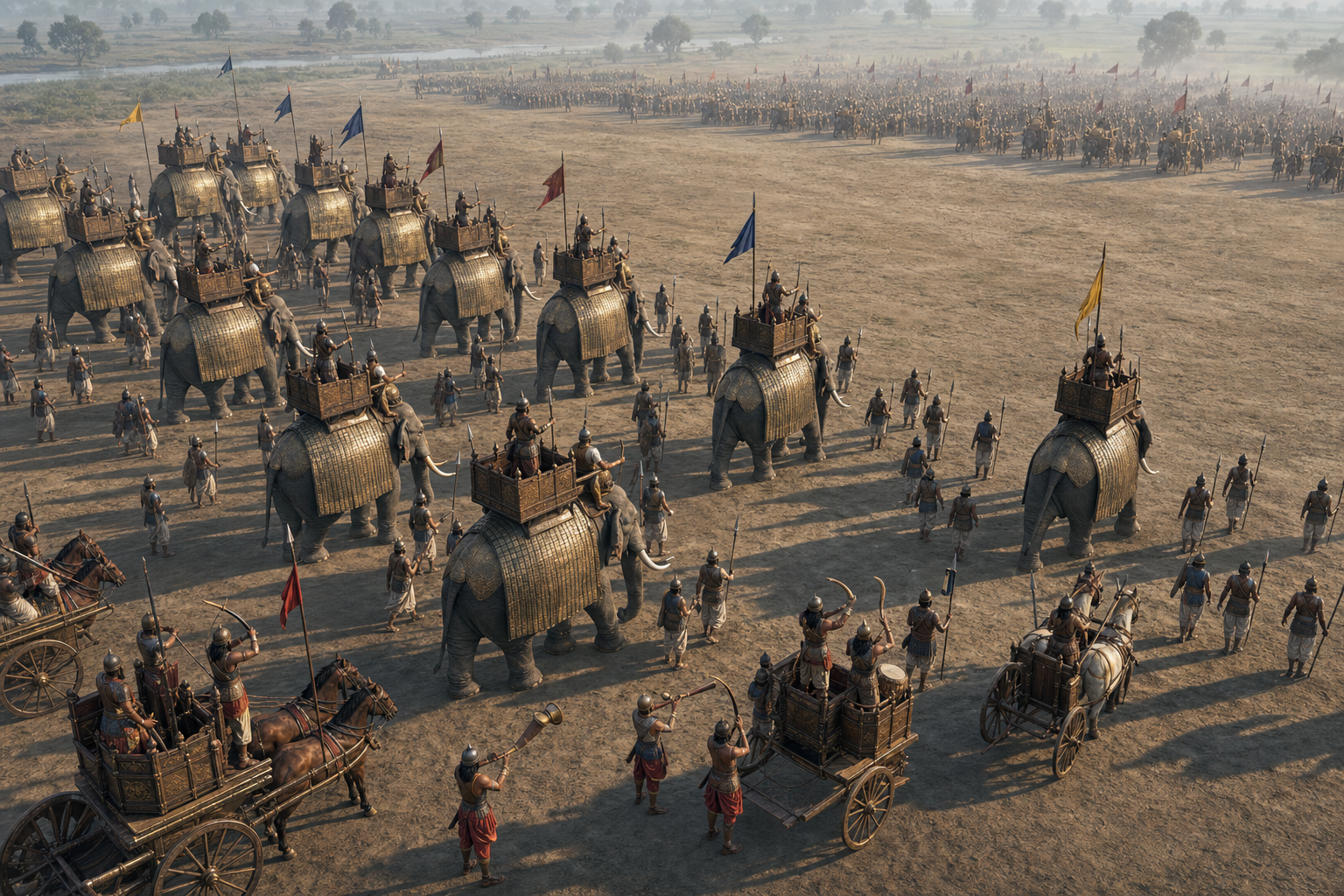
The first mistake is to imagine the gaja-sainya, or elephant corps, as an ancient equivalent of a row of unstoppable machines. Elephants possessed enormous shock value, but their battlefield effect depended on a living network of animals, mahouts, mounted fighters, supporting infantry, protected flanks and disciplined follow-up.
In the classical fourfold army, elephants stood beside infantry, cavalry and chariots. Armor and frontal plates could protect the animal, while a howdah might carry archers or lancers. A controlled charge could frighten horses, crush an infantry line and throw chariots out of position. The elephant’s size was only the beginning of its military value; the real objective was to make the enemy formation lose its shape.
That power came with a corresponding weakness. A wounded or frightened elephant could turn, collide with another animal or trample the soldiers it was meant to protect. If a mahout fell, the formation lost its most immediate layer of control. If supporting troops failed to exploit the opening, the charge could spend its force without producing a breakthrough. Mass became an advantage only while discipline held.
- The animal supplied weight, reach and fear.
- The mahout supplied direction and immediate control.
- Mounted fighters extended the elephant’s offensive range.
- Infantry and other arms protected the formation and occupied the gap created by its charge.
- Logistics kept the entire weapon usable through fodder, veterinary care, training and access to elephant forests.
The Arthashastra’s office of the gajadhyaksha, the superintendent of elephants, makes the logistical point especially clear. An elephant corps represented far more than prestige on the day of battle. It required continuing expertise, resources and care. When you encounter a king’s elephant force in an epic account, therefore, read it as evidence of organized state capacity as well as martial display.
You should also pay attention when the Mahabharata dwells on dust, noise, mud, trumpeting and obstructed sight. Those details are not disposable ornament. They describe the conditions in which commands were missed, animals became distressed and soldiers struggled to distinguish an ordered advance from the beginning of a rout.
Bhima won by converting shock into disorder
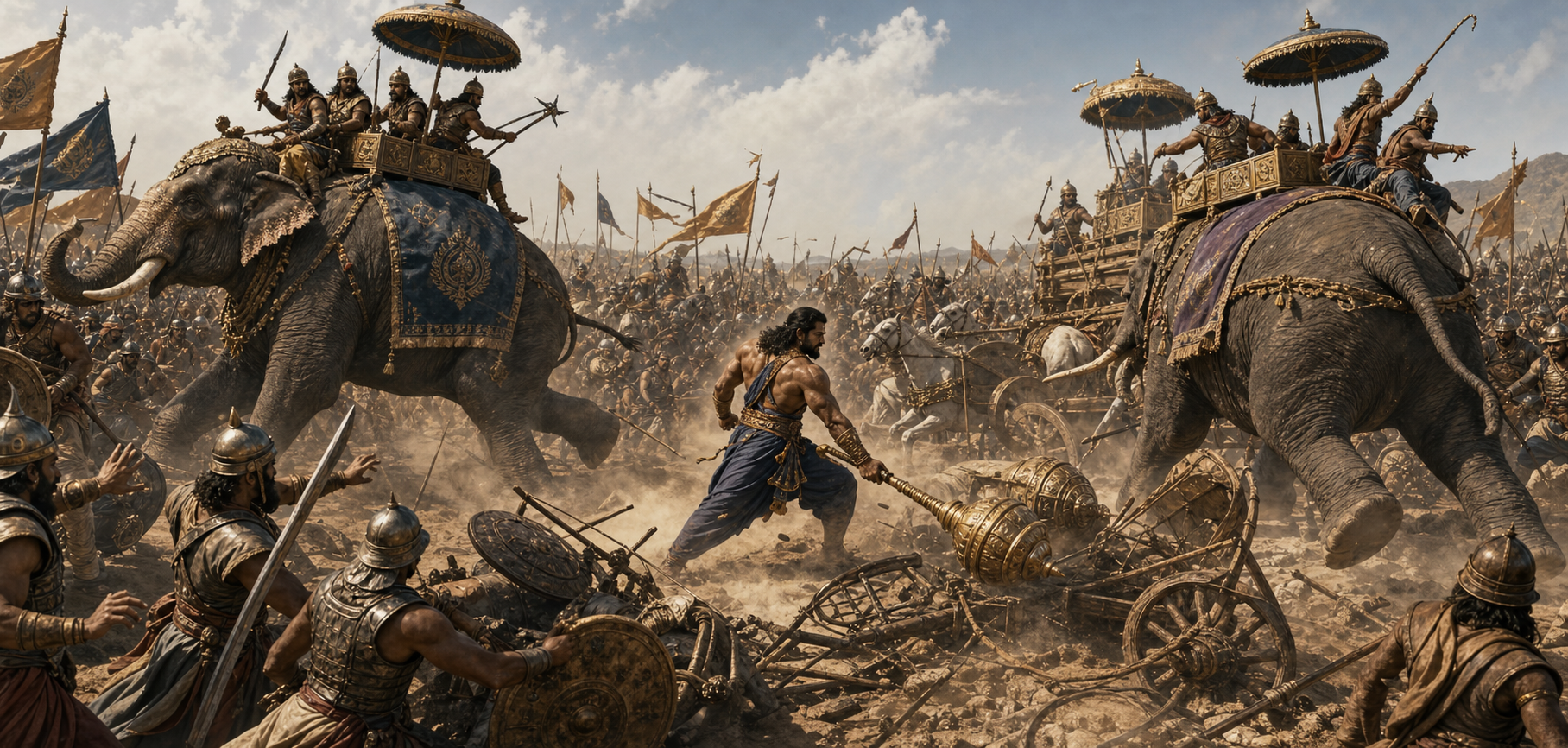
Bhima’s strength is obvious, but strength alone does not explain his success. His tactical function is more precise: he turns the Kauravas’ concentration of mass into a concentration of risk. Once a few elephants lose direction, every animal and soldier packed behind them has less room to recover.
The battle language surrounding Bhima emphasizes storms, thunder, wind and moving mountains. That imagery suits the son of Vayu, but it also describes a recognizable tactical process. Bhima does not merely endure the enemy’s momentum. He redirects it until the elephant formation begins damaging itself.
- Disrupt control. Attacks on mahouts and mounted fighters separate the elephant’s physical power from the human direction governing it.
- Concentrate force. The epic repeatedly directs attention to blows against trunks, temples and frontal protection rather than portraying Bhima’s mace as random violence.
- Destroy alignment. Positional movement encourages wounded or turning animals to meet the formation at an angle, where one loss of control can obstruct several ranks.
- Exploit the reversal. Once elephants retreat into friendly troops, the Kaurava shock arm becomes an obstacle to Kaurava recovery.
This sequence explains why Bhima repeatedly appears when elephant ranks threaten to clog or break the Pandava line. He acts as a shock-dispersal specialist. His gada is suited to close violence, but his deeper advantage is the ability to remain decisive inside a field of overwhelming sound, movement and fear.
Other counter-elephant methods followed the same governing logic. Agile troops could avoid a direct frontal impact and attack from the sides. Concentrated missiles could target eyes, riders or mahouts. Sound, flame and scent could exploit an elephant’s sensitivity. Fast detachments could enter the openings left by a faltering animal. Each method attacked the relationship between power and control rather than trying to match bulk with bulk.
This also corrects the lone-hero reading. Elephants were most effective when their flanks were screened and their breakthrough was supported. Countering them likewise required coordination. Bhima’s close assault complemented Arjuna’s precision at distance, Krishna’s counsel and Yudhishthira’s responsibility for the Pandava cause. Svadharma did not mean that every warrior should fight in the same way. It meant applying one’s particular capacity to the task that actually required it.
For a careful military reading, hold two conclusions together. The descriptions contain plausible knowledge of elephant warfare, including its sensory and command problems. They do not give you enough to reconstruct exact unit strengths, speeds or battlefield geometry. Treat gaja-vyuha as a meaningful formation term, not as permission to invent a detailed diagram that the narrative does not supply.
The elephant named Ashvatthama exposes the cost of deception
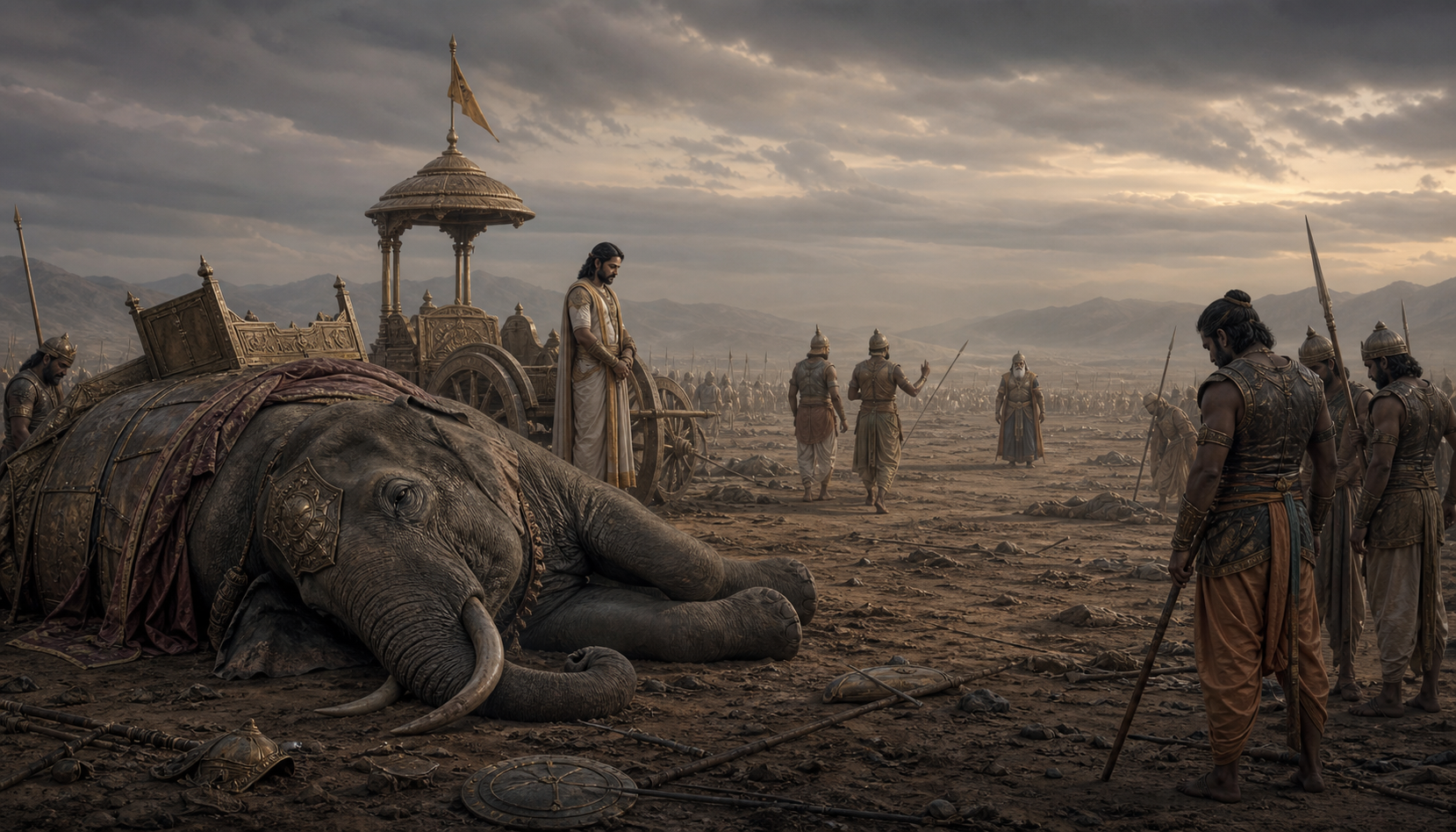
Elephant warfare reaches its sharpest ethical point not in Bhima’s most spectacular charge, but in the plan used to stop Drona. The Pandavas face a commander who is nearly impossible to defeat while armed and resolved. Bhima kills an elephant named Ashvatthama. Yudhishthira then announces that Ashvatthama is dead while qualifying, in effect, whether the dead being is the man or the elephant.
The plan is narrowly constructed around truth and misdirection. The elephant really bears Ashvatthama’s name, yet Drona is meant to understand that his son has died. Literal accuracy therefore does not remove the moral problem. The speech succeeds because its intended meaning and its technically defensible wording point in different directions.
A shallow reading turns this into a slogan: deception is acceptable whenever a righteous side needs it. The Mahabharata gives no such easy permission. In some recensions, Yudhishthira’s formerly elevated chariot sinks to the earth after the declaration. The image registers a diminishment in the man renowned for truth, even though the stratagem stops a devastating enemy commander.
The episode is more demanding than either a simple condemnation or a simple acquittal. It asks whether an emergency can make a compromised act necessary without making that act pure. It also asks whether intention, wording and foreseeable interpretation can ever be judged separately. Yudhishthira’s qualification matters, but so does his knowledge of what Drona will believe.
- Examine necessity. Was the deception tied to stopping an immediate cycle of destruction, or merely to gaining convenience or advantage?
- Examine design. Was a technically true statement deliberately shaped to produce a false belief?
- Examine scope. Was the compromised means constrained to the threat, or did it become a general license for misconduct?
- Examine accountability. Does the actor acknowledge a moral loss, or use victory to declare every means righteous after the fact?
Those questions keep dharma from collapsing into partisanship. A just cause matters, but it does not automatically sanctify every choice made in its name. The Mahabharata preserves moral residue because dharma-yuddha is not merely war conducted by people who call themselves righteous. It is a continuing discipline of purpose, means, restraint and responsibility.
The dead elephant intensifies that responsibility. These were intelligent, trainable beings drawn into human conflict and made to absorb its terror. Their military usefulness does not erase their suffering. Bhima’s necessary violence is therefore not a cheerful celebration of domination. It is part of the terrible account that rulers incur when failed diplomacy places soldiers, animals and entire communities in harm’s way.
The inner elephant is conquered by more than one kind of courage
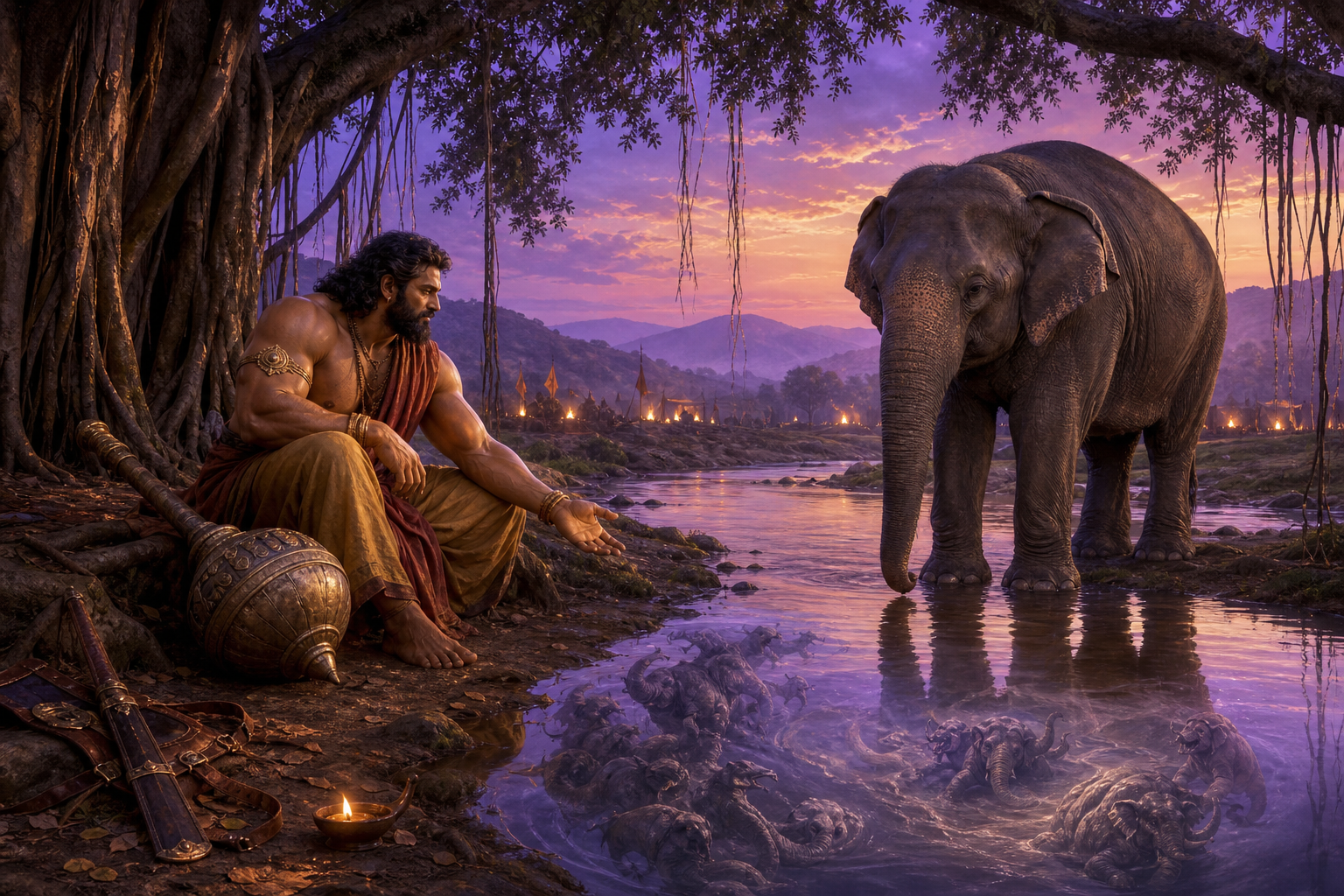
The physical battle supports a symbolic reading without becoming merely symbolic. Gaja can carry the sense of collective weight. Mada, the intensity associated with a rutting elephant, also evokes intoxication and pride. Tamas supplies the corresponding image of heaviness and inertia. Bhima, born of Vayu, represents movement, breath and the force that disperses what has become dangerously immovable.
His gada then becomes more than an emblem of muscle. It represents concentrated discipline: force gathered at one point and applied to the obstruction that must be broken. The practical spiritual lesson is not that anger makes you Bhima. Uncontrolled anger more closely resembles the panicked elephant. Bhima’s relevant quality is power directed toward a defined duty under conditions that would scatter an ordinary mind.
A wider Dharmic comparison helps you distinguish forms of courage rather than flatten them into a single doctrine. In the Buddhist account of Nalagiri, the Buddha meets a raging elephant with metta, or loving-kindness, and calms violence at its mental root. Jain dharma places ahimsa and the conquest of kashaya, the passions, above outward victory. The Sikh sant-sipahi ideal joins courage to ethical restraint, allowing force in defense of righteousness without making cruelty a virtue.
These responses are not interchangeable, and they should not be forced into artificial sameness. Bhima’s force, Buddhist metta, Jain self-conquest and Sikh saint-soldier discipline answer different conditions. Their shared measure is whether strength remains governed by awareness, restraint and a purpose larger than ego.
That distinction gives you a practical way to use the episode. When an “inner elephant” begins to move – pride, inertia, panic or accumulated resentment – first identify what kind of response the condition requires. Breath discipline such as pranayama can interrupt the first surge. Metta can prevent hostility from taking ownership of the mind. Jain pratikraman can expose and atone for harm already done. Naam Simran can anchor courage in remembrance rather than self-display. None of these practices turns avoidance into virtue; each helps ensure that any necessary action begins from steadiness.
The same test applies to institutions and states. Some threats can be calmed. Some can be contained. Some must be resisted directly. Wisdom lies in recognizing the condition before selecting the method. Compassion without the courage to defend can abandon the vulnerable, while force without inner discipline can become another form of mada.
Key takeaways
- A war elephant’s decisive strength came from coordinated shock, not size alone; mahouts, riders, supporting troops and logistics made the animal into a battlefield system.
- Bhima defeated elephant formations by attacking control, alignment and morale, causing concentrated Kaurava power to reverse into Kaurava disorder.
- The Mahabharata’s dust, noise, animal distress and collapsing ranks carry tactical meaning, but they do not justify invented precision about troop numbers or formation geometry.
- The Ashvatthama stratagem does not teach that righteous ends erase compromised means. Its success and its moral cost remain visible together.
- The symbolic elephant represents pride and inertia only after its material reality is respected; allegory must not erase the suffering of animals forced into war.
- Across Dharmic traditions, the governing question is not whether strength is used, but whether strength is mastered before it is applied.
When you next read a Kurukshetra battle passage, mark three things: what the weapon is meant to do, where its control fails and what moral burden remains after victory. Applied to Bhima’s elephant battles, that simple method turns spectacle into a disciplined study of power – how to direct it, when to resist it and why dharma still demands an accounting afterward.