
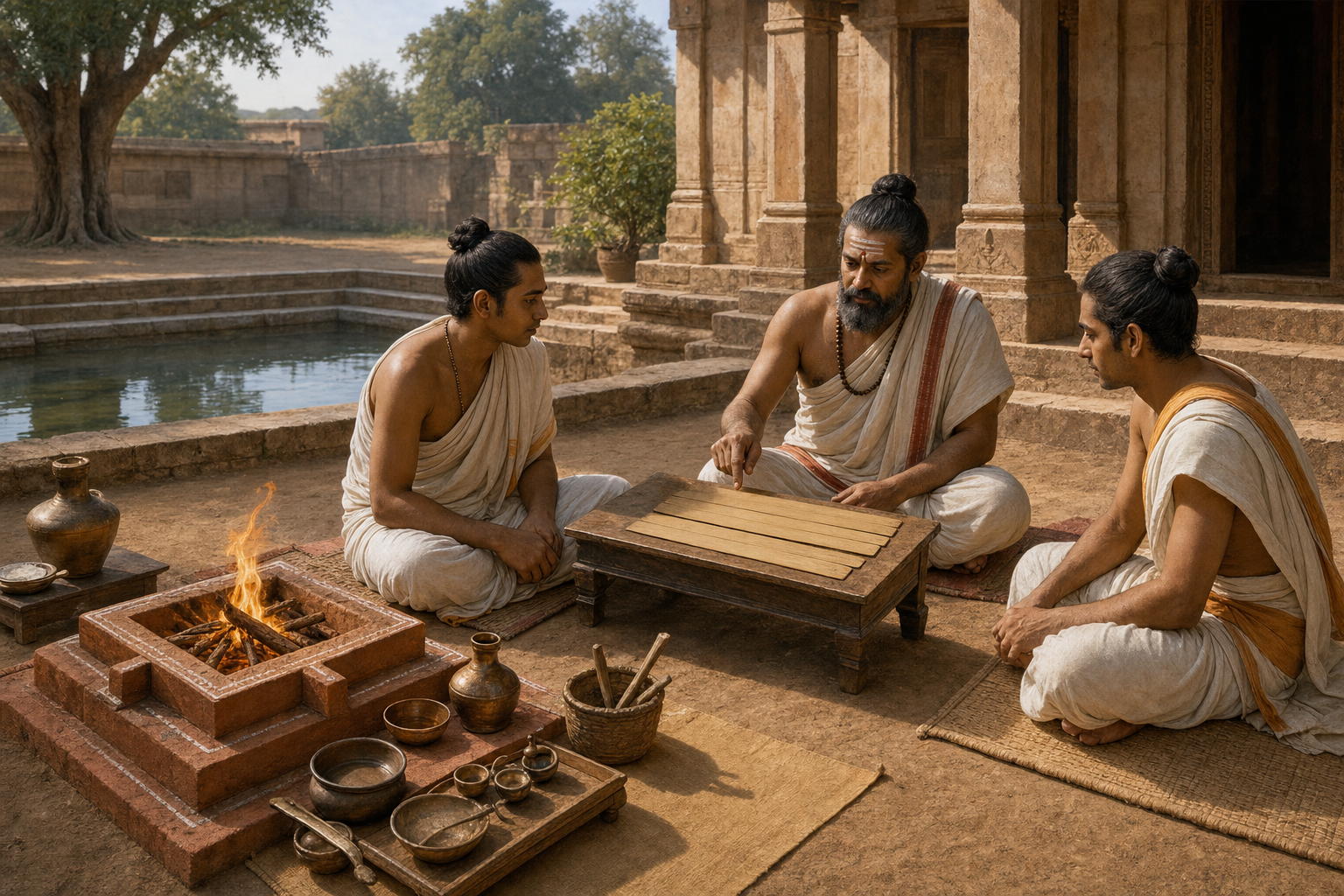
You encounter a Vedic passage, a commentary, and a family custom that seem to point in different directions. One person calls the passage a binding command. Another treats it as praise. A third turns it into a broad spiritual metaphor. How do you decide what the tradition is actually asking you to do?
Mīmāṃsā gives you a disciplined answer. Begin with a real world, reliable knowledge, and language capable of directing action. Then identify the function of each sentence, test competing interpretations against explicit wording and context, and keep commands distinct from explanations, names, and praise. This approach does not eliminate disagreement, but it makes disagreement precise enough to resolve.
Start with the world in which dharma must be performed

Mīmāṃsā realism matters because interpretation never remains an exercise in abstract symbolism. A rite requires materials, time, sequence, speech, and an agent. A prohibition restrains a possible action. A duty changes what someone must do. If the experienced world were dismissed as merely unreal, the precision of these distinctions would lose its force.
This realism is not a denial of spiritual meaning. It is the claim that ordinary experience normally presents an independently existing world and that error does not invalidate experience as a whole. The doctrine of svataḥ-prāmāṇya treats cognition as intrinsically credible: a cognition does not begin as false until something else proves it true. It carries an initial claim to validity, while later knowledge can expose a mistake.
The Prābhākara explanation of error, called akhyāti, preserves this position. Error can arise when you fail to distinguish what is presently perceived from what memory supplies. The lesson for interpretation is practical: do not use one mistaken reading as evidence that language, perception, or the world is generally unreliable. Locate the specific confusion. Ask what was directly present, what was remembered or assumed, and what later evidence corrected it.
Mīmāṃsā also refuses to make one means of knowledge answer every kind of question. Bhāṭṭa thinkers generally recognize six pramāṇas: perception, inference, comparison, postulation, non-cognition of an absent entity, and verbal testimony. Prābhākaras generally recognize five because they do not treat non-cognition as an independent pramāṇa. That disagreement should not obscure their shared discipline: use the kind of evidence appropriate to the claim.
- Use perception when the issue is what is visibly or audibly present.
- Use inference when an observed sign supports something not directly perceived.
- Use comparison when an unfamiliar thing is understood through a known resemblance.
- Use arthāpatti, or postulation, when accepted facts require an otherwise unstated explanation.
- In the Bhāṭṭa account, use anupalabdhi, or non-cognition, when the absence of something is itself known.
- Use śabda, trustworthy verbal testimony, for knowledge communicated through words; the Veda has a distinctive role in disclosing dharma.
This division prevents a common category mistake. The Veda’s authority concerning dharma does not make observation irrelevant to agriculture, medicine, architecture, or astronomy. Conversely, an empirical description alone cannot establish every obligation. Facts can tell you what an action produces in observable terms; they do not always tell you whether the action is enjoined, restricted, optional, or forbidden.
Classify the sentence before extracting a teaching

Many disputes become unmanageable because every sentence is treated as though it performs the same job. Mīmāṃsā asks a prior question: what kind of utterance is this? Until you answer that, you do not yet know whether you are dealing with an obligation, a prohibition, ritual speech, a name, or supporting explanation.
| Sentence function | What it does | Question to ask |
|---|---|---|
| Vidhi | Enjoins an action | What must be done, by whom, and under what conditions? |
| Niṣedha | Prohibits an action | What conduct is being excluded? |
| Mantra | Accompanies, recalls, or focuses a ritual act through sacred utterance | Which act does this utterance belong to? |
| Nāmadheya | Names or identifies a rite, object, or element | Is this prescribing something, or identifying what is already under discussion? |
| Arthavāda | Praises, criticizes, explains, or supplies supporting significance | Which command or prohibition does this passage reinforce? |
The distinction between vidhi and arthavāda is especially important. Vivid praise can make an associated act appear more extensive or more obligatory than the actual injunction warrants. Strong language does not automatically create a second command. First identify the operative instruction; then read the praise or explanation in relation to it.
Once a passage has been identified as vidhi, classify the kind of prescription more closely:
- Utpatti-vidhi establishes the action that is to be performed.
- Niyama-vidhi restricts the manner of performance when more than one route might otherwise be available.
- Vikalpa-vidhi permits an alternative rather than requiring every stated option.
- Parisaṅkhyā-vidhi excludes what might have been mistakenly included.
These are not interchangeable. If an optional form is misread as an additional obligation, practice becomes needlessly burdensome. If a restriction is mistaken for a mere preference, the prescribed form loses its boundaries. If an exclusion is expanded into a universal prohibition, the reading reaches beyond its evidence.
When you examine a disputed passage, write down five things before consulting broad theological claims: the operative verb, the action, the relevant conditions, any stated restriction, and the sentence type. If you cannot identify an injunction at all, do not manufacture one from praise, narrative intensity, or symbolism.
Use six evidence tests when interpretations conflict

Mīmāṃsā evaluates an interpretation through six indicators: śruti, liṅga, vākya, prakaraṇa, sthāna, and samākhyā. They are best used as a sequence of increasingly indirect evidence. Explicit expression deserves initial priority; context, placement, and naming help where the wording leaves a genuine question.
- Śruti, direct statement: Identify what the passage expressly says. Is there an unmistakable command, prohibition, qualification, or relation? Do not begin with what you expect the passage to mean.
- Liṅga, indicative force: Look for wording that signals purpose, emphasis, association, or the role of an element. An indication can narrow an ambiguity, but it should not casually overturn an explicit statement.
- Vākya, syntactic unity: Read the words that form one sentence together. Check which verb governs which object and which qualifications belong to which action. A fragment detached from its sentence can acquire a force it never had in the whole.
- Prakaraṇa, context: Determine the matter being discussed. A sentence within the treatment of one rite should not be transferred to every rite merely because its wording sounds general when isolated.
- Sthāna, position: Notice where the passage occurs and what material stands beside it. Placement can reveal association, especially when wording and immediate context do not settle the relation.
- Samākhyā, title or conventional designation: Use a name or heading as supporting evidence about the subject’s identity. A title can orient the reading, but it is weaker than a direct and syntactically complete instruction.
Suppose a local practice is defended because a passage near it promises an exalted result. Begin by separating the sentences. Is the result attached to an explicit instruction, or is it commendatory language supporting a narrower act? Does the grammar join the praised result to that act? Does the surrounding section concern the same rite? Does the passage’s placement establish a connection, or only proximity? This process may confirm the custom, limit it, or show that it is locally valued without being universally commanded.
Your conclusion should be stated at the same level of strength as the evidence. Use categories such as required, prohibited, restricted, optional, explanatory, commendatory, or merely identificatory. Avoid the vague claim that a practice is simply “Vedic” when the real question is whether the text commands it, permits it, praises it, names it, or supplies words for its performance.
Why a dictionary meaning is not enough
The Bhāṭṭa and Prābhākara schools disagree about how sentence meaning arises. In the Bhāṭṭa theory of abhihitānvaya, words first convey their referents and those meanings are then connected into the sentence’s unified sense. In the Prābhākara theory of anvitābhidhāna, words convey meaning through their syntactic connectedness from the outset.
For the working reader, both theories expose the same bad habit: lifting a word out of its grammatical relations and treating its dictionary range as the passage’s conclusion. Check the plausible meaning of each word, but also check what that word is doing in this sentence. A translation that preserves vocabulary while breaking the instruction’s syntax may still be a poor translation.
Treat sacred symbolism as a discipline of action

Mīmāṃsā realism does not force you to choose between literal performance and symbolic depth. Its stronger proposal is that symbolism can be embodied in exact action. Fire, altar, mantra, measurement, and sequence matter as real elements of a rite while also expressing a cosmos ordered by ṛta.
The sacrificial fire can correspond to cosmic fire, and the altar can image ordered time and space, without either becoming a disposable metaphor. In Agnicayana, the geometry associated with the Śulbasūtras and the arrangement of bricks join mathematical precision to cosmological meaning. The symbol is not an invitation to improvise freely. Its form teaches through disciplined performance.
Use four questions when someone offers a symbolic interpretation:
- What concrete act, object, utterance, or sequence carries the symbolism?
- Which details of the prescribed form constrain the interpretation?
- Does the symbolism clarify the act, or does it replace the act without textual warrant?
- What pattern of attention or conduct is the practice meant to cultivate?
This test also applies to household observances. Lighting a lamp, offering water, or reciting a mantra should not be reduced either to empty mechanics or to private feeling. Ask what is actually done, how carefully it is done, which words govern it, and what disposition repeated performance forms. Precision and inward significance need not be rivals.
Apūrva extends this action-centred account beyond immediately observable effects. It names the unseen potency through which a correctly performed act is connected to a later result, including svarga. That is a philosophical explanation internal to Mīmāṃsā’s account of ritual causation; it should not be confused with a presently measurable physical mechanism.
The Veda’s authority is likewise framed in a distinctive way. Mīmāṃsā treats it as apauruṣeya, not the composition of a human or the authored decree of a creator-god. Its authority concerning dharma therefore does not depend on proving an author’s reliability. This position can coexist with devotional Hindu theologies, but its own argument does not require divine authorship.
When discussing these claims, keep three levels separate: what the rite physically involves, what the text enjoins, and how Mīmāṃsā explains the act’s unseen efficacy. Confusing those levels produces two equal errors. One treats a normative or ritual claim as though it were a laboratory hypothesis; the other invokes sacred authority to settle an ordinary empirical question that perception and inference can answer.
Key takeaways for your next interpretive dispute
- Begin with the exact action under dispute, not with a sweeping claim about whether all ritual is literal or symbolic.
- Identify whether each passage is an injunction, prohibition, mantra, name, or supporting explanation before assigning it authority.
- Distinguish an originating duty from a restriction, an option, and an exclusion; each changes practice differently.
- Test a reading through direct wording, indicative language, syntax, context, placement, and title, in that order of increasing indirectness.
- Use the appropriate pramāṇa for the question. Vedic testimony concerning dharma does not displace perception and inference in empirical matters.
- Accept a symbolic reading only when it remains accountable to the concrete form, language, and purpose of the practice.
The next time text, commentary, and custom appear to conflict, make a one-page interpretive record. Copy the exact passage, classify each sentence, mark its operative verb, and apply the six indicators. Then state the result with calibrated force: command, prohibition, restriction, option, praise, explanation, or name. That small discipline will do more for clarity and community harmony than an argument built from isolated quotations.