
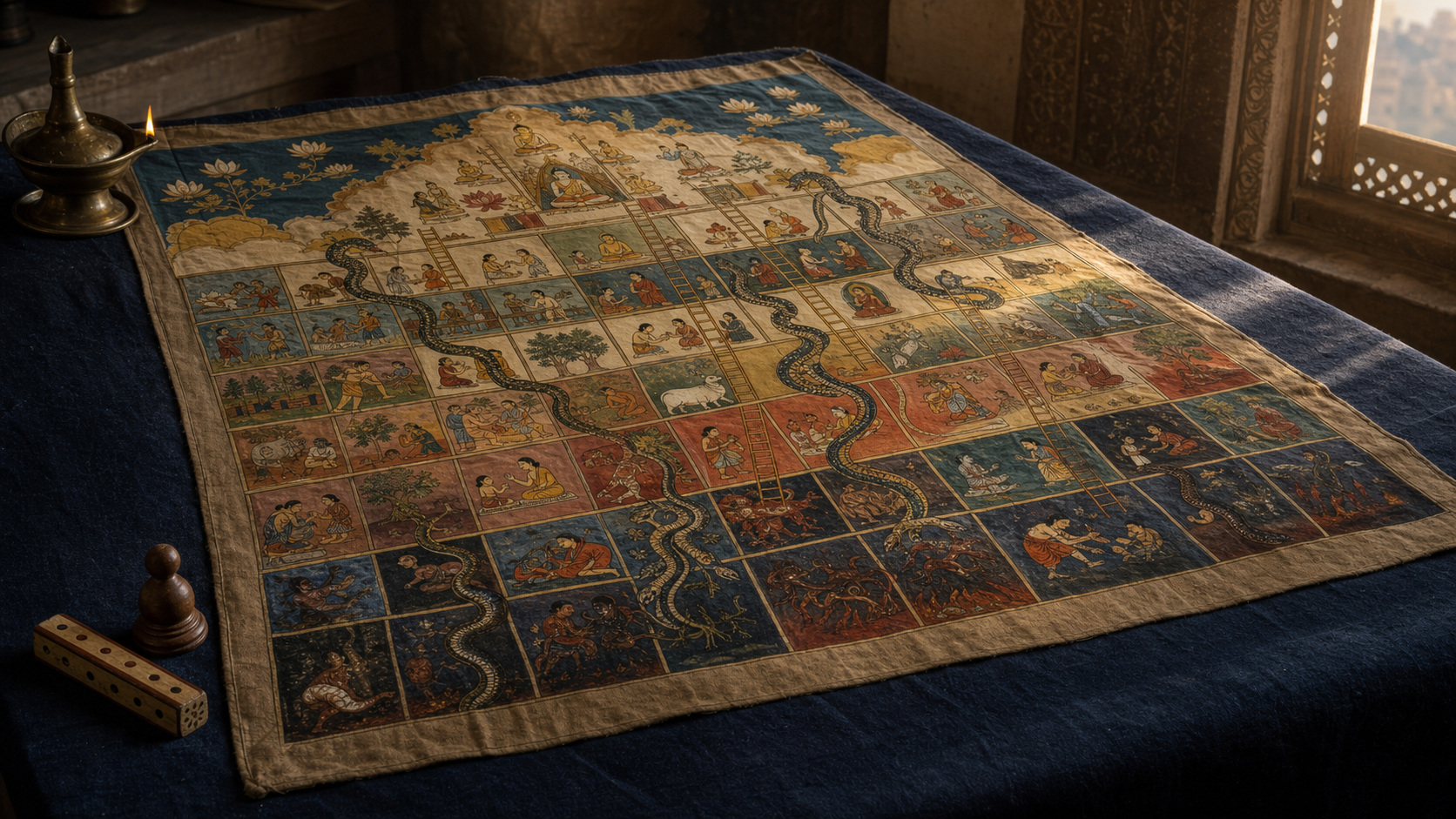
If the Snakes and Ladders board you remember was only a race to square 100, you learned the movement but missed the question at the heart of the game: what makes a human being rise, and what causes a fall?
Recovering that question changes how you see the board and how you introduce it to your family. Gyan Chaupar was not simply entertainment from Bharat with religious pictures added around the edges. Its virtues, vices, irregular leaps and final square formed a working model of karma, samsara and liberation. You can restore much of that purpose even if the only board available to you is a modern commercial one.
Gyan Chaupar asks what moved you, not just how far
The name Gyan Chaupar, or Game of Knowledge, identifies its educational purpose. The numbered path represents movement through conditioned existence. A ladder begins at a virtue such as dana, satya, ahimsa, kshama, bhakti or dhyana. A serpent begins at a fault such as kama, krodha, lobha, moha, mada or matsarya. The destination may be named Moksha, Vaikuntha or Paramapada, depending on the board and its religious setting.
This is more precise than the familiar idea that ladders stand for good deeds and snakes for bad deeds. A named square identifies the quality of mind behind an action. Dana is not merely behaving well; it is generosity that loosens possessiveness. Kshama interrupts retaliation. Dhyana disciplines attention. Krodha does not signify an unlucky event imposed from outside; it identifies anger as a force that can undo hard-won progress.
The board therefore gives you a vocabulary for examining conduct without needing a long lecture. A child sees immediately that one habit can change an entire course. An adult sees something equally important: progress is not always linear. Years of discipline do not make heedlessness impossible, while one decisive reorientation can lift a person beyond a pattern that once seemed permanent.
Key takeaways
- Gyan Chaupar is an Indian moral and spiritual precursor of modern Snakes and Ladders, not merely a decorative regional edition of the modern game.
- The ladders and snakes originally carried named virtues and vices, so their meanings were part of the rules rather than optional storytelling.
- No single grid represents every historical form. Earlier boards could contain 72, 96 or 132 squares, while the now-familiar format commonly contains 100.
- Hindu and Jain boards use the same broad grammar of ascent and descent but organize it through distinct theological and philosophical vocabularies.
- Buddhist and Sikh teachings offer close ethical parallels, but those parallels should not be turned into claims about distinct canonical boards where such boards are not attested.
- To restore the game at home, label the transitions, explain one term whenever a player moves and treat a fall as an occasion for reflection rather than shame.
What the surviving boards let us claim about its history
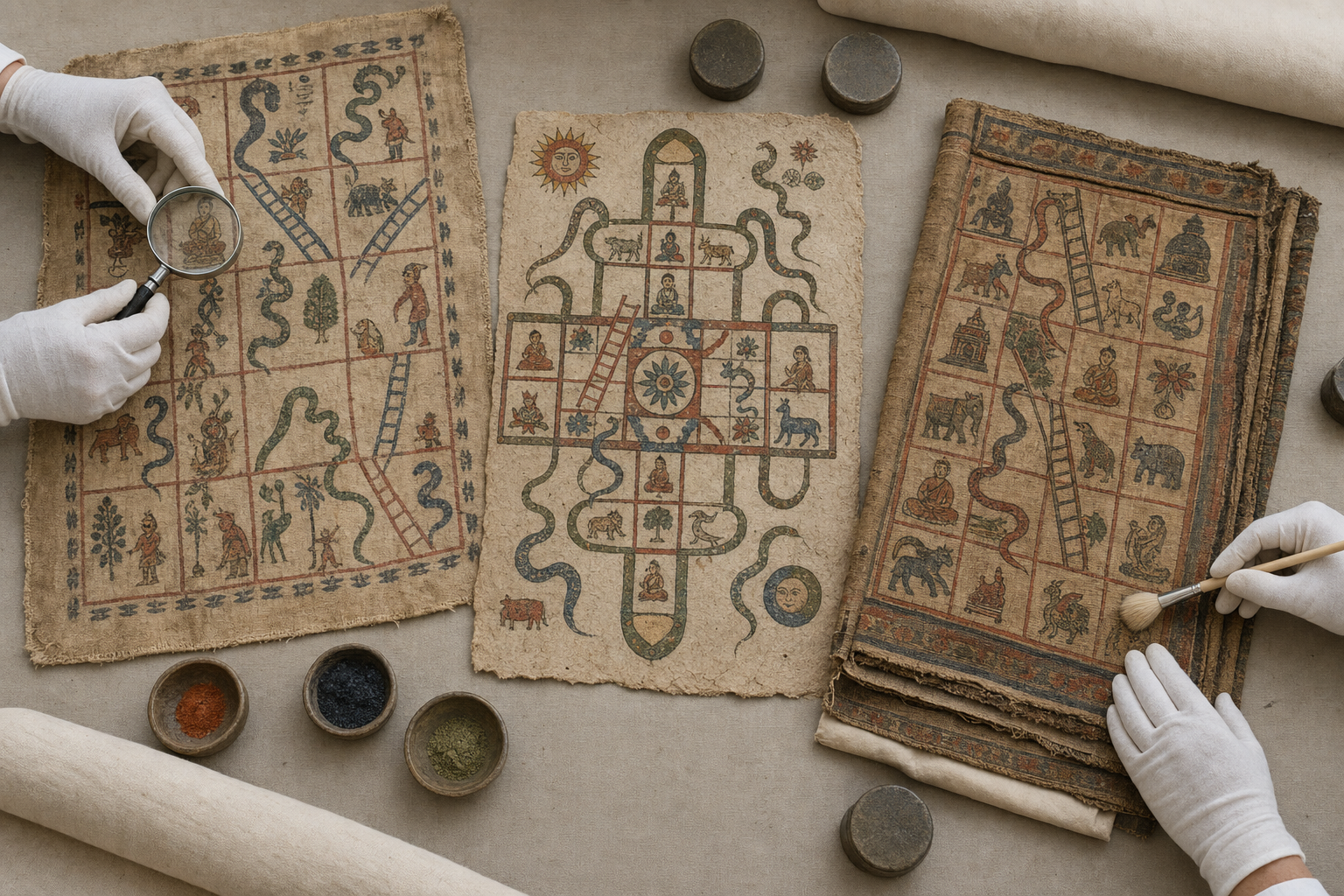
The strongest historical case begins with material evidence. Surviving boards are associated with early modern India, roughly the 17th through 19th centuries, with examples connected to Rajasthan, Gujarat and the Deccan. They were painted on cloth or paper and annotated in scripts including Devanagari and Gujarati, with Persian appearing on occasion.
That evidence supports a substantial Indian history without requiring an exaggerated date. You do not need to call every form of Gyan Chaupar thousands of years old to recognize it as Dharmic heritage. A responsible account distinguishes the age of surviving objects from the possibility that practices, teachings or less durable boards circulated earlier. It also avoids treating one regional board as the original template for all others.
The range of names is itself instructive. Moksha Patam circulated in North Indian settings. Paramapada Sopanam belongs especially to Tamil traditions. Jnana Chaupar appears in Jain communities. These are related forms, but the names are not disposable synonyms. Each tells you what its makers and players placed at the center: liberation, the steps to the supreme abode, or knowledge of the soul’s condition.
The layouts varied as well. Boards with 72, 96 and 132 squares are known alongside other arrangements. That variation matters because the grid was a curriculum. Changing the number, order or connections between squares could change the lesson. A 10 by 10 commercial board should therefore not be mistaken for the timeless or universal form of the game.
Colonial-era adaptations retained the memorable mechanism while reducing much of this specificity. English editions, and later the American game Chutes and Ladders, favored a general children’s race with simplified moral or child-friendly imagery. The physical movement survived; the detailed map of karma, rebirth, discipline, devotion and liberation largely did not. The transformation was therefore not just a change of artwork. It narrowed what the game was capable of teaching.
If you are examining a reproduction, museum image or inherited board, do not identify it by counting serpents alone. Look for the features that reveal its intellectual setting:
- Read the title and the name of the final square before interpreting the route.
- Look for inscriptions beside the heads or tails of serpents and at the feet or tops of ladders.
- Notice whether the labels describe ordinary virtues, the six inner enemies, Jain stages of spiritual development, devotional practices, realms or restraints.
- Identify the script without assuming that script alone establishes the board’s religious community.
- Examine marginal notes, sages, temple forms, lotuses and cosmological markings as instructional elements rather than mere ornament.
- Expect regional and sectarian variation; a different grid is not necessarily an inaccurate one.
This method keeps cultural recovery anchored in what the object actually contains. It also prevents a common mistake: replacing the moral thinness of the modern game with a new but equally thin claim that every old Indian board taught exactly the same doctrine.
One ethical grammar carries several Dharmic vocabularies
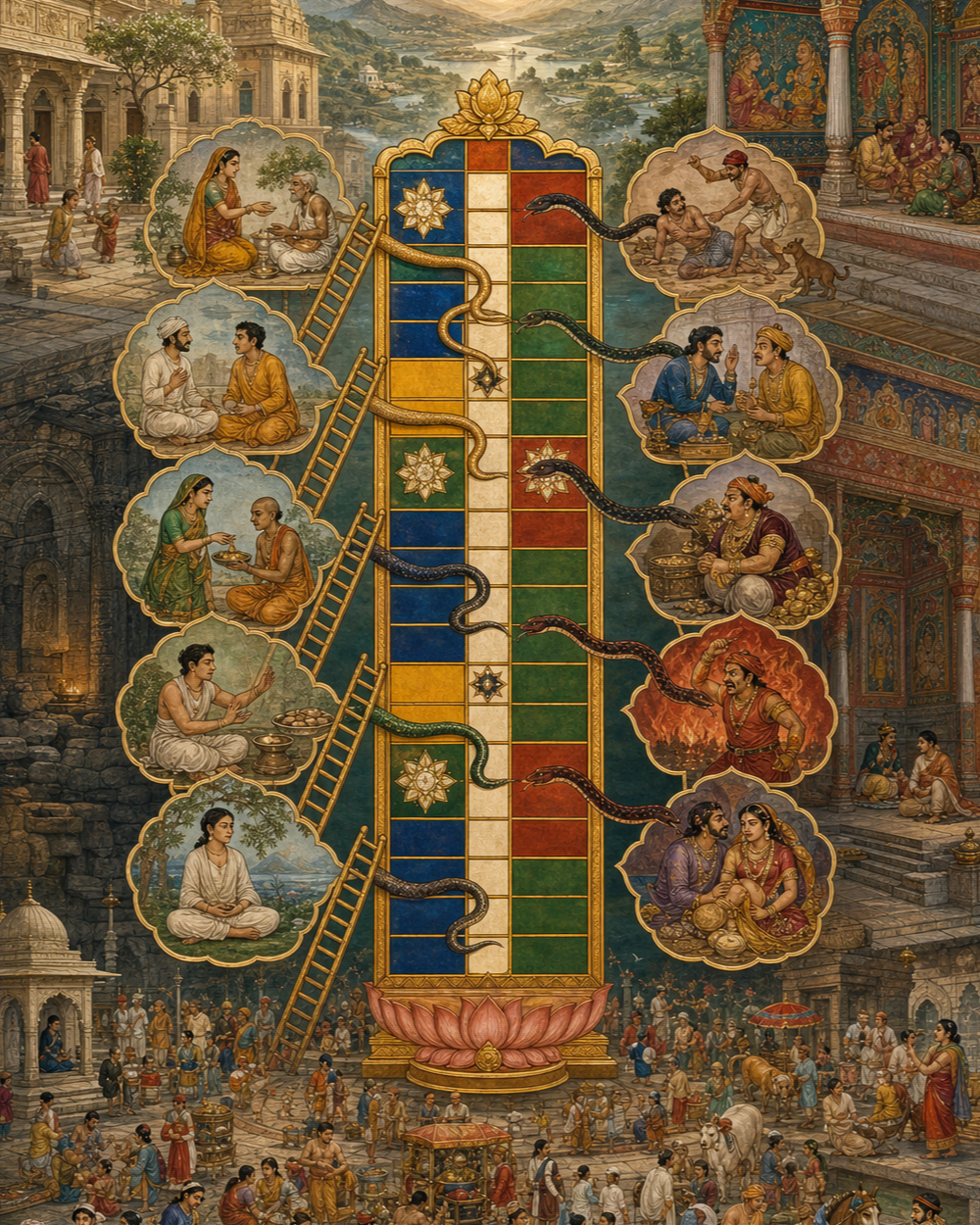
Gyan Chaupar can express Dharmic unity because it does not require uniformity. Hindu, Jain, Buddhist and Sikh traditions all recognize that ignorance, attachment and undisciplined passions bind human beings, while truthful conduct, restraint, insight, devotion or service redirect life. They do not always define bondage, grace or liberation in the same way.
| Religious frame | What the serpents can represent | What the ladders can represent | How to present it accurately |
|---|---|---|---|
| Vaishnava and broader Hindu forms | Kama, krodha, lobha, moha, mada and matsarya, the six inner enemies, together with related forms of adharma | Dana, satya, ahimsa, kshama, dhyana, bhakti, satsanga, nama-japa, vrata, pilgrimage and other disciplines | Let the board’s own final square determine whether the culmination should be called Moksha, Vaikuntha or Paramapada. Where devotion is central, preserve the relationship between disciplined effort and divine grace. |
| Jain Jnana Chaupar | The kashayas of anger, pride, deceit and greed, as well as conditions that continue karmic bondage | Right faith, right knowledge and right conduct; samvara, which stops karmic influx; and nirjara, which sheds bound karma | Read the route in relation to the 14 gunasthanas when the board invokes them. The summit may point toward kevala-jnana and moksha, not a devotional heaven borrowed from another version. |
| Buddhist interpretive frame | Kleshas such as ignorance and craving | The paramitas and the Noble Eightfold Path as disciplines that transform mind and conduct | Present this as a close ethical interpretation unless you have evidence for a particular historical Buddhist board. Do not convert similarity into an unsupported claim of a canonical form. |
| Sikh interpretive frame | The Five Thieves: kam, krodh, lobh, moh and ahankar | Seva, sangat and simran, with ascent understood under nadar, or divine grace | Use the parallel to illuminate Sikh teaching while making the same historical distinction: ethical correspondence is not proof of a separate canonical board. |
The practical rule is simple: begin with the vocabulary of the board or community in front of you. If you are teaching Paramapada Sopanam in a Tamil Vaishnava household, do not replace Vaikuntha with a generic idea of success. If you are explaining Jain Jnana Chaupar, do not turn kevala-jnana into another name for entering a divine abode. The shared pattern becomes more meaningful when the distinctions remain visible.
You can introduce cross-traditional parallels after the first meaning is clear. Krodha can open a discussion of the Hindu inner enemies, the Jain kashayas and the Sikh Five Thieves. Ahimsa can show a powerful ethical convergence while still allowing Jain, Hindu and Buddhist accounts of non-violence to retain their particular depth. This is unity through intelligible relationship, not unity through erasure.
How dice, snakes and ladders make karma experiential
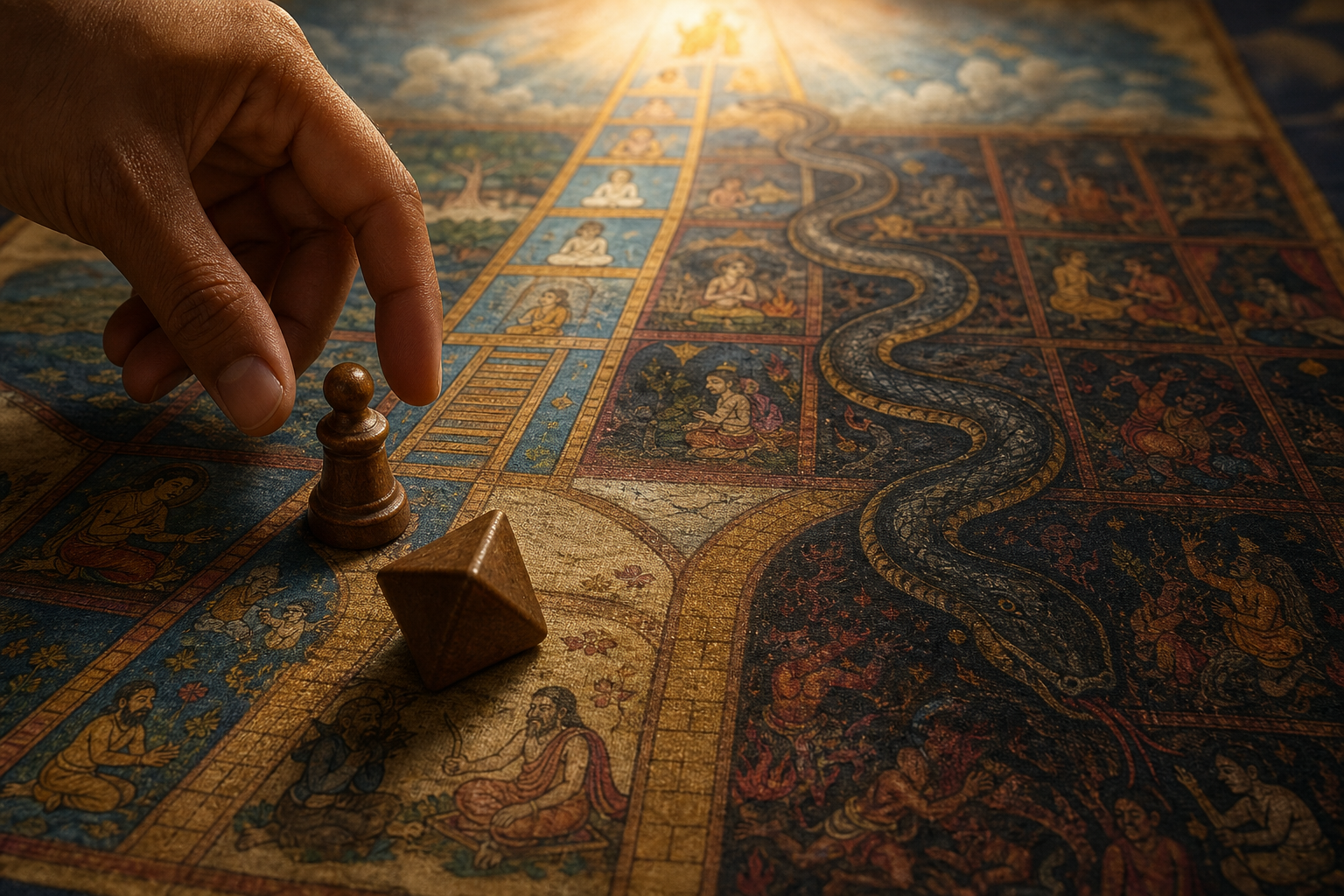
The throw of dice or cowrie shells introduces contingency. You do not choose every condition into which you move. Yet chance does not decide the moral meaning of the board. The player must still encounter the named state, recognize the transition and continue from its consequences. The combination gives you a compact way to distinguish daiva, the conditions not entirely under personal command, from purushartha, purposeful human effort.
Read each turn on three levels. The throw represents circumstances. The square represents the condition now present. The response represents agency. This prevents two opposite errors: imagining that a person controls every result, or imagining that karma means helpless submission to fate.
A ladder makes the effect of virtue visibly disproportionate. Satsanga can change what a person considers normal. Truthfulness can end the need to maintain layers of deception. Meditation can interrupt a recurring mental pattern. The game does not promise that one outwardly good act mechanically purchases liberation. It shows that a cultivated quality can redirect the whole path.
A serpent dramatizes the same non-linearity in the other direction. Pride can corrupt learning. Greed can undo generosity by making it transactional. Anger can destroy trust accumulated over time. The downward movement is memorable because consequences do not always arrive in equal, tidy portions.
Many rulesets require an exact throw to enter the final square. That rule is worth preserving. It prevents liberation from becoming a destination that a player simply overshoots into by accumulating enough motion. In the game’s symbolic language, effort matters, favorable conditions matter and the culmination requires alignment rather than mere speed.
The mechanism can also be described mathematically. Gyan Chaupar behaves like an absorbing Markov chain: each square is a state, each throw creates possible transitions, and Moksha or Vaikuntha is absorbing because the journey ends when it is reached. Ladders and serpents create long transitions that radically alter the expected path.
This matters if you are designing or restoring a board. Placement is part of the teaching. Frequent long serpents can make the journey punishing, while a few powerful ladders can shorten it dramatically. A board filled with easy ascents teaches something different from one in which progress is gradual and lapses are costly. Premodern makers appear to have used these distributions pedagogically, but you should not assume that every placement on every surviving board has one universal explanation.
Most importantly, never shame a player for landing on a vice. The throw placed the token there; it did not diagnose the player’s character. The educational moment lies in naming how that vice operates and what discipline counters it. Treating a random landing as proof of moral failure confuses the model and can make children hide mistakes rather than examine them.
How to restore Gyan Chaupar as a household practice
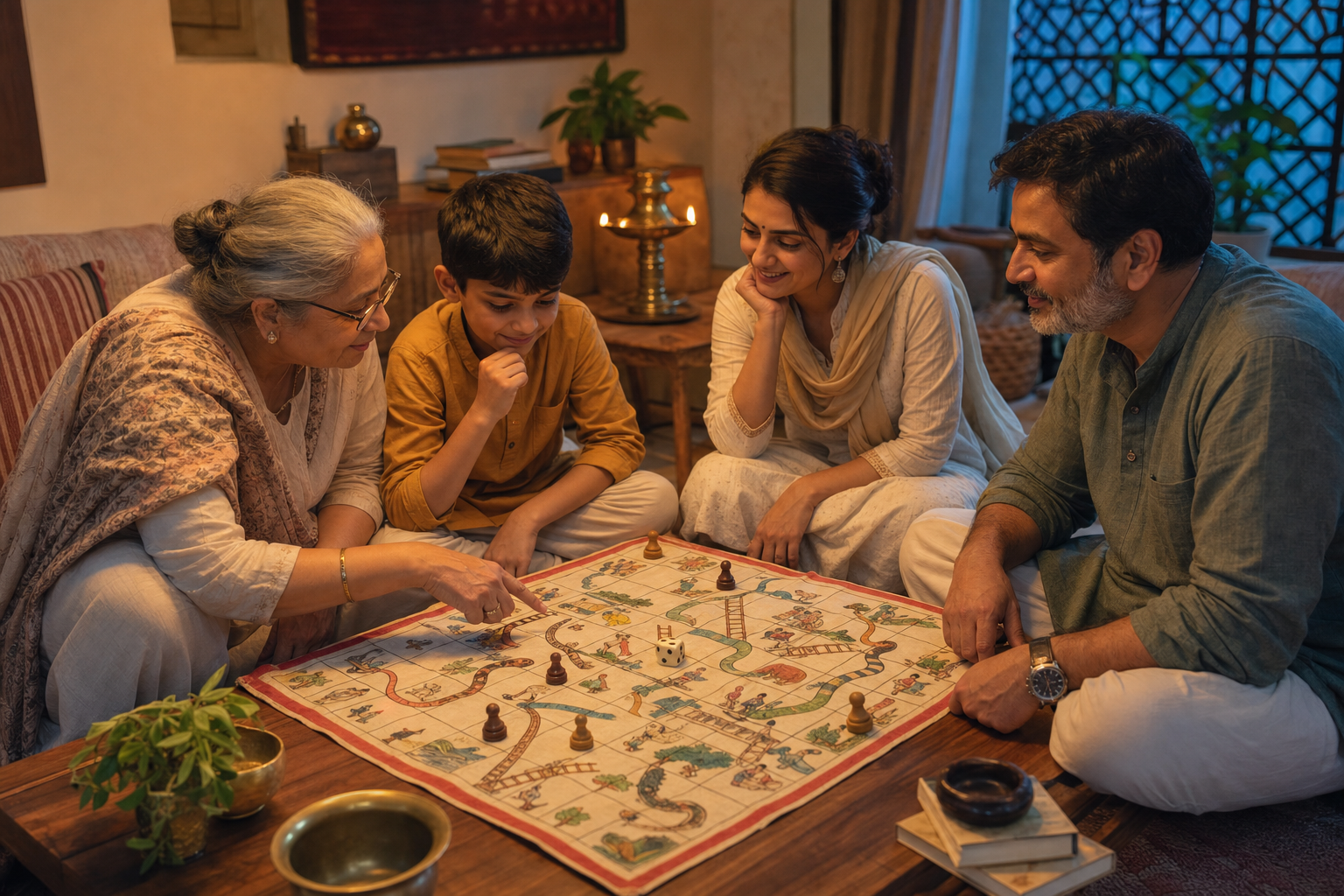
You do not need an antique board to recover the central method. If you have a historical reproduction, follow its inscriptions. If you have only modern Snakes and Ladders, place removable labels beside the beginnings and ends of its transitions. The labels matter more than an imitation of old artwork whose symbols you cannot explain.
- Choose the religious frame. Decide whether you are presenting a general Hindu ethical board, Paramapada Sopanam, Jain Jnana Chaupar or a clearly identified contemporary adaptation. Write that choice at the top so related traditions are not accidentally blended.
- Name the destination. Use Moksha, Vaikuntha, Paramapada or the appropriate Jain culmination according to the frame you selected. Explain that the last square represents liberation or the highest spiritual state, not material victory.
- Label every ladder and serpent you intend to discuss. A simple Hindu set can draw ladders from dana, satya, ahimsa, kshama, bhakti and dhyana, and serpents from kama, krodha, lobha, moha, mada and matsarya. A Jain board should use its own more technical categories rather than merely changing the title.
- Define each term before the game begins. Use one plain sentence and one ordinary example. Satya can be telling the truth when concealment would be convenient. Lobha can be wanting more when enough is already present. The example should clarify the term without pretending to exhaust it.
- Keep the ordinary movement rules. Advance by dice or cowries, take the full ascent or descent and require an exact throw for the final square if you want to preserve that symbolic lesson.
- Pause for one sentence at each transition. On a ladder, let the player name an action that expresses the virtue or something for which they are grateful. On a serpent, let the player identify a corrective intention. Keep the reflection short enough that the game remains a game.
- End with a chosen practice. Each player can select one ladder to cultivate or one serpent to watch in daily life. At the next game, invite reflection without keeping score of personal virtue.
The questions should be concrete. For dana, ask what can be offered without demanding recognition. For satya, ask what honesty requires when the truth is inconvenient. For ahimsa, ask which response reduces avoidable harm. For krodha, ask what pause might prevent anger from choosing the next action. For lobha, ask how a person recognizes enough. For moha, ask what attachment may be preventing someone from seeing clearly.
An elder’s role is to connect the square to lived conduct, not to deliver a sermon after every throw. Let younger players supply examples from school, friendship, sport or family life. Adults can offer examples that reveal their own need for practice. That shared vulnerability keeps the board from becoming a tool for policing children while exempting elders.
Festival context can deepen the practice when it belongs to the family’s tradition. Tamil households have associated Paramapada Sopanam with Vaikunta Ekadashi, joining play to remembrance of the supreme abode. In that setting, the occasion, final square and devotional vocabulary reinforce one another. Outside that setting, explain the connection respectfully rather than presenting the custom as universal to every Hindu household.
If you restore only one feature before your next game, restore the names. A nameless ladder teaches acceleration; dana teaches a way of living. A nameless snake teaches disappointment; krodha teaches you what to notice before anger carries you downward. Once those names return, the board can again become a conversation between play, conduct and liberation.