
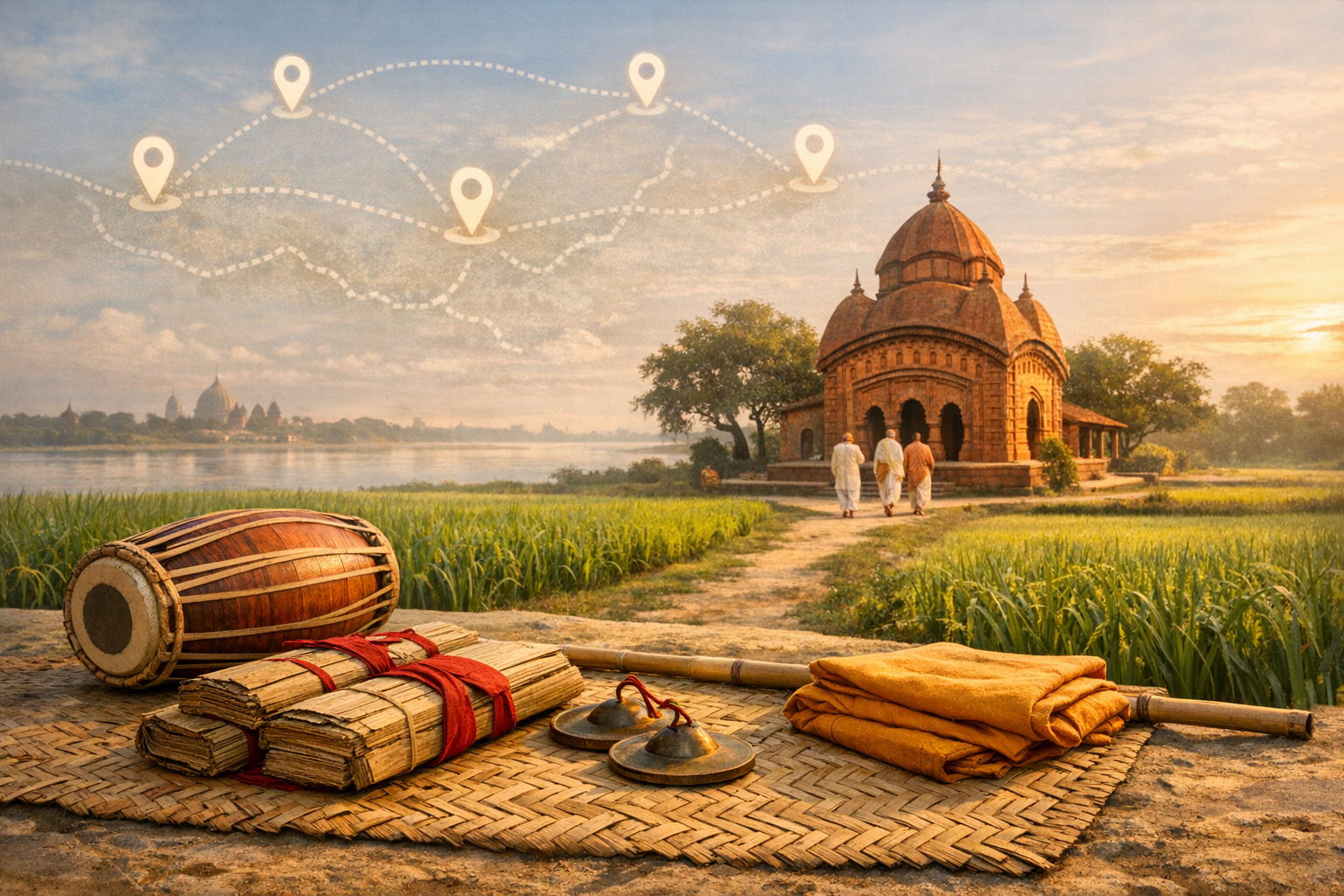

Yajigrama, a quiet village approximately 4 km from Katwa in West Bengal, sits at a pivotal crossroads in the sacred geography of Gaudiya Vaishnavism. Situated about one hour from Navadvipa and roughly two hours by road from Mayapur (travel times vary with traffic and season), it anchors a compact yet profound circuit of pilgrimage that connects devotees and cultural historians alike to the formative sites of the Bhakti movement in eastern India. For those mapping a Yajigrama Yatra, the region offers an integrated view of devotional practice, literary transmission, and community memory.
Katwa is historically renowned as the place where Sri Caitanya Mahaprabhu accepted sannyasa from Kesava Bharati, a decisive moment that galvanized the public expression of kirtana and bhakti in the broader Ganga-Brahmaputra delta. The ritual of sannyasa at Katwa functions, in Gaudiya hermeneutics, as both a personal renunciation and a civilizational reorientation toward accessible devotionsankirtanaas a primary means of spiritual realization. This devotional turn shaped not only local practice but also the itineraries of teachers, poets, and householders who sustained and disseminated the tradition.
Within this sacred landscape, Yajigrama (often identified in traditional sources as Jajigram) is intimately linked with the lives and labors of three Vaishnava stalwartsSrila Narottama Das Thakura, Srila Shrinivasa Acharya, and Srila Ramachandra Kaviraj. Traditional biographies and regional lineages recognize Yajigrama/Jajigram as the birthplace and early arena of service of Srila Shrinivasa Acharya, whose life threads together Katwa, Navadvipa-Mayapur, and eventually Vrindavana, forming a corridor of learning and devotion that is still legible to pilgrims today.
Following the aprakata (unmanifest) departure of Sri Caitanya Mahaprabhu, Nityananda Prabhu, and their associates, a new phase of structured transmission emerged. Under the guiding scholarship and blessings of the Six Gosvamis of Vrindavana, Srila Narottama Das Thakura, Shrinivasa Acharya, and Sri Shyamananda Prabhu undertook a pioneering mission: to systematize, preserve, and circulate the Gosvami granthas, and to root the theological aesthetics of Gaudiya Vaishnavismbhakti-rasa and sambandha–abhidheya–prayojanaamong communities across Bengal, Odisha, and beyond. Their coordinated travels and teaching established a durable infrastructure for congregational practice and textual study.
Srila Shrinivasa Acharya’s trajectory illustrates this blueprint. Emerging from Yajigrama/Jajigram near Katwa, he sought advanced instruction in Navadvipa and later in Vrindavana under the aegis of the Gosvamis. His return journey, preserved in Gaudiya memory as a landmark in the transfer of sacred literature, seeded institutions of study and kirtana that still inform local devotional rhythms. Yajigrama’s significance therefore extends beyond a single biography; it embodies the logistical and spiritual bridges that connected Vrindavana’s theological elaboration with Bengal’s congregational heartland.
Srila Narottama Das Thakura, closely allied in purpose with Shrinivasa Acharya, is celebrated for organizing devotional festivals, authoring songs of profound theological clarity, and harmonizing community practice with the Gosvami corpus. His initiativesespecially large-scale kirtana gatheringsstrengthened the social architecture of Gaudiya Vaishnavism, enabling households and renunciants to participate in a shared devotional economy. While Narottama’s principal organizing centers lay farther east, the Katwa–Navadvipa–Mayapur axis, with Yajigrama as a node, served as a vital conduit for his collaborative endeavors.
Sri Shyamananda Prabhu further extended this network southward into Odisha, deepening the living bond between Vrindavana scholarship and regional devotional ecologies around Sri Jagannatha. Together, Narottama, Shrinivasa, and Shyamananda formed a triad whose pedagogy and pastoral care ensured that the Six Gosvamis of Vrindavana would not remain confined to a single geography, but would circulate as a shared inheritance. Yajigrama’s place in this story is as a stable point from which these currents flowed and to which pilgrims can still return to contemplate the lineage’s integrative vision.
Srila Ramachandra Kaviraj, a renowned poet and physician, lived and taught in the Katwa–Srikhanda region and maintained deep association with both Narottama Das Thakura and Shrinivasa Acharya. His contributions exemplify how Gaudiya Vaishnavism nurtured accomplished householders who synthesized literary excellence, medical service, and devotional leadership. For visitors, pairing Yajigrama/Jajigram with nearby Srikhanda and Katwa creates a compact itinerary that reveals how poets, preceptors, and communities collectively sustained bhakti through song, instruction, and daily seva.
Textual memory anchors these landscapes. Devotees and researchers often consult Chaitanya-bhagavata, Chaitanya-charitamrita, and later hagiographies such as Bhakti-ratnakara for site references, lineages, and festival accounts. These texts, along with the Gosvami treatises (e.g., Bhakti-rasamrita-sindhu, Hari-bhakti-vilasa), clarify the doctrinal core while also preserving vernacular detailsvillage names, seasonal gatherings, and modes of congregational worshipthat animate a Yajigrama Yatra with historical depth and theological texture.
As a living pilgrimage, Yajigrama offers more than commemoration. Visitors frequently describe a palpable intimacyhomespun kirtana drifting across courtyards, pathways edged by paddies, and quiet shrines where everyday acts of reverence sustain the memory of great teachers. The region’s devotional life illustrates how sacred geography functions when scripture, song, and social practice mutually reinforce one another. Such experiences, while personal to each pilgrim, consistently point to a continuity of bhakti that is both scholarly and embodied.
A practical route for a day or weekend circuit often runs Mayapur–Navadvipa–Katwa–Yajigrama (Jajigram)–Srikhanda, with Katwa serving as a transport hub. Road conditions and public transit schedules change seasonally; cooler, drier months generally favor easier access. Respectful conductmodest dress, willingness to follow local temple etiquette, and sensitivity to photography restrictionssupports community goodwill and preserves the sanctity of small shrines. These simple practices align with the broader dharmic ideal of pilgrimage as inner refinement expressed through outward courtesy.
Crucially, the values embodied in the Yajigrama Yatradevotion, ethical living, disciplined study, and reverence for teachersresonate across the dharmic family of Hinduism, Buddhism, Jainism, and Sikhism. Despite doctrinal distinctions, these traditions share commitments to non-harm, truthfulness, self-cultivation, and community service. Approached in this spirit, the yatra becomes a conduit for unity in diversity, reinforcing that India’s sacred landscapes invite mutual respect and learning among all dharmic paths.
From an academic perspective, Yajigrama serves as a case study in how textual canons travel: manuscripts move with teachers, teachers settle among communities, and communities translate scholastic insight into public devotion. The Katwa–Yajigrama–Navadvipa–Mayapur corridor demonstrates how intellectual capital and embodied practice travel together, leaving a cartography of shrines, schools, and festivals. In this way, a Yajigrama Yatra functions not only as pilgrimage but also as a primary field encounter with the social history of Gaudiya Vaishnavism.
In sum, Yajigrama’s proximity to Katwa and its associations with Srila Narottama Das Thakura, Srila Shrinivasa Acharya, and Srila Ramachandra Kaviraj grant it enduring relevance for devotees, historians, and cultural travelers. The site crystallizes a moment when the post-Caitanya generation systematized teaching, circulated texts, and shaped congregational life. For those seeking a thoughtful, well-documented pilgrimage experiencerich in theology, history, and living practicethe Yajigrama Yatra offers a compact yet comprehensive window into the heart of Gaudiya sacred geography, harmonizing scholarship with devotion and fostering unity across dharmic traditions.
Inspired by this post on Dandavats.
