
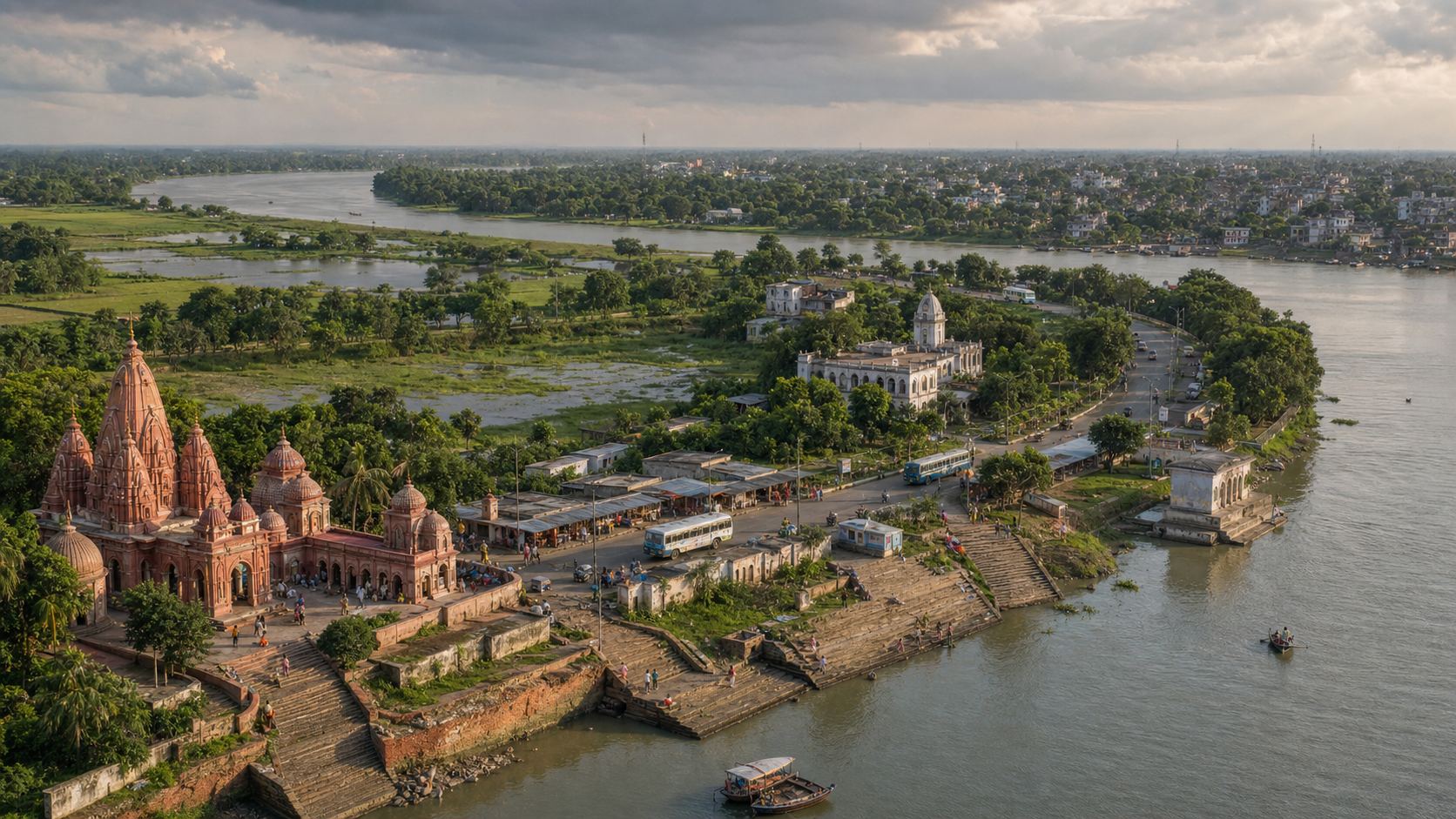
If you are trying to decide whether West Bengal’s temple-and-ashram politics is a civilizational correction or another round of political theatre, don’t begin with the photographs. Begin with the sequence, the institutions chosen, and what happens after the motorcade leaves.
A sacred visit is a signal, not proof of delivery. Yet signals matter when they tell officials, religious institutions, voters, and local communities what the government intends to treat as public inheritance. Your task is to distinguish cultural recognition from selective patronage and a pilgrimage circuit from a governing programme.
The oath and the yatra perform different political tasks
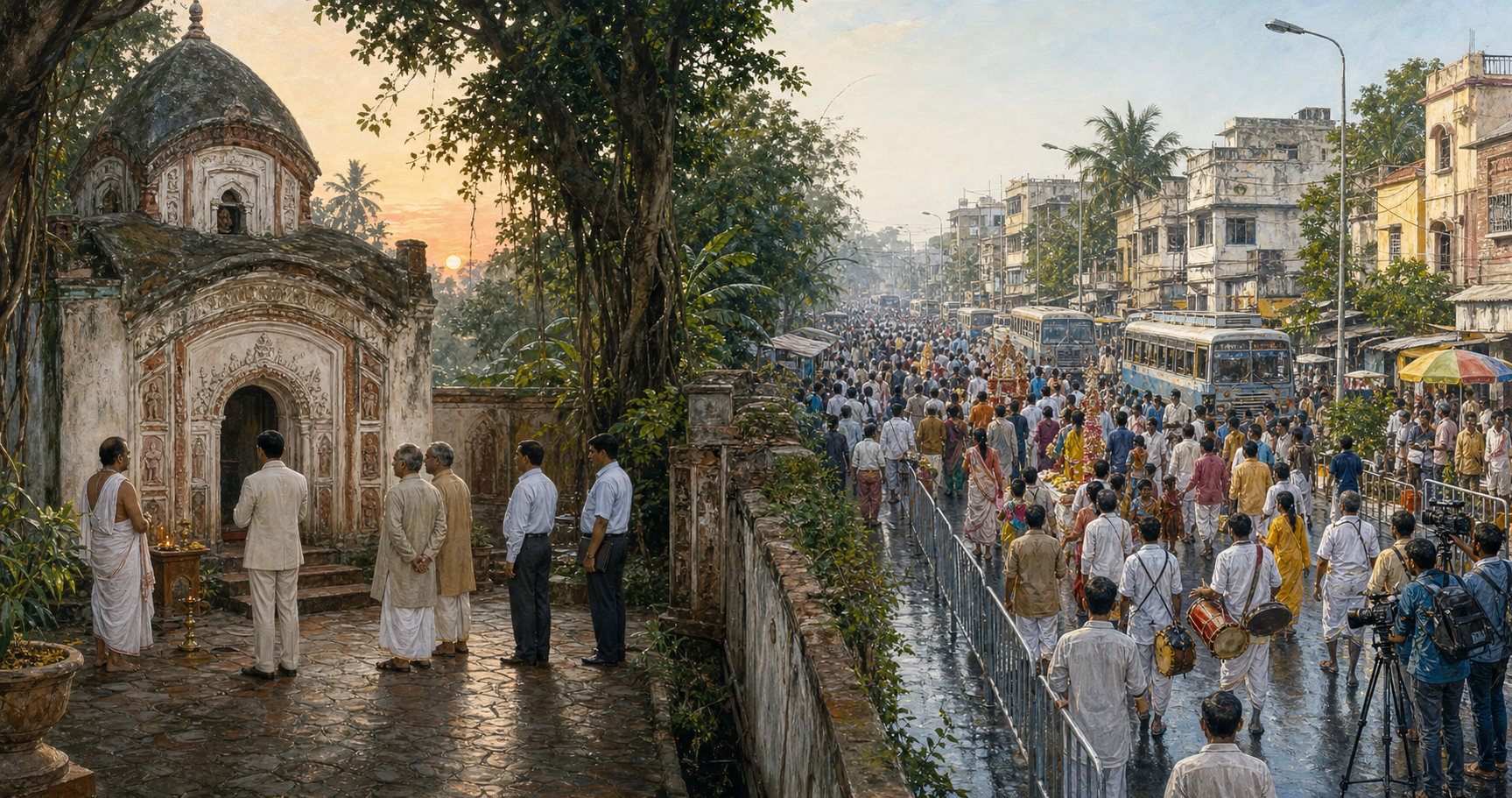
Suvendu Adhikari’s swearing-in as West Bengal’s first BJP chief minister was followed by a conspicuous circuit of temples and ashrams. The order matters. The constitutional oath established his legal authority; the yatra sought recognition within Bengal’s cultural and spiritual world.
The first ceremony says who may govern. The second says which inherited places, memories, and networks the new government wants citizens to see as central to governance. Moving directly from one to the other turns pilgrimage into an announcement of priorities: sacred heritage will no longer be treated merely as private devotion or festival scenery.
That is politically consequential, but it is not yet a policy result. A temple visit does not repair a dangerous approach road. An ashram meeting does not by itself create a disaster-response partnership. A public blessing does not establish a fair grant process. Symbolism can align expectations and restore dignity to neglected traditions, but you should classify it honestly as symbolism until administrative commitments appear.
For every stop on a political yatra, ask four questions. Was the institution selected because of genuine heritage or service needs, or only because it offers political visibility? Was a specific public problem identified? Which department or civic body owns the follow-up? Will citizens be able to see what was promised, funded, and completed? If the last three answers remain unclear, the visit may still have cultural value, but it has not crossed the threshold into governance.
This distinction protects both politics and faith. It prevents a government from claiming administrative success on the strength of devotional imagery, and it prevents critics from pretending that public recognition of Bengal’s sacred inheritance has no legitimate civic meaning.
Bengal’s sacred map cannot be reduced to one political colour
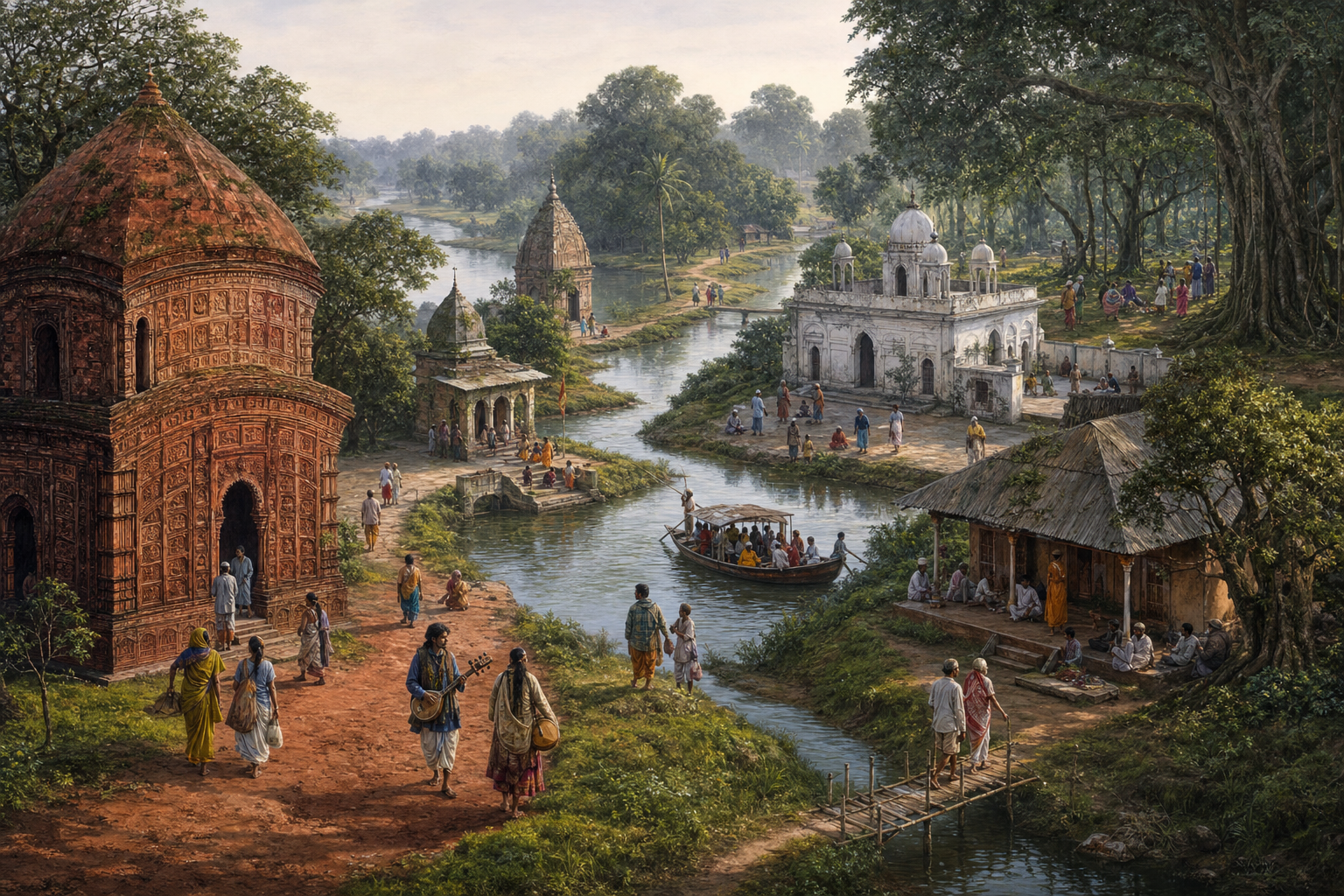
Sacred geography is more than a collection of famous buildings. It is the relationship among places, pilgrimage routes, communities, rituals, memories, and institutions of service. A shrine becomes politically relevant not simply because worship occurs there, but because generations may also associate it with learning, shelter, charity, artistic practice, or collective survival.
Bengal’s landscape contains interwoven Shakta, Shaiva, and Vaishnava traditions alongside Buddhist, Jain, and Sikh institutions. That plurality does not diminish Bengal’s Hindu civilizational character. It reveals how that character has historically accommodated multiple paths, chosen ideals, disciplines, and communities without requiring them to become identical.
A serious Dharmic programme should therefore avoid two errors. The first is dilution: treating a temple as generic tourism infrastructure while ignoring its ritual character and community authority. The second is monopoly: presenting one influential institution, lineage, or sect as if it exhausts Bengal’s sacred inheritance.
The better frame is a Dharmic commons. Hindu temples and mathas, Buddhist viharas, Jain derasars, Sikh gurdwaras, and service-oriented ashrams remain doctrinally distinct, yet they can meet around ahimsa, seva, dana, and karuna. Public cooperation can be organised around conservation, education, relief, accessibility, and local livelihoods without asking any tradition to surrender its own discipline.
You can test an administration’s claim of civilizational stewardship by mapping its itinerary and its projects. Record the type of institution, its location, the public need identified, and the eventual outcome. Inclusion should appear not only in ceremonial visits but also in the rules governing conservation assistance, roads, sanitation, safety, and service partnerships.
Constitutional impartiality does not require cultural amnesia. Articles 25-28 of the Constitution provide the rights framework within which religious freedom and state action must operate. A pro-Dharmic government strengthens its case when it applies public criteria openly, respects every institution’s lawful autonomy, and refuses to turn heritage grants into rewards for party loyalty.
Four ways a sacred circuit can become practical governance
Conserve the living site, not just its facade
Heritage work should begin with a documented condition assessment. Officials and custodians need to know what is structurally vulnerable, what is historically significant, which living practices must continue during the work, and which craftspeople have the necessary knowledge. Structural stabilisation, archival documentation, and craft revival serve different purposes; putting them under the single label of beautification hides whether anything valuable was actually preserved.
The practical test is evidence before and after intervention. Look for a site-condition rating, a defined scope of work, an independent technical review, and records that future conservators can consult. Fresh paint and a new entrance may be visible, but they do not substitute for stabilising a vulnerable structure or documenting material that could be lost.
Design the entire pilgrimage journey
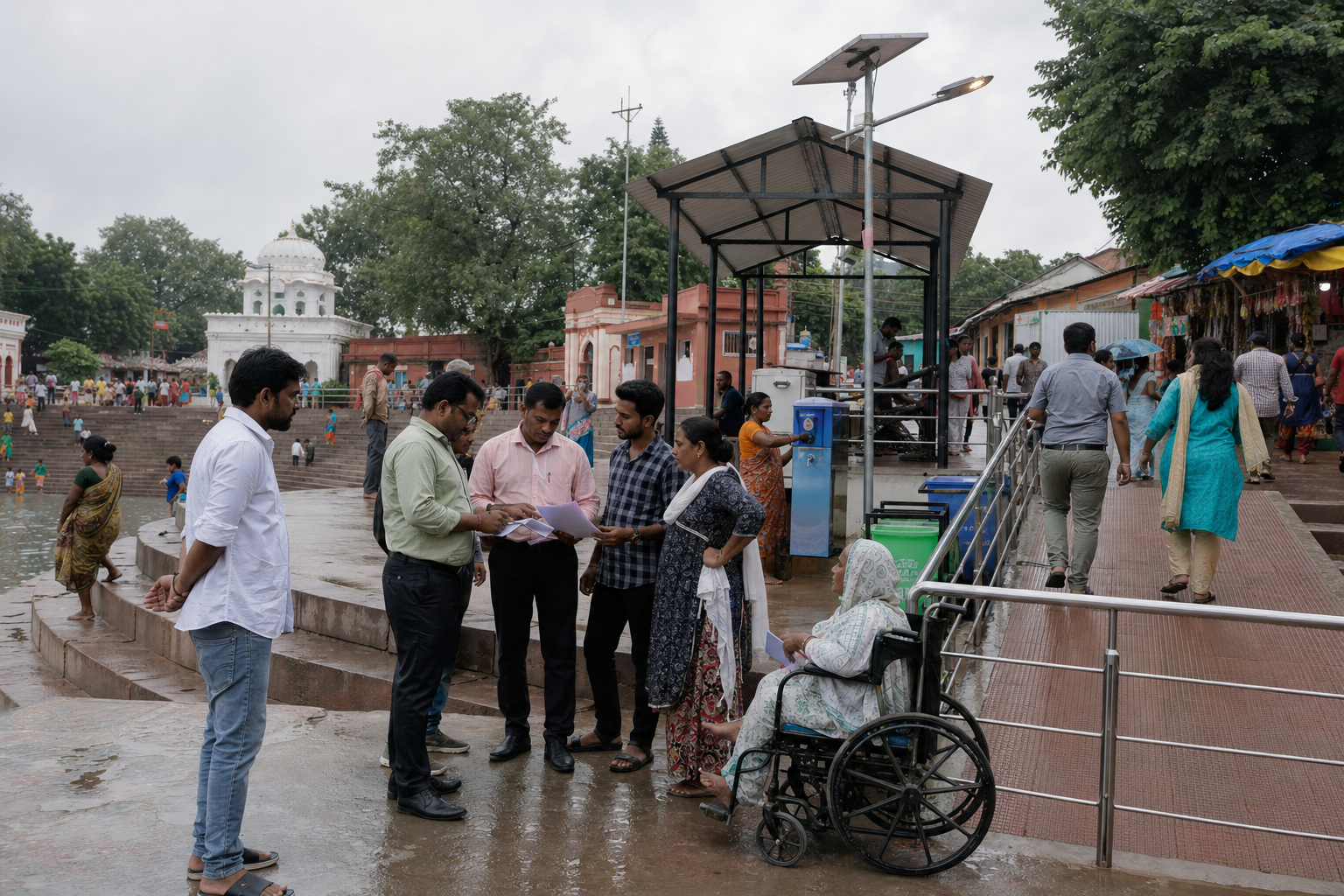
A pilgrimage begins before the devotee reaches the sanctum. Roads, public transport connections, safe walking routes, sanitation, lighting, crowd management, and intelligible signs determine whether an elderly pilgrim or a family can complete the journey with dignity.
Accessibility must also describe a continuous route, not an isolated ramp. The useful questions are whether a person with limited mobility can move from the arrival point to the accessible areas of the site, whether tactile guidance serves people with visual impairments, and whether multilingual signs explain routes and safety information. A ramp that ends at another set of steps is a photograph, not access.
Measure journey performance as well as construction. Transit times, accident rates on important approaches, sanitation compliance during major yatras, and the number of pilgrimage nodes made continuously accessible reveal more than the number of inaugurated projects.
Partner with service institutions without absorbing them
The engagement with Bharat Sevashram Sangh highlights the governing value of organisations active in relief, education, and healthcare. Such institutions may possess local trust, volunteers, facilities, and knowledge that a distant bureaucracy cannot quickly reproduce. That can make them valuable partners in disaster response, social protection, and youth development.
The partnership still needs boundaries. Public money should purchase a defined and auditable public outcome. The institution should retain control of its spiritual life and lawful internal discipline. Government should neither convert independent religious bodies into party auxiliaries nor use partnership as an indirect route to ritual control. Written roles, transparent funding, service standards, and an agreed grievance process protect both sides.
Build a local economy that does not consume the sacred place
Better pilgrimage access can support guides, transport workers, small traders, craftspeople, accommodation providers, and food services. Heritage conservation can also renew demand for specialised artisanal skills. But footfall alone is a poor measure of success. A site can attract more visitors while becoming less dignified, less accessible, or less economically useful to its surrounding community.
Track heritage-skilled livelihoods, artisan-cluster revenue, and the share of work reaching local participants alongside visitor numbers. Community tourism standards should address waste, congestion, vendor organisation, visitor conduct, and protection of ritual space. The objective is not to turn a tirtha into a theme park. It is to let economic activity support the place that gives the activity meaning.
The boundary between stewardship and party capture is visible
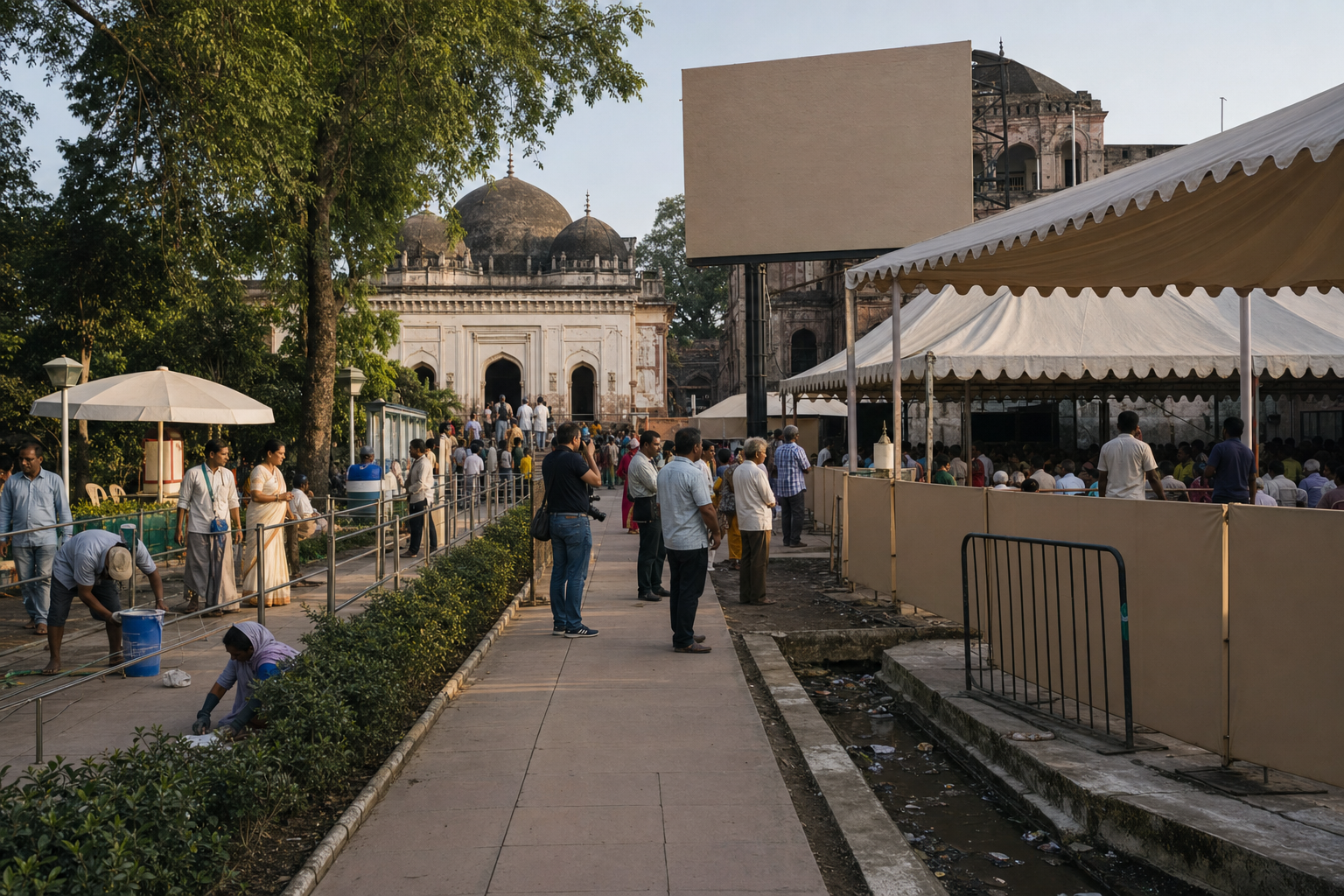
Sacred-geography policy becomes partisan property when access to public support depends on political proximity, project selection is unexplained, or contractors face no meaningful scrutiny. The safeguards are not mysterious. They can be stated before the first grant is approved and checked throughout the project.
| Risk to watch | Evidence of responsible stewardship |
|---|---|
| Party-first site selection | Published, non-discriminatory eligibility criteria based on heritage condition, access, safety, or service need |
| Opaque patronage | Public disclosure of grants, tenders, implementing bodies, and audited expenditure |
| Cosmetic or damaging renovation | Condition documentation and review by an independent conservation panel before work begins |
| Interference in ritual authority | A written boundary between public works, institutional management, property questions, and internal religious practice |
| Tourism overwhelming sanctity | Conservation, sanitation, crowd, and community-tourism standards designed around the living site |
| Token inter-Dharmic inclusion | Comparable public criteria and disclosed outcomes across Hindu, Buddhist, Jain, and Sikh heritage nodes |
Legal clarity is particularly important where property, rituals, endowment administration, and festival logistics intersect. Repairing a public approach road is not the same function as deciding a ritual. Managing an emergency route is not the same as managing a lineage. When responsibilities are written clearly, the state can perform its civic role without swallowing the authority of the sacred institution.
Transparent Religious Endowments oversight and better management capacity can improve confidence, but oversight must itself be accountable. Citizens should be able to see the rule used, the money allocated, the work procured, the milestone reached, and the authority responsible for correction. An independent technical panel can assess conservation quality; a citizen-reporting dashboard can expose broken facilities and unfinished work. Neither should be replaced by publicity material.
Use a public scorecard before deciding whether the model works
The number of temple visits is an activity count. It is not an outcome. To judge the programme fairly, establish a baseline for each selected site and publish results on a consistent reporting cycle. Without a baseline, an announcement can show that money was spent but not that conditions improved.
Key takeaways for citizens and institutional custodians
- Treat the oath-to-yatra sequence as an agenda signal. Look for named projects, responsible public bodies, disclosed funding, and measurable follow-up before calling it administrative success.
- Judge conservation by site-condition evidence, structural work, archival documentation, and craft continuity. Beautification is not a substitute for preservation.
- Measure the complete pilgrimage journey through transit time, accident rates, sanitation compliance, wayfinding, and continuous access for elderly people and persons with disabilities.
- Evaluate service partnerships through defined outcomes in areas such as relief, education, healthcare, or youth development, while insisting that the religious institution’s autonomy be recorded and protected.
- Track heritage livelihoods and artisan revenue alongside visitor numbers. Rising footfall is not a victory if sanctity deteriorates or local communities receive little benefit.
- Demand public selection criteria, tenders, grants, condition ratings, project milestones, and grievance reporting. Also track reported communal friction under a clear and consistent definition; a politics of shared inheritance should reduce it, not merely change its rhetoric.
When the next sacred-circuit announcement arrives, save the eligibility criteria, the condition report, the tender information, and the promised outcome. Then compare those records with the completed work. Support cultural restoration where the evidence warrants it, challenge party capture where the safeguards fail, and insist that Bengal’s sacred places remain living centres of dharma rather than scenery for a passing campaign.