
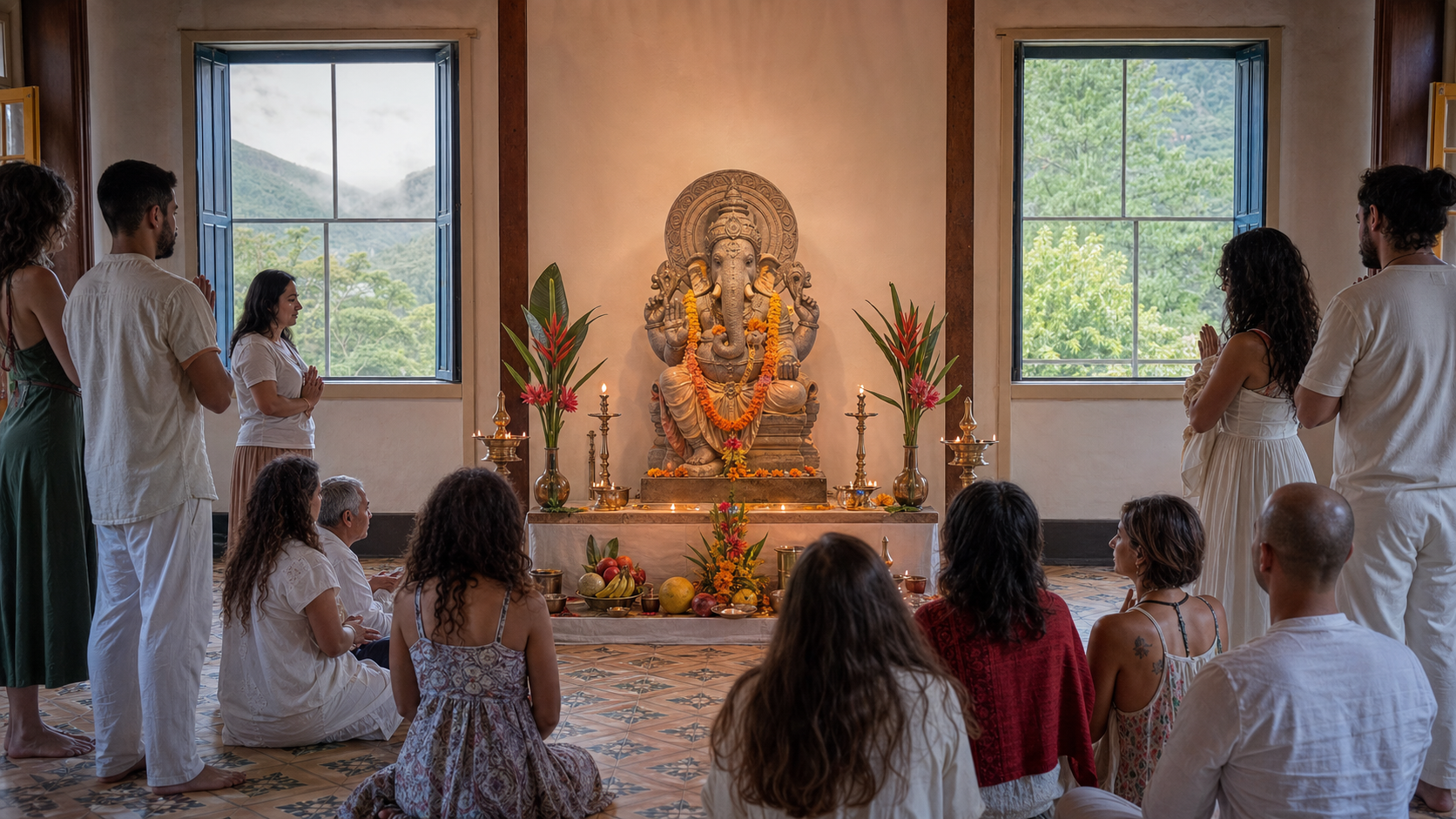
Does placing a Ganesha murti in a Brazilian cultural center make the room a Hindu sacred space? Not by itself. A murti may be an object of devotion, a teaching image, or sacred art. Pran pratishtha marks a more demanding transition: divine presence is ritually invoked, and the community accepts an enduring duty of worship and care.
That distinction matters if you plan to visit, support, or help establish a Hindu institution outside Bharat. The decisive questions are not whether the building resembles an Indian temple or whether most participants have Indian ancestry. Ask whether the murti follows an intelligible sacred tradition, whether the consecration was conducted with ritual authority, and whether daily life after the ceremony honors the presence that was invoked.
Key takeaways
- The Ganesha pran pratishtha held in Petrópolis on 9 May 2026 gave Brazil a visible, publicly accessible center of Hindu worship and Vedic learning.
- Claims that it was a regional first should be stated carefully: private shrines and other murtis may have preceded it, while the distinctive claim concerns a formal, public, textually grounded consecration.
- Pran pratishtha is the beginning of responsibility, not the ceremonial completion of a construction project. Nitya-puja, trained ritual care, teaching, and community accountability must follow.
- A Brazilian Hindu space can preserve Sanskrit liturgy and canonical iconography while explaining the practice in Portuguese and adapting its physical setting to local conditions.
- The most useful support is recurring support: help sustain worship, education, safeguarding, maintenance, and seva after the inaugural attention has passed.
What changed in Petrópolis on 9 May 2026
At Centro Cultural Vishva Vidya in Petrópolis, Brazilian teacher Jonas Masetti and a gathered community welcomed Indian Ambassador Dinesh Bhatia for the pran pratishtha of a Ganesha murti. The event was widely presented as the first formal consecration of its kind in Latin America. Its larger importance, however, does not depend on winning an absolute historical claim that would be difficult to prove across every home, ashram, and small shrine on the continent.
The defensible milestone is more precise. This was a public consecration, conducted through Vedic liturgy in a cultural and educational center committed to Hindu learning. It made worship visible, gave practitioners a common place to gather, and placed a continuing religious obligation upon an identifiable institution. A private devotional image can sustain profound sadhana, but a publicly consecrated murti also becomes the center of a community’s calendar, teaching, hospitality, and service.
Pran pratishtha literally concerns the establishment of life-breath. In ritual terms, it is the invocation of chaitanya, conscious divine presence, into a murti prepared to serve as the deity’s sacred form. Devotees therefore approach the consecrated murti as more than a visual reminder. Darshan, offerings, mantra, and service become forms of relationship with a presence that has been formally invited to abide there.
There is no single undifferentiated script used identically by every Hindu lineage. Smarta, Shaiva, Vaishnava, Ganapatya, and regional traditions may draw upon different Agamic and allied ritual manuals. A full sequence can nevertheless include the following recognizable stages:
- Sankalpa: the officiants state the ritual resolve, identifying the purpose of the rite and those undertaking it.
- Purification: practices such as achamana and prokshana prepare the participants, implements, and place.
- Raksha: the ritual field is protected and bounded so that the work proceeds within a sanctified order.
- Kalasha-sthapana: consecrated vessels become focal points for invoked sacred presence and ritual power.
- Homa: offerings are made through the consecrated fire with the appropriate mantras.
- Nyasa: mantras and divine powers are ritually placed in the form through prescribed acts of installation.
- Netronmilanam: the opening of the eyes marks a particularly intimate transition in the devotee’s encounter with the murti.
- Pran pratishtha and inaugural worship: the culminating invocations are followed by Pancha-upachara or Shodashopachara, worship through five or sixteen forms of reverential offering.
You do not need to master this vocabulary before attending. You should, however, recognize what the sequence tells you: consecration is deliberate, layered, and lineage-bearing. It is not a decorative unveiling with Sanskrit added for atmosphere. If you are helping organize such a rite, settle the ritual protocol, the qualifications of the officiants, the murti’s suitability, and the plan for subsequent worship before announcing a date.
Ambassador Bhatia’s presence carried a different kind of significance. It connected a Brazilian religious community with Bharat’s living civilization and gave the occasion public legitimacy. Diplomatic participation can open doors to universities, municipal authorities, and cultural institutions. It does not, and need not, supply the ritual authority of the consecration. Keeping those roles distinct protects both: priests and practitioners carry the sacred responsibility, while diplomats can help the resulting cultural bridge remain visible and constructive.
The real test begins after the consecration
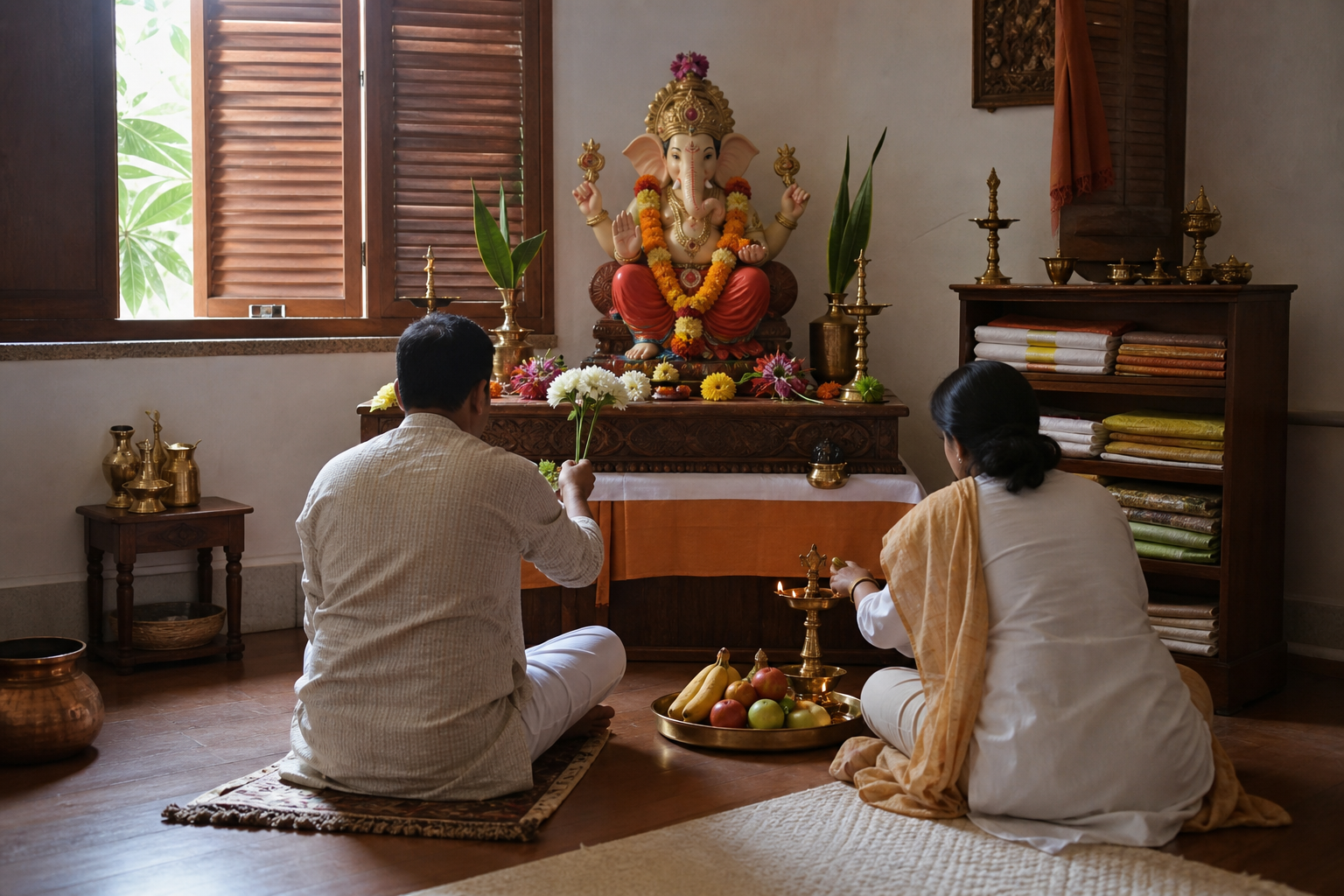
The inaugural fire may draw visitors, cameras, and dignitaries. The harder test arrives on an ordinary morning when there is no public audience. Is the shrine opened and cared for? Are the prescribed offerings made? Does someone with the necessary training know what to do when the regular priest or pujakari is unavailable? Can the institution meet the commitments it accepted?
Once worship has begun, nitya-puja gives the sacred space its daily rhythm. The exact practice depends upon lineage and institutional capacity, but regularity is the governing principle. Cleaning, bathing or abhishekam where prescribed, clothing and ornamentation, flowers, incense, lamp, food offering, mantra, arati, and the respectful distribution of prasada are not stage decoration. They are modes of attendance upon the deity.
If you are assessing the health of a new Hindu center, do not stop at photographs from the opening. Look for four forms of continuity:
- Ritual continuity: a defined schedule, responsible worshippers, access to qualified guidance, and clear procedures for the care of the murti and sanctum.
- Educational continuity: satsang, explanations of puja, study of philosophy, and age-appropriate teaching through stories, ethics, language, music, or chanting.
- Institutional continuity: maintenance, lawful use of the premises, financial accountability, safeguarding of children and vulnerable people, and succession beyond one charismatic teacher.
- Ethical continuity: seva that carries worship into community life through food support, environmental care, cultural literacy, or another locally relevant form of service.
This framework also tells donors where support is most useful. Funding a murti or inaugural ceremony is visible and emotionally satisfying. Recurring costs are less glamorous but more decisive: flowers and puja materials, training, translation, cleaning, utilities, repairs, children’s programs, and responsible administration. Before making a major contribution, ask who will sustain the shrine a year after the consecration and how the center will report on that work.
Festival observance should grow from the same daily foundation. Ganesh Chaturthi can bring a wider public into the space, but the festival should not become the center’s only active day. A well-rooted institution allows the large celebration to deepen an existing practice rather than temporarily substitute for one.
A Brazilian sacred space can be rooted without being a replica
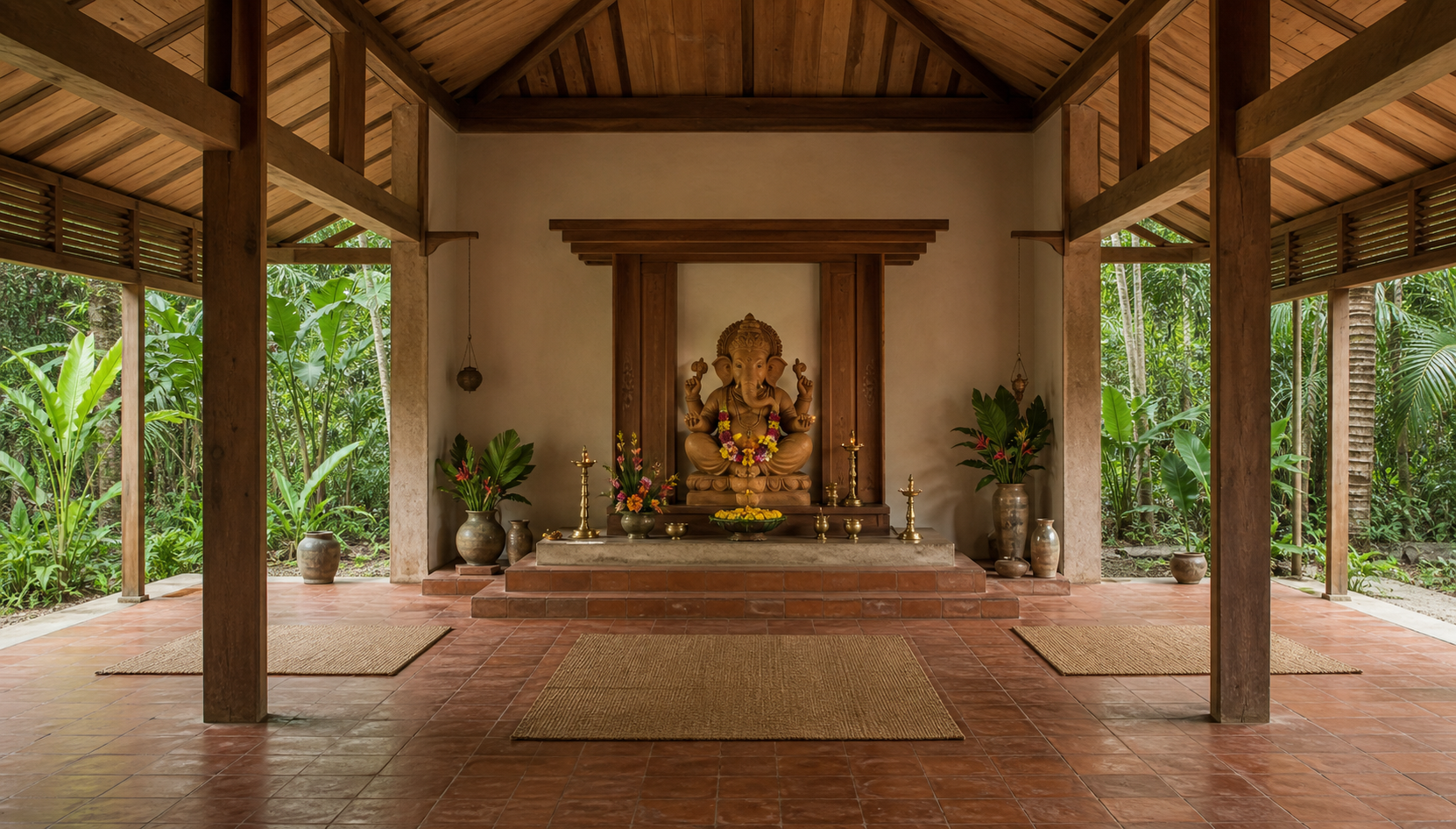
A common mistake is to measure authenticity by visual resemblance. A compact room in Petrópolis cannot and need not imitate every feature of a large temple complex in Bharat. Fidelity lies first in the relationships among murti, ritual, space, teacher, practitioner, and daily discipline.
Shilpa Shastra gives attention to the murti’s material, proportions, attributes, and iconographic marks. Panchaloha, stone, and wood each carry their own technical requirements. Systems of tala govern proportion, while lakshana makes the deity recognizable through the appropriate form and emblems. These are not merely aesthetic preferences. They help ensure that the chosen image is ritually suitable and theologically intelligible.
Vastu Shastra and established temple practice also shape orientation and spatial movement. Even a modest diaspora center must decide how the sanctum or garbhagriha is approached, where offerings are prepared, whether a balipeetha is appropriate, how congregants gather, and how sacred and ordinary functions are separated. Local building, fire, accessibility, occupancy, and public-safety requirements remain real obligations. They should be incorporated early with competent local advice, not treated as obstacles to be considered after the sacred layout has been fixed.
A useful way to make adaptations without losing the tradition is to separate three kinds of decision:
- Preserve under qualified guidance: the murti’s canonical form, the lineage-specific requirements of consecration, the mantras that carry the rite, and the standard of care owed after invocation.
- Explain in the language people understand: the sankalpa, the meaning of the offerings, the expected conduct in the shrine, and the theology behind darshan, prasada, and seva.
- Adapt the cultural and civic container: the building configuration, public schedule, educational format, locally available flowers and materials where acceptable, and partnerships with Brazilian institutions.
The combination of Vedic mantras, Portuguese explanation, and Brazilian participation offers a practical model. Sanskrit can preserve liturgical precision while Portuguese makes intention and meaning accessible. Spanish may widen regional exchange, but in Brazil the first duty is to speak clearly to the local community in its own language.
Brazilian leadership is not a dilution of Hindu tradition merely because it is Brazilian. Jonas Masetti’s role illustrates how Advaita Vedanta, bhakti, Sanskrit learning, and ritual culture can be taught through local language and experience. The relevant tests are training, fidelity, humility before the tradition, and accountability to the community. Passport or ancestry alone cannot supply those qualities, just as local enthusiasm alone cannot replace disciplined learning.
This also clarifies the difference between invitation and proselytization. A Hindu center can welcome people without demanding that they erase their ancestry, stage a conversion, or accept every philosophical proposition before entering. Open puja, satsang, and seva allow a sincere visitor to learn through participation. At the same time, hospitality should not blur the identity of the space. Ganesha is not a generic emblem of wellness, and pran pratishtha is not a multicultural performance. Clear Hindu self-description makes genuine pluralism possible because guests know what they are being invited to encounter.
Read Ganesha’s form as a guide to practice
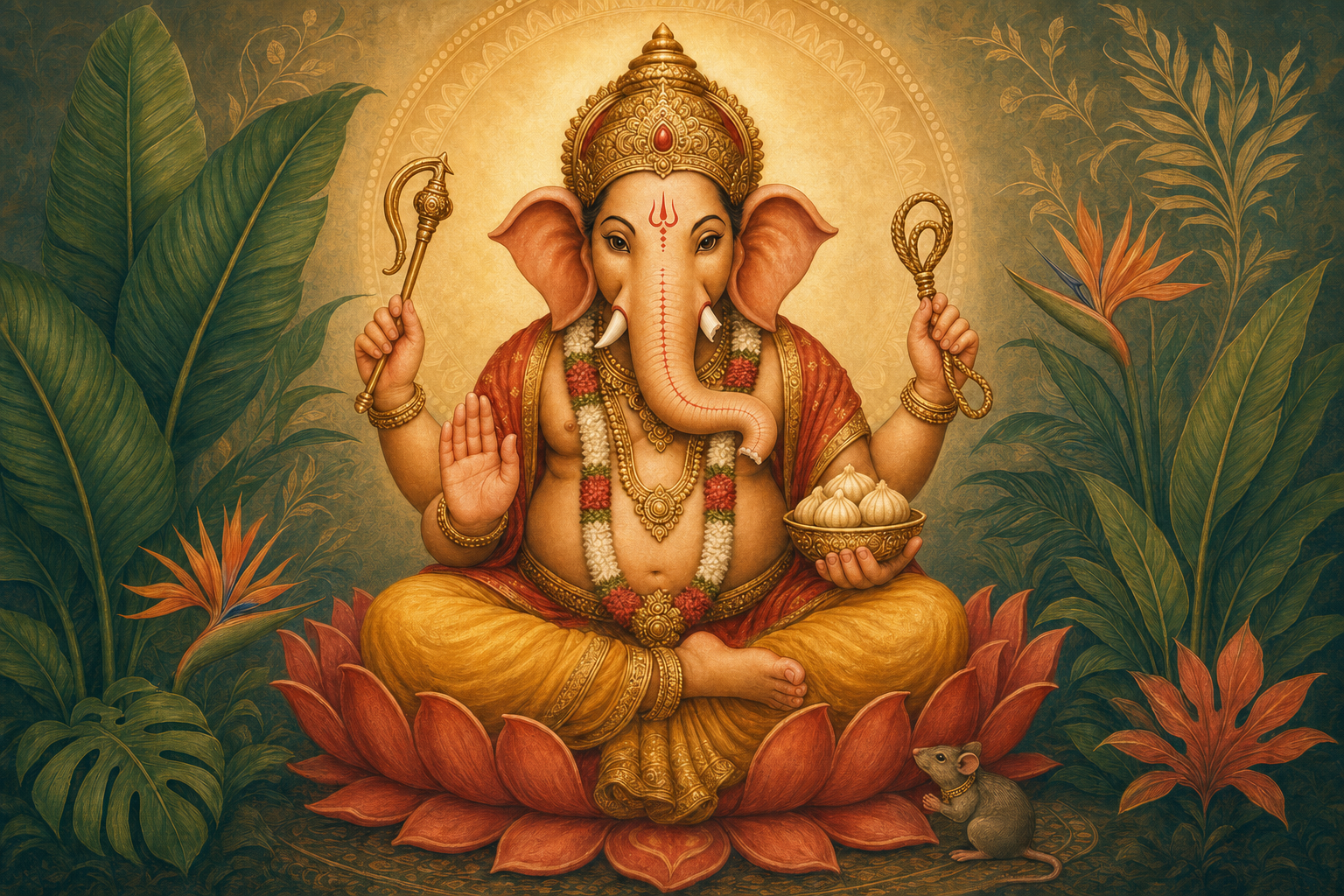
Ganesha is especially fitting at the beginning of a new sacred geography. Hindus invoke him when undertaking study, worship, travel, construction, and other consequential beginnings. Yet his presence should do more than confer an auspicious atmosphere. His iconography gives a new community a concise discipline for how to begin well.
| Feature | Sacred meaning | Practice it can prompt |
|---|---|---|
| Broken tusk | Sacrifice undertaken for wisdom | Give up one convenience that is preventing serious study, worship, or service. |
| Modaka | The sweetness of realized knowledge | Do not confuse collecting information with transforming conduct; carry one teaching into daily life. |
| Mouse vahana | The restless mind and desire brought under discipline | Choose a small, repeatable sadhana and keep it even when enthusiasm fades. |
| Right-turned trunk, when present | A more exacting mode of ritual and spiritual discipline | Do not select or worship an iconographic form merely for novelty; understand its requirements through qualified guidance. |
These meanings should not be treated as an exhaustive code in which every visual detail has one uncontested interpretation. Puranic narratives, Ganapatya practice, regional art, and teaching lineages can emphasize different associations. Use the symbolism to enter practice, then learn how the community’s lineage understands the murti before making confident claims on its behalf.
The mouse offers an especially useful lesson for a young institution. A community may have abundant energy on the day of consecration and little patience for quiet repetition afterward. The same mind that wants a major inauguration can resist maintaining a schedule, cleaning the shrine, teaching children, or resolving administrative disagreements. Discipline does not suppress that energy; it gives the energy a worthy direction.
Ganesha can also provide a hospitable point of entry for the wider dharmic family. Hinduism, Buddhism, Jainism, and Sikhism remain distinct traditions with real philosophical and ritual differences. They need not be collapsed into a vague universal spirituality. Ahimsa, dana or seva, introspection, disciplined learning, and respect for more than one path nevertheless offer practical ground for cooperation. A food program, environmental initiative, lecture series, or cultural workshop can express that kinship without pretending that every doctrine is identical.
Turn attendance into stewardship
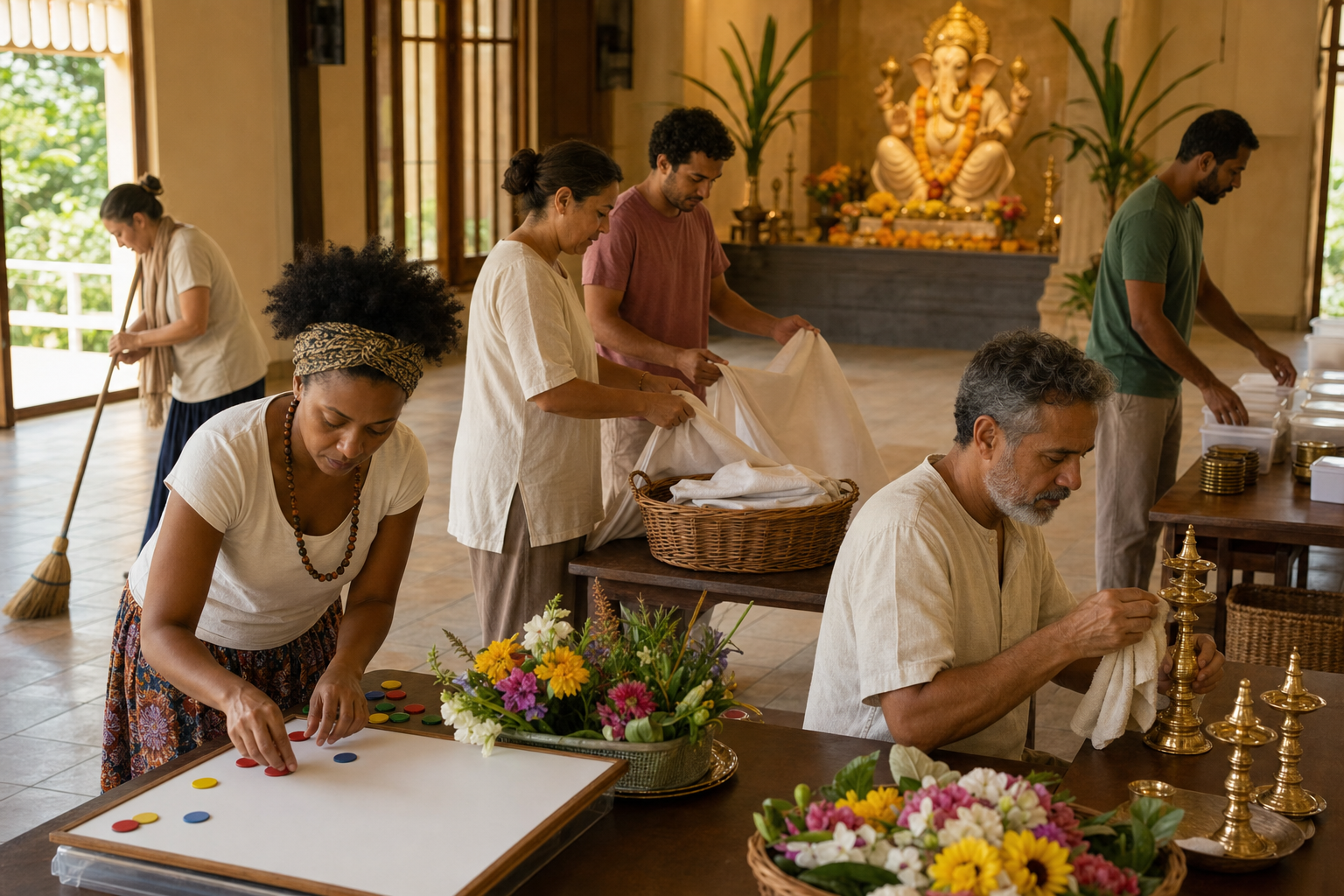
The future of Hindu sacred space in Brazil will be decided by what visitors, practitioners, organizers, and public partners do after the novelty of the occasion has passed. Choose the role that actually belongs to you.
If you are visiting or beginning to participate
- Attend a regular puja or satsang, not only a large cultural event. Ordinary practice will show you the center’s real rhythm.
- Ask about local protocol before making an offering, approaching the sanctum, touching ritual objects, or taking photographs. Customs differ, and respectful inquiry is better than guessing.
- Listen to the Portuguese explanation, then learn a small part of the Sanskrit practice accurately: a name, mantra, response, or offering sequence taught by the center.
- Take on one repeatable form of help. Cleaning, arranging flowers, assisting a class, preparing prasada, or supporting a seva activity can matter more than occasional enthusiasm.
- Let darshan lead to discipline. Choose one lesson represented in Ganesha’s form and practice it consistently until your next visit.
If you are helping lead or fund the institution
- Write down the ritual lineage, sources of priestly guidance, daily and festival schedule, and backup responsibilities. Sacred continuity should not depend on one person’s memory.
- Budget for the life of the shrine, not merely its opening. Include worship materials, training, maintenance, translation, education, insurance or compliance costs where applicable, and safeguarding systems.
- Build Portuguese communication into the religious work. Explain the sankalpa, symbolism, and conduct without turning the mantra itself into an improvised translation exercise.
- Train priests, teachers, and volunteers in cross-cultural communication as well as liturgy. They should be able to respond to sincere newcomers without flattening Hindu concepts into generic spirituality.
- Establish child- and vulnerable-person safeguards before expanding family programming. Clear conduct rules, accountable supervision, and lawful local procedures protect both participants and the institution.
- Connect each major festival to a durable form of teaching or seva. A celebration should leave the community more capable than it was before.
If you represent a university, municipality, or cultural body
Treat the center as a living religious institution, not only as an exotic cultural exhibit. Useful partnerships could support language learning, comparative philosophy, migration and religious-life research, public cultural literacy, or community service. The presence of an Indian envoy can begin such relationships, but sustained cooperation needs named contacts, defined projects, and respect for the center’s Hindu identity.
The next meaningful milestone in Petrópolis will not be another ceremonial photograph. It will be an ordinary day on which the lamp is lit, the murti is served, a student understands a mantra in Portuguese, and seva carries that worship beyond the shrine. If you want this sacred space to endure, choose one recurring responsibility and begin there.