
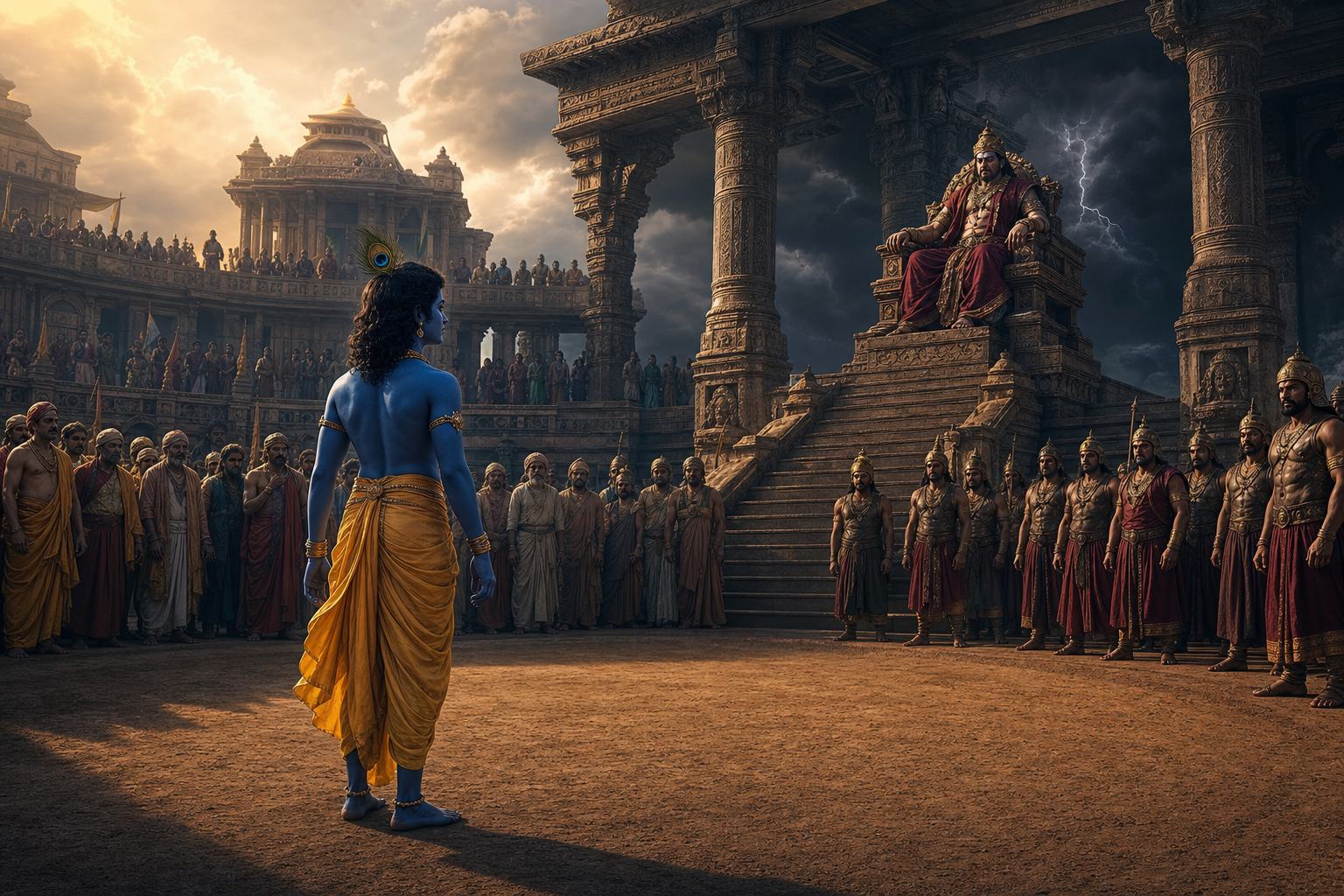
A warning tells you that someone close may one day become a threat. Do you treat the warning as information to examine, or as permission to harm that person now? Kamsa chooses the second path. That choice, more than the prophecy by itself, explains why his fate remains one of the clearest Dharmic lessons in moral causation.
If you have wondered whether Kamsa was destroyed by destiny, karma, divine will, or his own decisions, the most useful answer is not a single one of those. The prophecy establishes the danger. Fear interprets it. Repeated choices turn that interpretation into tyranny. Krishna ends the resulting disorder. Keeping those layers distinct helps you think more carefully about karma – and about your own decisions when fear demands certainty.
The prophecy did not make Kamsa a tyrant
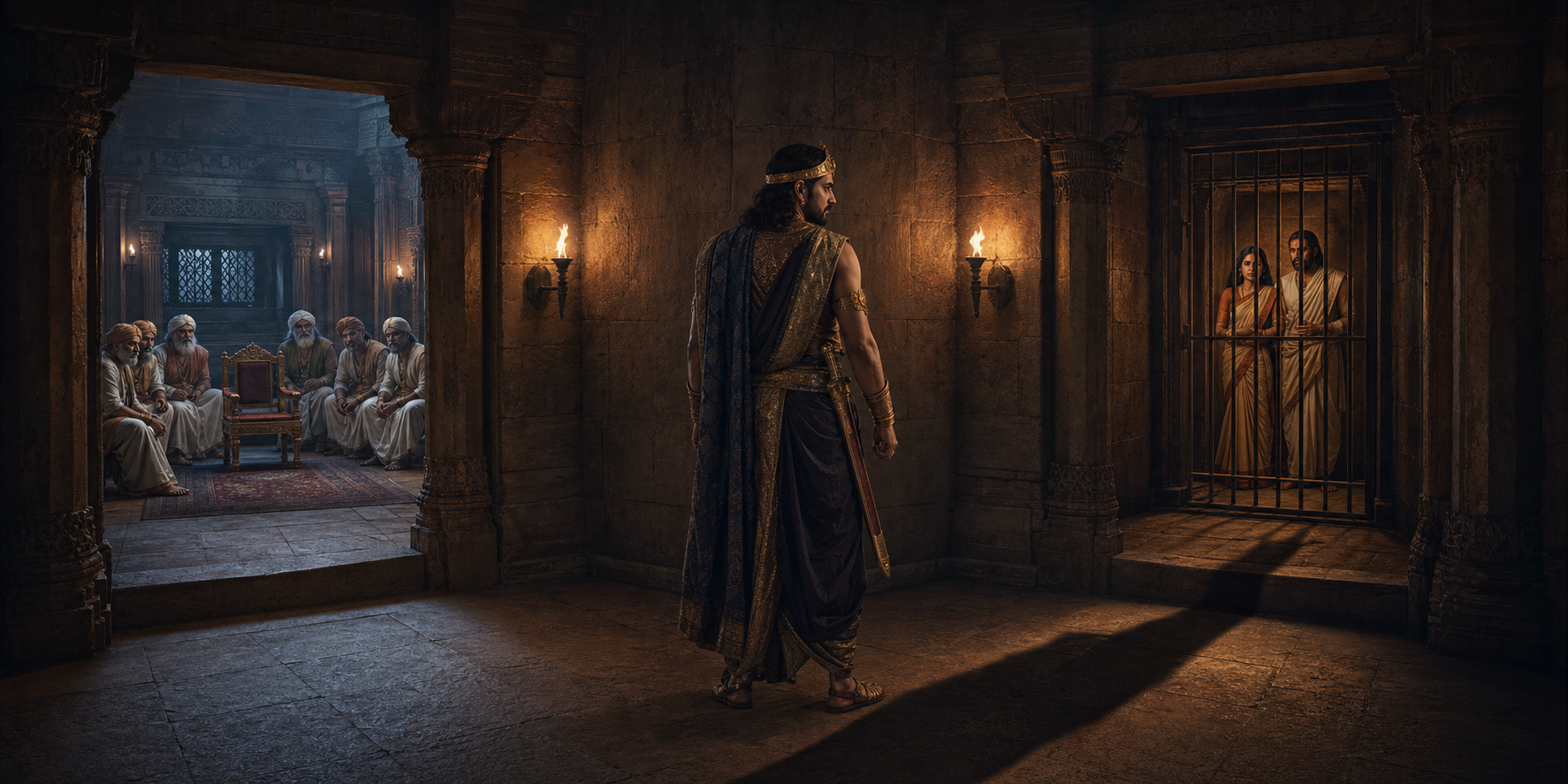
During Devaki’s wedding to Vasudeva, a divine voice announces that her eighth child will cause Kamsa’s death. Kamsa immediately seizes Devaki and prepares to kill her. Vasudeva intervenes with an appeal to reason and dharma, promising to surrender the children. Kamsa relents at that moment.
That pause matters. It establishes that Kamsa can hear counsel, delay action, and choose something other than immediate murder. Fear is present, but it has not yet become an unbreakable command. His responsibility begins precisely where alternatives remain available.
Kamsa then imprisons Devaki and Vasudeva and kills their first six infants. Balarama, the seventh child, is preserved through the transfer of the embryo to Rohini. Krishna, the eighth, is born in prison and carried across the Yamuna to Gokul, where Vasudeva exchanges him with the newborn daughter of Nanda and Yashoda. When Kamsa tries to kill that child, she appears as a goddess and announces that his future slayer already lives elsewhere.
Nothing in the warning instructs Kamsa to murder infants, imprison his sister, persecute the Yadavas, or send lethal agents into pastoral communities. Those are his additions. He converts knowledge of a possible future into a policy of pre-emptive violence. Each failed attempt then becomes, in his mind, proof that he needs still more violence.
This is the first practical distinction: a condition is not a command. A forecast, suspicion, prophecy, intelligence report, or anxious thought may describe a danger without deciding your response. Whenever someone claims that circumstances left no choice, look for the omitted decision between the warning and the action. Kamsa’s moral decline occupies that omitted space.
His conduct does not magically cause Krishna to be born, nor does the tale reduce divine purpose to psychology. Within the Bhagavata Purana’s theological horizon, Krishna’s arrival is divine intervention against adharma. Yet divine foreknowledge does not compel Kamsa’s cruelty. The prophecy may disclose how his life will end; it does not dictate who he must become on the way there.
Whether righteous conduct would have cancelled the prophecy remains unanswered. We should not pretend otherwise. The ethical point does not depend on that counterfactual. Even if death cannot be avoided, adharma is not therefore necessary. Kamsa cannot control mortality, but he remains responsible for the people he chooses to injure while trying to escape it.
Karma is moral causation, not cosmic retaliation

Divine purpose and karmic law answer different questions
Hindu and Jain readings illuminate different dimensions of Kamsa’s fall, but they should not be flattened into identical theology. Hindu Purāṇic thought gives Krishna’s birth the meaning of avatāra: divine descent restores dharma when a ruler turns protective power into predation. Kamsa’s death therefore belongs to a larger reordering of Mathura, not merely to a private quarrel between two relatives.
The Bhagavad Gita places fearlessness, abhayam, at the beginning of the divine qualities in 16.1. In 4.10, liberation is associated with freedom from attachment, fear, and anger. Kamsa displays the reverse sequence. Attachment to survival feeds fear; fear hardens into anger; anger recruits intelligence to serve violence. His cleverness does not disappear. It becomes subordinate to panic.
Within Jain karma theory, moral causation receives a more technical interpretation. A jīva agitated by anger, pride, deceit, and greed attracts subtle karmic matter whose effects later mature. Kamsa’s terror is therefore not merely an unpleasant feeling. When he repeatedly consents to suspicion and violence, he strengthens the passions and habits that bind him more deeply.
This account preserves agency without pretending that anyone acts in isolation. Prior causes condition the situation. Other people create opportunities, obstacles, and provocations. Yet each soul remains responsible for the intention and conduct it adds to that situation. Kamsa receives a frightening condition; he contributes imprisonment, murder, persecution, and escalating hostility.
Jain classifications sharpen the point further. Krishna occupies the heroic role of Vasudeva, Balarama that of Baladeva, and Jarasandha that of Prativasudeva. Balarama represents the greater ideal of restraint and non-violence. Krishna confronts violent disorder with the severity expected of a Vasudeva, but the use of force still carries karmic consequences. A righteous objective does not make the moral cost of every means disappear.
What moral causation does not allow you to claim
Karma should not be reduced to the slogan that bad things happen to bad people. That simplification turns a discipline of self-examination into a weapon for judging someone else’s suffering. You usually do not know the full causal history of another person’s pain, and visible fortune is not a reliable certificate of virtue.
Moral causation is better used prospectively: what quality of mind am I strengthening through this choice? What habit will be easier the next time? Who will bear the cost if my fear is wrong? What kind of family, institution, or polity will repeated versions of this act create?
Kamsa’s consequences unfold at several levels. His fear narrows perception. His decisions form a habit of pre-emption. That habit reorganizes political power around personal survival. Persecution creates resistance and destroys legitimacy. The final confrontation is therefore not an isolated punishment dropped upon him from outside. It is the fruition of a moral and political order he has spent years constructing.
Causal understanding also differs from excuse-making. Fear helps explain why Kamsa acts, but it does not make infant-killing permissible. Anekāntavāda, the Jain discipline of many-sided understanding, asks you to see more than one aspect of a person and situation. It does not require you to deny a victim’s injury or suspend a necessary boundary. You can understand the frightened attachment beneath aggression while still stopping the aggression.
A wider Dharmic vocabulary supplies related checks. Buddhist analysis locates reactive fear in clinging. Jain ahimsa refuses to transfer the cost of your passions onto another being. Sikh teaching joins Nirbhau, fearlessness, to Nirvair, non-enmity. These traditions do not share one metaphysical system, but they converge on a practical constraint: unmastered fear must not be given moral authority over other lives.
Krishna’s victory joins protection to restoration
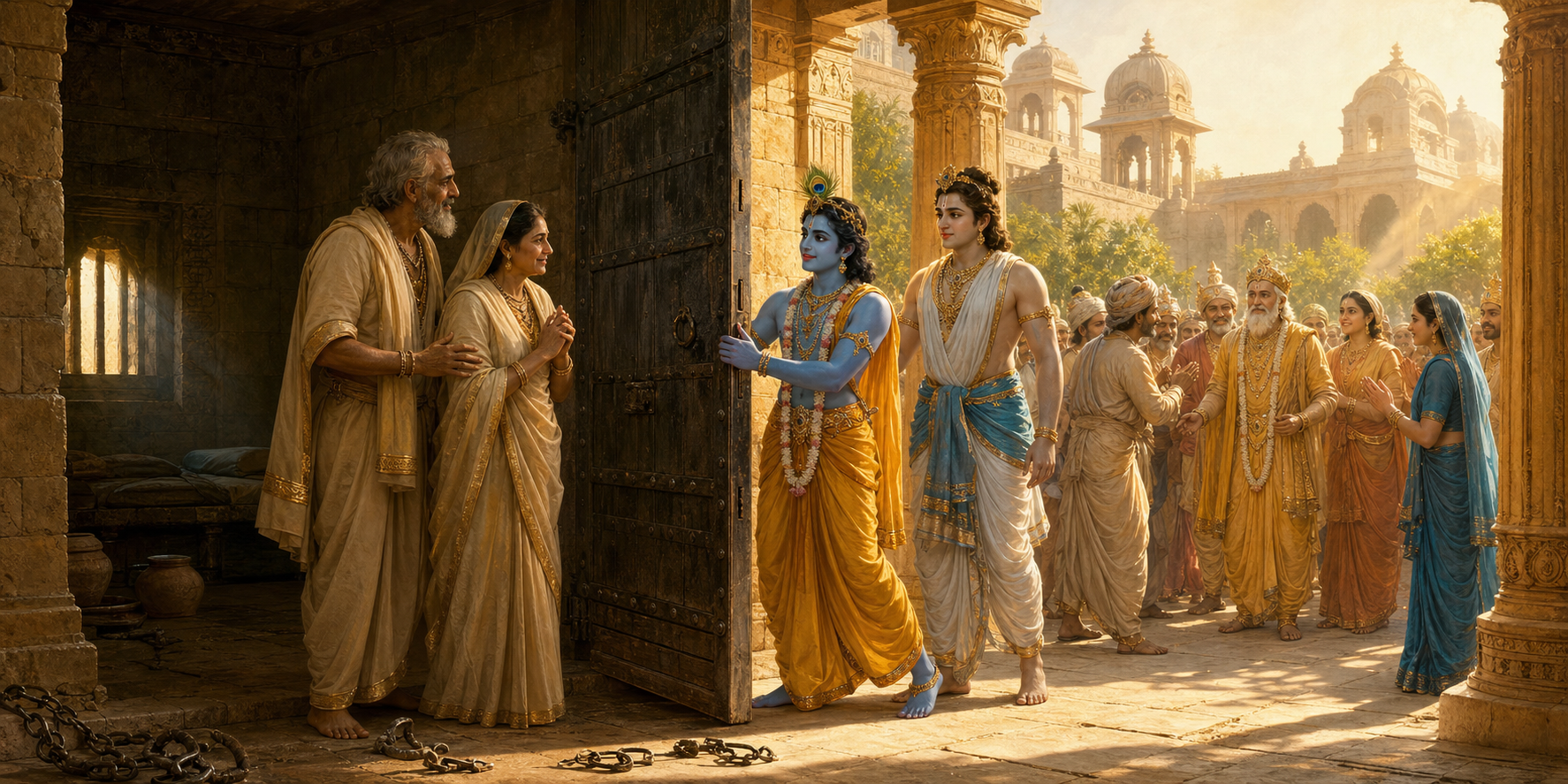
It is easy to read Krishna’s defeat of Kamsa as a simple reversal: the threatened child grows strong and destroys the persecutor. That is only part of the moral architecture. Krishna and Balarama face the dangers Kamsa has deliberately placed around the wrestling arena, overcome his coercive agents, and end his rule. Krishna then restores Ugrasena to the throne.
The restoration is as important as the victory. Krishna does not replace one fear-centred absolutism with another. The protective order damaged by Kamsa is repaired, and authority is returned to its rightful custodian. Success is measured by whether ordinary order can resume, not by whether the victor can prolong the emergency.
This gives you three criteria for distinguishing protective force from revenge:
- Its object is protection. The action stops ongoing harm to vulnerable people; it is not a vehicle for discharging humiliation or rage.
- Its scope is bounded. Responsibility is attached to actual conduct rather than spread across relatives, communities, or imagined future enemies.
- Its end is restorative. The desired outcome is lawful order, safety, and the return of ordinary life – not permanent emergency power or endless punishment.
These criteria do not demand passivity. Kamsa’s victims cannot be protected merely by offering him sympathy. Firm resistance becomes necessary because his power is actively predatory. The distinction lies in aim, limit, and aftermath. Dharmic action may stop an aggressor decisively while refusing to imitate the aggressor’s indiscriminate hostility.
The Jain portrayal makes this restraint especially sober. Krishna’s strategic courage is honoured, but his status as a Vasudeva does not exempt violent action from karmic residue. This blocks the comforting claim that a noble side automatically possesses pure means. Necessity may alter what can responsibly be done; it does not turn violence into something morally weightless.
When you judge a hard response, do not ask only whether the target deserves defeat. Ask what the response is designed to protect, whether a less harmful effective measure remains available, and what order will exist after success. If no one can describe the restored peace, retaliation may have displaced protection as the real objective.
Key takeaways
- A threat can be real without making every pre-emptive response righteous.
- Kamsa remains responsible because the prophecy does not command imprisonment, persecution, or murder.
- Karma is not a licence to blame people for suffering; it is a reason to examine the intentions, habits, and structures your own actions are creating.
- Understanding the fear behind wrongdoing can improve judgment without excusing the wrong.
- Krishna’s defeat of Kamsa is restorative: protection is completed by the return of legitimate order.
- A Dharmic response is judged by its aim, its means, its limits, and the condition it leaves behind.
Use the Kamsa test before fear becomes policy
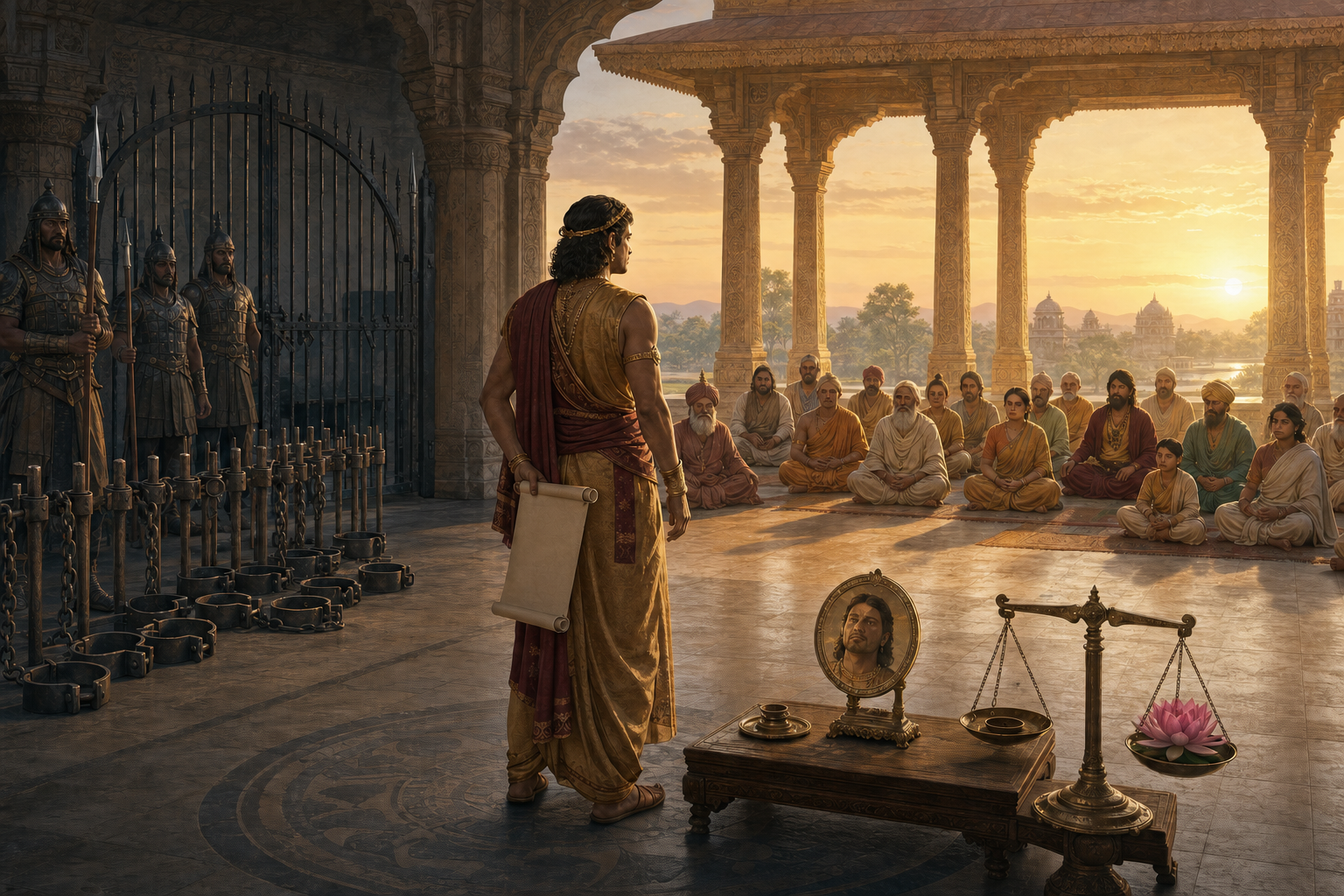
You need not be a king for this pattern to matter. A parent can punish a child for a feared future rather than a present act. A community can treat disagreement as betrayal. An institution can silence honest counsel because leaders confuse uncomfortable information with disloyalty. A state can impose collective suspicion on people who have committed no wrong.
These situations are not morally equivalent to Kamsa’s crimes. The comparison concerns the causal pattern: fear presents a prediction, the prediction is treated as certainty, innocent people are made to bear the cost, and every objection is reclassified as further evidence of danger.
Before making a consequential decision under fear, work through five questions in order:
- What is known, and what is merely predicted? Write the observable fact without assigning a hidden motive. Kamsa knows what the prophecy says; he does not possess evidence that Devaki or her newborn children are presently attacking him.
- Which attachment is interpreting the danger? Name the loss you cannot bear to imagine: status, control, reputation, security, or life itself. The goal is not to suppress fear but to prevent attachment from disguising itself as objective necessity.
- Who pays if the prediction is wrong? Identify the innocent people exposed by your proposed precaution. If all the protection belongs to the powerful decision-maker while all the risk is transferred to weaker people, the measure deserves immediate suspicion.
- What is the least harmful effective response? Separate immediate protection from punishment. Seek dissenting counsel, preserve due process, and favour a reversible boundary when it can contain the danger. If stronger action is genuinely necessary, connect it to specific conduct and a defined limit.
- What will end the response? State the condition that restores ordinary relationships, authority, or law. A measure with no review point and no route back to normal life can turn temporary fear into a permanent institution.
This test also exposes false fearlessness. Abhaya is not recklessness, denial, or the refusal to prepare. It is the capacity to see danger without making danger the sovereign of your conscience. Sometimes the fearless decision is a firm boundary. Sometimes it is waiting for evidence. Sometimes it is accepting that no amount of control can abolish uncertainty.
The next time a warning narrows your field of vision, pause before the first irreversible act. Put three things in writing: the fact you know, the duty you must protect, and the innocent cost your response could create. You may still need to act decisively. But you will be acting from dharma rather than asking fear to define it for you.
References
- DharmaRenaissance Blog – Kamsa Syndrome: How Fear Breeds Tyranny and How Dharmic Wisdom Defuses It
- DharmaRenaissance Blog – Krishna’s Birth Reimagined: Jain Mahabharata on Karma, Kamsa, Jarasandha, and Destiny