
Canada’s Combatting Hate Act brings together two questions that matter deeply to Dharmic communities: whether the law can confront targeted hatred without misrepresenting sacred traditions, and whether people can enter their places of worship without intimidation. CoHNA reports that Bill C-9 is scheduled to take effect across Canada on July 18, after receiving Royal Assent a month earlier.
The legislation contains a meaningful correction concerning the sacred Swastika, along with broader changes to hate-crime law and access protections. Its practical value, however, will be determined by police decisions, prosecutions, judicial interpretation, and sustained public scrutiny.
Key takeaways
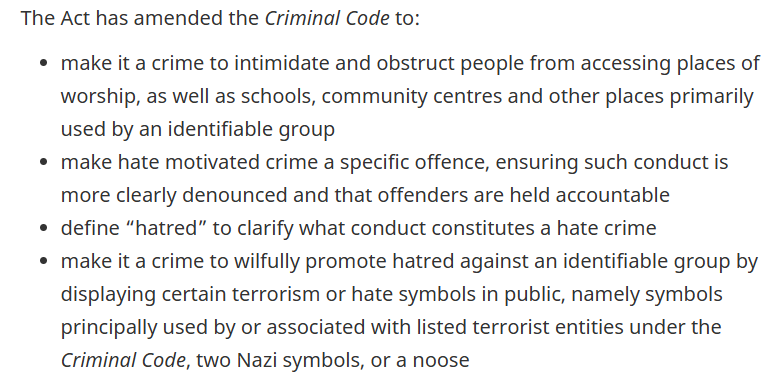
- Bill C-9 amends Canada’s Criminal Code to strengthen hate-crime provisions and protect access to places used by identifiable communities.
- The legislation distinguishes the Nazi Hakenkreuz from the sacred Swastika instead of treating the two symbols as interchangeable.
- Intimidating or deliberately obstructing people seeking entry to a protected site can carry standalone criminal consequences.
- The Act changes the treatment of certain religious-expression defences while preserving expression that does not wilfully promote hatred.
- Enforcement choices and future court rulings will decide how much protection communities experience in practice.
Why the Swastika correction is more than semantics
The bill’s original language risked repeating a long-standing category error by associating the sacred Swastika with the emblem used by Nazi Germany. According to CoHNA, Hindu, Jain, Buddhist, Indigenous, and other communities have faced harm from that conflation.
CoHNA says it worked with Hindu organizations, legal experts, volunteers, lawmakers, and Jewish, Buddhist, Jain, and Indigenous partners to press for accurate terminology. The campaign reportedly generated nearly 9,000 emails to members of Parliament and senators. On December 9, 2025, the House of Commons Justice Committee adopted an amendment advanced by MP Anthony Housefather, replacing the bill’s reference to the Swastika with the historically specific term Nazi Hakenkreuz.
For Hindus, Buddhists, and Jains, the distinction protects a sacred civilizational symbol from an imposed meaning. The wider Dharmic principle also matters to Sikhs: public institutions should understand each tradition on its own terms while protecting mandirs, viharas, Jain centres, and gurdwaras under equal standards. Unity does not require erasing differences; it requires defending every community against distortion and intimidation.
How the site-access provisions could protect worshippers
CoHNA describes the Act as protecting access to places used by identifiable communities, including sites such as Hindu temples and Jewish schools. The important legal shift is that intimidation and deliberate obstruction connected to entry can be addressed as distinct offences, rather than only through general provisions that may not capture the targeted character of an incident.
This could be consequential for Hindu Canadians who report facing intimidation or violence around temples and community spaces. Yet the boundary between lawful protest and prohibited conduct will remain important. The source notes that an exception for communicating information applies to the obstruction offence, but not to the separate offence of intimidating someone to prevent access.
That distinction protects room for peaceful expression while recognizing that expression, obstruction, and intimidation are not identical. Local police, Crown prosecutors, and eventually the courts will determine how the provisions operate in disputed situations.
Religious expression and the legal threshold for hatred
The Act also repeals the specific good-faith religious-opinion defence for certain hate-propaganda offences. At the same time, CoHNA’s account says the law clarifies that religious expression remains protected when it does not wilfully promote hatred.
The legislation reportedly defines hatred as an intense and extreme emotion associated with vilification and detestation. Conduct that solely humiliates, discredits, hurts, or offends is excluded from that definition. This is an effort to distinguish severe hate from speech that may be objectionable but does not cross the criminal threshold.
The distinction offers guidance, not automatic answers. Major prosecutions may still produce Charter disputes over where protected expression ends and criminal hatred begins. Religious communities therefore have a shared interest in both robust protection from targeted hate and careful safeguards for legitimate theological, political, and cultural speech.
The next test is consistent enforcement
Canada already had hate-propaganda provisions, including Criminal Code sections 318 and 319, before Bill C-9. The source’s central caution is that adding or clarifying offences cannot by itself guarantee institutional willingness to use them. Legal language becomes meaningful only when complaints are assessed consistently, evidence is handled seriously, and comparable conduct receives comparable treatment.
Dharmic organizations can help by documenting publicly reported incidents, educating officials about sacred symbols, and maintaining cooperation among temples, legal specialists, volunteers, and interfaith partners. A constructive Hindutva approach in this setting is civic and disciplined: defend Hindu dignity through accurate language, lawful advocacy, coalition-building, and equal protection for neighboring Dharmic traditions.
The amendment demonstrates that organized communities can improve legislation without weakening the fight against hate. The work ahead is to watch how Bill C-9 is applied and insist that its promise of precision extends from Parliament to every protected community space.
Inspired by this post on CoHNA.
