
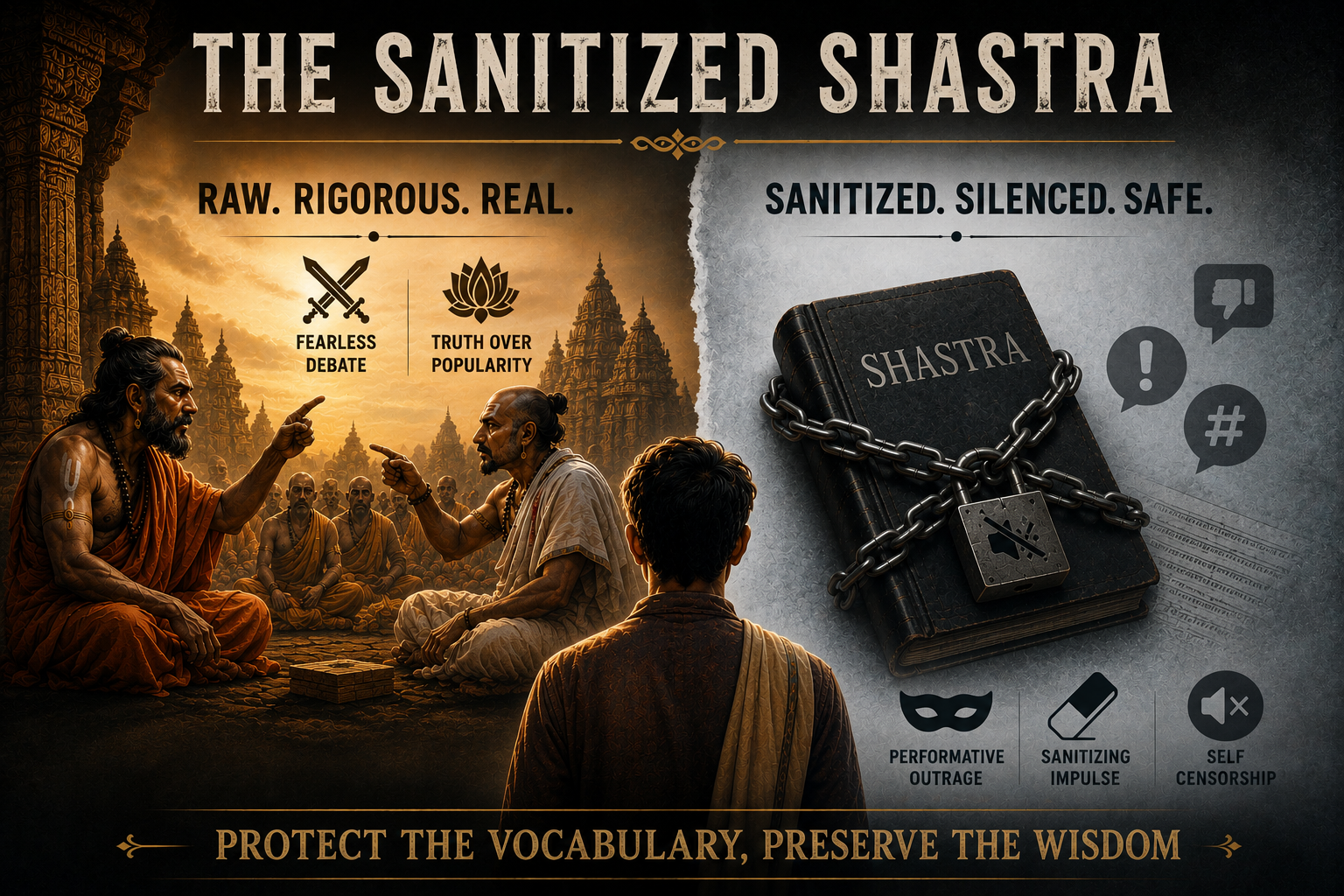
A controversy surrounding a traditional Harikatha performance in Udupi raises a difficult question: can a civilisation preserve vigorous philosophical disagreement without allowing it to become personal hostility?
The answer matters beyond one Vedantic dispute. Reviving Indian Knowledge Systems requires both fidelity to inherited traditions and the judgment to present their polemical language responsibly in modern public settings.
What the Udupi episode brought into view
According to Pragyata, two girls trained in Harikatha performed at a cultural program hosted by a Madhva matha. Their presentation drew upon their sampradaya’s traditional account of Sri Madhvacharya and its critique of Sri Shankaracharya’s Advaita. The performance reportedly used the category of asura-bhava while discussing the Advaita understanding of nirguna.
Pragyata reports that objections followed on social media, after which the matha issued a clarification and the performers apologized. The source interprets this response as evidence of a broader impulse to remove difficult language from traditional discourse. That interpretation is an argument, not an independently established account of every participant’s intentions, but it identifies a real editorial problem: words shaped within a technical theological setting can sound entirely different after being detached from it.
Polemics once marked doctrinal boundaries
Indian darshanas developed through sustained argument over reality, knowledge, liberation, the soul and the nature of the Supreme. Their disagreements were not cosmetic. If a school believed that a rival doctrine could misdirect a seeker, its language naturally reflected the seriousness of that judgment.
Pragyata argues that terms such as daiva and asura often functioned as markers of spiritual orientation rather than descriptions of physical monsters. It also recalls the traditional example of Sri Vijayindra Tirtha and Sri Appayya Dikshita: scholars associated with opposing Vedantic positions who are remembered as forceful disputants while maintaining personal respect. Whether every historical exchange met that ideal is a separate question. The important principle is that intellectual conflict need not become social rupture.
Why inherited language is easily misread
Modern audiences often hear a theological judgment as a statement about the dignity or civic status of present-day believers. Social media intensifies that confusion by stripping away performance setting, textual lineage and technical meaning. A phrase intended to defend a metaphysical boundary can then circulate as an isolated insult.
The saguna-nirguna disagreement illustrates the stakes. In the Dvaita view described by the source, denying auspicious attributes to the Supreme is not a minor semantic difference. Advaita approaches the issue through a different metaphysical framework. Erasing the disagreement would misrepresent both schools; presenting it without explanation would leave many readers unable to distinguish doctrinal criticism from hostility toward persons.
Key takeaways
- Dharmic pluralism protects serious disagreement; it does not require theological uniformity.
- Traditional polemical terms need textual, philosophical and performative context.
- Respect for living people can coexist with uncompromising criticism of doctrines.
- Institutional apologies made under digital pressure can obscure the deeper question of meaning.
Civilisational unity is larger than doctrinal agreement
A confident Hindutva need not compress every Hindu sampradaya into one theology. Its civilisational purpose is better served by protecting the common space in which distinct traditions can study, worship, reason and disagree without questioning one another’s belonging.
The same principle illuminates the wider Dharmic family. Hindu, Buddhist, Jain and Sikh traditions differ on foundational questions, yet all preserve disciplined paths of ethical formation, contemplation, learning and liberation. Their unity lies neither in interchangeable doctrines nor in polite vagueness, but in a shared civilisational ability to sustain multiple approaches to truth. Anekantavada, Buddhist traditions of inquiry, Sikh engagement with wisdom and the Hindu darshanas each demonstrate that conviction and dialogue need not be enemies.
How traditional institutions can preserve rigor responsibly
The choice is not between censorship and careless provocation. Mathas, teachers, performers and publishers can keep demanding traditions alive through a few disciplined practices:
- Identify which text, commentator or sampradaya supplies a contested expression.
- Explain whether the term is metaphysical, rhetorical, devotional or directed at conduct.
- Distinguish criticism of an acharya’s doctrine from humiliation of living adherents.
- Invite informed rebuttal from the tradition being criticized.
- Teach audiences how classical debate differs from social-media denunciation.
India’s intellectual inheritance will remain alive only if its disagreements can still be understood, answered and transmitted. The task ahead is to recover the maturity that permits sharp debate within an enduring Dharmic fellowship.
Inspired by this post on Pragyata.
