
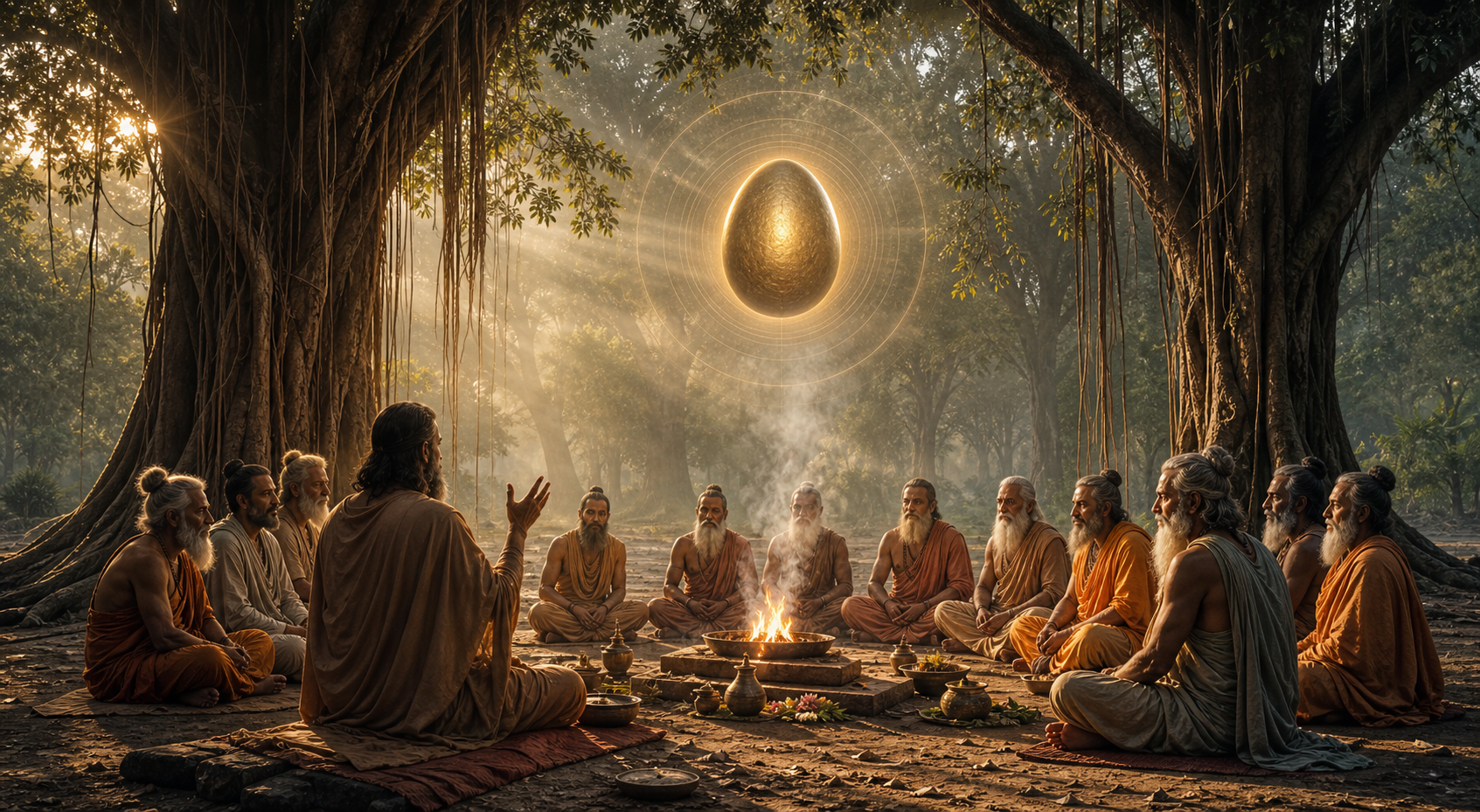
The Mahabharata is often read through its human struggles over dharma, kinship, power, and duty. The source fragment considered here points further back, toward a vision of creation represented by the cosmic egg.
The extract supplied by Hindu Blog is incomplete, so it cannot support a detailed reconstruction of that creation account. It does, however, preserve a meaningful narrative frame: sages assemble in a sacred forest, perform yajna, and ask to hear the epic. That setting helps readers understand how cosmological reflection belongs within the Mahabharata’s larger search for wisdom.
What the surviving fragment actually reports
According to Hindu Blog, a congregation of sages gathered for a grand yajna in the forest of Naimisharanya. Lomaharshana, also called Souti, sat among them as a disciple of Vyasa. The sages requested a narration of the Mahabharata, which the source describes as the vast body of wisdom compiled by Veda Vyasa.
These are the specific details available in the supplied text. Its heading identifies the cosmic egg as a primordial seed of creation, but the fragment ends before explaining the image, its stages, or its theological implications. Any fuller account would therefore require material that is not present here.
Why the epic begins with a community of listeners
The setting is not merely decorative. Knowledge enters the narrative through a relationship among a teacher, attentive listeners, sacred action, and a shared desire to understand. The sages do not encounter wisdom as isolated consumers. They gather, prepare a consecrated space, and receive an inherited teaching through narration.
This frame expresses a durable feature of dharmic learning: insight is sustained by parampara, disciplined listening, reflection, and community. Vyasa’s role connects the spoken account to an acknowledged lineage, while the sages demonstrate that asking for knowledge is itself a serious spiritual act. The scene therefore presents the Mahabharata not simply as literature, but as wisdom transmitted for collective examination.
How to read the cosmic egg without overclaiming
Hindu Blog’s heading presents the cosmic egg as the seed from which creation emerges. Because the explanatory passage is missing, the image is best approached as a symbolic invitation rather than as a fully recoverable doctrine. In general symbolic terms, an egg can suggest concentrated potential, unity before multiplicity, and an ordered emergence of differentiated life.
That interpretation should remain clearly separate from what the fragment reports. It should also not be promoted as a modern scientific theory. Sacred cosmology and physical science ask different kinds of questions: one may explore meaning, order, consciousness, and humanity’s place in existence, while the other develops testable accounts of physical processes. Respect for the Mahabharata does not require confusing these domains.
Key takeaways
- The source places the narration in Naimisharanya during a gathering of sages for yajna.
- Lomaharshana, or Souti, is identified as a disciple of Vyasa and the narrator approached by the sages.
- The supplied fragment names the cosmic egg as a primordial seed but does not preserve its full explanation.
- The narrative frame emphasizes lineage, sacred listening, and communal inquiry.
- Symbolic interpretation is valuable when it is not mistaken for missing textual detail or scientific proof.
A common dharmic reverence for ultimate questions
Hindu, Buddhist, Jain, and Sikh traditions should not be collapsed into one cosmology; each preserves distinctive teachings and vocabularies. Their unity is better sought at a deeper civilizational level. Across the dharmic family, ultimate questions are treated as worthy of disciplined inquiry, and knowledge is expected to shape conduct rather than remain abstract speculation.
The Mahabharata’s opening frame can therefore strengthen a capacious dharmic consciousness: rooted in Hindu scripture, respectful of distinct sampradayas, and open to dialogue among the traditions of Bharat. Such cultural self-knowledge is central to a constructive Hindutva that protects inheritance without demanding uniformity.
When the complete passage is available, its precise language and context should guide further interpretation. Until then, the fragment offers a sound starting point: creation is approached through sacred attention, and inherited symbols remain alive when communities study them carefully together.
Inspired by this post on Hindu Blog.
