
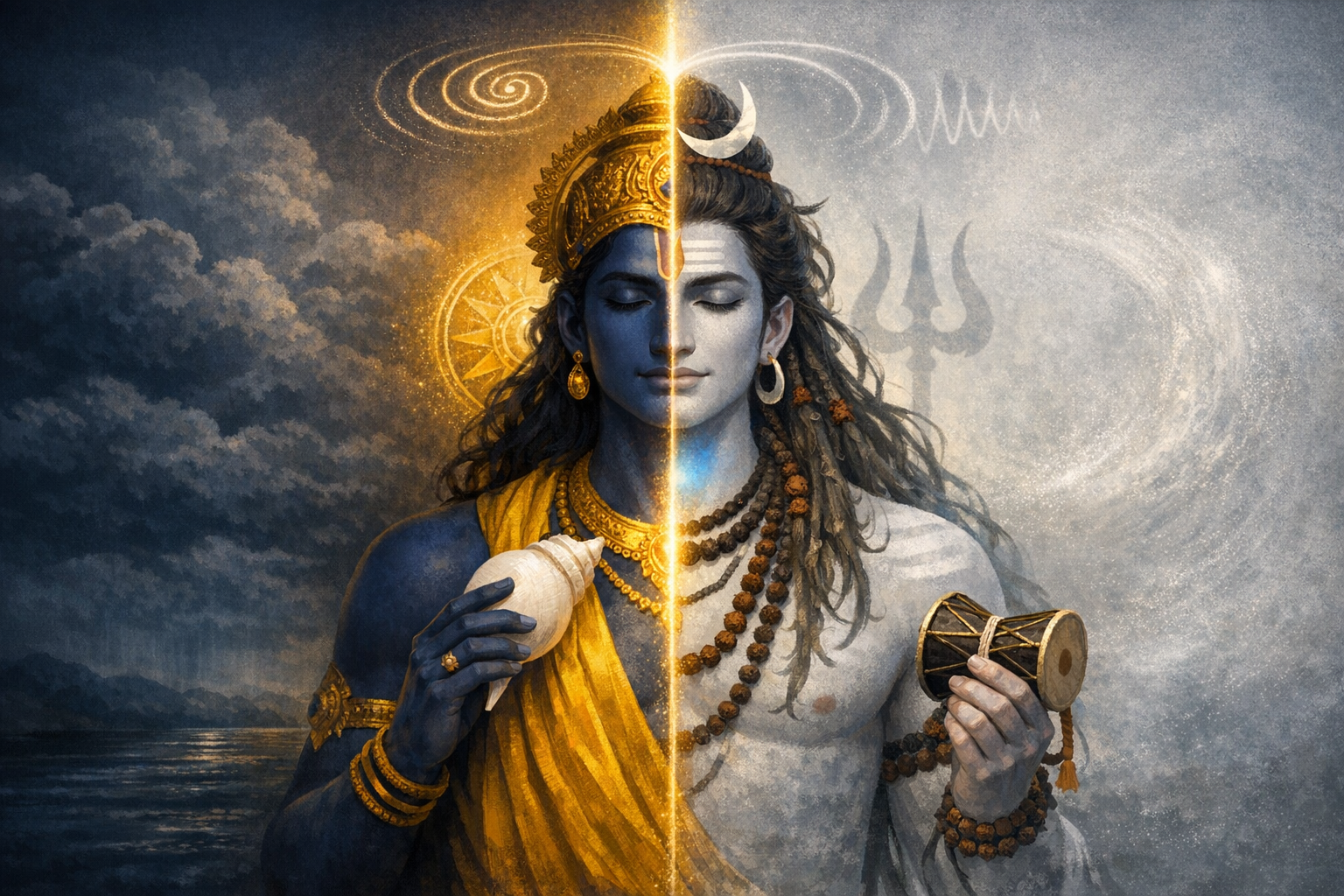
Hindu sacred art speaks through a precise visual grammar in which color is never ornamental but intentional. Within this grammar, a striking polarity stands out: Viṣṇu is frequently rendered as dark like rain clouds (megha-śyāma), while Śiva appears white through sacred ash (vibhūti). This contrast is not a moral binary; it is a multilayered iconographic, philosophical, and ritual code refined across centuries of śāstra, temple practice, and lived devotion.
Read as a cosmic color code, the dark hue of Viṣṇu and the white ash of Śiva illuminate two complementary faces of realitypervasion and dissolution, depth and residue, potentiality and consummation. The symbols are best approached through converging lenses: Purāṇic narrative, Śilpaśāstra prescriptions, Sāṅkhya-Vedānta metaphysics of guṇas, and the experiential knowledge of devotees in temples and homes.
In textual aesthetics and devotional poetry, Viṣṇu and particularly Kṛṣṇa are often described as “nīla-megha-śyāma,” dark like monsoon clouds. The metaphor is exacting. The monsoon cloud bears life-giving water; it withholds the sun’s glare and promises renewal. Likewise, Viṣṇu as the Pervader (vyāpaka) and Preserver rests upon the cosmic waters (Kṣīra-sāgara), sustaining beings with an unseen but omnipresent support. The dark hue signals depth, infinitude, and the absorptive mystery of Being rather than any moral obscurity.
Art-historically, this vision is codified. The Viṣṇudharmottara Purāṇa (noted for its Citrakarma/Chitrasūtra sections) and allied Śilpaśāstra traditions advise a śyāma or nīla (dark, blue-black) palette for Viṣṇu’s body. From Gupta-era basalts to South Indian bronze and mural cycles, the deity’s complexion coheres with this ideal: the dark expanse becomes a visual shorthand for the immeasurable. Regional ateliersPahari, Rājput, Chola, Keralareinterpret the hue within their materials and light, yet preserve its semantic charge.
The chromatic ensemble around Viṣṇu strengthens the reading. The pīta-ambara (golden-yellow garment) announces sattvalucidity and balanceset against the deep body hue of infinity. The śaṅkha (conch) is white, bearing the spiral of primordial sound (nāda), while the cakra (discus) flashes fiery intelligence, and the gadā (mace) grounds weight and order. In the same icon, whiteness, radiance, and density harmonize, signaling sovereignty over the guṇas rather than subjection to them.
In temple experience, this symbolism feels lived. Within a dim garbhagṛha, the dark-limbed Viṣṇu or Kṛṣṇa glows through oil-lamp light, jewels, and yellow silkthe visual mood evokes the monsoon dusk when creation drinks, rests, and renews. Devotees often describe a paradoxical intimacy in this “luminous darkness,” as if the infinite were close enough to touch yet vast enough to humble thought.
Śiva’s whiteness arises not from natural complexion but from vibhūtisacred ash. Purāṇic sources and Āgamic manuals on bhasma-dhāraṇa present ash as the residue of complete transformation: what fire leaves when all names and forms are offered up. Tripuṇḍrathe three horizontal ash linesencodes this teaching on the body: guṇas are burned, doership is quieted, and what remains is clarity without remainder. White therefore denotes transcendence born of total release, not mere pallor.
As Śmaśāna-vāsin, Śiva’s chosen abodethe cremation groundbelongs to this grammar. It is the frontier where identity ends and the real begins. Vibhūti on the skin proclaims that the last truth of form is ash, and the last truth of ash is the formless. Simultaneously, the epithet Nīlakaṇṭha (the blue-throated One) recalls the halāhala-poison myth: darkness and toxicity are contained, not expressed; whiteness spreads over the rest of the form. The dark is held at the threshold; the white proclaims the victory of stillness.
Śilpaśāstra conventions echo this vision. Texts for image-making frequently permit or prefer a gaura (fair) tone for certain Śiva forms and insist on vibhūti-marked bodies for ascetic and Bhairava aspects. South Indian bronzes of Naṭarāja may shine with the bronze’s coppery warmth yet remain ritually “whitened” through ash in liturgical contexts, honoring the metaphysics over the metallurgy.
Ritually, vibhūti is the wearable Upaniṣadic sentence. Smearing the tripuṇḍra across the forehead, chest, and arms, practitioners rehearse the doctrine of impermanence and the possibility of jīvanmukti (freedom while alive). Each application says, in effect: all that becomes will cease; that which witnesses becoming is free. The color white here is the quiet light after the flametruth unveiled.
An illuminating complement lies in Vaiṣṇava practice. While the deity is dark-hued, the Vaiṣṇava mark (ūrdhva-puṇḍra) is drawn in white clayoften gopīcandanadescending the forehead as a vertical channel. This whiteness signifies the pure path of ascent along the suṣumnā (by one interpretation), the sanctity of the Lord’s feet, and the clarity of sattva. Thus, the devotee’s body carries whiteness even while the deity embodies luminous darkness; the two together express completeness.
The well-known Sāṅkhya mapping assigns white to sattva (luminosity), red to rajas (activity), and black to tamas (inertia). A superficial reading would then expect Viṣṇu (closely linked to sattva in some Purāṇic schemas) to be white and Śiva (sometimes associated with tamas as dissolver) to be dark. Iconography resists this flattening. Viṣṇu bears the white śaṅkha and yellow pīta-ambara to signal his governance of sattva while retaining the dark hue of infinity; Śiva bears the white ash to display transcendence of guṇas while his blue throat alone “houses” toxic tamas in containment. The images therefore solve, rather than create, the so‑called color paradox.
Cosmology sharpens this integration. Viṣṇu’s dark limbs evoke the fertile, unbounded waters of potential out of which worlds arise and are sustained. Śiva’s white ash is what remains when cycles close and forms return to their source. Between these poles is the full rhythm of time: origin veiled in depth, culmination clarified as residue. Neither is “higher” in isolation; both reveal the One in motion and the One at rest.
Devotional rasa literature reinforces these moods. Kṛṣṇa’s megha-śyāma beauty carries śṛṅgāra and karuṇā in equal measureintimacy with an unfathomable beloved. Śiva’s vibhūti-scented presence inclines to śānta, the rasa of equanimity, as well as to raudra when compassion takes fierce, protective form. Color and rasa converge to map inner states that practitioners recognize in prayer, kīrtan, and meditation.
Sound adds a subtle layer to the palette. Viṣṇu’s śaṅkha unfurls the primordial Ōṁ across spacewhite spiral, life-breath of dharma. Śiva’s ḍamaru beats the pulse that issues and reabsorbs phonemes, time, and formthe rhythm to which Naṭarāja dances. The conch’s white wave and the drum’s cyclic beat are complementary signatures of order and dissolution, audible mirrors of darkness and ash.
In the composite deity Harihara, half is Viṣṇu, half is Śivaoften dark and white joined at the midline. The icon affirms that the Preserver and the Dissolver are not rivals but reflections. The two color fields meet without conflict, teaching that the path of devotion (bhakti), knowledge (jñāna), and disciplined action (karma) converge in a unity that exceeds any single emblem.
The same spirit of integration continues across Dharma’s broader family. In Vajrayāna Buddhism, color-coded Tathāgatas show a cognate logic: white Vairocana (spacious clarity) and blue Akṣobhya (unshakeable depth) together sketch a spectrum akin to śiva-śyāma polarity. Jain thought speaks of leśyā (colorations of consciousness), with śukla (white) representing the summit of purity and inward quiet. Sikh tradition centers on Ik ōaṅkār, the undivided Origin, while communities such as the Nihang cherish deep blue, the sky’s limitless canopy, alongside whites of simplicity and service. These resonances do not erase difference; they point to a shared civilizational intuition that darkness can signify depth and white can signify clarity without importing a moral dualism.
Practical implications for sādhanā naturally follow. Meditators who visualize Viṣṇu’s dark, rain-bearing presence often report a felt sense of support and cool expansiveness, a mind settling into quiet trust. Those who bear vibhūti and contemplate Śiva’s ash may notice a release of clinging, grief, and self-importancean unburdening that the color white makes immediate. Both practices cultivate compassion and steadiness in daily life.
This grammar of color also cautions against anachronism. Modern habits that read “dark” and “white” as value-laden moral codes from other cultural histories do not belong to Indic aesthetics. In Hindu iconography, the monsoon cloud is auspicious; ash is sacred. Black basalt and white sandal paste meet on the same altar. The interpretive key is function and realization, not hierarchy.
Regional, sectarian, and temporal variations enrich, rather than contradict, the core code. Śaiva images may appear golden or coppery; Viṣṇu may be rendered lighter in certain schools or materials. What persists beneath stylistic change is the stable semantics of depth and residue, of sustaining infinity and liberating stillness.
In summary, Viṣṇu’s dark hue and Śiva’s white ash are complementary teachings encoded in sight. Viṣṇu’s darkness is the fathomless, nourishing ocean of Being; Śiva’s whiteness is the serene transparency after all becoming has burned away. Between them, a devotee learns to live lucidly in the world while remembering what lies beyond itan ethic of balance, love, and freedom that honors the unity underlying all Dharmic traditions.
Seen this way, the temple is a school of metaphysics. Each darśan reiterates: depth without fear, clarity without pride. The dark cloud and the white ash do not compete; they complete. To read them together is to recover a shared civilizational wisdomHindu, Buddhist, Jain, and Sikhcommitted to harmony, plurality, and the search for truth.
Inspired by this post on Hindu Blog.
