
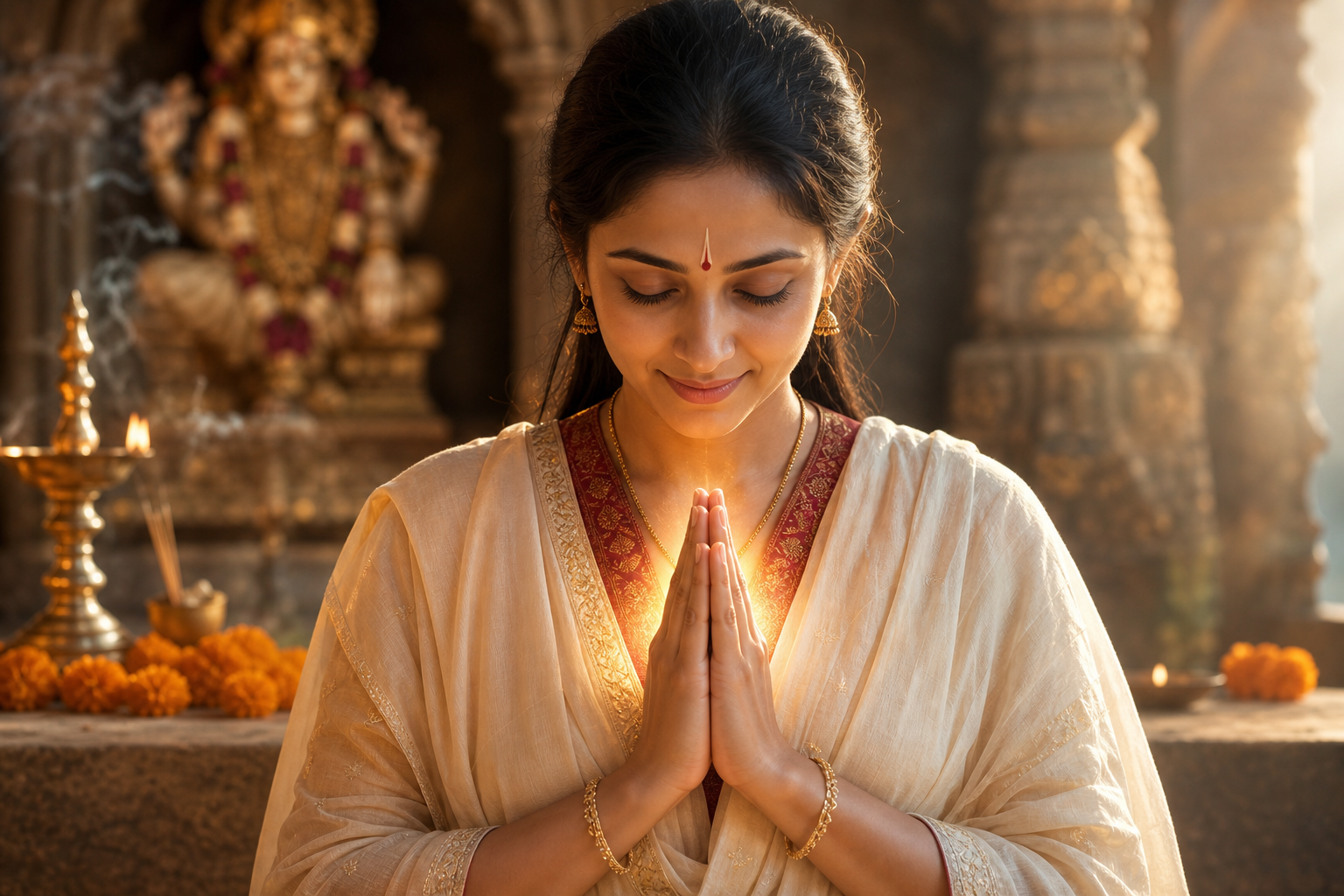
Anjali is one of the simplest and most profound gestures in Hindu spiritual life. It is formed by bringing the palms together, usually before the heart, with the fingers pointing upward and the head inclined in reverence. In ordinary social life it appears as a respectful greeting; in ritual life it becomes an offering; in yoga it becomes a mudra of integration; in temple worship it becomes a visible sign of surrender before the divine. Its power lies in this rare combination of accessibility and depth. No elaborate material arrangement is required, yet the gesture can express devotion, humility, gratitude, self-discipline, and inner alignment.
The Sanskrit word Anjali is commonly understood as a joined-hand offering, a hollow formed by the palms to receive or present something sacred. This meaning is important because the gesture is not merely a hand position; it is an embodied act of offering. The devotee does not approach the divine as a consumer of blessings, but as one who brings the mind, speech, body, and intention into a posture of reverence. In Hindu rituals, this offering may be directed toward a deity, guru, elder, sacred river, fire altar, scripture, or inner Self.
In Hinduism, Anjali is closely connected with namaskara and pranama, the broader culture of respectful salutation. When the palms meet, the gesture communicates that the sacred is recognized in the one being greeted. This is why the gesture has remained meaningful across regions, languages, sampradayas, and social settings. It can be used before Lord Shiva, Lord Vishnu, Devi, Ganesha, Surya, a guru, parents, guests, saints, and even the natural world. Its symbolism supports the Hindu view that divinity is not confined to a single form, but is encountered through many names, forms, relationships, and paths.
The physical structure of Anjali carries layered symbolic meaning. The right and left palms may be read as complementary forces: action and knowledge, devotion and wisdom, individual effort and divine grace, masculine and feminine principles, or the outer and inner life. Their union suggests the harmonizing of dualities. In this sense, Anjali is not only a devotional sign but also a philosophical statement. It quietly teaches that spiritual maturity begins when scattered energies are gathered, opposing tendencies are reconciled, and the person stands before truth without arrogance.
When performed at the heart center, Anjali also expresses the centrality of bhava, the inner feeling behind ritual action. Hindu practice repeatedly emphasizes that the value of worship does not rest only in external precision, but also in sincerity, purity of intention, and steadiness of awareness. A person may offer flowers, lamps, incense, water, food, or mantra, yet Anjali reminds the practitioner that the deepest offering is the self made receptive. The joined palms become a small temple formed by the body itself.
In puja, Anjali appears at many points: while invoking a deity, receiving darshan, offering prayers, listening to mantras, making sankalpa, accepting prasada, and concluding worship. It frames the ritual experience by turning attention from distraction toward sacred presence. The devotee may stand before the murti with folded hands not because the divine needs flattery, but because the human mind needs refinement. The gesture disciplines the body, softens the ego, and prepares the heart to receive grace with humility.
Anjali is also deeply connected with the Hindu understanding of darshan. In a temple, the devotee sees the deity and is also seen by the deity. The folded hands create a posture of receptivity during this exchange. The body communicates what words may not fully express: reverence, dependence, longing, gratitude, and trust. For many practitioners, this moment is emotionally powerful precisely because it is simple. A crowded temple, a quiet home shrine, a roadside image of Hanuman, or a lamp lit before Devi can all become spaces where Anjali gathers the mind into devotion.
From a yogic perspective, Anjali Mudra has psychological and energetic significance. The symmetrical joining of the hands can stabilize attention, calm restless movement, and support inward awareness. In yoga practice it is often used at the beginning and end of asana, during meditation, or in standing postures such as Pranamasana. Its placement near the heart encourages a contemplative mood and reminds the practitioner that yoga is not merely physical training. It is a discipline of integration involving body, breath, mind, and consciousness.
The gesture is sometimes associated with the anahata chakra, the heart center in yogic anatomy. While interpretations vary across traditions, the association is symbolically coherent: Anjali at the heart suggests devotion, compassion, balance, and relational awareness. The hands that usually grasp, defend, work, and separate are brought together in stillness. This embodied stillness can help transform ordinary action into mindful presence. In that sense, Anjali teaches that spirituality is not limited to temples or scriptures; it can be practiced through the disciplined use of the body in daily life.
In classical Indian dance traditions such as Bharatanatyam, Kuchipudi, Odissi, Kathak, and other regional forms, joined palms often communicate salutation, worship, invocation, or respectful address. Dance preserves the visual theology of Hindu civilization by translating sacred concepts into gesture, rhythm, expression, and movement. Anjali in performance is not decorative; it is part of a larger grammar of meaning. It can honor the deity, the guru, the audience, the earth, the stage, and the lineage through which knowledge has been transmitted.
Anjali also has an ethical dimension. Folding the hands reduces the aggressive display of the body. It conveys non-threatening presence, self-restraint, and willingness to honor another. In a culture shaped by dharma, such gestures are not trivial social ornaments. They help cultivate habits of respect. A child greeting elders with joined palms, a student saluting a teacher, a pilgrim bowing before a sacred river, or a devotee greeting another seeker all participate in a civilizational discipline that links manners with metaphysics.
The significance of Anjali becomes clearer when viewed through the Hindu idea of the body as an instrument of spiritual practice. Hindu traditions do not sharply separate belief from embodiment. Sitting, standing, bowing, circumambulating, fasting, chanting, breathing, touching the feet of elders, applying tilaka, lighting a lamp, and joining the hands are all ways through which the body participates in dharma. Anjali belongs to this larger field of sacred embodiment. It trains reverence until reverence becomes natural.
The gesture also expresses the relationship between humility and knowledge. In Hindu philosophy, true knowledge is not merely intellectual accumulation. It requires the refinement of character. Pride, anger, carelessness, and excessive self-importance obstruct insight. Anjali is therefore a small but repeated correction of ego. It reminds the practitioner that the sacred is not conquered by argument or possession; it is approached through attention, discipline, and openness.
In bhakti traditions, Anjali becomes especially tender. The devotee may fold the hands before Krishna, Rama, Narasimha, Shiva, Lakshmi, Durga, Saraswati, Ganesha, Murugan, Ayyappa, Venkateswara, Jagannath, or a chosen Ishta Devata. The gesture accommodates the rich plurality of Hindu worship while preserving unity of intention. Whether the devotee is singing kirtan, reciting stotra, silently praying, or standing in darshan, the joined palms express the same inner movement: the individual turns toward the divine with trust.
Anjali is also significant because it does not require social privilege. A person may have wealth or poverty, learning or little formal education, ritual expertise or simple faith, yet the gesture remains available. This accessibility reflects a major strength of Hindu spiritual culture. The highest truths are preserved in scriptures and philosophical systems, but they are also made available through everyday practices. A folded-hand salutation can carry the essence of devotion even when the practitioner cannot perform complex rituals.
At the same time, Anjali should not be reduced to a casual cultural habit. Its sacred meaning depends on awareness. When done mechanically, it may remain polite but spiritually thin. When done with attention, it becomes a practice of recollection. The practitioner remembers the divine, the guru, the ancestors, the community, and the ethical order that sustains life. The same outer gesture can therefore operate at different depths depending on the quality of consciousness behind it.
In the broader Dharmic context, Anjali resonates beyond Hindu practice. Buddhist, Jain, and Sikh communities also preserve forms of respectful salutation, reverence, and folded-hand devotion in their own theological and cultural settings. This shared vocabulary of respect does not erase doctrinal differences; rather, it reveals a civilizational commitment to humility, discipline, and sacred regard. For a society seeking unity among Dharmic traditions, Anjali offers a graceful symbol: many paths may differ in philosophy and practice, yet reverence remains a common language.
The gesture has further relevance in modern life because it offers an alternative to hurried, transactional communication. In an age of constant distraction, Anjali slows the body and collects the mind. It asks the person to pause before speaking, receiving, praying, or departing. Even outside formal ritual, this pause can restore dignity to human interaction. It is a reminder that respect need not be loud, expensive, or performative. Sometimes it is communicated through a quiet alignment of the hands and heart.
There is also a subtle social intelligence in Anjali. It allows reverence without physical contact, making it adaptable across contexts of health, distance, personal boundaries, and cultural difference. Yet its meaning is much older and richer than modern convenience. It emerges from a worldview in which the human encounter is spiritually charged. To greet another with folded hands is to acknowledge that the person before one is not merely a social unit, but a bearer of consciousness and dignity.
Theologically, Anjali can be understood as an offering of the limited self to the limitless reality. The hands are empty, but their emptiness is meaningful. They indicate readiness to receive and willingness to give. This double movement is central to Hindu spirituality: the seeker offers effort, discipline, devotion, and attention, while grace is received as insight, strength, peace, or transformation. Anjali therefore stands at the meeting point of sadhana and kripa, practice and grace.
Its symbolism also intersects with the doctrine of unity within diversity. Two hands are distinct, yet they become one gesture. This image is philosophically suggestive for Hindu thought, where multiplicity and unity are often held together rather than treated as enemies. Different deities, scriptures, teachers, rituals, and paths can coexist within a larger sacred order. Anjali visually communicates this principle without needing abstract explanation.
In family life, Anjali often becomes the first religious gesture a child learns. Before a child understands theology, Sanskrit, or ritual procedure, the child may learn to fold the hands before a shrine or elder. This early training is not insignificant. It introduces the child to reverence as a bodily habit. Over time, such habits shape emotional memory. The smell of incense, the sound of a bell, the sight of a lamp, and the feel of joined palms can remain powerful markers of belonging and spiritual continuity.
In pilgrimage settings, Anjali acquires yet another dimension. A pilgrim reaching Kashi, Rameswaram, Tirupati, Puri, Badrinath, Kedarnath, Vaishno Devi, Pandharpur, Sabarimala, or countless local temples may fold the hands after a long journey. At that moment the gesture can contain fatigue, hope, gratitude, grief, and fulfillment. It becomes a vessel for emotions too complex for ordinary language. This is why Anjali continues to speak across generations: it allows the body to pray when words are insufficient.
Academically, Anjali may be studied as a mudra, a ritual marker, a cultural sign, a performative act, and a devotional technology. Each lens reveals something valuable. As a mudra, it organizes bodily energy and attention. As ritual action, it marks sacred intention. As cultural sign, it communicates respect. As performance, it transmits meaning through gesture. As devotional practice, it forms the heart. Its richness lies in the fact that all these meanings can coexist in one simple act.
The sacred significance of Anjali therefore cannot be exhausted by calling it a greeting. It is a compact expression of Hindu philosophy, bhakti, yoga, ritual culture, ethical refinement, and civilizational memory. It teaches humility without humiliation, devotion without fanaticism, and unity without uniformity. In the joined palms, Hindu tradition preserves a profound lesson: the path to divine grace often begins not with complexity, but with reverent simplicity.
Inspired by this post on Hindu Blog.
