
The killing of Tarun Butolia in Delhi’s Uttam Nagar during Holi has become more than a local criminal case. It has become a painful test of how society discusses violence, festival safety, inter-community trust, policing, and justice without allowing grief to harden into collective blame. Reported accounts describe a young Hindu man losing his life after a minor Holi water-splash incident escalated into a violent confrontation between families and groups in the neighborhood. The human cost is immediate and irreparable: a family lost a son, a community lost a young life, and a festival associated with color, reconciliation, and renewal was overshadowed by fear.
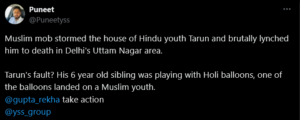
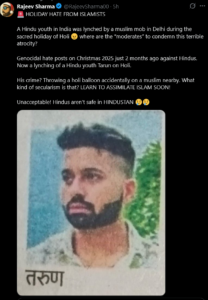
Early social-media posts described the incident in stark communal language, alleging that Tarun was lynched by a Muslim mob after a child accidentally threw a Holi balloon. Later news reports added important details that sharpen the factual picture while also showing the complexity of the case. Reports in the Times of India and the Economic Times identified the victim as 26-year-old Tarun Butolia and reported that the flashpoint involved an 11-year-old girl whose Holi water splash allegedly fell on or near a woman from another community. The case, therefore, should be discussed with precision: it involved allegations of communal violence, but it also appears to have been shaped by prior neighborhood tensions, family disputes, and a rapid failure of conflict control.
Holi is not merely a public celebration. In Hindu tradition, it carries layered meanings: the triumph of dharma over arrogance, the burning away of hostility, the renewal of social bonds, and the temporary softening of hierarchy through shared color and laughter. That is why violence during Holi feels especially jarring. When a playful splash becomes a trigger for retaliation, the issue is not simply one act of criminality; it is the collapse of civic restraint in a setting where restraint should have been strongest. For families who teach children that festivals are safe spaces of joy, such an incident creates a deep emotional rupture.
According to later reporting, the incident unfolded on March 4, 2026, in southwest Delhi’s Uttam Nagar. A child was reportedly playing during Holi when water splashed onto a woman from another community. A quarrel followed. Tarun, who was away at a Holi gathering, reportedly received a phone call that his parents were under attack and rushed back home on his motorcycle. Accounts then state that he was attacked by a group with rods, bricks, stones, and sharp weapons. He succumbed to the assault. This sequence, if established in court, shows how quickly a minor provocation can become fatal when crowd aggression, family grievance, and communal suspicion interact.
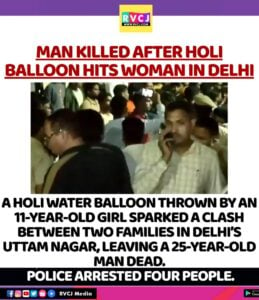
The legal dimension matters because justice cannot rest on viral claims alone. Delhi Police reportedly arrested 14 people by March 16, 2026, in connection with the case, and security in the area was increased after protests and fears of further tension. Earlier claims mentioned four arrests and a minor being apprehended; subsequent reports indicated a broader set of arrests as the investigation developed. In a rule-of-law framework, the central questions are clear: who participated in the assault, who planned or instigated it, whether weapons were brought deliberately, whether any prior threats existed, and whether communal motivation can be proven through evidence rather than assumed through outrage.
The distinction between moral grief and legal proof is not a weakness. It is a civilizational necessity. A society guided by dharma must demand justice for Tarun without abandoning fairness, evidence, and due process. Criminal responsibility belongs to those who committed, enabled, or instigated the crime. It should not be transferred mechanically to an entire religious community. Collective blame may feel emotionally satisfying in the immediate aftermath of violence, but it weakens the ethical foundation required for lasting security. It also risks placing innocent families, including children and elders, under suspicion for acts they did not commit.
This is where the broader Dharmic lens becomes important. Hindu, Buddhist, Jain, and Sikh traditions differ in theology and practice, yet they share a moral concern for restraint, accountability, compassion, and courage. Ahimsa does not mean passivity before injustice; it means refusing cruelty as a principle of life. Dharma does not mean vengeance; it means right action proportionate to truth. Seva does not mean silence; it means standing with the suffering in a disciplined and constructive way. Justice for Tarun, therefore, requires firmness without dehumanization, solidarity without mob retaliation, and remembrance without reckless rumor.
The original social-media framing repeatedly asked why Hindus do not unite when a Hindu is attacked. That question deserves a more careful treatment than anger alone can provide. Community unity is not measured by inflammatory slogans or by the ability to provoke counter-hostility. It is measured by whether temples, civil-society groups, lawyers, local residents, and public representatives can organize lawful support for the victim’s family, monitor the investigation, assist witnesses, preserve evidence, and demand transparent prosecution. A disciplined community response is stronger than a reactive one because it converts grief into institutional pressure.
There is also a practical security lesson. Festivals in dense urban neighborhoods require advance risk assessment, especially in areas where past tensions are known. Police deployment cannot be limited to symbolic visibility at major roads. Local beat officers, resident welfare associations, temple committees, mosque committees, school networks, and market associations should identify known friction points before festivals begin. Disputes over parking, garbage, street space, noise, and children playing outside often appear trivial, but in tense localities they can serve as triggers for larger conflict. The Uttam Nagar case suggests that neighborhood-level grievance mapping is not bureaucratic overreach; it can be a life-saving measure.
The reported reference to a decades-old feud between families is particularly important. If a conflict has existed for years, a Holi water splash may have been the immediate spark rather than the deeper cause. Long-running neighborhood disputes often produce a climate in which every small incident is interpreted as intentional insult. In such settings, rumor travels faster than verification, and relatives or associates may arrive already emotionally prepared for confrontation. Effective policing must therefore examine not only the final assault but also the social history that made escalation possible.
For readers concerned about Hinduphobia and anti-Hindu violence, the case should not be minimized. A Hindu man was killed during a Hindu festival after an incident linked to Holi play, and the pain felt by Hindu families is real. Many Hindus in India and the diaspora have become increasingly sensitive to patterns in which Hindu festivals, processions, temples, or symbols become sites of contestation. That concern should be documented and discussed. However, serious documentation requires careful language, verified facts, and a refusal to exaggerate beyond available evidence. Accuracy strengthens the case for justice; careless claims weaken it.

The ethical failure of crowd violence is universal. Whether the accused belong to one community or another, no religious identity can excuse the act of surrounding, beating, stabbing, or humiliating a person. Public order depends on a simple norm: no private group has the right to punish perceived insult through violence. If a water balloon, color powder, music, procession route, or verbal argument causes offense, the remedy is complaint, mediation, or lawful police intervention. The moment a group chooses collective assault, it attacks not only the victim but also the civic order that protects everyone.
There is a gender and childhood dimension as well. Reports indicate that a child was involved in the initial Holi play. Children do not understand the full weight of adult communal tension. A society that allows a child’s festival act to become the cause of adult violence has failed in guardianship. The proper response to accidental splashing should have been correction, conversation, or at most a complaint to the family. The escalation into fatal violence reflects a breakdown in adult responsibility.
The public reaction after Tarun’s death also requires thoughtful interpretation. Protests demanding punishment for the accused are understandable when families fear that a case may be diluted or forgotten. Public pressure has often helped keep serious crimes visible. Yet protest must remain lawful, focused, and evidence-based. The demand should be for swift investigation, witness protection, transparent charges, forensic rigor, and timely trial. The demand should not become a license for retaliatory hostility or generalized suspicion toward ordinary neighbors.
Media and social-media users carry a special responsibility in such cases. The first version of a violent incident is often incomplete. Names, ages, motives, arrest numbers, and sequence of events may change as police gather evidence and journalists verify accounts. In Tarun’s case, early posts referred to a 6-year-old sibling and a Muslim youth; later reports referred to an 11-year-old female relative and a woman from another community. These differences matter. They do not erase the tragedy, but they show why claims should be updated as reliable information emerges.
From a policy perspective, three reforms stand out. First, festival policing should include micro-level coordination in mixed and high-density neighborhoods, not only broad citywide advisories. Second, local administrations should create rapid mediation channels for festival-related disputes before they become street confrontations. Third, criminal cases with potential communal implications should be communicated clearly by police through regular factual briefings. Silence or vague statements create a vacuum, and that vacuum is quickly filled by rumor, anger, and partisan interpretation.
There is also a need for community education before festivals. Holi committees and local Hindu organizations can help by encouraging consent-based celebration, especially in public streets where not everyone wishes to be splashed with water or color. This does not mean weakening Holi. It means preserving Holi from avoidable conflict. A festival rooted in joy should not be handed over to provocation, intoxication, harassment, or competitive displays of dominance. Responsible celebration protects both tradition and public legitimacy.
At the same time, respect for consent cannot become an excuse for violent overreaction. If someone objects to water or color, the objection must be handled peacefully. If a child makes a mistake, adults must de-escalate. If a family feels insulted, it must seek lawful remedy. The central moral line is clear: no grievance arising from a festival incident can justify a mob attack. The sanctity of human life stands above wounded pride.
Tarun’s death should also push temples and Dharmic institutions to think beyond ritual calendars. Temples are not only places of worship; historically, they have also been centers of education, charity, social coordination, and cultural continuity. In modern urban life, they can help communities build legal-aid networks, emergency response groups, youth discipline programs, interfaith communication channels, and support systems for victims of violence. Such work does not politicize religion; it restores the social function of sacred institutions.
For Sikh, Jain, Buddhist, and Hindu communities alike, the lesson is shared. A Dharmic public culture must combine compassion with courage. Compassion prevents hatred from spreading beyond the guilty. Courage prevents violence from being normalized or ignored. The memory of Tarun Butolia should therefore be held with seriousness: not as a symbol for indiscriminate anger, but as a reminder that festivals require vigilance, communities require discipline, and justice requires perseverance.
The most constructive demand now is straightforward. The investigation should be completed thoroughly. The accused should face charges supported by evidence. Witnesses should be protected from intimidation. The victim’s family should receive legal and social support. Local peace should be maintained without suppressing legitimate grief. Public discourse should condemn the killing unequivocally while avoiding language that endangers innocent people. That balance is difficult, but it is precisely the balance a mature society must uphold.
Tarun Butolia’s killing during Holi will remain a painful marker in discussions of communal violence, Hinduphobia, festival safety, and justice in India. Its significance lies not only in the brutality of one incident, but in what it reveals about fragile neighborhood relations and the consequences of unchecked escalation. The proper response is not silence, denial, or collective hatred. The proper response is truth, lawful accountability, community organization, and a renewed commitment to ensuring that no family, Hindu or otherwise, must fear that a festival day can turn into a funeral.
Inspired by this post on Hindu Human Rights Blog.
