
Tulsi Gabbard’s reported resignation as United States Director of National Intelligence, citing her husband Abraham Williams’s rare bone cancer diagnosis, became more than a political transition. It became a revealing public test of how political figures, media voices, and online communities respond when public duty intersects with private suffering. In such moments, the central issue is not whether citizens may criticize a senior official’s record. Criticism is legitimate in a democracy. The deeper question is whether criticism can be expressed with proportion, evidence, and compassion when a family is facing illness.
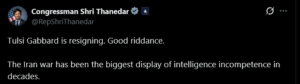
The controversy developed after an X post attributed to Congressman Shri Thanedar circulated online. The post reportedly stated: “Tulsi Gabbard is resigning. Good riddance. The Iran war has been the biggest display of intelligence incompetence in decades.” The remark drew strong reactions because it appeared to compress two very different matters into a single political attack: Gabbard’s record as Director of National Intelligence and her personal decision to step away during her husband’s serious illness. That distinction matters. A public official’s decisions can be scrutinized rigorously, but grief and illness demand a basic discipline of language.
From a Dharmic perspective, this episode is not merely about partisan etiquette. It touches on the relationship between satya, ahimsa, karuna, and maryada: truth, non-harm, compassion, and dignified conduct. These values are not confined to one sect or one political identity. Hindu, Buddhist, Jain, and Sikh traditions all contain powerful teachings on restraint, empathy, truthful speech, and responsibility toward vulnerable beings. A public statement that ignores human suffering may win attention, but it rarely strengthens society.

Gabbard has long occupied an unusual place in American public life. She has been a military officer, a former Democratic congresswoman, a later Republican-aligned figure, and one of the most visible Hindu public officials in the United States. Her tenure in national security politics has attracted both support and criticism. Her positions on foreign policy, intelligence reform, and interventionism have generated intense debate. None of that should place her family beyond empathy. The fact that her husband Abraham Williams’s illness was cited in connection with her departure should have encouraged a more careful public response, even from political opponents.
The role of Director of National Intelligence is technically complex. The DNI does not command military operations in the way a combatant commander does, nor does the office alone determine whether a president chooses war, restraint, escalation, or diplomacy. The intelligence cycle involves collection, analysis, counterintelligence, interagency coordination, briefings, and policy support. A conflict involving Iran, or any major national security crisis, may raise serious questions about intelligence assessment, warning, risk analysis, and policy use of intelligence. Yet responsible criticism should identify the specific failure: Was the problem collection? Was it analytical bias? Was it politicized interpretation? Was it a failure of warning? Was intelligence ignored by policymakers? Without such distinctions, the phrase “intelligence incompetence” becomes political heat rather than serious analysis.
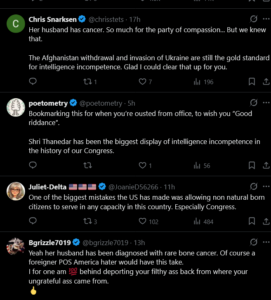
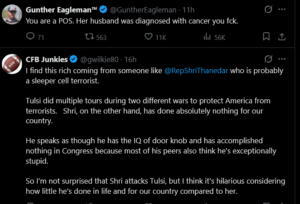
This is where the public reaction to Thanedar’s alleged post becomes understandable. Many readers did not object simply because Gabbard was criticized. They objected because the reported wording appeared to celebrate her exit at a moment linked to family illness. In public ethics, timing is not a small matter. The same sentence can carry different moral weight depending on when it is spoken. A critique issued after a policy hearing differs from a dismissive remark issued when a spouse’s cancer diagnosis is part of the public context.
There is also a wider concern about the coarsening of political debate on X and other social media platforms. Public figures are rewarded for brevity, sharpness, and provocation. The platform structure encourages moral compression: complex events become slogans, private pain becomes a political opportunity, and opponents become symbols rather than persons. Dharmic traditions caution against this loss of inner discipline. Speech is not treated as morally neutral. Words can clarify, heal, provoke, humiliate, or inflame. In that sense, digital speech is still karma-producing action.
Thanedar’s own public biography adds another layer to the discussion. He is an Indian-American politician and entrepreneur who has spoken at times about issues affecting Hindus and Hindu institutions. That makes the controversy more sensitive for many Hindu Americans, not because all Hindus must agree politically, but because public conduct by prominent figures can shape broader perceptions of a community. A Dharmic public ethic does not require silence in the face of disagreement. It requires that disagreement be expressed without cruelty, dehumanization, or disregard for suffering.
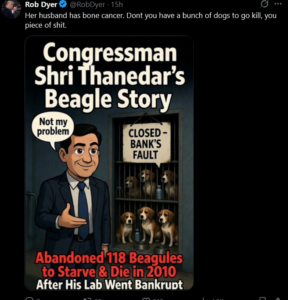
The earlier controversy involving Thanedar’s business past has also returned to public discussion. Reports from 2010 described the collapse of companies connected to pharmaceutical and chemical testing operations, including Azopharma and AniClin Preclinical Services. Animal welfare groups and media reports stated that beagles and macaque monkeys were left at a New Jersey facility after receivership and bankruptcy-related disruption, while former employees and caretakers helped provide food and water until rescue groups became involved. Thanedar has denied that he abandoned the animals and has pointed to the role of the bank and receivership process. The matter remains relevant not as a tool for personal abuse, but as part of a broader ethical discussion about responsibility, corporate collapse, and the treatment of sentient beings.
In Dharmic traditions, the treatment of animals is not an ornamental concern. Ahimsa in Hinduism, Jainism, Buddhism, and Sikh ethical reflection is not only about avoiding direct violence. It also concerns negligence, indifference, and the structures that allow suffering to become invisible. When animals are used in commercial or scientific settings, the moral burden increases because they cannot consent, cannot advocate for themselves, and are dependent on human systems for survival. A business failure may be legally complex, but ethical responsibility cannot be reduced entirely to paperwork.
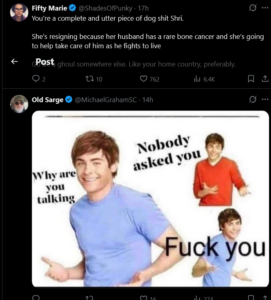
That said, the present debate should avoid personal mockery, appearance-based insults, and ridicule. Such rhetoric weakens the argument and contradicts the very Dharmic values being invoked. If the concern is compassion, then compassion cannot be selectively applied. Criticism of Thanedar should focus on public conduct, political judgment, accountability, and ethical consistency. It should not descend into body-shaming, ethnic ridicule, or personal derision. A community that seeks to defend dignity must practice dignity even when angry.
The Gabbard resignation controversy therefore offers a useful case study in Hindu American politics and broader American civic life. It shows how quickly political disagreement can become moral failure when human vulnerability is ignored. It also shows why Dharmic language should not be used merely as a tribal weapon. Dharma is not a slogan for defending allies and attacking opponents. It is a discipline that tests conduct precisely when emotions are high and public pressure rewards harshness.
A more responsible response to Gabbard’s resignation would have separated sympathy from scrutiny. It would have acknowledged Abraham Williams’s illness with basic human concern, wished the family strength, and then, if necessary, offered a carefully argued assessment of Gabbard’s tenure as DNI. Such an approach would not weaken political criticism. It would strengthen it by demonstrating seriousness, restraint, and moral proportion. In a polarized society, the ability to criticize without cruelty is not weakness. It is civic maturity.
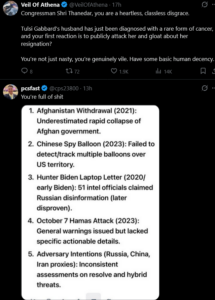
The same standard applies to intelligence policy. If there were failures connected to the Iran war, they deserve investigation through evidence, congressional oversight, classified review where appropriate, and public explanation where possible. Serious national security analysis should examine intelligence estimates, threat assessments, decision timelines, dissenting views, and the relationship between intelligence agencies and elected leadership. The public deserves more than applause lines. It deserves clarity about how decisions were made and whether institutions performed their duties responsibly.
For Hindu, Buddhist, Jain, and Sikh communities in the diaspora, this episode carries an additional lesson. Representation alone is not enough. A public figure may share a civilizational background, religious vocabulary, or cultural identity, yet still need to be evaluated by conduct. Dharmic unity does not mean automatic agreement. It means building a public culture where truth and compassion are held together, where disagreement does not become hatred, and where human suffering is not treated as an opening for partisan triumph.
The reaction across X reflects a genuine discomfort with political speech that appears to ignore illness and family hardship. That discomfort should be channeled constructively. It should lead to higher expectations for elected officials, better standards for social media discourse, and more careful public engagement from communities that invoke Dharma. Anger may be understandable, but it should not become the governing principle. The better answer is firm, factual, ethical criticism grounded in compassion.
In the end, the controversy surrounding Tulsi Gabbard’s resignation and Shri Thanedar’s reported response is not only about two politicians. It is about the moral quality of public life. Democracies need scrutiny, but they also need restraint. Communities need courage, but they also need compassion. Dharmic traditions remind society that speech, power, and responsibility are inseparable. When illness enters the public square, the first response should be humanity. Political judgment can follow, but it should not erase the person at the center of the story.
Inspired by this post on Hindu Human Rights Blog.
