
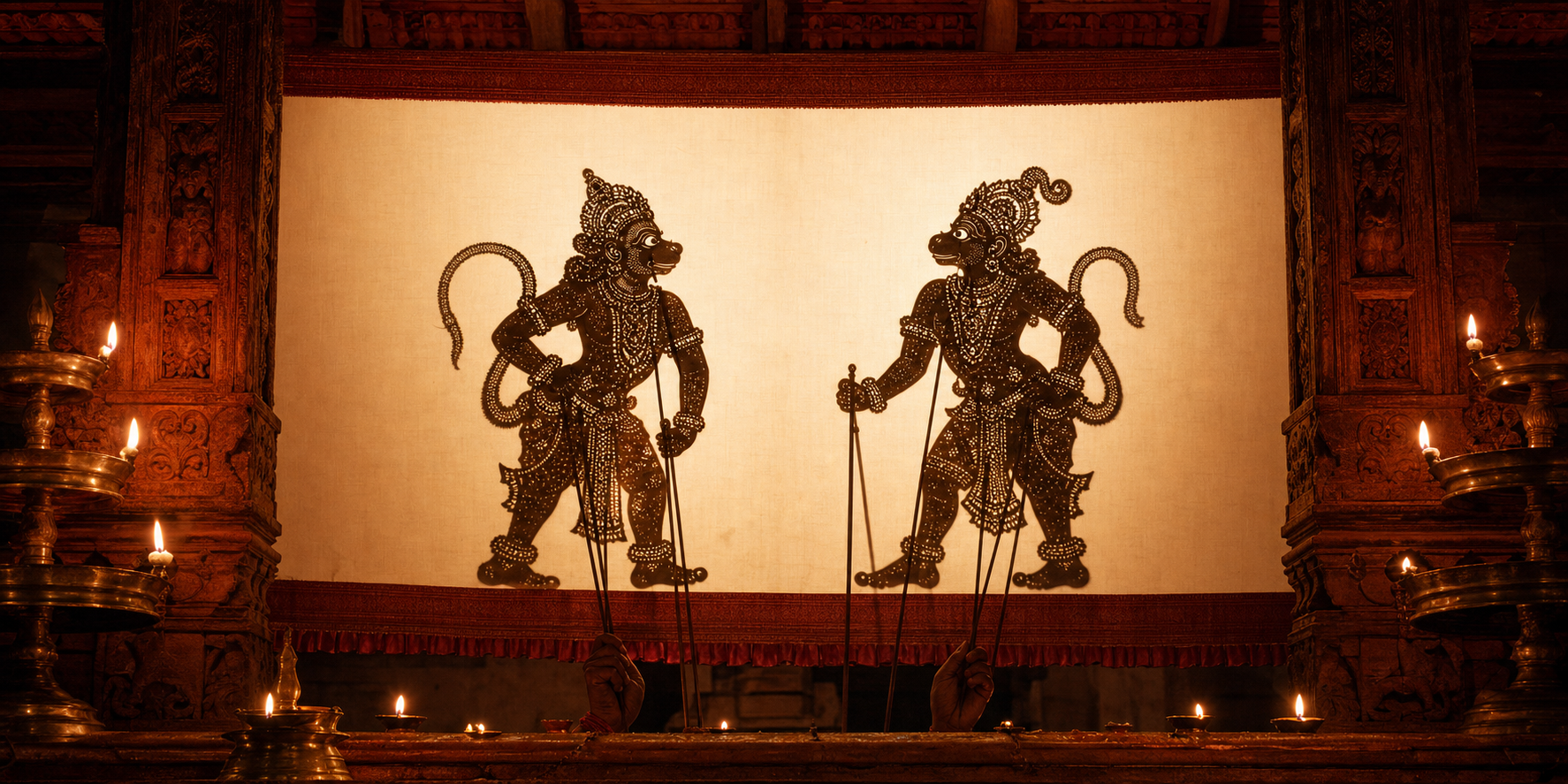
A fragment supplied by Hindu Blog points to an unusual Ramayana birth narrative involving Irakathaswan, Bali and Sugriva. The available source text, however, ends before explaining the episode or the transformation suggested by its original title.
What survives is still valuable: it places the story within Tholpavakoothu, Kerala’s temple-based shadow-puppetry tradition, and presents the Ramayana as an epic sustained through many regional forms.
What the surviving source establishes
According to Hindu Blog, the Ramayana has been retold, reshaped and reimagined across the Indian subcontinent rather than confined to one unchanging mode of narration. The source identifies Tholpavakoothu as a traditional form of Kerala shadow puppetry performed inside Bhagavati temples.
It also introduces the subject as Irakathaswan’s tale concerning the birth of Bali and Sugriva. The supplied passage does not provide the plot, dialogue, sequence of events or symbolic explanation. Those missing details cannot responsibly be reconstructed from the title alone.
Regional variation keeps an epic in public memory
A performance tradition does more than reproduce written words. Voice, movement, music, visual form and ritual setting all shape how an audience encounters a narrative. Shadow puppetry translates characters and events into silhouettes, action and spoken interpretation, allowing epic memory to be renewed through communal performance.
Variation within a sacred narrative need not mean abandonment of its larger tradition. A regional telling can emphasize a lesser-known character or episode while remaining connected to the wider Rama-katha. This is a distinctly Dharmic strength: unity can rest on shared civilizational memory without demanding uniform expression.
Hindu, Buddhist, Jain and Sikh traditions differ in doctrine and practice, yet each has preserved teachings through combinations of text, recitation, art and community memory. Tholpavakoothu belongs to that wider culture of disciplined transmission, in which inherited wisdom is carried forward through forms people can see, hear and gather around.
The Bhagavati temple setting changes the meaning
The detail that Tholpavakoothu is performed inside Bhagavati temples matters. It places storytelling within sacred space, bringing artistic performance and devotional life into contact. The Ramayana is therefore encountered not merely as literature but as part of a living cultural environment.
The fragment does not describe the associated ritual sequence, performers, audience or duration, so no conclusions about those particulars should be drawn here. Even with that limitation, the temple context demonstrates why preserving traditional arts also protects religious memory, local vocabulary and community continuity.
Key takeaways
- Hindu Blog presents the Ramayana as a living epic expressed through regional performance traditions.
- Tholpavakoothu is identified as Kerala shadow puppetry performed inside Bhagavati temples.
- The source associates Irakathaswan with a birth story about Bali and Sugriva but does not supply the narrative itself.
- The available fragment supports discussion of cultural transmission, not a detailed reconstruction of the missing tale.
A fuller treatment should await a complete account of the performance narrative. Until then, the fragment is best read as an invitation to preserve and study the regional arts through which the Ramayana continues to speak in many voices while sustaining a shared Dharmic inheritance.
Inspired by this post on Hindu Blog.
