
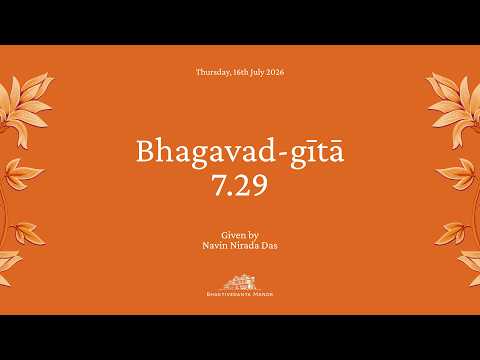
Dandavats identifies its featured video as a discourse on Bhagavad Gita 7.29 by Navin Nirada Das, dated Thursday, 16 July 2026. The listing offers the recording and its basic details, but it does not include a transcript or summary of the speaker’s interpretation.
This guide therefore keeps a clear boundary: it reports only what the listing establishes about the video, then provides general scriptural context to help viewers approach the verse attentively.
What Dandavats establishes about the recording
The source presents Navin Nirada Das as the speaker and Bhagavad Gita 7.29 as the subject. Beyond the date, speaker, verse reference and video itself, it supplies no claims, quotations or outline that can be attributed to the discourse.
That limitation matters. A responsible reader should not assume which translation, commentary or theological emphasis the speaker adopts without hearing the recording. The video is best approached as the primary material, while the context below serves only as a reading aid.
The spiritual question at the heart of Bhagavad Gita 7.29
Bhagavad Gita 7.29 addresses the search for freedom from old age and death. In its familiar scriptural context, the verse connects that search with taking refuge in Krishna and with knowledge concerning Brahman, the inner self and karma. Liberation is thus presented as more than an abstract theory: it requires a transformed spiritual orientation.
The verse does not require readers to despise embodied life. Rather, it directs attention toward what remains spiritually meaningful when bodily conditions change. Its challenge is practical: can action be guided by dharma and devotion instead of fear, possessiveness or the demand for permanent security in an impermanent world?
Refuge as disciplined spiritual practice
Within Krishna-bhakti, refuge is not passive withdrawal. It can be cultivated through attentive hearing, reflection on scripture, remembrance of the Divine, japa, seva and ethical conduct. These practices align knowledge, intention and action so that spiritual understanding becomes a way of living rather than a collection of concepts.
This also gives karma a constructive place in the discussion. Actions continue, but their motive can change. Duty performed with humility and devotion loosens the ego’s claim to ownership, preparing the mind for deeper discernment about the self and its relationship with the Supreme.
A shared dharmic concern, expressed through distinct paths
Hindu, Buddhist, Jain and Sikh traditions do not define the self, liberation or the Divine in identical ways. Those differences deserve careful respect. Yet they share a serious engagement with suffering, attachment, ethical responsibility, disciplined awareness and freedom from narrow egoism.
Bhagavad Gita 7.29 contributes a distinctly Vaishnava voice to that wider dharmic conversation by centering refuge in Krishna. A confident dharmic civilizational outlook can honor this theological clarity while recognizing the related disciplines of compassion, self-mastery and liberation found across Bharat’s spiritual traditions. Unity does not require flattening sampradayas; it grows through mutual respect and purposeful practice.
Key takeaways
- Dandavats identifies the recording as a discourse by Navin Nirada Das on Bhagavad Gita 7.29.
- The source provides no transcript, so particular interpretations should not be attributed to the speaker without viewing the video.
- The verse’s established themes connect liberation, refuge in Krishna, spiritual knowledge and karma.
- Its practical value lies in examining how devotion and dharmic action can reshape one’s response to impermanence.
The most fruitful next step is to hear the discourse with the verse open, note how its key terms are explained, and test those insights through steady sadhana rather than leaving them at the level of theory.
Inspired by this post on Dandavats.
